Training a GPT 4 level model in a minute.
Aschenbrenner decomposes GPT-2 to GPT-4 (2019-2023) into about 0.5 orders of magnitude per year of raw compute plus about 0.5 OOMs/year of algorithmic efficiency, for roughly 100,000x effective compute (4.5-6 OOM) total. Epoch AI estimates GPT-4 used 3,000x to 10,000x the raw compute of GPT-2.
Extending the trendline gives another roughly 100,000x effective compute by end of 2027, implying a second preschooler-to-smart-high-schooler leap. His illustration: if GPT-4 took 3 months to train, a 2027 lab trains a GPT-4-level model in a minute.
Why it matters: algorithmic efficiency compounds silently alongside compute, so capability jumps arrive before the headline compute numbers look dramatic.
Source: Leopold Aschenbrenner, "From GPT-4 to AGI: Counting the OOMs" (Situational Awareness series), research essay, June 2024. Figure: "Base Scaleup of Effective Compute" (the essay's own chart).
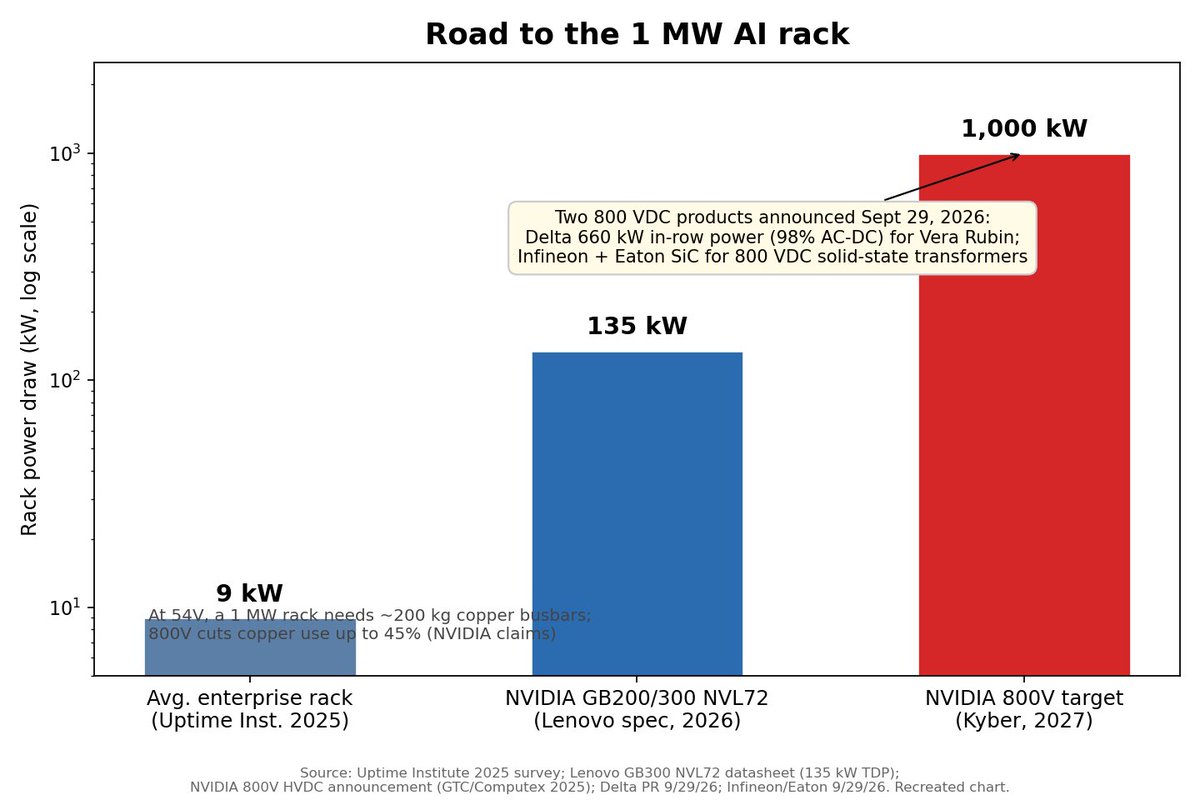
1,000 kW in a single rack.
NVIDIA's target for 2027 is a 1 megawatt AI rack. The average enterprise rack today draws 9 kW. A GB200/300 NVL72 pulls 135 kW. So the industry is rebuilding power delivery from the ground up: Delta just announced 660 kW in-row power at 98% AC-DC efficiency for Vera Rubin, and Infineon plus Eaton announced SiC parts for 800 VDC solid-state transformers. Both landed today.
The reason is copper. At the old 54V standard, a 1 MW rack would need roughly 200 kg of copper busbars. Moving to 800V cuts copper use up to 45%, per NVIDIA.
Power delivery is becoming the AI bottleneck nobody benchmarks. Who wins the 800V supply chain?
$NVDA
3,000 tokens per second. That is the target.
Gimlet Labs and Cerebras announced a partnership on Sep 28: 100 MW of wafer-scale inference capacity, targeting up to 3,000 tokens per second per deployment. A 10-minute agentic task compresses to roughly 20 seconds at that rate.
First datacenter goes live late 2026. Private deployments have been serving tokens since 2025. Gimlet gets first external access as the CS-4 launch partner in 2027.
The inference race is splitting in two. One side chases cheaper tokens on commodity GPUs. The other bets that wafer-scale hardware makes speed itself the product: agents that act in seconds instead of minutes.
Token throughput is becoming the new spec sheet. Whoever owns the fastest inference owns the agentic layer.
Wondering if latency is about to matter more than cost?
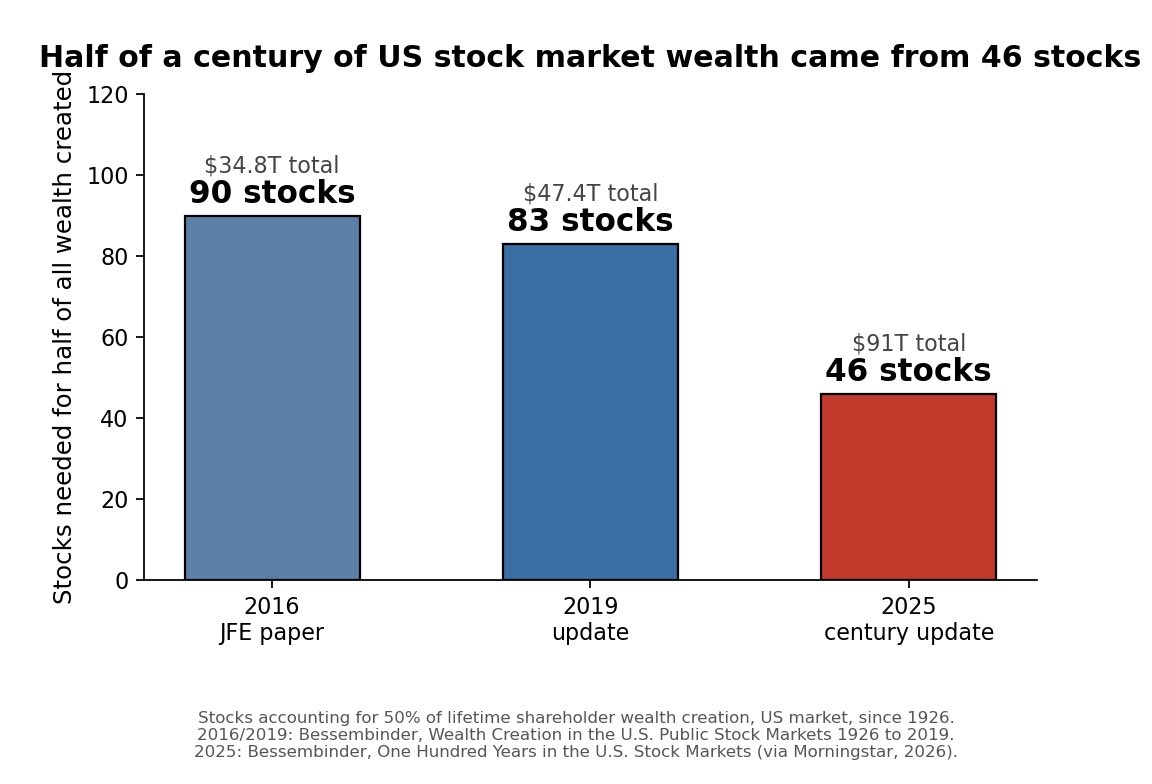
46 stocks created half of a century of US stock market wealth.
Hendrik Bessembinder's 2026 century update: across nearly 30,000 US stocks from 1926 to 2025, a total of $91 trillion in shareholder wealth was created. Just 46 stocks accounted for half of it. And only 41.17% of all stocks ever beat a Treasury bill.
The concentration is accelerating: 90 stocks made up half the wealth in his 2016 study, 83 in the 2019 update, 46 now. The distribution of stock returns keeps getting more skewed, not less.
Why it matters: the math of equity investing is a lottery ticket distribution. Missing the handful of compounders is what separates index returns from stock-picking failure. Diversification is not caution, it is the only rational response to positive skew.
Source: Hendrik Bessembinder, "One Hundred Years in the U.S. Stock Markets" (century update of "Do Stocks Outperform Treasury Bills?", JFE 2018), 2026 (chart recreated from the paper's data).
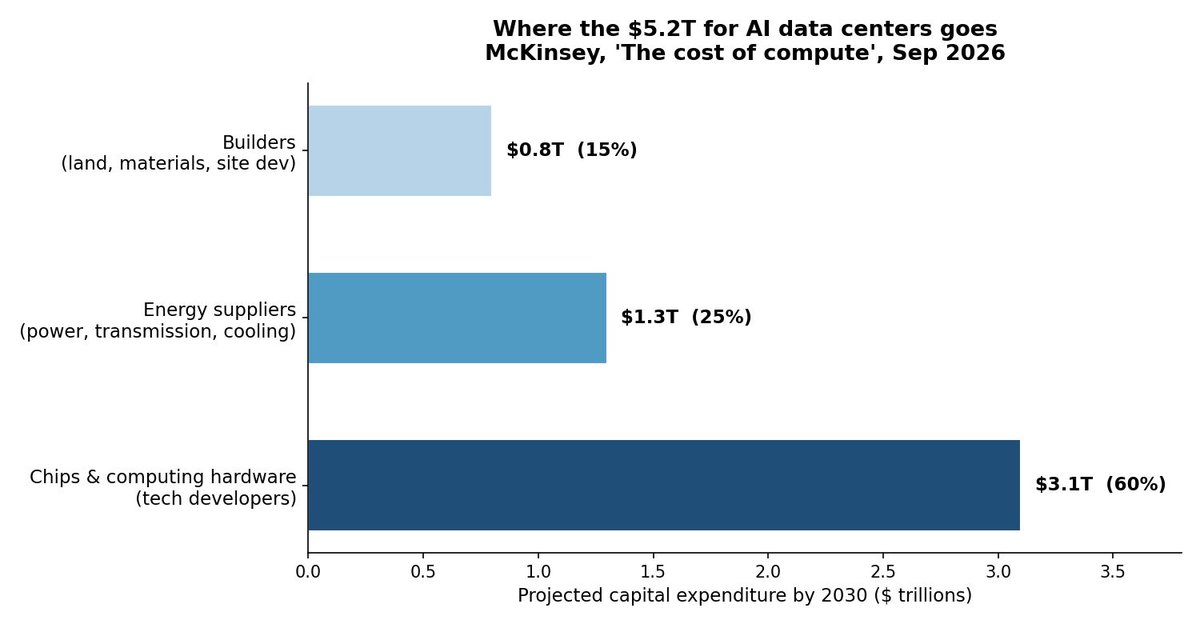
McKinsey prices the AI data-center build at $5.2 trillion
McKinsey's "The cost of compute" report, published September 24: projected AI data-center capex by 2030 totals $5.2 trillion.
The split: 60% ($3.1T) to chips and computing hardware, 25% ($1.3T) to energy suppliers for power, transmission, and cooling, and 15% ($0.8T) to builders for land, materials, and site development.
Chips get the majority of every dollar, but energy at a quarter of the total is the number that keeps growing. The constraint is not money, it is electrons.
Why it matters: $1.3 trillion in energy capex by 2030 means the power side of AI is now a standalone investment thesis. Utilities, grid equipment, and gas generation are getting priced into the build-out whether or not the models monetize.
Source: McKinsey, "The cost of compute: A $7 trillion race to scale data centers," published September 24, 2026. Chart recreated from published figures.
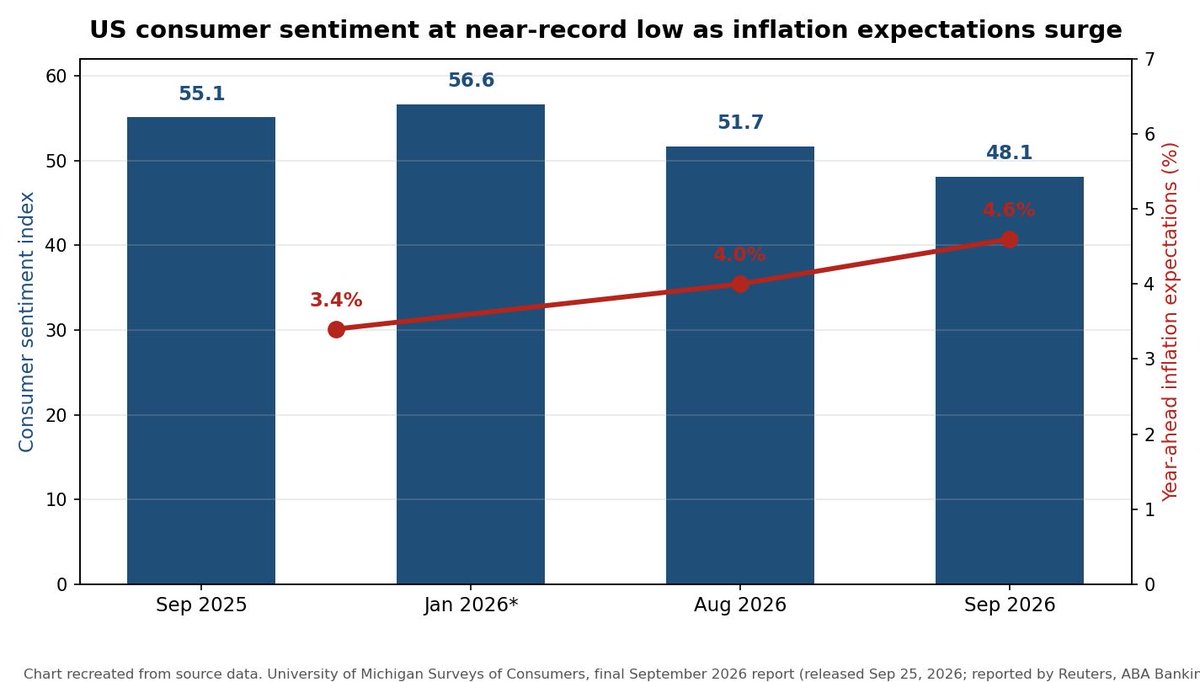
US consumer sentiment just hit a near-record low
The University of Michigan's final September reading: sentiment fell to 48.1, down from 51.7 in August and near the all-time lows of 2022. Year-ahead inflation expectations jumped to 4.6%, up from 4.0% in August and 3.4% in February.
Consumers are describing the worst buying conditions for big-ticket items in the survey's history, driven by tariff-driven price expectations and a weakening labor market.
Why it matters: sentiment this low with inflation expectations this high is the stagflationary setup the Fed fears. It constrains how far the Fed can cut even as growth slows.
Source: University of Michigan Surveys of Consumers, final September 2026 report, released September 25, 2026 (via Reuters). Chart recreated from source data; January 2026 value derived from UMich's reported -15% change.
A 25% tariff costs consumers $1.59 for every $1.19 the government collects.
Here’s how :
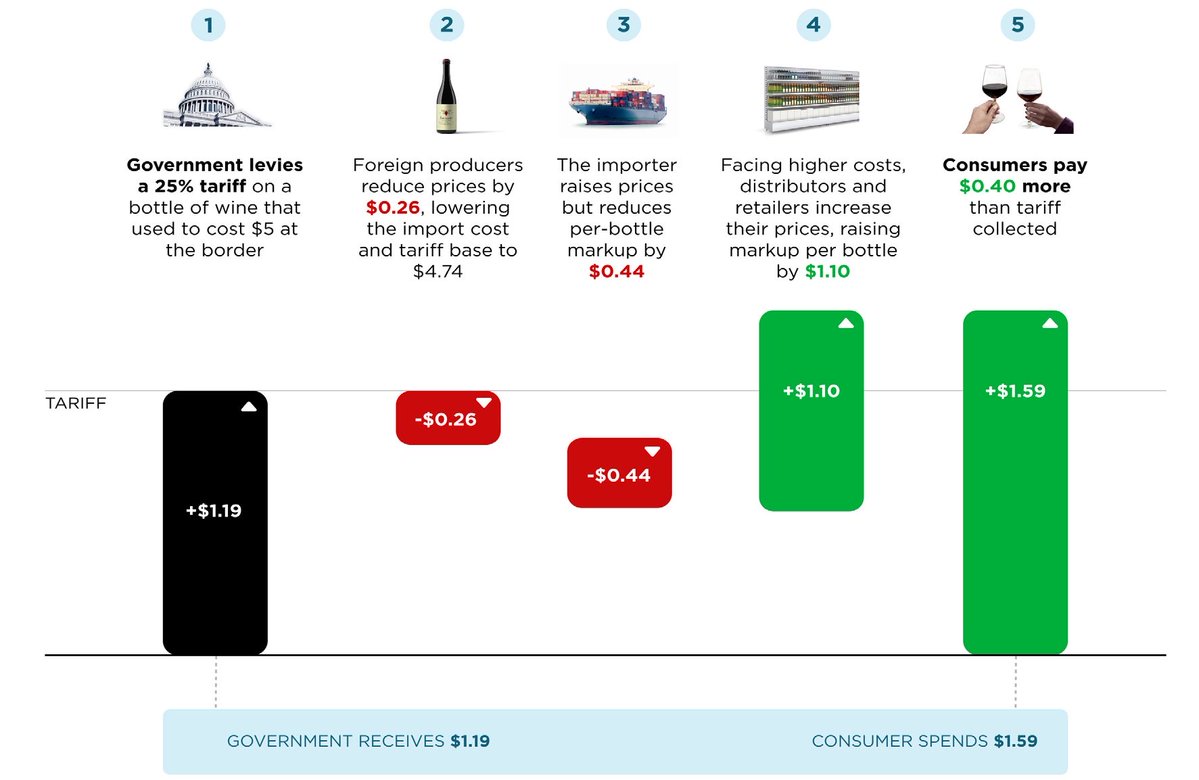
Flaaen et al. trace a 25% US tariff on a $5 bottle of wine through the supply chain. Foreign producers absorb part of it, cutting prices by $0.26 and lowering the import cost to $4.74. The importer trims its per-bottle markup by $0.44. But downstream, distributors and retailers widen their markups by $1.10, and consumers end up paying $1.59 more while the government collects only $1.19.
Why it matters: the standard debate assumes tariffs either hit consumers dollar-for-dollar or get absorbed abroad. This shows a third outcome: middlemen mark up over the tariff, so the consumer burden exceeds the tax. Any model of tariff inflation that stops at the border undercounts the damage.
Source: Flaaen et al., NBER Working Paper w34392 / BFI 2025-137 (paper's own Figure 1).
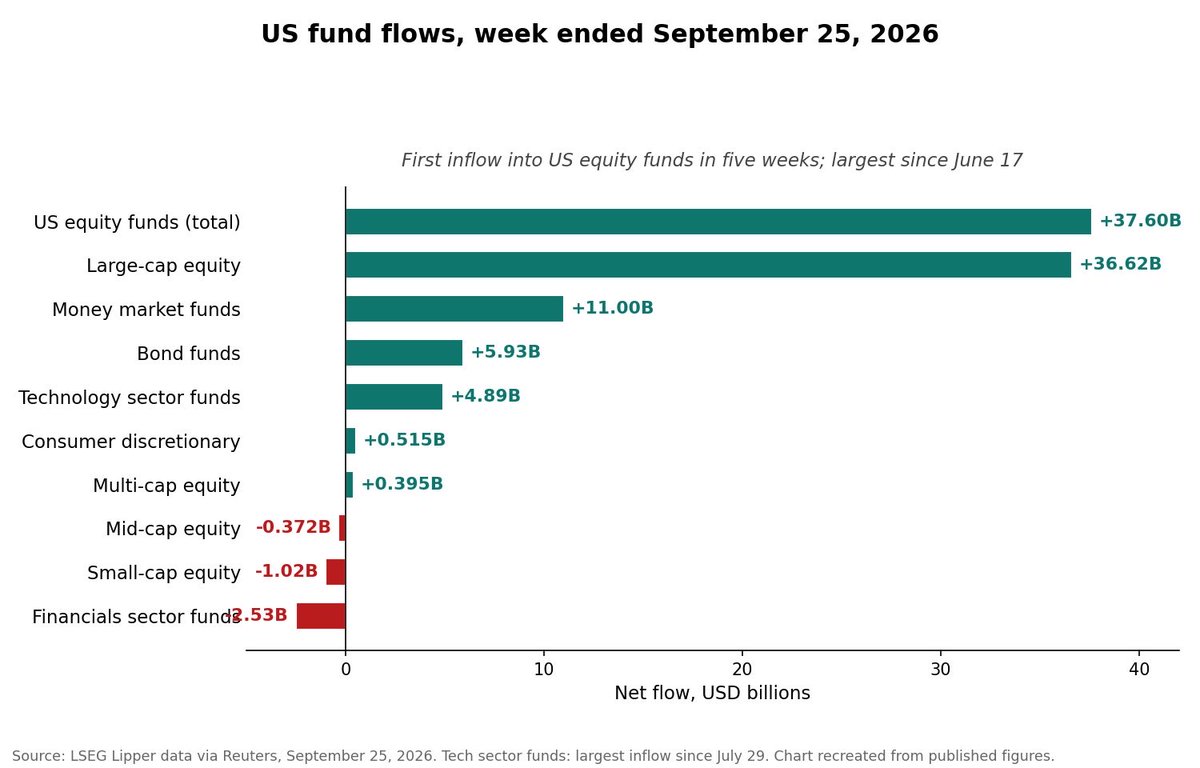
Reuters also reported US equity funds pulled in $37.6B in the week ended September 25, the first inflow in five weeks and the largest since June 17. Large-cap funds captured nearly all of it at +$36.62B. Technology sector funds drew +$4.89B, their biggest inflow since July 29.
Small-caps (-$1.02B) and financials (-$2.53B) were the losers. Bond funds (+$5.93B) and money markets (+$11B) still gained, but the rotation was clearly into big tech.
This inflow landed in the same week the 30-year Treasury hit a 22-year high. Investors are buying the rate hike story as good news for growth, and the bid is going almost entirely to large caps.
More appealing story is even though we see treasuries hit record high - wall
st. saw record high flows.
US equity funds pulled in $37.6B in the week ended September 25, the first inflow in five weeks and the largest since June 17. Large-cap funds captured nearly all of it at +$36.62B. Technology sector funds drew +$4.89B, their biggest inflow since July 29.
Small-caps (-$1.02B) and financials (-$2.53B) were the losers. Bond funds (+$5.93B) and money markets (+$11B) still gained, but the rotation was clearly into big tech.
Investors are buying the rate hike story as good news for growth, and the bid is going almost entirely to large caps.
Source: LSEG Lipper data via Reuters, September 25, 2026. Chart recreated from published figures.
US Private-Sector Growth Hits a 5-Year High
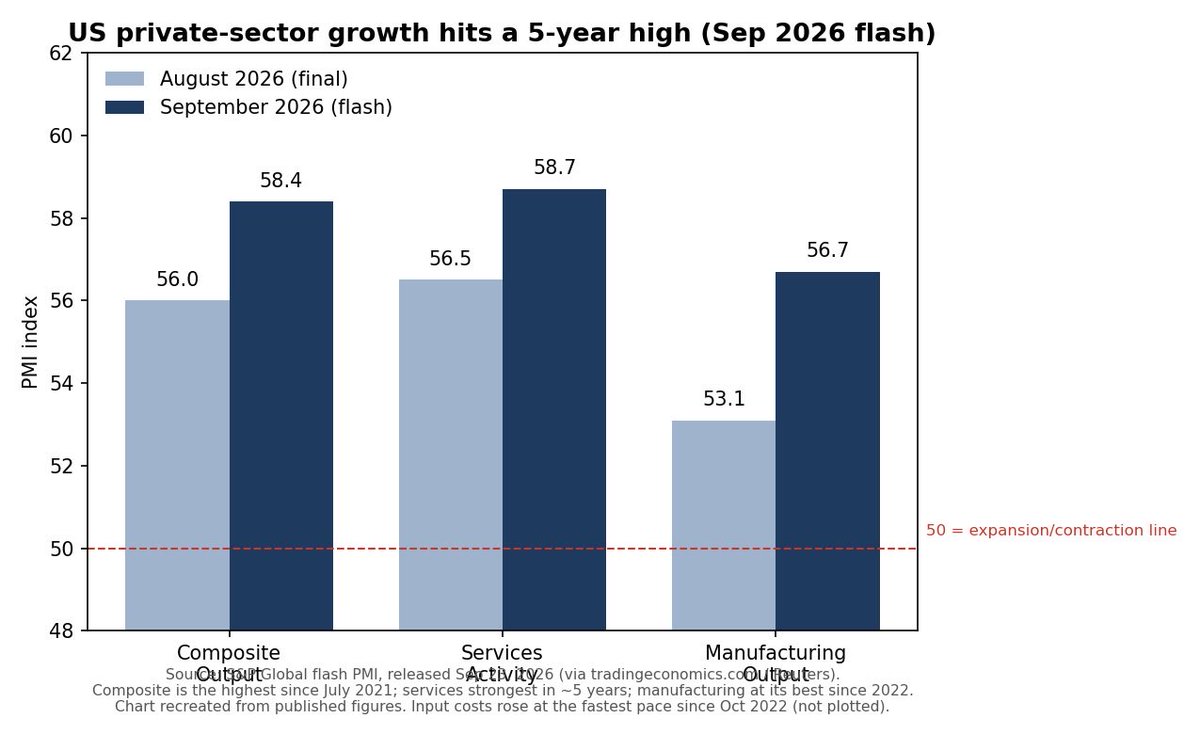
The S&P Global US flash composite PMI came in at 58.4 for September, the highest since July 2021 and the fourth consecutive month of acceleration. Services hit 58.7, its strongest in about five years. Manufacturing output reached 56.7, its best since 2022.
Input costs rose at the fastest pace since October 2022 and hiring was the fastest since June 2022. S&P's economist notes the cost pressure will pass through to selling prices. This reading is consistent with a roughly 5% annualized growth pace.
Source: S&P Global flash PMI, released September 23, 2026 (via https://t.co/xCEBEQAA50 and Reuters).
BULLISH
Goldman's AI math: $1.42T of revenue needed to justify the spend
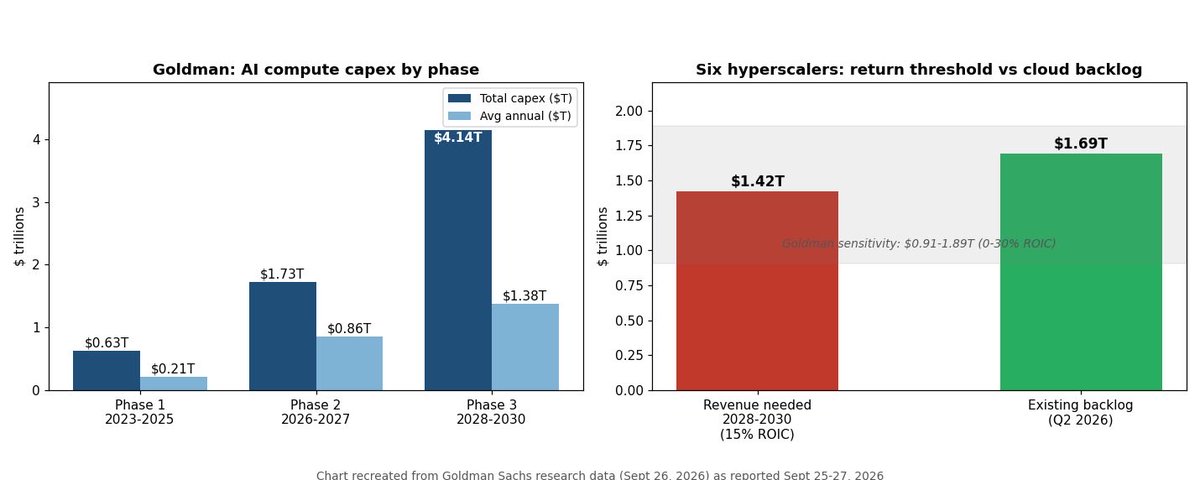
Goldman Sachs (report released September 26, 2026) calculates the six hyperscalers need about $1.42T in cumulative AI revenue from 2028-2030 to clear a 15% return on their 2026-2027 capex. The sensitivity band runs $0.91T to $1.89T for 0% to 30% ROIC.
Their existing $1.69T cloud backlog already covers the base threshold about 1.7 times over. The left panel shows the scale: Phase 3 capex of $4.14T dwarfs the $0.63T of Phase 1.
Why it matters: this is the clearest bull-case arithmetic for AI infrastructure. The backlog covers the hurdle rate. The bear case has to argue the backlog itself gets impaired.
Source: Goldman Sachs, via multiple outlets, September 26, 2026. Chart recreated from source data.
The OECD just raised its inflation forecast by half
The OECD's Interim Economic Outlook (September 23, 2026) revises G20 headline inflation up to 4.1% for 2026 and 3.6% for 2027. Nine months ago the December 2025 forecast was 2.8% and 2.5%.
That is a 1.3 percentage point upward revision for this year. Inflation proved stickier than every major institution expected.
Why it matters: this is the institutional basis for the Fed's October hike odds. When the OECD stops forecasting disinflation, central banks stop cutting.
Source: OECD, Interim Economic Outlook "Weathering Successive Shocks", September 23, 2026. Chart recreated from source data.
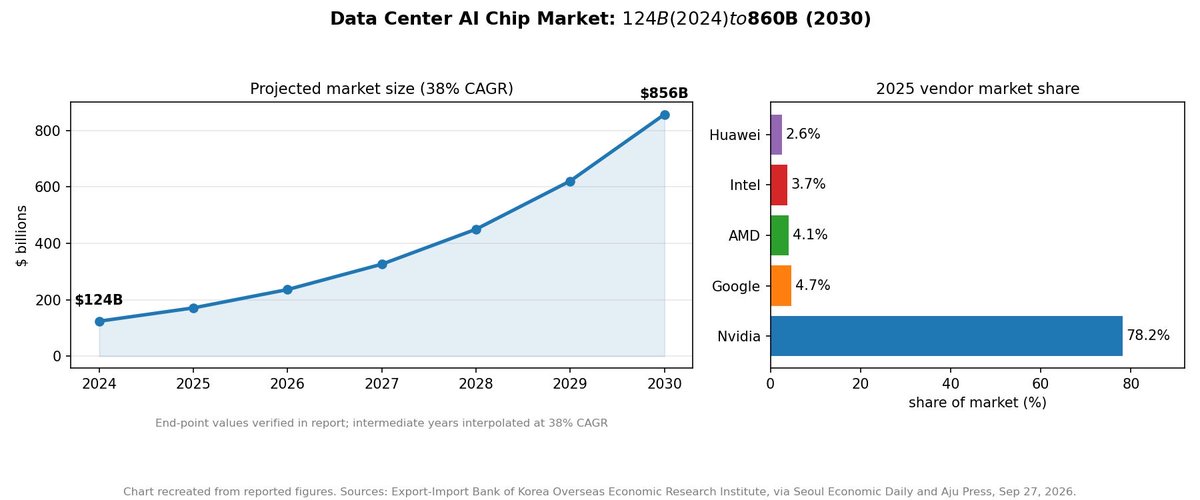
The AI chip market goes 7x by 2030
Korea Ex-Im Bank's research institute projects the data center AI chip market grows from $124B in 2024 to $860B by 2030, a 38% annual growth rate. Demand is shifting from training chips toward inference.
Nvidia holds 78.2% of the 2025 market. Google's custom chips are second at 4.7%, AMD at 4.1%.
Why it matters: a $860B market this concentrated means the value capture stays with one company unless inference architectures break the moat. That is the trade thesis to watch.
Source: Export-Import Bank of Korea Overseas Economic Research Institute, via Seoul Economic Daily and Aju Press, September 27, 2026. Chart recreated from reported figures; intermediate years interpolated at 38% CAGR.
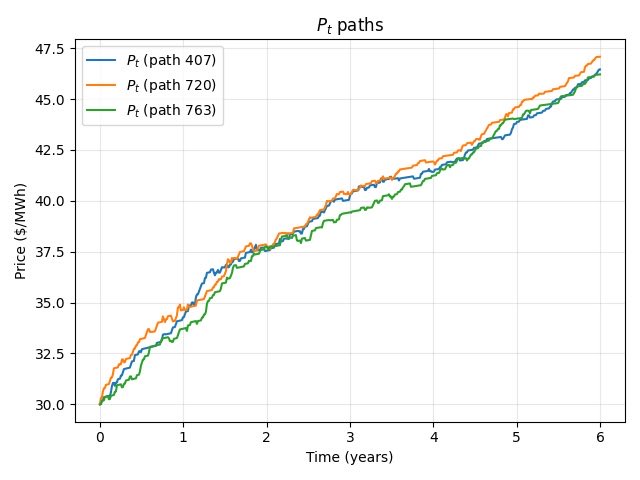
Your electric bill is estimated to rise by 50% in next 6 years.
The three lines are Monte Carlo sample paths (paths 407, 720, 763) of electricity prices over six years under the paper's optimal investment policy. Different random outcomes, same destination: prices converging around $46 to 49/MWh by year six.
Source: Crosier, Onghai, Sircar, "AI for AI: Optimizing Additional Infrastructure Build-out to Power Artificial Intelligence Data Centers," arXiv 2609.08166, Sep 2026
Copper Just Printed an All-Time Record
LME copper hit an all-time record of $14,875 per tonne on September 10, after setting a record at $14,533 on September 7. It has since pulled back to $14,607 as of September 24.
Copper is the metal that prices electrification and the AI buildout. Record prices with a quick pullback say demand is structural and traders are nervous about how fast it got there.
Source: Reuters via MMPI, September 24, 2026; Dow Jones. Chart recreated from reported figures.
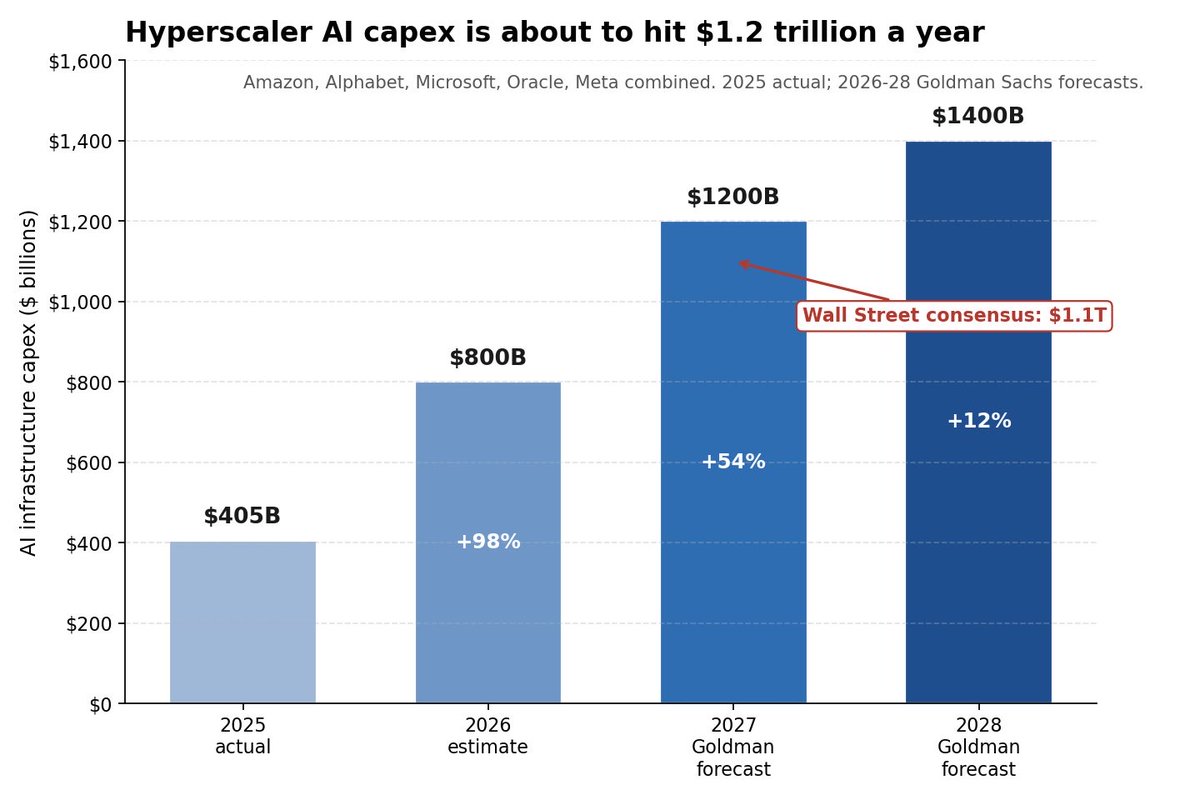
The $1.2 Trillion AI Capex Year Is Nearly Here
Goldman Sachs now expects the five big US hyperscalers (Amazon, Alphabet, Microsoft, Oracle, Meta) to spend a combined $1.2 trillion on AI infrastructure in 2027. That is up from about $800 billion this year, a 54 percent jump, and $100 billion above the Wall Street consensus of $1.1 trillion. Spending growth then cools to 12 percent in 2028 ($1.4T).
Goldman estimates they need roughly $300 billion a year in AI revenue just to break even on this buildout. Cloud revenue is running only about $70 billion above its pre-AI trendline.
It matters because Goldman says 2027 capex will be a larger share of GDP than any technology investment cycle since the railroad buildout of the late 1800s, and spending already exceeds what the companies generate from operations, which points to more debt financing.
Source: Goldman Sachs via Bloomberg, Sept 25, 2026. Chart recreated from source data.
Your LLM's Weights Are Mostly Empty Spaces
Tan, Chen, Alonso et al. measured the true Shannon entropy of quantized weights across six open models. The effective information content sits 2 to 6x below the stored bitwidth. The biggest gap: an INT4 Mistral-7B carrying 10.4x less actual information than its 4-bit storage suggests.
They then built a lossless ANS compression scheme landing within 0.01 to 0.1 bits of the Shannon limit, getting up to 10x memory savings with zero accuracy loss and 1.6x throughput on Mixtral-176B. Storage formats are padded with air. The bits that matter are a fraction of what is usually shipped.
Source: Tan, Chen, Alonso et al., "Approaching Shannon Bound with Lossless LLM Weight Compression," arXiv, Jun 2026
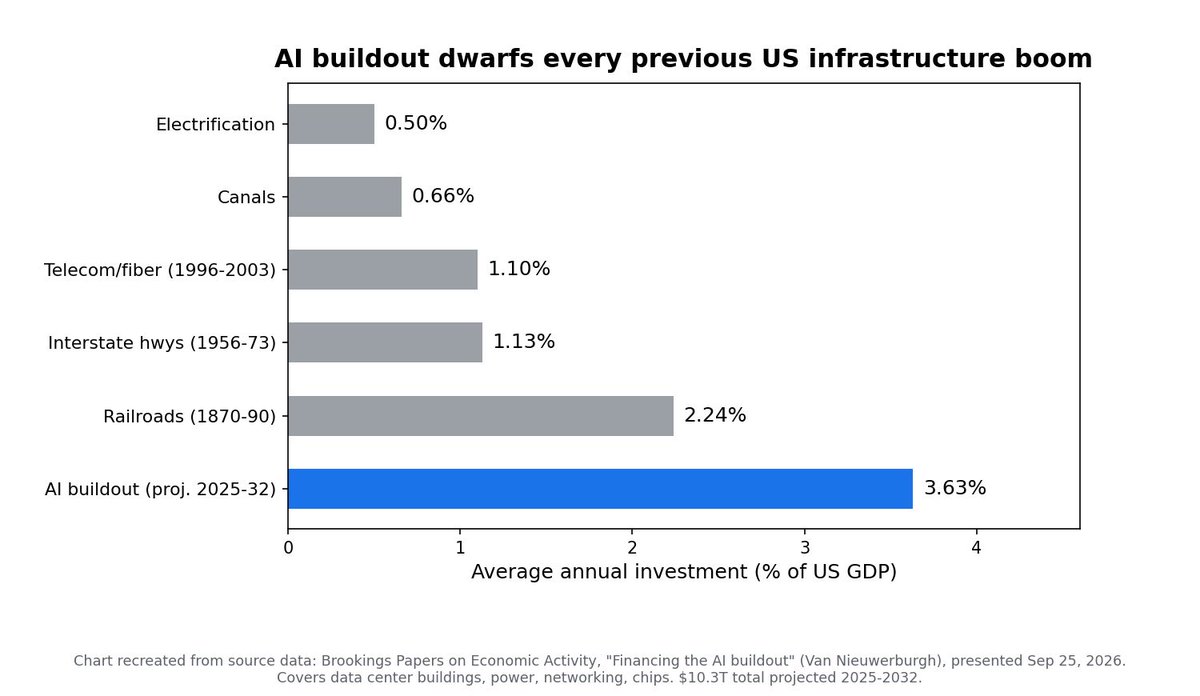
The AI Buildout Dwarfs Every US Infrastructure Boom Ever
Brookings projects AI infrastructure investment at $10.3 trillion over 2025 to 2032, averaging 3.63% of US GDP per year.
That is bigger than the railroad boom of the 1870s (2.24% of GDP) and triple the interstate highway system (1.13%).
This is the largest infrastructure project in American history. The paper also flags the financing: a growing share is off-balance-sheet, which is how the risk hides.
Source: Brookings Papers on Economic Activity, "Financing the AI buildout," presented Sep 25, 2026. Chart recreated from source data.