Fijaos en Iceta. Sin estudios ni preparación alguna, pero cobrando una pasta gracias al socialismo en Cataluña. El hombre era feliz haciendo la croqueta bailante con Sánchez en campaña electoral en Cataluña de vez en cuando.
De repente a Sánchez le da por mandar a Illa para allá, pero como Iceta siempre le apoyó, considera que no lo puede dejar tirado, así que le nombra Ministro de Política Territorial. Claro, a Iceta, que le cuesta hasta firmar sin tener faltas, se lía en Madrid y no sabe ni cuál es su cometido, así que Sánchez decide cambiarle a los meses de ministerio, a alguno donde se noten menos sus carencias. Curiosamente, le mete en Cultura y Deporte, pensando que nadie le va a hacer mucho caso ahí.
Y vive de nuevo feliz, el hombre, inadvertido, hasta que sale el tema Rubiales. Tiene que mirar en Google varias veces para enterarse de quién es y de qué era ese Mundial del que hablaba la gente. Mirando fotos de Rubiales se confunde con otro calvo famoso y tiene que ir explicando en el Ministerio por qué ha acabado viendo vídeos subidos de tono con el ordenador de su despacho. Qué sofoco.
Acaba diciendo que va a cesar al calvo en cuestión de horas, porque Pedro y Yolanda le llaman muy enfadados exigiendo que haga algo. Le ha asesorado legalmente un primo segundo, de profesión escayolista, que contrató a dedo porque se lo pidió su tía Enriqueta. El caso es que el Tribunal que tiene que juzgar el tema, compuesto seguramente por fascistas, aunque en su mayoría los nombró el PSOE, no está de acuerdo en que lo de Cascajares o Rubiales o como se llame sea muy grave. Y ya tiene el lío montado.
Entonces, tras la quinta bronca de Pedro, que es muy guapo pero tiene muy malas pulgas y no hay quien lo soporte, se desploma en la silla de su despacho, soñando con aquellos días en que rodaba por la tarima del mitin del PSC al ritmo de los Village People.
Plovdiv in Bulgaria is one of the most beautiful cities you've (probably) never heard of.
Why? With more than 3,000 years of wild history and architecture influenced by three different continents, there's simply nowhere else like it.
So, here is the brief story of a hidden gem.
In 342 BC King Philip II of Macedon (father of Alexander the Great) founded a city in modern-day Bulgaria and called it Philippopolis. He picked a naturally advantageous site, what with seven steep hills (just like Rome) rising up around the Maritsa River, all within view of the Rhodope Mountains to the south and the Balkans to the north.
There had already been a town in the area since 6,000 BC — it was also once ruled by Xerxes of Persia — and Plovdiv is still filled with ruins left by the ancient Thracians who lived in it so for so long. But it was Philip who established the first truly major city there and settled a mix of Thracians, Macedonians, and Greeks within it.
Over the next two thousand years Plovdiv (which has had many names) was fought over, captured, sacked, and rebuilt several times. Thracians, Macedonians, Persians, Romans (including Marcus Aurelius), Huns, Bulgars, Byzantines, Crusaders, Ottomans, and Russians have all fought over or found their way to this old and storied city.
And what has survived is an architectural and cultural delight. Plovdiv is scattered with ancient ruins, from the tumbled masonry of Thracian and Byzantine walls on Nebet Tepe (one of the seven hills, known as tepes, from Turkish) to the Roman theatre — one of the most complete in Europe, which regularly hosts musical & theatrical performances — and the great stadium which once held 30,000 spectators.
Medieval fortifications have survived too, such as the Hisar Kapia Gate, and as with many Balkan cities Plovdiv has places of worship belonging to Orthodox Christians, Catholics, Jews, Protestants, and Muslims. The Dzhumaya Mosque, built by the Ottomans when they conquered Plovdiv in the 14th century, is the oldest mosque in Europe outside of Iberia.
Its Old Town, which stands on ancient and Medieval foundations, was further developed in the mid-19th century during the Bulgarian National Revival — as national consciousness awakened and the desire for independence from the Ottomans grew ever stronger — hence its profusion of traditional architecture.
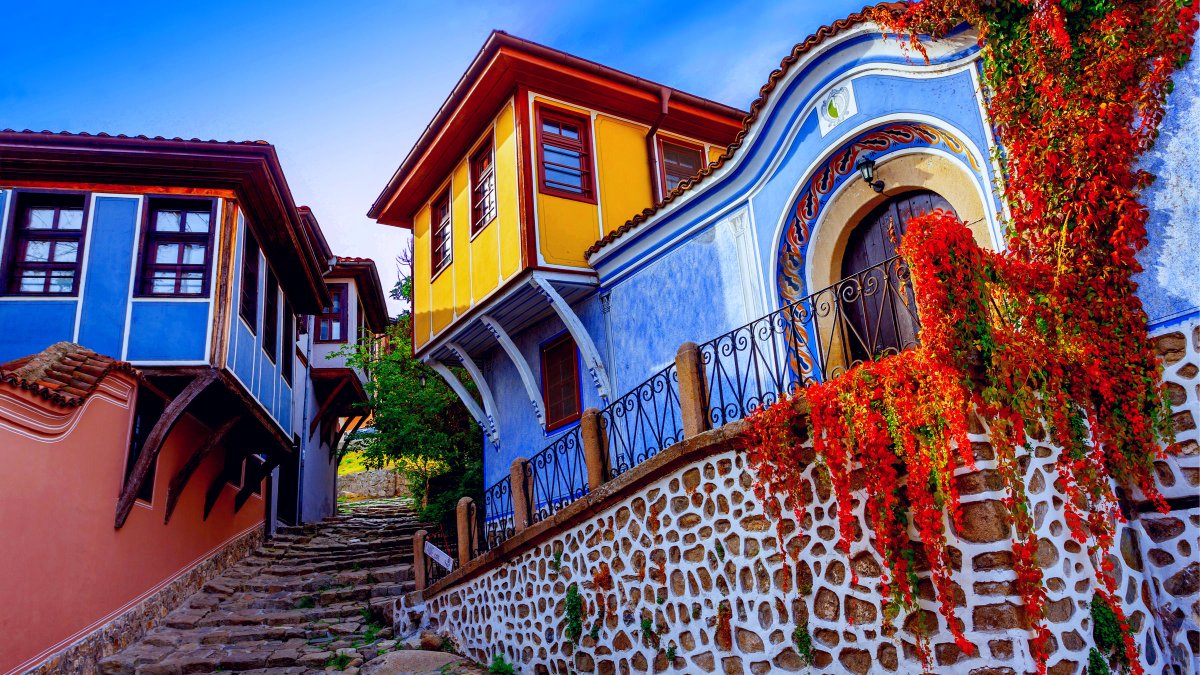
Those timber-framed houses, with their jettied stories and projecting windows, are typical of Medieval Bulgarian architecture. And the result is a labyrinth of brightly painted houses and churches built along the cobbled lanes of a Medieval street plan, all raised several hundred feet above the surrounding landscape on the three hills of Nebet Tepe, Dzhambaz Tepe, and Taksim Tepe.
The city was blessed with a new wave of architecture in the late 19th and early 20th centuries, when Bulgaria had revolted from the Ottomans and become an independent kingdom. Then, influenced by the Central European architecture of the Austro-Hungarian Empire, Plovdiv's streets were filled with the colourful stucco and eclectic historicism of cities like Vienna.
Soon enough a neighbourhood called "Kapana" emerged, the cultural and artistic heart of Plovdiv — which, to this day, is filled with artisans' workshops, galleries, cafés, and exhibition spaces. After that came the USSR and a host of Communist-era edifices. In other words, this city has become an architectural palimpsest of the highest order.
Plovdiv is an aesthetic delight, a city of colour and shape, of narrow alleys and shimmering squares, of temples and fortresses and of a vibrant, living culture. And it is also a prime example of architecture's power to tell the whole story of a city.
Each street is lined with thousands of years of war, religion, politics, cultural exchange, revolution, technological progress, and artistic evolution. This is one of the reasons why architecture is so important; it's like a language which brings the world to life. The buildings of Plovdiv are a physical story waiting to be read.
Plovdiv's Old Town also speaks to the profound cultural significance of architecture. Those traditional houses were about a reawakening of Bulgarian identity after five centuries of enforced sleep under Ottoman rule. And this, if anything, is architecture's greatest significance: that the way things are built and how they look matters to people, that in buildings can be manifest identity, meaning, place, and purpose.
Plovdiv is a beautiful city partly because of the unpredictable twists and turns of its history, caught as it was between the cultural and geopolitical cross-winds of countless different empires and peoples down the centuries — and partly by intention, because of how the people who live there have chosen to build and design their wonderful city.
Pues el nuevo Consejero de Cultura de la @ComunidadMadrid ha conseguido que los edificios de @PatrimNacional se iluminen al menos hasta la medianoche.
¡Qué menos y ya ven la diferencia! Y el lujo que ello supone.
Muchas gracias, don Mariano @depacoserrano 🎩
Empieza con buen pie. 👏🏼👏🏼
A true test for #hydrogentrucks: The #H2AccelerateTrucks project will test 150 hydrogen trucks on corridors connecting Scandinavia to Italy.
IRU is proud to be part of this @H2AccelerateEU project and advance the #decarbonisation of long-haul trucks.
https://t.co/oPeWoMPGYQ
Watch Piers Morgan's fascinating discussion on Artificial Intelligence with 'Sapiens' author Yuval Noah Harari and music consultant Nick Stewart 👇
@harari_yuval | @colonelstewart | @piersmorgan | #PMU
"Después de tantos años estudiando la ética, he llegado a la conclusión de que toda ella se resume en tres virtudes: coraje para vivir, generosidad para convivir, y prudencia para sobrevivir".
Fernando Savater
#Fuedicho
Cuando somos amables y cordiales, dejamos una huella positiva en la vida de los demás y construimos relaciones más saludables y duraderas.
Esto nos permite conectar con los demás desde el corazón y generar un clima de confianza y respeto.
#Cordialidad#MarioAlonsoPuig
The pressures of industrial development, as well as progressing electrification and decarbonisation as part of the energy transition, are likely to turbocharge demand for the red metal https://t.co/7ppJ3SgY1B