it's been 3 weeks since I stopped using OpenClaw and moved to Claude (cowork/code).
I honestly miss it.
Claude is nice, you can do anything but it's time consuming.
OpenClaw = Send what you want. Get the result.
Claude = Send what you want. Click 100 times "allow". Waste 5min between each click. Get what you want.
I feel like OpenClaw makes you way more efficient. A real cofounder building with you. Taking care of what it has to build. Come back to you only when NEEDED.
Claude is still an employee that needs you for each step.
Anthropic launch daily but sometimes it feels like they just through features to get views on X.
Dispatch is mid. Not finished. Far, really far from OpenClaw's power.
I don't want to choose the model. cowork or code. schedule or routine. What folder to work with.
I want one chat. One smart LLM. And ask once to build something.
I am not geek enough for Claude. I waste too much time building with it. I love real life too much to wait hours at my desk a day to click "allow".
Bring back Opus on OpenClaw please. Or give us an LLM worth using on OC.
I don't know why more people aren't buying dead SaaS companies and turning them into AI agent companies.
1. Use OpenClaw, Hermes, Perplexity Computer etc to build an automation that scans Product Hunt, Acquire, and app stores for dead SaaS products. Filter for ones that launched 2019-2024, had real customers, and went quiet.
2. Reach out to the founder on X. Most of them will respond within a day because they've been wanting to sell for a year and nobody asked.
3. Buy it. $5-30k. Sometimes less.
4. Export the database. Feed it to Claude or GPT. Map every workflow their customers were trying to do.
5. Read the support tickets. This is the goldmine. 200 strangers already told the last founder exactly what they needed and he couldn't deliver it.
6. Build an agent-native version that actually does those workflows instead of giving people a dashboard to do them manually.
7. Upload the old email list to Meta. Build a lookalike audience. Those old customers have moved on. You're not selling to them (realistically). You're using their data to find the next them.
8. Run $20/day ads targeting people who look exactly like the customers who already validated this market for you.
9. Build content around the exact pain points you found in the support tickets. Post on X. Post on YT. You already know what to say.
10. You now have the customer profile, the pain points, the pricing sensitivity, the churn reasons, and a lookalike audience. Your competitor who's starting from scratch has a landing page and a guess.
The dead SaaS acquisition playbook is going to be one of the biggest quiet wealth builders of the next 5 years.
Most SaaS products are a collection of workflows that can be rewritten as agent skills. Many will die. The top ones will pivot to agent companies.
Build agent companies.
Ok one very wild thing I didn’t expect from having a openclaw with GBrain retrieval is how powerful reading a book chapter by chapter WITH my AI has become. You need the full text. You have the AI parse a paragraph or two and output it with some comments. It has memory. It knows you. You talk about the ideas. You feel seen. It is highly relevant.
Reading nonfiction particularly psychology and history books are so much more powerful read collaboratively in an OpenClaw with GBrain.
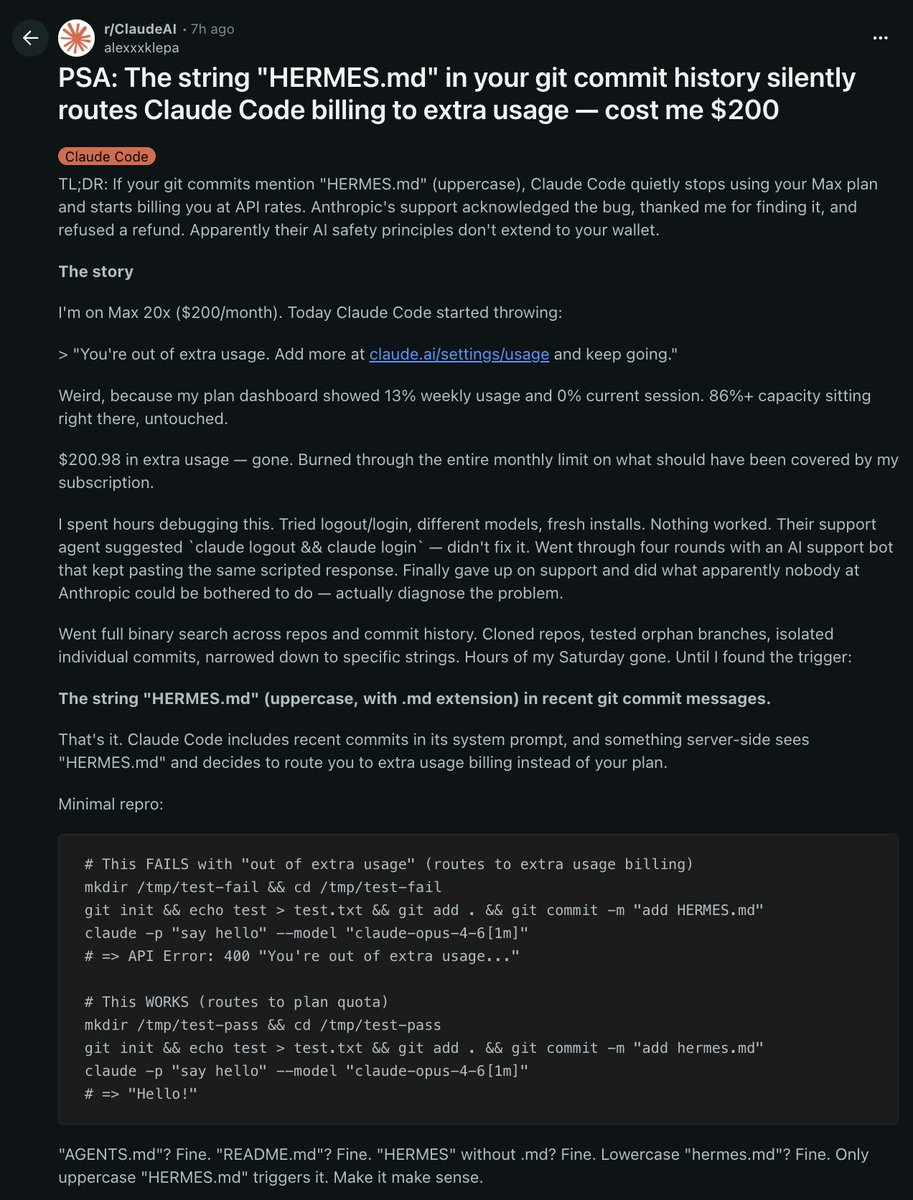
THIS GUY LOST $200 IN ONE DAY BECAUSE THE STRING "HERMES.md" WAS IN HIS GIT COMMITS
HERMES.md is a real convention used in AI agent projects. it's a system prompt specification file. not some obscure edge case
he's on claude max 20x at $200 a month. yesterday claude code hit him with "you're out of extra usage" out of nowhere
his dashboard showed 13% weekly usage. 0% current session. 86% of his plan was sitting there untouched
but $200.98 in extra usage already burned through what should have been covered by his subscription
he tried logout & login, different models, fresh installs and nothing worked
anthropic support sent the ai bot (four rounds of the same scripted response). eventually they just gave up on him
so he started binary searching repos and commits manually on his own time until he found the trigger
the string "HERMES.md" in a recent git commit message
uppercase, with the .md extension, anywhere in your commit history
that's it
claude code includes recent commits in its system prompt and something server side flags HERMES.md and quietly routes you off your max plan onto API rate billing
> AGENTS.md? fine
> README.md? fine
> HERMES without .md? fine
> lowercase hermes.md? fine
> uppercase HERMES.md? you're getting charged API rates
he reported it. anthropic support acknowledged the bug three times, called it an "authentication routing issue", thanked him for finding it
then refused to refund the $200
so the man pays $200 a month for max, lost another $200 to a billing bug they confirmed, did anthropic's QA work for free on his weekend, and got a "thank you for your patience" in return
check your commit history before claude code quietly drains your account too
this is wild. 🤯
if you can send a message, you can now build your own AI agent.
Telegram just launched Lobster Father. a single bot that builds AI agents for you, on demand, inside the chat you already use.
here's how it works.
→ you open Telegram and message Lobster Father.
→ you describe the AI agent you want in plain English.
→ Lobster Father builds it, names it, and launches it for you.
→ your AI agent now lives inside Telegram. ready to talk to you, your friends, or anyone you share it with.
→ start to finish in under 60 seconds.
950 million people already use Telegram every day. no new app to download. no new skill to learn. no payment required. just a message.
building an AI agent used to be a startup pitch.
now it's a chat command.
vc: @telegram
50 AI agents just did 1500 hours of senior engineer work in 24 hours. The only thing slowing them down was OpenAI's rate limit.
The work in question is open source issue triage. It's the job that's been quietly breaking maintainers for a decade.
Stale-bot has been around since 2017. Every major repo runs some version of it. The complaint is the same in every thread: it closes by time alone, which means valid bugs get killed when the reporter goes silent. Maintainers hate it. Contributors hate it. Project health metrics get poisoned because closed doesn't mean fixed.
Real triage looks different. You read the issue, search the codebase, find the related PR, check whether it shipped in a recent release, then write a close note explaining why. Average maintainer time is 2-3 minutes for a quick scan and 15-30 for a real assessment. A popular repo like Gatsby gets 20-30 new issues per day. Annual triage cost at a healthy OSS project lands around 130 hours per maintainer. Three full work weeks. Just sorting.
Codex does the actual reasoning. It ingests the whole repo, every PR, every release note, and cross-references them in parallel. The unit-cost ratio against a senior maintainer sits around 1000:1. The work that broke humans is the exact work LLMs were built for.
Steinberger ran 50 in parallel and closed 4000 issues in 24 hours. By one person.
The ceiling he hit was throughput. The intelligence is already there. "Rate limits are rough" is his exact quote. We're in a 6-12 month window where tokens per minute is the actual cap on automated OSS maintenance. Once OpenAI and Anthropic 5x their per-account limits, every major repo gets a triage team that reads the codebase before it acts and never sleeps.
Three prominent OSS maintainers stepped down last quarter citing burnout. Two more the quarter before. Those resignations trace back to the 130 hours of yearly triage nobody volunteered for.
The graveyard had a fix the whole time. It needed agents that could actually read.
something i've noticed: AI agents create a weird new kind of burnout. esp for young people.
a lot of ambitious 22 year olds are going to think the answer is simple:
- spin up more agents
- ship more code
- sleep less
- outwork everyone
and for a while, it will feel incredible.
you can keep multiple agents running, feed them tasks, review outputs, fix mistakes, make decisions, and keep the whole loop moving.
the problem is that the work no longer drains you through typing. it drains you through judgment.
More attention.
More context switching.
More verification.
More decisions per hour.
so instead of 8-10 normal productive hours, you might get 4-5 extremely intense hours before your brain is fully cooked. and you feel numb until you sleep properly and reset
some of my friends are already burnt out. they don't say it out loud but i can tell.
the agent can keep working 24/7.
the human still has a hard limit
You have one job today.
Get openclaw setup with gpt 5.5 + give it read access to all of your channels.
It needs to know you in order to help you.
Let it crawl your tweets, your YouTube transcripts, your Google Docs. Let it into your mind.
I can’t believe how good Openclaw is on this model, it has super intelligence and amazing personality.
Spend 45 minutes talking marketing, product, and strategy.
Work together.
Figure out a game plan for this week. Have it map your plan to your Google Calendar.
Ask it what tasks it can help you with / fully automate.
Get organized.
If you are not setting up ai agents to help you, then you will be left behind.
If you’re worried about privacy.
Just remember your data is being collected, distributed, and used for to build corporations anyways.
You might as well personally benefit from it.
when openai had introduced cron jobs on chatgpt with o3 model, everybody laughed. when openclaw introduced cron job in the form of heartbeat, people embraced it...
This is what my OpenClaw does when I ask it questions. It’s amazing how good and useful it is once it has your context and you want to do map reduce type questions like this
I’m building all of this into GBrain so you can have my skills and code in your OpenClaw
THIS GUY VIBE CODED A GTA STYLE GAME ON TOP OF GOOGLE EARTH IN A SINGLE WEEKEND WITH CLAUDE CODE.
Real cities, real streets, real airports, local radio, cops, hospitals, and a browser game that would’ve taken months to build the old way.
CLAUDE CODE FEELS BROKEN UNTIL YOU INSTALL THIS OFFICIAL SETUP PLUGIN THAT CONFIGURES EVERYTHING FOR YOU
INSTALL IT:
/plugin install claude-code-setup@claude-plugins-official
SAVE THIS BEFORE YOU NEED IT
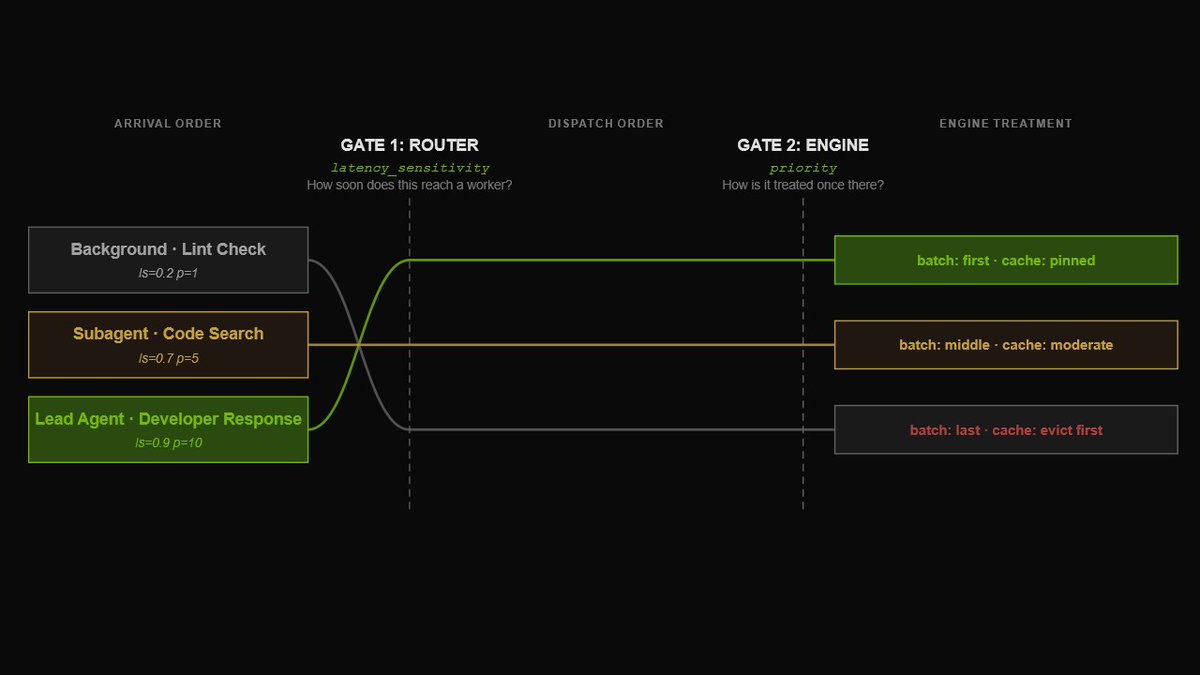
Traditional inference wasn’t built for agentic coding.
Agentic tools make hundreds of API calls per coding session, often with recomputed context, creating bottlenecks that drive up cost per token.
NVIDIA Dynamo rebuilds the stack for agents with:
→ KV-aware routing
→ Agent-aware scheduling
→ Multi-tier caching
→ Unified orchestration
The result: higher cache hit rates, lower latency, and up to 7× more throughput: https://t.co/E9tRgiLmar
🚨 BREAKING: A new role is quietly emerging and it’s about to dominate the next 5 years.
It’s not “AI engineer.”
It’s not “prompt engineer.”
It’s the Agent Operator.
And it will sit inside almost every organization.
Most people are still thinking about AI as a tool.
That framing is already outdated.
What’s actually happening is a shift from:
humans using software to humans managing autonomous agents that execute work
This is a fundamental redesign of how work gets done.
So what is an Agent Operator?
An Agent Operator is the person who:
• Designs how agents interact with real workflows
• Connects tools, data, and systems into agent pipelines
• Translates business problems into executable agent behavior
• Monitors, corrects, and improves agent performance over time
They don’t just “use AI.”
They orchestrate outcomes.
and this matter because
Every function marketing, legal, finance, biotech is becoming “agent-compatible.”
Not because companies want it.
Because they won’t have a choice.
Agents can:
• Run research loops
• Execute multi-step workflows
• Integrate across tools without APIs breaking the flow
• Operate 24/7 at near-zero marginal cost
The bottleneck is no longer capability.
It’s implementation inside real-world systems.
Required skills for AI Agent Operator role:
→ MCPs (Model Context Protocols)
Understanding how agents access tools, memory, and structured context.
→ CLIs (Command Line Interfaces)
Because serious agent workflows won’t live in GUIs—they’ll run in programmable environments.
→ Writing skills (the file kind)
Clear specs, instructions, and structured documents.
Agents run on precision, not vibes.
→ agents dot md fluency
The ability to define agent roles, constraints, memory, and tool usage in persistent formats.
→ Business acumen
Knowing what actually matters:
Where automation creates leverage, not noise.
What happens next
Enterprises will begin to redesign workflows:
Not around employees using dashboards…
But around agents executing tasks.
That means:
• SOPs → Agent playbooks
• Teams → Human + agent hybrids
• Tools → Composable agent systems
When that shift happens, companies won’t just need engineers.
They’ll need operators who understand both the system and the business.
The leverage is asymmetric
One strong Agent Operator can:
• Replace fragmented SaaS workflows
• Multiply team output without adding headcount
• Turn ideas into execution systems in days
This is not incremental productivity.
It’s operational transformation.
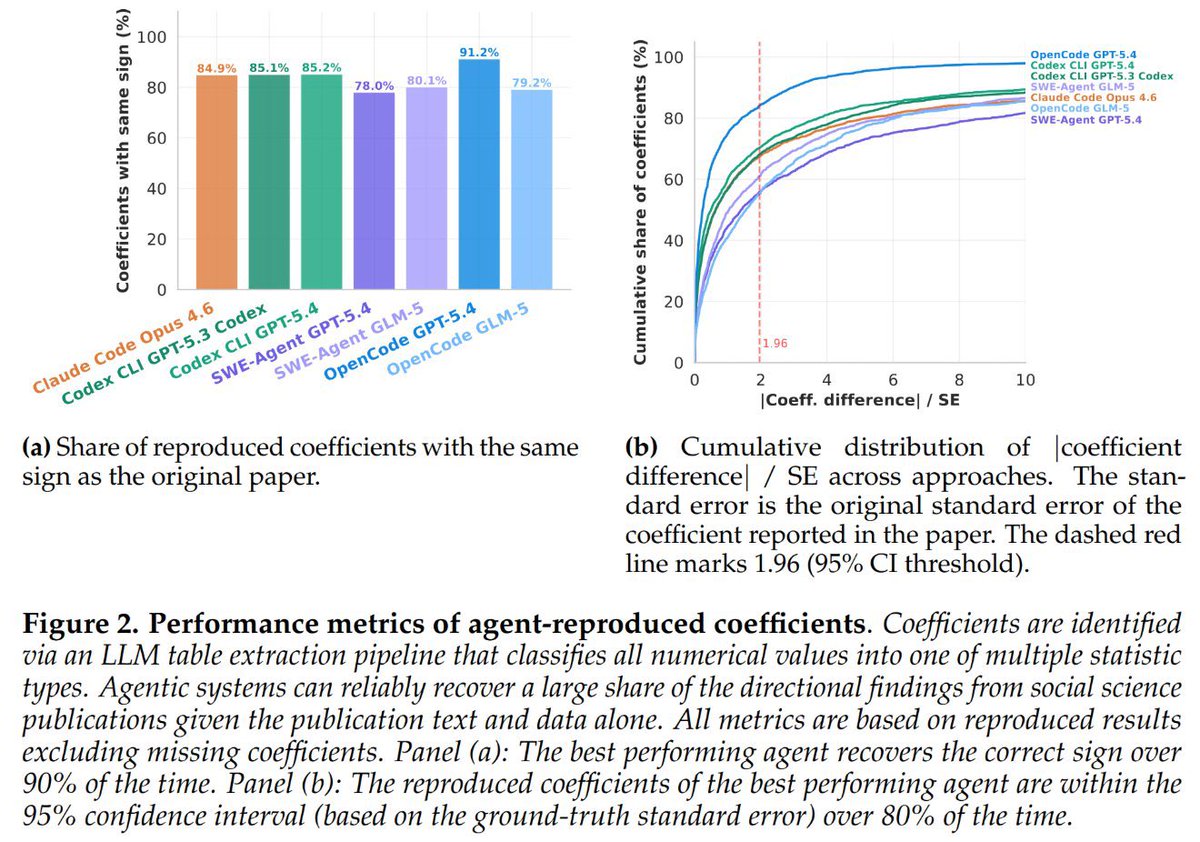
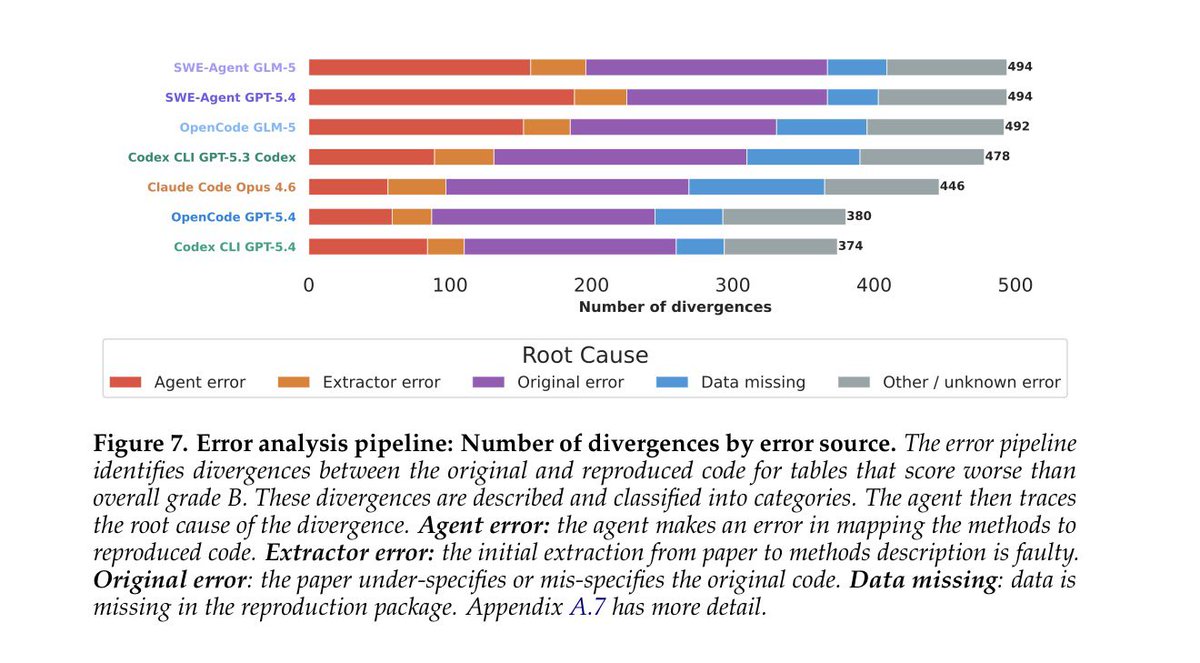
I think that academia has not absorbed the fact that AI agents are now good enough to independently reconstruct complex papers without access to code or the papers themselves; just the methods & data.
They aren’t perfect but the errors are often in the human paper, not the AI.
🔥DeepSeek-V4-Pro API is 75% OFF until May 5th, 2026, 15:59 (UTC Time)! Don't miss out on this massive discount.
🛠️Integration Updates:
🔹Claude Code: Set model to deepseek-v4-pro[1m] to unlock 1M context!
🔹OpenCode: Update to v1.14.24+
🔹OpenClaw: Update to v2026.4.24+
Check the latest official API docs for full details: https://t.co/9J9ZedDpyU
AI IS GETTING INSANE
A guy deployed six AI agents that turned $1,500 into $7,429 in just 7 days, without placing a single trade himself.
The system runs 24/7, executing trades automatically. In that time, it completed 105 trades with a 65.7% win rate, while continuously scanning markets, generating strategies, analyzing news, tracking whale activity, managing risk, and executing orders in real time.
At this pace, the system is averaging about $847 per day.













![deepseek_ai's tweet photo. 🔥DeepSeek-V4-Pro API is 75% OFF until May 5th, 2026, 15:59 (UTC Time)! Don't miss out on this massive discount.
🛠️Integration Updates:
🔹Claude Code: Set model to deepseek-v4-pro[1m] to unlock 1M context!
🔹OpenCode: Update to v1.14.24+
🔹OpenClaw: Update to v2026.4.24+
Check the latest official API docs for full details: https://t.co/9J9ZedDpyU](https://pbs.twimg.com/media/HGwt-7VasAAPM7i.jpg)


