Happy to see my last work of my PhD published! 🥳 We proposed a new protocol to simulate two-dimensional electronic spectroscopy experiments that can substantially reduce simulation runtime and memory requirements!
https://t.co/5pyJ5J8vu8
We analyze the computational resources to run our protocol and estimate that it can enable few orders of magnitude reduction of memory and runtime when applied to realistic light-harvesting systems such as the FMO complex compared to the standard approach.
To reach some consensus about the prospects of near-term (nisq and early ft) quantum computing, we had a 3-day discussion event (“Quantum Now”) in Lapland with both optimists and pessimists. This continued at SeeQA 2024 in Oxford. See our conclusions here https://t.co/UaQB9LmTqF
7/ Check out the full preprint here: https://t.co/S1xZfbKHGa
We’d love to hear your feedback! Feel free to reach out!🌟
#QuantumComputing#QuantumSimulation
🚀 Excited to share our new preprint "Simulation of two-dimensional electronic spectroscopy on a near-term quantum computer".
In this work, we introduce the probe qubit protocol (PQP), a novel approach to simulate 2D electronic spectroscopy (2DES) on near-term quantum devices 🧵
6/ While this work focuses on 2DES, we believe PQP opens the door to broader applications in spectroscopy and quantum simulations. Future research could address challenges like shot noise and decoherence, further improving efficiency and scalability.
🧵 [1/7] With @quantum_minhsiu, Leandro Mendes, and Sathya Subramanian, we’re pleased to unveil our latest pre-print about an unconditional separations btw quantum (QNC0) and classical bounded polynomial threshold circuits of constant-depth (bPTF0[k]). https://t.co/AqSvnAiDrF
Caught sight of my colleagues at amazing @INLnano José Diogo Guimarães (@JoseDGuimaraes), Carlos Tavares, Luís Soares Barbosa, and Mikhail Vasilevskiy featured in @skdh's new video. Take a peek!
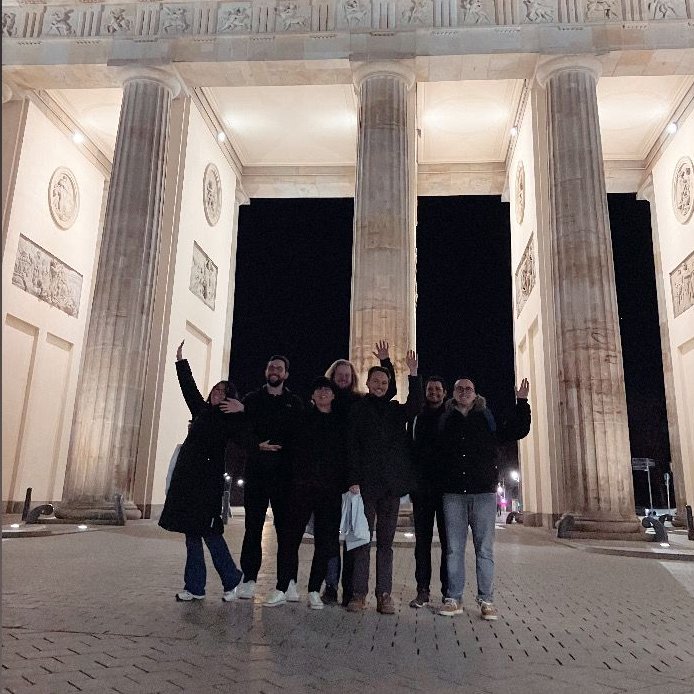
Our team bringing the latest discoveries to the DPG Meeting in Berlin ✨🇩🇪 Always exciting to share insights and engage in discussions with fellow enthusiasts 🤝Inspiring to witness the future of science in action #DPG2024#Quantum
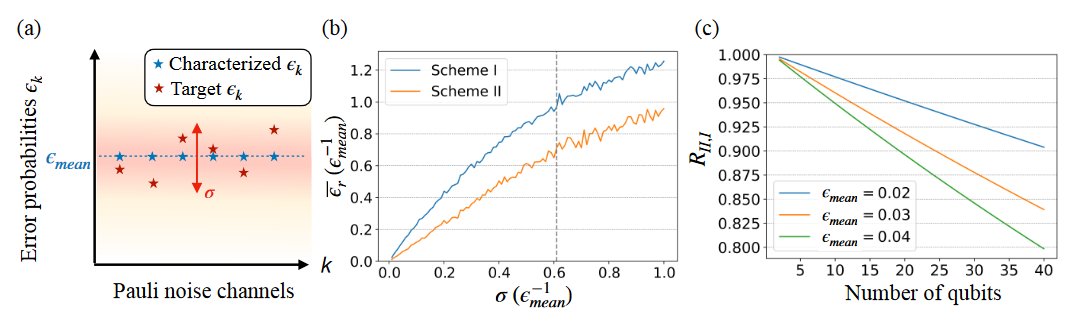
More on turning noise into an advantage! Our latest work https://t.co/7iJJv08FUS enhances our methods of https://t.co/bL1qG9RYv3 to showcase noise as an algorithmic resource in NISQ quantum computing. 🚀 #QuantumComputing#quantum
New preprint is out 📢
https://t.co/m4cjwpWFV7
In this work, we propose several new improvements to the original noise-assisted quantum simulation approach [PRX Quantum 4, 040329]. 1/n
These improvements allow us to simulate perturbative non-Markovian dynamics on NISQ devices without the need for ancilla qubits or mid-circuit measurements. 4/n