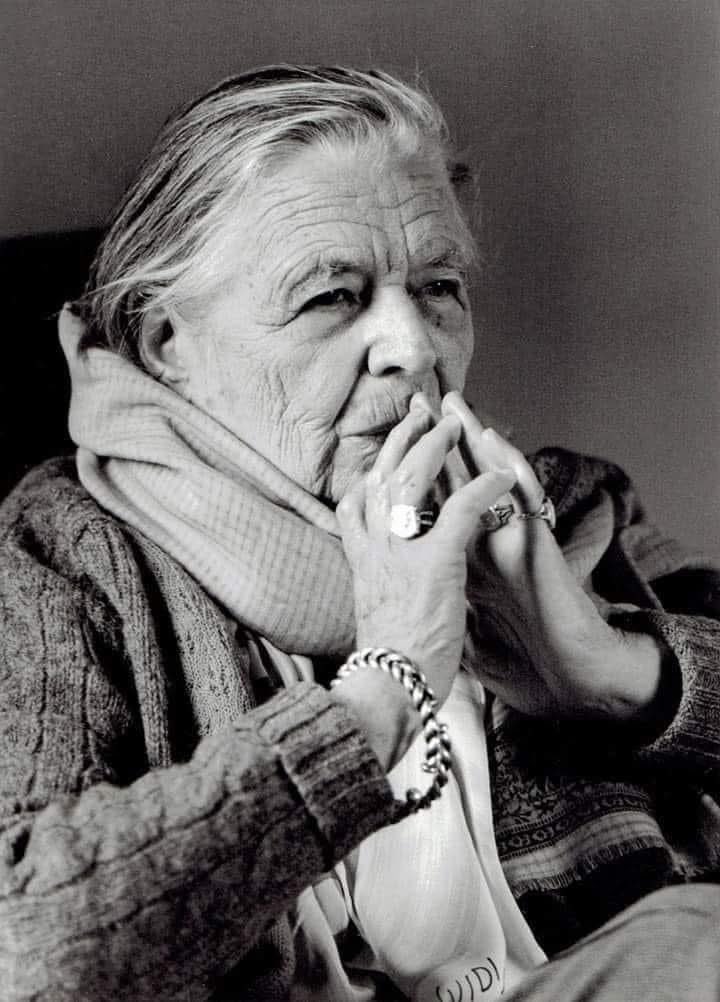
Magnifique Texte de Marguerite Yourcenar (Les Yeux Ouverts, 1980) 🤩
"Je condamne l’ignorance qui règne en ce moment dans les démocraties aussi bien que dans les régimes totalitaires. Cette ignorance est si forte, souvent si totale, qu’on la dirait voulue par le système, sinon par le régime. J’ai souvent réfléchi à ce que pourrait être l’éducation de l’enfant.
Je pense qu’il faudrait des études de base, très simples, où l’enfant apprendrait qu’il existe au sein de l’univers, sur une planète dont il devra plus tard ménager les ressources, qu’il dépend de l’air, de l’eau, de tous les êtres vivants, et que la moindre erreur ou la moindre violence risque de tout détruire.
Il apprendrait que les hommes se sont entretués dans des guerres qui n’ont jamais fait que produire d’autres guerres, et que chaque pays arrange son histoire, mensongèrement, de façon à flatter son orgueil.
On lui apprendrait assez du passé pour qu’il se sente relié aux hommes qui l’ont précédé, pour qu’il les admire là où ils méritent de l’être, sans s’en faire des idoles, non plus que du présent ou d’un hypothétique avenir.
On essaierait de le familiariser à la fois avec les livres et les choses ; il saurait le nom des plantes, il connaîtrait les animaux sans se livrer aux hideuses vivisections imposées aux enfants et aux très jeunes adolescents sous prétexte de biologie.
; il apprendrait à donner les premiers soins aux blessés ; son éducation sexuelle comprendrait la présence à un accouchement, son éducation mentale la vue des grands malades et des morts.
On lui donnerait aussi les simples notions de morale sans laquelle la vie en société est impossible, instruction que les écoles élémentaires et moyennes n’osent plus donner dans ce pays.
En matière de religion, on ne lui imposerait aucune pratique ou aucun dogme, mais on lui dirait quelque chose de toutes les grandes religions du monde, et surtout de celle du pays où il se trouve, pour éveiller en lui le respect et détruire d’avance certains odieux préjugés.
On lui apprendrait à aimer le travail quand le travail est utile, et à ne pas se laisser prendre à l’imposture publicitaire, en commençant par celle qui lui vante des friandises plus ou moins frelatées, en lui préparant des caries et des diabètes futurs.
Il y a certainement un moyen de parler aux enfants de choses véritablement importantes plus tôt qu’on ne le fait."
Estas reflexiones de @SIntxaurrondo son para enmarcar.
Cuando un diputado tumba un real decreto que deja sin efecto la moratoria de los deshaucios de personas vulnerables, tiene que asumir su voto, como PP y Vox
No echarle la culpa al sistema cuando han sido ellos.
Ya está bien.
Cómo quien se abstienen en un proposición de ley para que los fondos buitres puedan comprar viviendas, PSOE.
Jeffrey Sachs: a president stood at the UN and claimed the right to annihilate a civilization. Congress said nothing. That is the constitutional order collapsing in public.
“I shuddered then, and I shudder now that a president of the United States can stand at the podium of the UN General Assembly speaking to world leaders in a language of annihilation of other countries and of sending them to hell. It was ghastly, unprecedented, totally disgusting, disgraceful for the United States. But I would also say a measure of how broken the constitutional order of the United States is.
Trump basically said, like a madman, which I think arguably he is, that he and he alone will decide the survival of Iran. He said that he has a big, big choice to make. Maybe Iran will be a great country. Maybe Iran will be annihilated. Maybe Trump will send it to hell. And not only was the language vulgar in a way that I certainly could never in my lifetime have imagined coming from a president of the United States or anybody standing at the UN podium—because what Trump said was odious and completely in violation of every religious, moral, ethical, and legal standard that we have in this world—it was also a measure of the brazen collapse of our Constitution.
Is there a political system where one man decides the fate of another civilization? Is that how the American system works? Of course the answer is no. The founding fathers who rebelled against a mad King George III were very explicit in the Declaration of Independence, celebrated this year 250 years after its issuance. We’re in the 250th anniversary, one that Trump says is about our freedom. It was explicitly that King George arrogated, took on the authority to put the military above civil rule. And when the founding fathers wrote the US Constitution, they assigned specifically the power to declare war not to the commander-in-chief, but solely and exclusively—and not by choice, not if they care about it or want to or want to delegate it or not, but solely—to the United States Congress.
And Trump said yesterday he doesn’t care what the public thinks. He doesn’t care what the vote is. He says it doesn’t even cross my mind. And he said earlier this year, when he was asked, well, are there any limits on your power? He thought about it. He said Yes, my morality, but it’s my will. It’s what I want to do. Otherwise, no, there are no other limits.
What did our Congress do on that occasion? I can tell you, as we know, that the majority party in both houses simply remained silent. That is a violation of their sacred oath of office, which is to uphold the Constitution. Trump yesterday said he’s going to have the difficult choice of whether to annihilate, by the way, one of the most ancient civilizations in the world, 5,000 years old, twenty times older than the United States of America. And what did our Speaker of the House say? Well, he said nothing, of course. What did our Senate majority leader say? He said, of course, nothing. What did all of the party of the president of the United States say, the members of Congress? They said, of course, nothing. This is worse than the Roman Empire. There was a Senate that actually still said something. Our Senate says nothing.
We are so broken that not only do we have a madman in power, but there is no respect for our constitutional order. And the president can make statements as he made yesterday, unprecedented in the chamber of the General Assembly in front of the world leaders, speaking like the worst tyrant or gangster imaginable, and not a murmur from the Republican Party which dominates the House and the Senate. You know, I am not partisan. And a Democratic president who dared to be as absolutely mad and deranged as this president would probably find subservience in that party too. So I’m not even making a partisan point. I’m making a point about the collapse of our constitutional order.
Have we come to a point where one man, who I happen to think is utterly incompetent, utterly sociopathic, actually—when people are killed under his order, not a moment of reflection or remorse when 150 schoolgirls are murdered, and he knows the truth. He says, yeah, the Iranians probably did it. We’ll find out. No, not any control at all in our system of government.
So for me, you asked how I feel. I shudder at the last 24 hours, both at what the president said. It made my skin crawl. I was sitting there in the chamber listening to this madness. I mean it really, psychopathic madness, speaking in this way, with a vulgarity that is unimaginable. But then I’ve shuddered since then at the lack of response by the leaders, the majority leader of the US Senate, the Speaker of the House, Supreme Court justices, anybody to say no. In our system of government, it’s not one person who decides on the fate of another civilization.
We are a country, we say, first of all, of representation, and the American people are aghast at this. They oppose it overwhelmingly. They do not support this war of Netanyahu and Trump, which is a two-person war of murder and destruction and assassination of leaders of another country. They do not support it. And the constitutional order is that we are a representative government, and our representatives have an oath of office that only they can declare war. So where are they standing up to say No, you don’t have a penny to spend on this? We control the power of the purse. The tens or hundreds of billions of dollars that Trump has wasted of American income in this flagrant war of whim. Where is Congress to say you have no authority whatsoever to spend that because only we can decide on the spending and only we can declare war.
So this is the grim fact. It wasn’t just the awful statements. That was my first reaction. But then I thought, what have we come to when one person can make a statement like this and then remain essentially unchallenged in the United States system of government?”
Annihilation is not diplomacy. Congressional silence is not restraint. A constitutional republic cannot survive if one man claims the power to decide whether another civilization lives or dies.
La propiedad no se regula en la Constitución como derecho fundamental y puede modularse en situaciones concretas. Como bien de primera necesidad, el derecho a la vivienda no puede quedar por completo a merced del mercado. La civilización empieza cuando acaba la ley de la selva.
“Encomiendo a las estrellas, la luna, el sol, el azul del cielo, el viento, los pájaros, la luz, la inmensidad del espacio, que están siempre contigo, a todo ello le encomiendo mis pensamientos para ti y que cada día te dé la alegría que te deseo”.
J’ai 82 ans.
4 enfants, 11 petits-enfants, 2 arrière-petits-enfants…
Et une chambre de 12 m².
Je n’ai plus ma maison.
Plus mes meubles, ni mes souvenirs autour de moi.
Mais j’ai quelqu’un qui fait mon lit, me prépare à manger,
et prend ma tension chaque matin.
Je n’entends plus les rires d’enfants,
je ne prépare plus mes boulettes, ni mes œufs mimosa.
Je ne tricote presque plus.
Certains passent me voir tous les quinze jours.
D’autres, tous les trois mois.
Et puis… certains ne viennent plus du tout.
Alors je fais mes sudokus.
Je vais en ergothérapie.
Je parle avec ceux qui restent… mais pas trop.
Parce qu’ici, les liens se brisent vite.
Ils partent souvent sans prévenir.
On dit que la vie dure plus longtemps qu’avant.
Mais pourquoi, si c’est pour la finir si seule ?
Il me reste mes photos.
Quelques objets ramenés de “chez moi”.
Et le silence, parfois trop lourd.
Si quelqu’un me lit…
J’espère que les générations futures comprendront une chose :
La famille, ce n’est pas que des débuts.
C’est aussi des retours.
C’est prendre soin de ceux qui nous ont aimés les premiers.
Prendre soin de ceux qui ont pris soin de nous…
C’est peut-être ça, le vrai respect.
— Une maman, une grand-mère…
Ou peut-être toi, un jour
Amigas y amigos! Hoy abuso de ustedes, pero esta entrevista de ayer en 24 horas con Lara Hermosa es complementaria con el artículo que acabo de colgar. Gracias a Lara y a Borja. Fue un placer.
Hadrian spent more of his reign outside Rome than inside it. Britain to Egypt, on the road for years at a time.
At the end he could not get anywhere at all.
He was dying of what the sources call dropsy: fluid filling the body faster than anyone could draw it off. Cassius Dio says charms and magic gave him relief for a while, and then the water came back.
He wanted it finished. He asked for a sword. He asked for poison. Nobody would give him either.
The Historia Augusta says he ordered a servant to stab him, and demanded poison from his doctor, who killed himself rather than hand it over. Dio says he found a barbarian hunter named Mastor and made him promise to do it, and Mastor lost his nerve.
They disagree about how it actually ended. The Historia Augusta has him carried to Baiae for treatment that did nothing. Dio has him give up on his doctors' regime, eat and drink whatever he liked, and go out shouting an old proverb: many physicians have slain a king.
He died at Baiae in July, AD 138.
Somewhere in that last summer, the most travelled man in the empire is said to have written five lines to his own soul, about the one journey he did not want to make.
animula vagula blandula,
hospes comesque corporis,
quae nunc abibis in loca
pallidula rigida nudula,
nec, ut soles, dabis iocos!
Little soul, little drifter, little charmer, guest and companion of my body, where are you going now? Somewhere pale, stiff, bare. And you will not make your jokes any more. 🏛️
🗣️ Mónica López: "Ahora les toca a los jóvenes protestar y quejarse, pero me da la sensación de que una gran parte de los jóvenes se ponen de parte del patrón que del trabajador"
"Le problème n'est pas que vous n'ayez pas été éduqué. Le problème est que vous avez été éduqué juste assez pour croire ce qu'on vous a enseigné, mais pas assez pour remettre en cause tout ce qu'on vous a dit."
Edgar Morin, La Méthode
"El arte de la vejez es arreglárselas para acabar como los grandes ríos, serena, sabiamente, en un estuario que se dilata y donde las aguas dulces empiezan a sentir la sal y las saladas, un poco de dulzura. Y cuando te das cuenta ya no eres río, sino océano"
Jose Luís Sampedro
LA ENERGÍA CURATIVA DE LOS GATOS DOMÉSTICOS
Leonardo Boff
Tenemos en casa un gato maravilloso llamado Queiros. De vez en cuando desaparecía y reaparecía 3 o 4 días después. Por esta razón, le pusimos el nombre de Queiros, en referencia a aquella figura política que desaparecía y luego reaparecía. Servía a los intereses de una conocida familia de políticos, todos hombres, que construyeron sus fortunas de forma oscura. Nuestro Queiros es cariñoso y posee una especial energía curativa.
Si entramos en el Google o en otras plataformas de información, encontraremos en todas ellas referencias a la energía terapéutica de los gatos. Cumplen una misión que va más allá de ser animales de compañía. Son portadores de energías sutiles que se conectan con las energías humanas. Su ronroneo, en distintas frecuencias, es una de las formas mediante las cuales se acercan al ser humano, especialmente cuando está enfermo.
Jean-Yves Leloup, un psicoanalista de las profundidades, de origen francés, estudió especialmente la terapia con animales, particularmente con gatos, en la historia del antiguo Egipto. Llegó a crear un movimiento conocido con el nombre de «Los terapeutas del desierto» (Vozes, 1997).
El terapeuta no necesita necesariamente una formación académica en psicología o psiquiatría. Puede provenir de otros saberes, pero se propone entrar en contacto íntimo con la naturaleza y sus elementos, de modo de vivir una verdadera comunión con ellos. Es este proceso de comunión el que libera la irradiación de las energías de los elementos y hace que se vuelva curativa. Esto no invalida las terapias clásicas de las diversas escuelas de psicología y psiquiatría. C. G. Jung fue uno de los pocos que valoró esta energía natural, pues, según la fórmula de Einstein, materia y energía son equivalentes. Werner Heisenberg, desde la mecánica cuántica, insistía siempre en que la materia no existe: todo es energía en distintos grados de densidad. Y la energía, formando campos, se difunde siempre en todas las direcciones.
Tuve la oportunidad de visitar algunas veces a una mística, poeta y escritora, Adriana Zarri (1919-2010), cerca de Strambino, en el norte de Italia. Hacía una dura crítica al conservadurismo del papa Juan Pablo II y de Benedicto XVI. Vivía con su gatita Arcibalda, a quien dedicó su último artículo.
Ella, como pude comprobar personalmente, mantenía con la gata una relación afectuosa, como la de dos amigas íntimas. Aquello que nuestra gran psicoanalista junguiana Nise da Silveira describió en su libro Gatos, a emoção de lidar (1998) fue confirmado por la escritora Zarri, quien escribió: «el gato tiene la capacidad de captar nuestro estado de ánimo; si me ve llorando, enseguida viene a lamer mis lágrimas».
VCuentan que la gata permaneció junto a ella mientras expiraba. Al ver llegar a los amigos para el velorio, se enroscaba en la cortina de la sala para recibirlos. Como si supiera que había llegado el momento, discretamente, poco antes de que cerraran el féretro, entró en la capilla que había en la casona donde Zarri estaba siendo velada.
Alguien, sabiendo del amor de la gatita por la mística, la tomó en brazos y la acercó a su rostro. Lo contempló largamente y parecía que lloraba. Después se colocó debajo del féretro y allí permaneció en absoluta quietud.
Volvamos a nuestro gatito Queiros. Por razones que no corresponde mencionar aquí, estuve durante cierto tiempo en cama. Queiros permanecía a mi lado y, a veces, durante largo rato sobre mi pecho. Dormía junto a mí, pegado a mi cuerpo, para poder sentir el calor.
Por la mañana venía presuroso y me saludaba con su patita, colocándola sobre la manta. Permanecía durante largo tiempo sobre la parte herida de mi cuerpo, como si quisiera transmitirme su energía curativa. Y efectivamente la transmitía, pues escuchaba su ronroneo, la forma mediante la cual los gatos y las gatas se comunican.
Se estima que existen en el mundo entre 600 millones y 1.000 millones de gatos, pertenecientes a unas 250 razas diferentes. Generalmente viven entre 15 y 20 https://t.co/hX9iOeO6Jo presume que el gato ancestral (Felis Catus) se remonta a unos 15 millones de años. Sin embargo, su domesticación habría comenzado en Babilonia alrededor del año 7500 a. C. Es un animal cosmopolita, pues existe en todo el mundo.
ue importante durante el Neolítico, cuando surgió la agricultura. Los alimentos y las frutas eran atacados por ratas y otros roedores. Fue entonces cuando la función de los gatos, considerados siempre buenos cazadores, se volvió decisiva, también en las casas donde había esos roedores.
Los gatos, debido a su ADN, poseen un cerebro bastante evolucionado, lo que los hace capaces de sentir emociones y, según consideramos, de poseer una irradiación curativa. Son extremadamente higiénicos y dedican mucho tiempo al cuidado de su pelaje, utilizando la parte áspera de la lengua para eliminar la suciedad y el polvo.
Aunque durante prácticamente toda su historia fueron animales de compañía, a comienzos de la Edad Media se difundió, sin embargo, la creencia de que estaban asociados con las brujas y con el demonio. Curiosamente, llegaron a ser excomulgados, juzgados en plazas públicas y quemados, como se hacía con las brujas.
Gracias a Dios, superado aquel período oscuro, incluso durante la Edad Media de las universidades y de los estudios, fueron reintroducidos como animales de compañía.
Hoy existen gatos de todas las razas en muchas familias. Algunos reciben incluso cuidados estéticos especiales y son llevados por las señoras a encuentros sociales, quizá recibiendo más cariño que el dedicado a sus propios hijos.
Finalmente, cuidemos de estos seres domésticos, cariñosos como Queiros, respetando su libertad intrínseca y proporcionándoles una alimentación adecuada, sin aditivos químicos que les resulten perjudiciales. Son compañeros en nuestras sociedades y forman parte de la naturaleza, portadora de derechos. Por eso, los gatos aparecen como conciudadanos, también sujetos de derechos que deben ser respetados.
Leonardo Boff autor de O pescador ambicioso e o peixe encantado: a busca da justa medida (Vozes, 2022 y escribe también para LIBERTA, revista del ICL (https://www.revista https://t.co/F6OZGDtjgz)
🎙️ Julián Casanova (@CasanovaHistory): "Tengo temor y miedo porque he analizado el pasado, y cuando lo he analizado he encontrado los factores que contribuyeron a que hubiera guerras y veo muchas rimas e irresponsabilidad"