Super excited to launch the first version of my portfolio using @tachyons_css 🎉
(PS: Looking for a job for when I graduate, so sharing would be appreciated)
https://t.co/bD0f6J4uBc
I think we have lost some sense of judgment and moderation when it comes to product building currently.
The moment you turn something into a universally celebrated metric, whether that is token burn, prototype count, or percentage of agent-written code, you start losing sight of what actually matters.
I have felt the same way for a long time about overusing data and A/B testing to build products. The moment you reduce product quality or productivity to a metric, you stop shipping value and start shipping numbers.
A lot of what people are doing with AI makes directional sense. The missing piece is counterbalance:
1. AI should help engineers build better products. Leaderboards and adoption metrics can be useful as directional signals. They do not tell you what is being built, whether it is good, or whether it should exist at all.
2. Users do not care what percentage of your code was written by agents. They care about the outcome. Faster output is useful. Like usually, faster doesn't seem to add to quality, clarity, or stability of products. Power to build should not become an excuse to lower quality bars.
3. LLM-generated prototypes can feel like late-night whiteboarding sessions. They look exciting in the moment and feel productive very quickly. Then a few days later you realize the idea was shallow, distracting, or simply wrong. The same trap shows up in jumping straight to code and solutions more broadly. You may just be building the wrong thing more efficiently. Prototyping has its place. So do clear thinking, good design, and a real understanding of the user’s problem. In terms of activities or momentum, the main quest and the side quest can both feel productive but only one actually moves the mission forward.
4. Adding more to products is still dangerous as ever even if time or effort to add it has gone down. Every addition creates complexity, maintenance cost, and user confusion. New features should be pushed back unless they clearly show it should exist and how it improves the product.
5. Not everything needs to be an agent shaped. A simple scheduled task does not need a full LLM sandbox. Making something agentic because it feels current or impressive does not make it right-sized, correct, or effective.
The core ideas are:
- even if you can, maybe you should not.
- more power we have to build should not reduce our need to think, it should increase it.
If anyone is in need of a product designer there is likely no-one better than Dennis. His work ethic and end output are easily among the best, anyone would be lucky to have him in their team.
Welp, I was laid off from my role at Northstar due to budget cuts 💔
If you have design needs for freelance or full time roles please let me know!
Shares, leads, and kind words are very much appreciated 😊
My website: https://t.co/QVg2Jwr5y8
Not a single person in this picture knows how to attach a PDF but they’re about to regulate one of the most important emerging technologies.
Typical euro L
I took a while to respond to this because Eric’s answers were very good, and logical so it’s hard to refute. I also do respect Eric Ries a lot, he has lot of experience with different companies and his book Lean Startup was really influential to me when it first came out.
But… something bothers me about this whole MVP discussion. Is this all just a distraction?
Eric’s answer was basically “MVP can be anything you need to validate an idea or the customer demand in the market”. Later in the discussion Eric mentions that a brochure can be an MVP. I agree. Sometimes sales material is a good way to validate demand, but I’d say it’s not an MVP. There is no product for anyone to use.
What bothers me is that if anything can be MVP, it’s trying to bucket all kinds of activities and outputs into this one term, it kind of loses in meaning and becomes more confusing than it’s helpful. Anything you do to validate an idea or build a product is essentially MVPs.
If MVP is just a way to test or validate something, then why not say, “I’m validating the product demand by using a sales brochure”. Or if I’m showing an initial product to potential users, why not just call it that. Why do I need to talk about MVPs? People also like to argue what truly is or not is an MVP, which I find just a waste of time.
In my experience, people generally mean MVP is some kind of baseline or beta version of a feature or product. It’s functional and hopefully solves user needs but doesn’t have all the polish and features. It’s a state in the product development lifecycle. Almost every product probably starts as some kind of “baseline” product where the baseline is defined by the expectations of the users. Which is fine, you have to start from somewhere.
The problem I’ve seen in companies is that this MVP thinking promotes taking constant shortcuts and shipping shitty things in the name of the MVP. These often get abandoned or not fixed afterwards because the project is technically done and the team moved over. Then the whole product becomes half-assed and disjointed because it’s just a string of MVPs.
Now someone might argue, well you are doing it wrong. MVPs doesn’t mean you shouldn’t finish it. Yes but in practice how often it happens and is this whole method just encouraging the wrong things or distracting from what are actually doing?
The MVPs & Lean Startups remind me of agile/scrum where you create these terms for a show or doing some mental gymnastics for basic activities. Then when someone argues it’s a waste of time the answer is often “you’re doing it wrong” or “you just don’t get it”. Maybe so, but maybe there isn’t anything to get?
My way of thinking around product building is not about experiments or MVPs, it’s about how to make the product successful.
As a startup you often just have to build something that people want. Providing a great experience is a great way to do that. Purposefully building and launching half-assed things to me is just a waste of time.
It’s like you operate a restaurant and instead of fully cooking the food, you purposefully leave it raw and let users tell you it’s inedible and makes them sick. Anyone who has eaten or cooked food knows that. Next time you cook it fully, and behold, the consumer now can eat the food but they still don't like it. Experiment and MVP of fully cooking the food was validated. Yay! We can now move to the next variable...
Obviously, chefs don't operate this way. They have their skills and experience and they use that make a dish and people would enjoy. Sometimes they are wrong and sometimes they make something really great.
Sometimes you know more about the market or the problem, sometimes you know less. You should try to think about what you do know, and what you don’t know, and how critical that information is. To know more you can talk to users and customers, knowing that they can’t ever give you the vision of what to build, only input to that vision. The ultimate test is to have a product out there, and see if people buy it. I’d say you should have vision, not just throw random stuff at people and see what they say.
This is also not about fear of launching a product early. We launch early and get feedback early, but still care about the quality of the experience. We got our first few users for @linear about 1 month after we announced the company. But by that time we already had a product that was 10x faster than anything else there, and had a design people liked. And yes it was scoped down and didn't have all the features (common sense). We never considered it as a MVP or an experiment, it was a product stage and we wanted to get user feedback.
My problem with trying to make the product building into some kind of science which most of the time is not necessarily and likely just a distraction, especially for startups. Your only focus should be how do I make a product that is 10x better than anything else in the market. The fact is that if you enter any category that only has solid incumbents or existing products, then your product needs to be very different and higher quality than those products. You don’t need an experiment to know that.
If your product has no traction then it either is the wrong product or the execution is not good enough. You can try to validate the product idea with research but until you make the execution good then you never know for sure. Users won't tell you that, they just leave or don't use it.
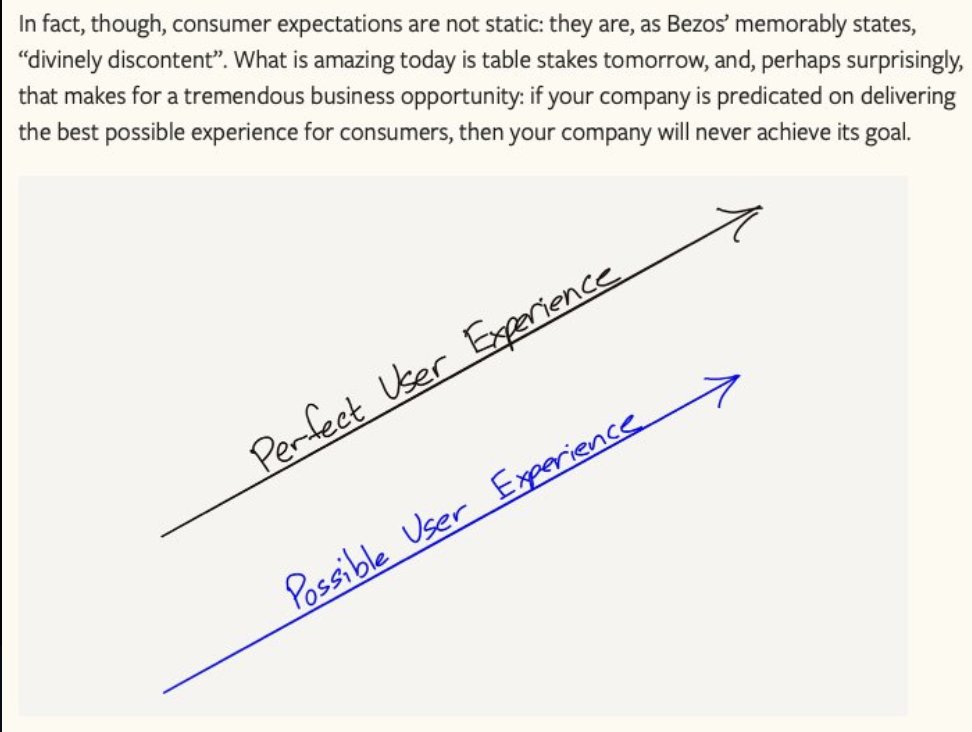
My point with this question was that today the user and customer expectations are high in many areas, and there are very few new novel markets like AI (crypto before that) that can be more of the wild west. But as those markets mature, you are again fighting against higher quality bars. As Bezos stated this, consumer expectations are ever increasing or “divinely discontent”,
So my advice would be to focus more on how you deliver a product that exceeds those expectations.
Don't spend your energy on running great experiments instead what would make the experience great.
Sidenote: On the iOS apps vs backup battery system also I disagree. Battery backup system buyers can have very high standards, but they are also rational buyers knowing what they want. Many consumer iOS apps only succeed in more irrational ways. There is no spec sheet for social apps you can pull out from teenagers. You can try to understand them and build something, but if it doesn’t engage them your app fails. These apps are not needed, they are wanted. Most products are some kind of mix of rational and irrational needs. Logic and emotion.
@ben_strak Great read - iterations alongside holding a high quality bar and great judgement/intuition from both ICs and leadership I think are the big levers here.
Can you share who posted this? Would love to give them a follow but can’t find any reference to their details