Recovery actions are ongoing across affected Microsoft 365 infrastructure and progressing in phases. We’re seeing incremental improvement in several workloads, but service health remains variable and capacity has not yet fully returned to baseline. To protect delayed mail, we’ve extended the email timeout window to 48 hours while queue and backlog processing continues. A more comprehensive update can be found at MO1550821 in the Microsoft 365 admin center, as well as https://t.co/bVoAAh3D2G if the admin center is not available to you.
Microsoft's outage reports on November 12 reached 74 countries and territories in about an hour on Downdetector.
Microsoft says its Exchange Online incident began at 16:17 UTC. Reports to Downdetector about Outlook began climbing at about 17:25 UTC, 12:25 in New York. By 18:25, reports about five Microsoft services combined reached 19,650 a minute, against <15 a minute on an average Thursday.
Outlook reports alone peaked at more than 2,000 times their normal level.
Reports did not stay in the Americas. They jumped tenfold in the UK at 17:43, in India at 23:21 local time and in New Zealand at 06:55 local time. Between 17:00 and 18:55 UTC, nearly 3 in 10 reports came from outside the US. We count a country here once its reports reach ten times normal and at least 20 in five minutes.
Reports about Microsoft 365, Copilot, Teams and OneDrive each rose more than a hundredfold, and Azure about a hundredfold. Xbox, GitHub and LinkedIn, also Microsoft's, rose far less.
Microsoft said a portion of its infrastructure was experiencing elevated load across multiple regions. At 19:38 UTC, reports were still running at more than 11,000 a minute.
🆕 New CVE
Authentication bypass in administrator login flow (CVE-2026-39430)
An unauthenticated attacker can skip login, change admin settings, and export configs holding credentials.
No patch listed yet
https://t.co/Wy9SNLEepW
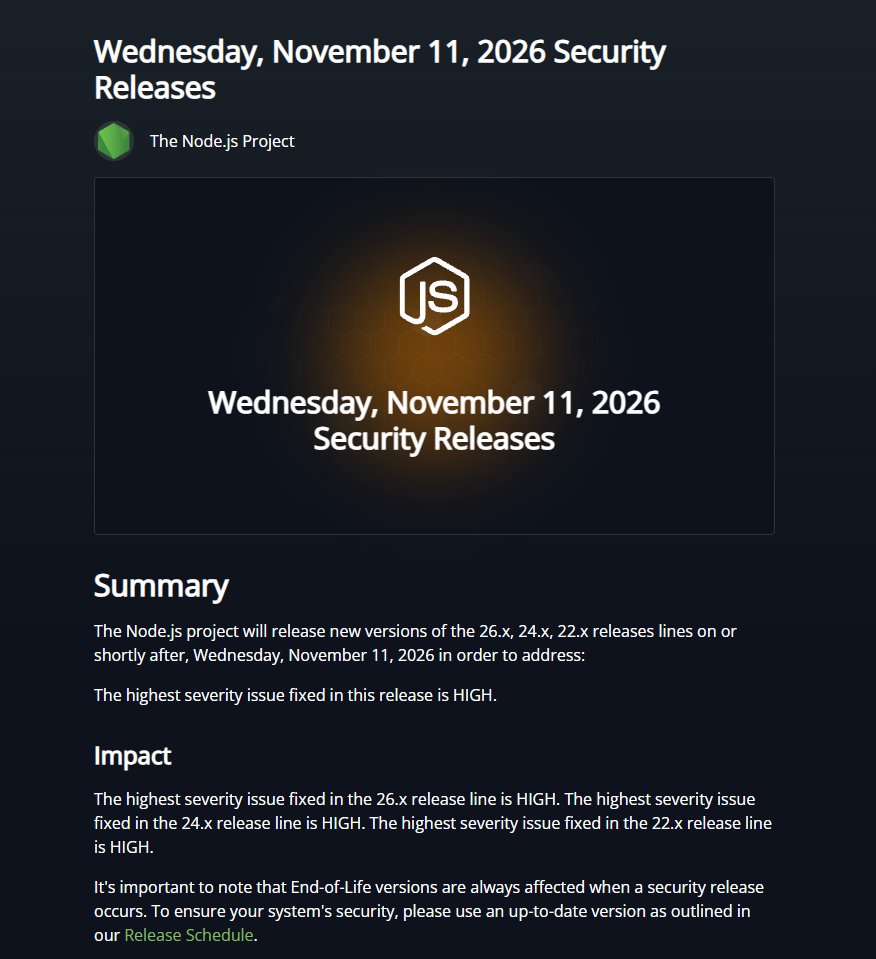
🚨 Node.js warns of HIGH-severity security vulnerabilities.
Security fixes are coming November 11 for Node.js 26.x, 24.x, and 22.x.
All three release lines are affected. Production users should take note.
Details: https://t.co/kyerFMiO8K
An MIT Media Lab study used EEG to track what happens in the brain when people write with ChatGPT rather than on their own. Fifty four students completed essay tasks while wearing electrode caps. One group used ChatGPT, one used a search engine, and one used no tools. Across sessions, the ChatGPT group showed the weakest neural connectivity in networks linked to memory, attention, and analytical work. They also had more trouble recalling what they had just written and produced more generic prose. The authors describe this as a kind of cognitive debt: the tool does the synthesizing, and the brain stays quieter [1].
The same experiment points to a better order of use. Students who first wrote unaided and only later switched to ChatGPT showed stronger recall and more widespread brain activity than students who started with the model and then had to work alone. In other words, the model helped more when it scaffolded thinking that was already underway than when it replaced that thinking from the start. The practical lesson is not that large language models should be banned. It is that they work best as a second pass, after the writer has already done the hard part of forming and remembering an argument [1].
[Kosmyna, N., Hauptmann, E., Yuan, Y. T., Situ, J., Liao, X. H., Beresnitzky, A. V., Braunstein, I., & Maes, P. (2025). Your Brain on ChatGPT: Accumulation of Cognitive Debt when Using an AI Assistant for Essay Writing Task. arXiv. DOI: 10.48550/arXiv.2506.08872]
Security experts warn North Korean hackers aren't just using AI in their new campaigns, but also 'post-quantum' encryption | TechRadar https://t.co/JMruACM1FK