Wow. Synthetic hype generated against Tyler in the absence of evidence.
These people were lecturing you about trial integrity being in jeopardy due to your skepticism about Tyler(how dare you presume his innocence), meanwhile they are lying about evidence and pumping the lie out at full Elon-zio-cuck-speed...
Can we take a second and think about the nerve of Zio-sloppers to take vicarious offence on Charlie's behalf as if they knew him, when his last wish(es) -WHICH TPUSA WAS FIGHTING AGAINST- was bringing in Candace and Tucker to debate/speak.
He used them as a return threat "Keep threatening me and I'll fucking do it, I'll bring in the zio-destroyers"
The fact Viva and others ignore this major fact.
We live in fuct up times.
This Tyler Robinson case reminds me of Russiagate, the Vegas Shooting, Hunter Biden’s laptop and Covid! Where a bunch of bootlickers deepthroated the CIA and FBI mockingbird medias talking points and parroted them all over social media. Then when the story started to unravel like it always does the slowly and quietly pulled a Homer Simpson and disappeared in the bushes!
🔬 Mining Toolbox: Episode 5
From the mine to the lab, the first stop is the drying oven. Before a sample can be analyzed for gold, it first heads to the drying oven, where moisture is removed so it can be properly prepared for crushing and testing.
You definitely wouldn't want to bake cookies in this oven - at 270°C, it's built for rocks, not recipes.
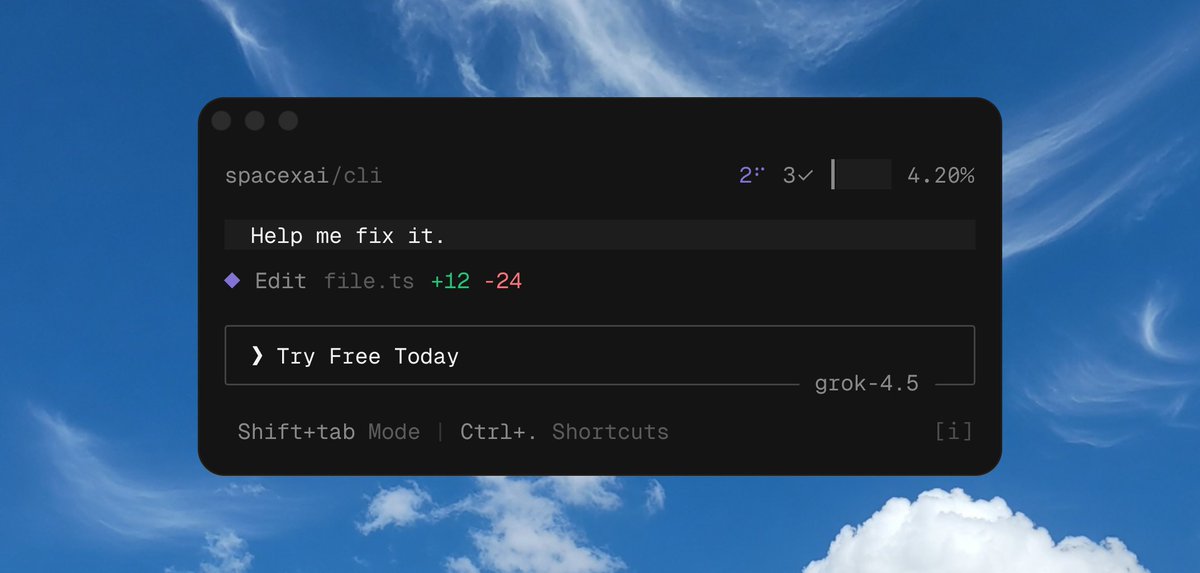
Grok 4.5 is now available to try on the free tier. Use Grok Build with any X or Grok account.
We’re excited to hear your feedback.
https://t.co/NYsa0Ar9eo
Our recently announced Commercial Toll Processing Agreement, which includes a minimum annual revenue commitment of US$4.0 million represents the first commercial deployment of our patented Air Classifier technology.
Most mineral processing is done in batches.
Material is loaded, processed, unloaded, and the process starts again.
Our patented Air Classifier is designed as a continuous flow process. Material continuously enters one end while separated products continuously exit the other.
Continuous operation can support efficient throughput and commercial processing applications
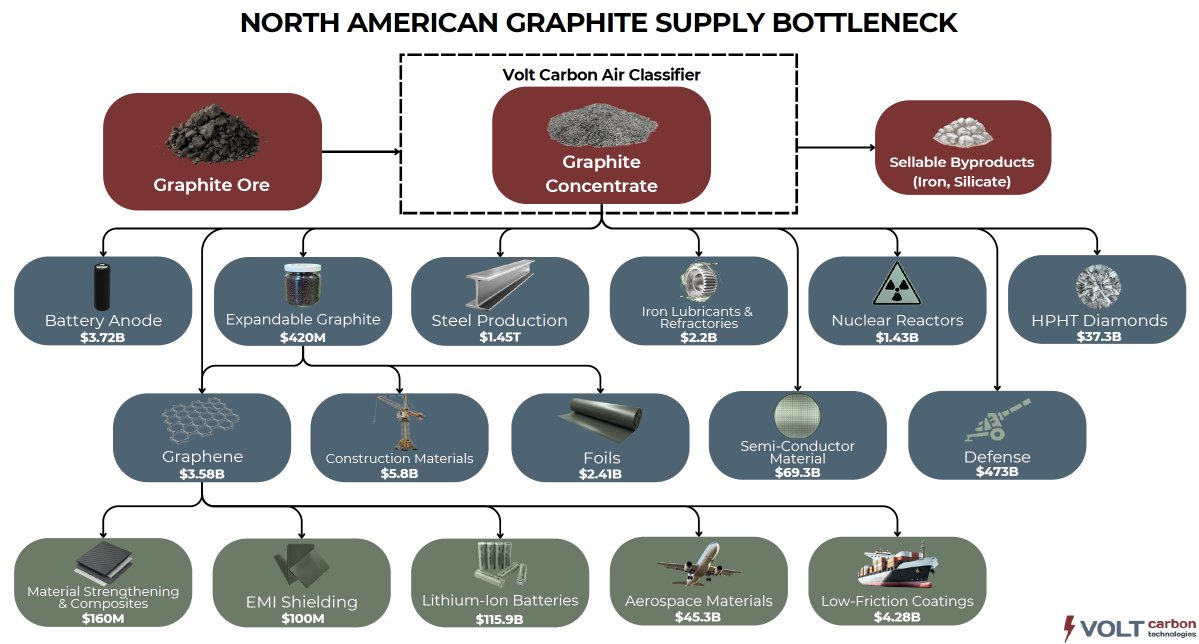
This weeks's commercial agreement is only the beginning. We believe our Air Classifier technology has potential applications across graphite, graphene, vermiculite, and other industrial minerals.
#CriticalMinerals #MineralProcessing #IndustrialTechnology #Manufacturing #Graphite #Innovation
$VCT $TORVF
A recap of recent progress across two of our key growth assets:
⛏️ Ana Paula
High-grade drilling continues to expand the deposit, results include 99.8 m at 10.9 g/t Au. Drilling is ongoing at the Expansion Zone.
🏗️ La Colorada
Strong drill results and final permits continue to advance the Veta Madre expansion. Engineering of Veta Madre Plus pit is ongoing with waste stripping on track to start this quarter.
Work continues across our portfolio this summer. Don't miss an update, subscribe to our list: https://t.co/OoBzkhlTaL
Today's announcement is about more than a single commercial agreement.
It's about building recurring commercial revenue while demonstrating that our patented technologies are transferable across multiple products, applications, and industries.
As we continue advancing our graphene, graphite, battery, and advanced materials technologies, we're building a business with real customers, real applications, and real cash flow.
One milestone at a time.
We're just getting warmed up. The first inning hasn't even started yet.
$VCT $TORVF #Innovation #CriticalMinerals #Graphene #Graphite #AdvancedManufacturing #EnergyStorage
We are currently drilling at our Red Mountain project in Alaska. This is a large polymetallic VMS deposit (inferred resource of 168.6 Moz AgEq¹) with SEDEX‑style targets² and numerous additional prospects.
The 10,000 meter ongoing drill program offers new discovery potential for silver‑gold‑zinc‑copper‑lead mineralization, with identified critical mineral upside in antimony and gallium.
Drill program objectives:
→ Further delineation and expansion of the Dry Creek deposit (~3,000 metres). Dry Creek has an inferred mineral resource of 104.0 million silver equivalent ounces* at 279.4 g/t AgEq
→ 7,000 metres of discovery-focused drilling at:
⏵⏵⏵ Hunter - prior rock chip samples returned assays up to 616 g/t Ag, 18.6% Zn, 5.4% Pb, 2.5% Cu, and 0.33 g/t Au.
⏵⏵⏵ Glacier Creek - testing for VMS-related mineralization hosted along 6 km of highly prospective Totatlanika schists
⏵⏵⏵ FOMO - Prior sample highlights include 1,792 g/t AgEq (74 g/t Ag, 2.54 % Cu, 10.05 % Pb, and 23.20 % Zn, sample F0033147
⏵⏵⏵ Sheep Creek – a SEDEX‑style Ag‑Zn‑Sn massive sulfide target supported by high‑grade samples and geophysical anomalies
¹ ² For more information and important disclosures, see the June 4, 2026 release → https://t.co/ofEZSu14le
¹ Notes: g/t=grams per tonne; AgEq=silver equivalent; ZnEq=zinc equivalent; m=metres; Ag=silver; Au=gold; Cu=copper; Zn=zinc; Pb=lead; 1ppm=1 g/t. Equivalencies are calculated using ratios with metal prices of US$2,750/tonne Zn, US$2,100/tonne Pb, US$8,880/tonne Cu, US$1,850/oz Au, and US$23/oz Ag and metal recoveries are based on metallurgical work returned of 90% Zn, 75% Pb, 70% Cu, 70% Ag, and 80% Au. Silver Equivalent (AgEq g/t) = [Zn (%) x 47.81] + [Pb (%) x 30.43] + [Cu (%) x 119] + [Ag (g/t) x 1] + [Au (g/t) x 91.93]
² SEDEX = Sedimentary Exhalative Deposits which are formed when metal-rich fluids vent onto the seafloor and precipitate lead, zinc, silver and often other metals. They are a major global source of lead and zinc.
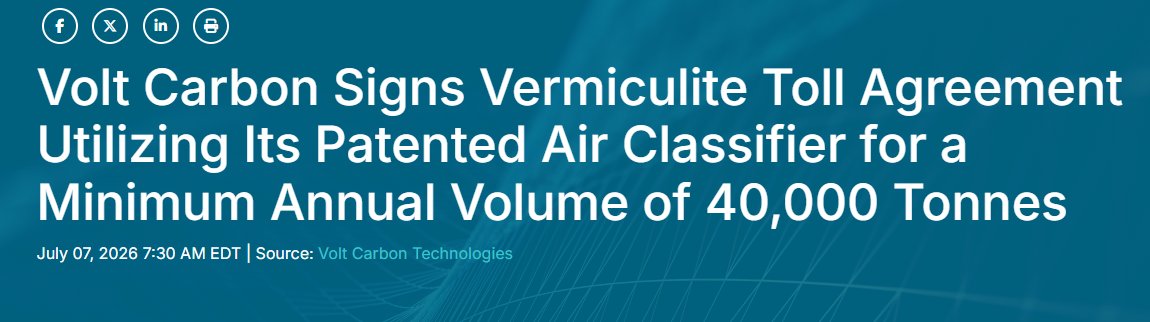
Volt Carbon has signed its first commercial toll processing agreement utilizing its patented Air Classifier technology.
Key highlights:
-Minimum 40,000 tonnes/year
-Minimum US$4.0M annual revenue commitment (subject to the agreement's terms and conditions)
-2.5% Equity Interest in Northern Ore
-First commercial deployment of our patented dry processing technology
-Expands into the vermiculite market
This milestone demonstrates how our patented technology can create recurring revenue while opening new opportunities beyond graphite.
$VCT $TORVF #CriticalMinerals #Mining #AdvancedManufacturing #Innovation #Vermiculite #Graphite #CleanTech
https://t.co/iOmMjWzLyH
Two weeks ago, Ethereum researchers met in Berlin to continue charting the protocol's long-term trajectory, following along discussions with client teams in Svalbard in April.
The updated strawmap is at https://t.co/9e2AQ6rhz6, and I attached a picture of it to this post.
My own high-level takeaways:
* "Lean Ethereum" is not a single one-shot upgrade, it is a collection of improvements that will come online to the Ethereum network over the course of three or four years. But make no mistake, this IS the third major iteration of Ethereum in the same way that the Merge was the second. Almost every major piece of the protocol will be replaced:
- Verification through recursive STARKs, rather than direct re-execution. Recursive STARKs become an enshrined first-class core component of the protocol
- Replacing everything quantum-vulnerable with quantum-safe alternatives
- Consensus: decoupled available chain and finality, one or two-round finality. Theoretically optimal security properties, simpler than today, and faster than today
- Multidimensional gas
- State: not just tree structure, but what *types* of state are available
- Changes to client architecture
...
At the same time, simplification, cleanup and future-proofing. And this will all be done in a way that minimizes disruption to existing application. We've done this before (the Merge), we can do it again.
* H-star (aka Hegota) is probably Ethereum's last thematically "pre-Lean" fork. Starting from I-star, most of everything we do will have a very strong "Lean" feel to it in one way or another.
* Privacy is no longer an afterthought, it is a first class goal. When designing Frames, the mempool, additions to the state tree, we explicitly ask the question "okay, how do quantum-safe, intermediary-free privacy protocol transactions go through this, and what is the overhead?"
* Formal verification of everything for security.
* FV also makes us much more comfortable with canonicalization (having pieces of the protocol that are directly defined as a piece of bytecode expressed in some language). evm-asm is being written in part to become a canonical proof system for the EVM.
* Quantum safety has shifted up a LOT in priority. This adds a lot of work (eg. finalizing a quantum-safe blobs design has become urgent; this work has already been ongoing for months)
* Probably the single most disruptive part of the plan is the changes to state. There is growing consensus around leaving present-day-style "dynamic state" mostly unchanged, but scaling it only a medium amount, and adding new types of state that are more scalability-friendly (eg. no need for builders to sync/store all of it) but more restrictive, and that will scale a large amount.
eg. possible Ethereum in 2030: 2 TB of present-day-style (dynamic) state, and 100 TB of new-style (scalable but restrictive) state
This "new-style" state would work very well for ERC20s, NFTs, many defi use cases, but not eg. highly "central" objects like Uniswap contracts, or onchain order books, or other complex things (which are crucial for Ethereum but which only take up a small percentage of state)
Hence, it will not be *necessary* to rewrite any apps, but it will be *very cost-effective* to eg. rewrite an ERC20 token into a newer design that uses a new type of UTXO storage that is currently being explored, so that it will have >10x lower txfees.
Design of these new state types (current ideas: keyed nonces, ring buffers, UTXOs, statically accessible state, temp state) is an area where we will need a lot of feedback from application developers (incl. privacy-friendly application developers) and probably several rounds of rethinking and iteration.
* In the context of a much larger total state size, we need to figure out the incentive issues around who stores this state and what motivates them to. Even saying "each node stores 1%" is not good enough - why do they store that 1% and why are they willing to serve it? This is being elevated as a first-class research area.
* Ethereum will need to have a "VM" other than EVM in one form or another - at the very least, we need something like leanISA for recursive STARKs - and the gains are large in exposing it to users so that we support programmable privacy and better scalability. Right now, the most likely contenders are leanISA and RISC-V.
My own ideal is that in this world, we adjust the protocol so that the EVM becomes a high-level-language compiler-level feature, and the protocol only "sees" RISC-V / leanISA directly. But this is still far away.
* Gas limit increases, blob increases and slot time decreases will happen many times over the next ~5 years. We expect a large gas limit increase with Glasterdam. Each step of increased scale or decreased slot time is a matter of getting to the point where it is safe to do it, which comes from a combination of client optimization and protocol changes.
Ethereum is CROPS.
Ethereum is scaling.
Ethereum is reinventing itself.
Onward.








![Silver47co's tweet photo. We are currently drilling at our Red Mountain project in Alaska. This is a large polymetallic VMS deposit (inferred resource of 168.6 Moz AgEq¹) with SEDEX‑style targets² and numerous additional prospects.
The 10,000 meter ongoing drill program offers new discovery potential for silver‑gold‑zinc‑copper‑lead mineralization, with identified critical mineral upside in antimony and gallium.
Drill program objectives:
→ Further delineation and expansion of the Dry Creek deposit (~3,000 metres). Dry Creek has an inferred mineral resource of 104.0 million silver equivalent ounces* at 279.4 g/t AgEq
→ 7,000 metres of discovery-focused drilling at:
⏵⏵⏵ Hunter - prior rock chip samples returned assays up to 616 g/t Ag, 18.6% Zn, 5.4% Pb, 2.5% Cu, and 0.33 g/t Au.
⏵⏵⏵ Glacier Creek - testing for VMS-related mineralization hosted along 6 km of highly prospective Totatlanika schists
⏵⏵⏵ FOMO - Prior sample highlights include 1,792 g/t AgEq (74 g/t Ag, 2.54 % Cu, 10.05 % Pb, and 23.20 % Zn, sample F0033147
⏵⏵⏵ Sheep Creek – a SEDEX‑style Ag‑Zn‑Sn massive sulfide target supported by high‑grade samples and geophysical anomalies
¹ ² For more information and important disclosures, see the June 4, 2026 release → https://t.co/ofEZSu14le
¹ Notes: g/t=grams per tonne; AgEq=silver equivalent; ZnEq=zinc equivalent; m=metres; Ag=silver; Au=gold; Cu=copper; Zn=zinc; Pb=lead; 1ppm=1 g/t. Equivalencies are calculated using ratios with metal prices of US$2,750/tonne Zn, US$2,100/tonne Pb, US$8,880/tonne Cu, US$1,850/oz Au, and US$23/oz Ag and metal recoveries are based on metallurgical work returned of 90% Zn, 75% Pb, 70% Cu, 70% Ag, and 80% Au. Silver Equivalent (AgEq g/t) = [Zn (%) x 47.81] + [Pb (%) x 30.43] + [Cu (%) x 119] + [Ag (g/t) x 1] + [Au (g/t) x 91.93]
² SEDEX = Sedimentary Exhalative Deposits which are formed when metal-rich fluids vent onto the seafloor and precipitate lead, zinc, silver and often other metals. They are a major global source of lead and zinc.](https://pbs.twimg.com/media/HMkFhRtaYAAU_gj.png)


