We're headed to the Supreme Court in Dept of Labor v. Sun Valley Orchards!
“Small businesses targeted for fines have the right to defend themselves in a real court, with a real judge and jury, rather than an agency court where the only judge is an agency bureaucrat,” said IJ Senior Attorney Rob Johnson (@FreeRangeLawyer).
“It’s fundamentally unfair to try a business in a court where everybody involved is employed by the same administrative agency.”
@JerusalemDemsas If it becomes possible for less affluent people to live in single family home neighborhoods, some cities will literally change the law to stop it from happening. More barriers to renting makes this problem worse. https://t.co/mKE1LxjKVt
Alex Pepin thought he was doing everything right when he applied to build a backyard ADU in Blaine, MN, with plans to house aging in-laws, his children, and families transitioning out of homelessness. Instead, his application sparked a neighborhood backlash that ended with the city council banning detached ADUs outright.
At a time when Arlington County is raising taxes and cutting services, maybe we shouldn't be spending limited funds on a board that is openly antagonistic to our rights (and that is being used as a thinly veiled effort to block affordable housing) 1/5
At the same time, Arlington is proposing to shutter some community centers, withhold tax revenue that usually goes to schools, and raise property tax rates (on top of rising assessments). E.g., https://t.co/rDyhca1a0Q 4/5
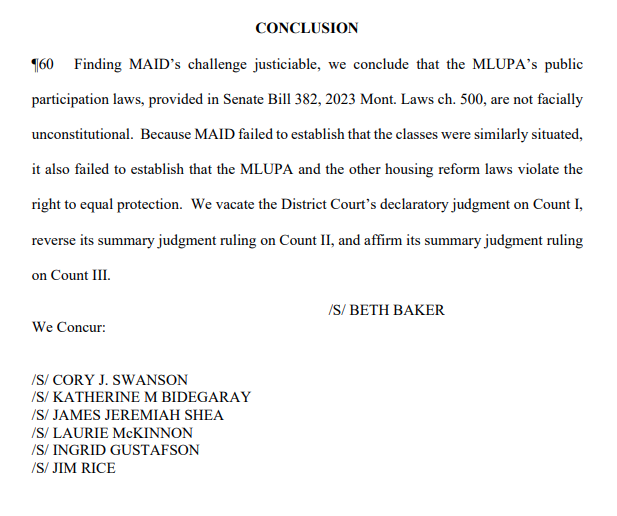
Great news! The Montana Supreme Court unanimously upholds statewide zoning reforms!
That some reforms apply only to larger cities, or potentially impact people w/ covenants less, does not violate equal protection. And frontloading public participation is not facially invalid.
BREAKING: MTSC rules unanimously in the MAID v Montana case to uphold the 2023 Montana Miracle housing reforms.
COMPLETE AND TOTAL VICTORY!
Will read the full order now. Stay tuned..
Shout out to intervenors @MontanaLeague@PacificLegal@Shelter_WF for their strong defense.
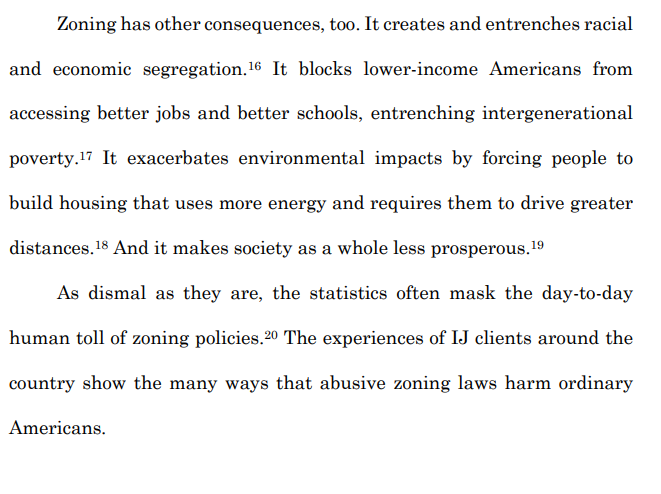
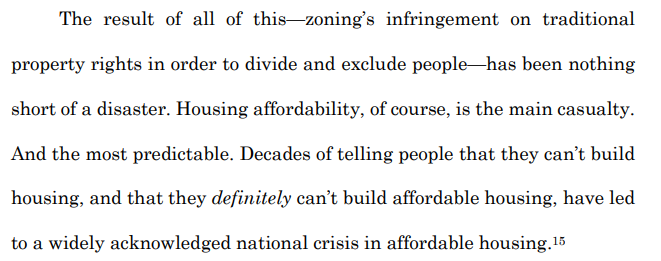
. @AriBFla & I filed an @IJ amicus brief supporting the reforms. We explain how modern zoning law completely upended the historical right to use your property for housing, that it did so largely to exclude people, and that the result has been a disaster for ordinary Americans.
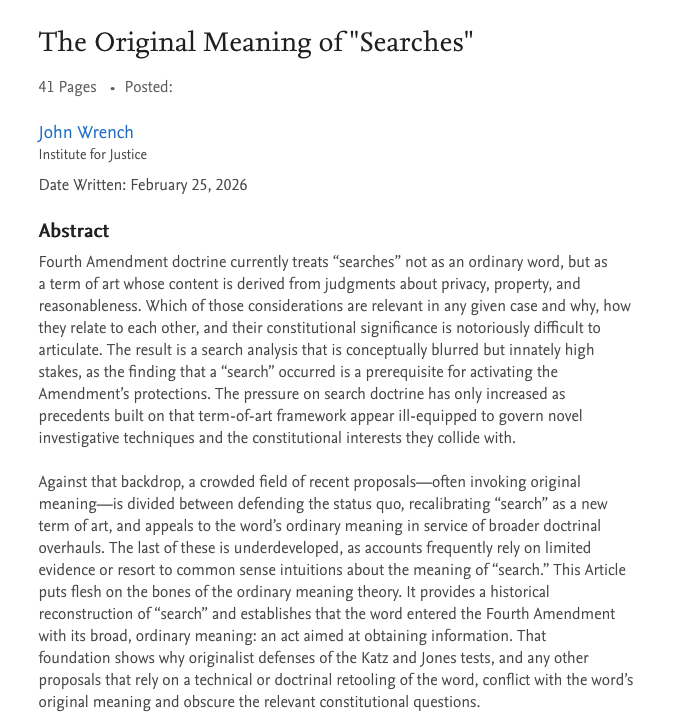
The Supreme Court will decide this term, in Chatrie v. U.S., whether executing a multi-step geofence warrant violated the Fourth Amendment. The en banc Fourth Circuit deadlocked 7-7 on what they took to be the relevant question: whether the gov't conducted a "search."
For years, courts have been confused about how to determine which government acts count as a "search" under the Amendment. More recently, the search tests that produce the confusion have been defended as historically rooted. They're not, and the historical evidence is overwhelming. A draft of my new article is up on SSRN: https://t.co/S9SgUGdHXS Comments welcome at [email protected].
@IJSanders Fascinating, but possibly a typo? It's usually referred to as "Holmes v. Walton." I do hope that's wrong, though, and that it's actually Watson.
So an easy first step toward increasing the supply of modestly sized, affordable starter homes would be for local governments to just stop unconstitutionally banning modestly sized, affordable starter homes.
The Washington Post reports that smaller, more affordable starter homes are increasingly rare. Causes include government regs (eg, requiring large lots), market dynamics, etc. I'll add one more: Many localities directly *ban* smaller starter homes. https://t.co/g6t4eCfZn0
These bans aren't just wrong & counterproductive, they're unconstitutional. The flimsy pretexts behind many zoning restrictions (eg, traffic) don't apply to smaller homes. It's just a bare desire to exclude people who can't afford larger homes. That's not a legit govt interest.