Christian brothers and sisters, stop tolerating wicked speech and behavior from your favorite influencer.
"But we NEED him to help us WIN"
This is worldly thinking.
"Do not be misled. Bad company corrupts good character." - 1 Cor. 15:33
@JeremyDBoreing I'm not even really concerned about what happened re: USS Liberty but rather you should be asking why Thomas Massie was in Congress for 14 years and only decided to do this little stunt now. That's the question worth asking
@wolfsangel23@not_our_guy I was being sarcastic smart guy. Nobody that follows Webbon is going to unfollow him because of his views on traditional marriage. Be serious
The Bible commands Christians to expose the unfruitful works of darkness (Ephesians 5:11), so let's do some exposing.
What Michael Spangler is promoting is not Christianity, it is an attempt to baptize racial partiality with long-discredited proof-texting.
Spangler begins with Acts 17:26, arguing that because God established the boundaries of nations, Christians should embrace racial particularism and organize churches around modern racial constructs. Of course, natural providence is not morally binding, particularly in a fallen world. And of course, Acts 17 teaches the opposite of what he claims.
Paul's point is that God made all nations from one man and ordered history so that mankind would seek Him (Acts 17:26-27). The emphasis is the unity of the human race under God's sovereignty, not the separation of believers according to bloodlines.
Likewise, Spangler appeals to Noah, Shem, Ham, and Japheth as though Genesis establishes permanent, morally-binding racial destinies and obligations. Yet the New Testament never treats Genesis 9-10 that way. Instead, the gospel moves relentlessly toward the gathering of the nations into one people of God (Matthew 28:19; Acts 2; Revelation 7:9). The descendants of Noah are not the organizing principle of the church, Christ is.
Spangler then invokes the Fifth Commandment, claiming that honoring father and mother creates obligations to one's race. But again, Scripture never makes that connection.
The Fifth Commandment concerns honoring actual parents and lawful authority (Exodus 20:12; Ephesians 6:1-3). It does not create a category of racial loyalty or racial preservation. That idea has been imported into the text, not drawn from it.
He also appeals to "natural affection," arguing that Christians owe special duties to their own people because of blood ties. Certainly Scripture recognizes special obligations to family (1 Timothy 5:8). But the New Testament repeatedly teaches that spiritual kinship in Christ transcends ethnic and biological distinctions (this would apply particularly to a gathered church). Jesus Himself declared that those who do the will of God are His true family (Mark 3:31-35).
Most revealing is Spangler's claim that "our white people have unique privileges according to God." Scripture doesn't teach this. Rather, Paul spent much of his ministry dismantling claims of ethnic privilege. Even the Jews, who actually possessed covenant privileges under the Old Covenant (Romans 9:4-5), were told that those distinctions no longer determined standing in the people of God (Galatians 3:28; Ephesians 2:11-22).
The very privilege Spangler claims for whites is a privilege Paul denied to Jews.
Finally, Spangler argues for maintaining a church "for our own people." But one of the great themes of the New Testament is that Christ has broken down the dividing wall between peoples (Ephesians 2:14-16). The church is a body composed of believers from every tribe, tongue, people, and nation (Revelation 5:9), united not by modern concepts of race but by union with Christ.
The fundamental problem with Spangler's argument is that it elevates modern racial framework into a category Scripture never does. Race becomes a matter of covenant obligation, Christian duty, church organization, and divine privilege. The apostles never taught this. Instead, they taught that in Christ, believers become "one new man" (Ephesians 2:15), fellow citizens in God's household (Ephesians 2:19), and members of one body through one Spirit (1 Corinthians 12:13).
Spangler is replacing the centrality of Christ with the centrality of ancestry. Scripture has a name for showing favoritism based on external distinctions: Partiality. And Christians are explicitly forbidden from it (James 2:1-9).
One of my biggest concerns about this movement is that it’s breeding distrust of leadership amongst young men. It emboldens them to think they know better than their elders.
I saw this happen at my parents church where a young man removed his family from the congregation because the elders raised concerns with how he was leading/treating his wife and infant. He even told my mom that an illness she was suffering from was a punishment from God for her and my dad (an elder-in-training) overstepping by raising their concerns to him.
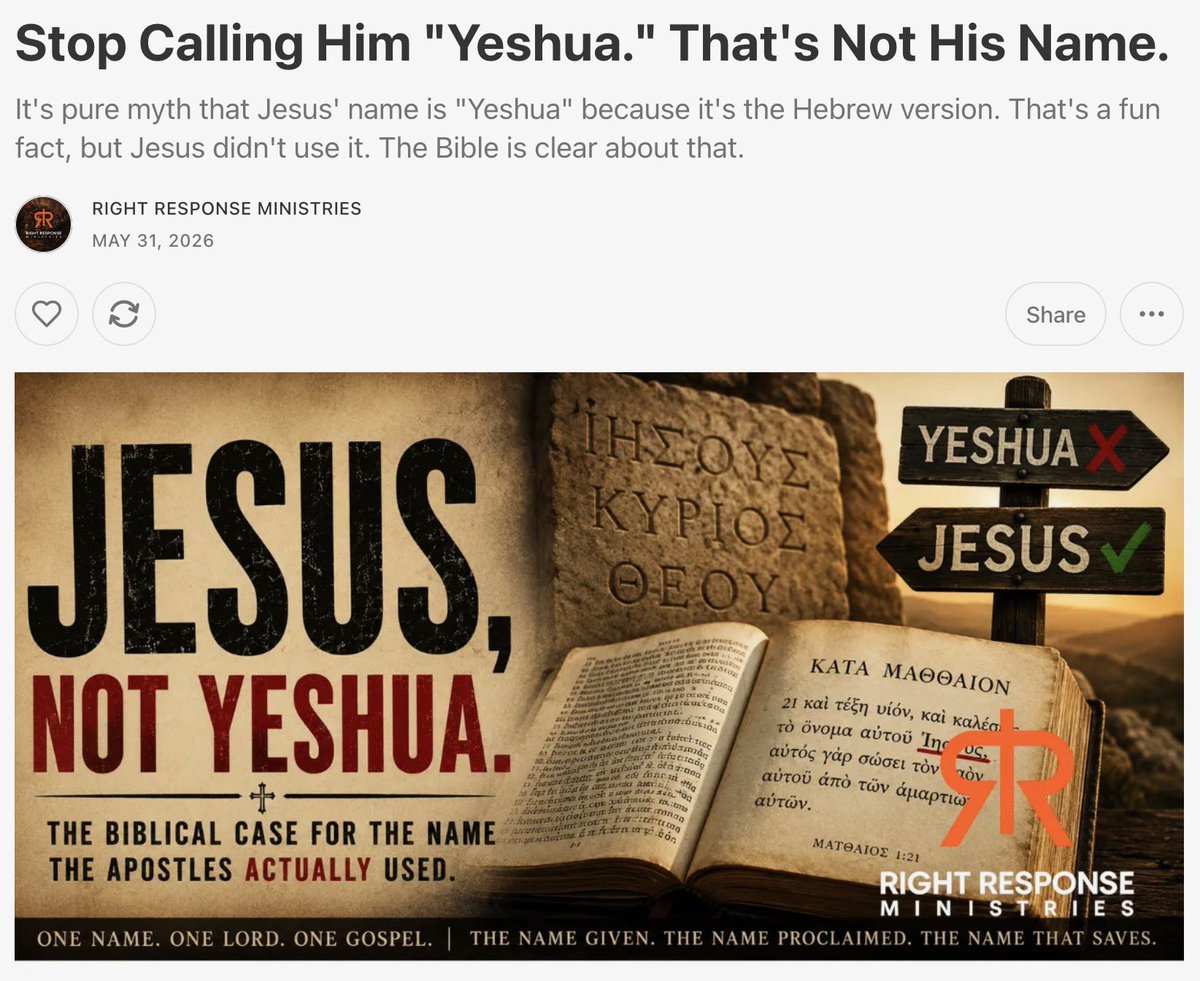
Stop Calling Him “Yeshua.”
That’s Not His Name.
“The irony is almost painful. The same people who insist on calling Jesus "Yeshua" because they want to be more authentic than ordinary Christians rarely stop to consider that the Apostles themselves lived, preached, wrote, and quoted Scripture in Greek. The New Testament is Greek. The churches were Greek-speaking. The Septuagint was the Bible of the early Church. Even the Jewish men walking beside Christ bore Greek names without embarrassment. Yet two thousand years later, a man with a shofar in the garage and a Hebrew Roots podcast subscription becomes convinced that he has uncovered a level of authenticity unavailable to Peter, Paul, Luke, John, and the congregations they planted. At some point, trying to be more Hebrew than the Apostles stops being reverence and starts becoming a theological hobby.
What makes the Matthew argument so difficult to escape is that Matthew repeatedly shows his work whenever preserving an original-language phrase actually matters. He gives his readers Raca. He gives them Mammon. He gives them Eli, Eli, lama sabachthani. In each case, the original words remain in the text precisely because Matthew wants the reader to know those specific words were spoken. Yet when the angel announces the name of the Messiah, Matthew suddenly abandons this practice entirely and gives us Ἰησοῦς without qualification, explanation, or linguistic footnote. The simplest explanation is usually the correct one. Matthew preserved original-language expressions when he believed preserving them mattered. He did not do so with the name of Jesus because, for Matthew and the Church that received his Gospel, Ἰησοῦς was not standing in for the real name. It was the real name.”