Fertility
Rock bottom wasn't the end of my story, it was the soil God used to grow my roots. He sent me down and quieted the chaos. If you have ever made your bed in the grips of hell. Then you know exactly what I'm talking about. You know how it feels to be spiritually dead. That's when God set me down and then words started appearing on paper.
God was leaking truth through my pen one broken sentence at a time.
I wasn't trying to be deep. I wasn't trying to write no book. I was just trying not to get high. Trying to make it all make sense. Trying to outrun the demons that used to sing me lullabies in the needles whisper. I was trying to put all my pain on the paper so maybe I wouldn't feel it anymore. So if you see me scribbling in a notebook, know I'm not just journaling. I'm surviving. I'm surrendering. I'm letting the most high speak through an old dope fiend that he refused to give up on. I made peace with the pain. So can you. Yo there is a way out let me show you.
Jeremiah 1:9 (NIV)
"Then the Lord reached out his hand and touched my mouth and said to me, 'I have put my words in your mouth.'"
This verse captures the raw and sacred moment where God uses someone flawed, hesitant, or broken to speak His truth just like my pen pouring out His message one cracked line at a time.
God
Thank you for never giving up on me
Amen
Faith
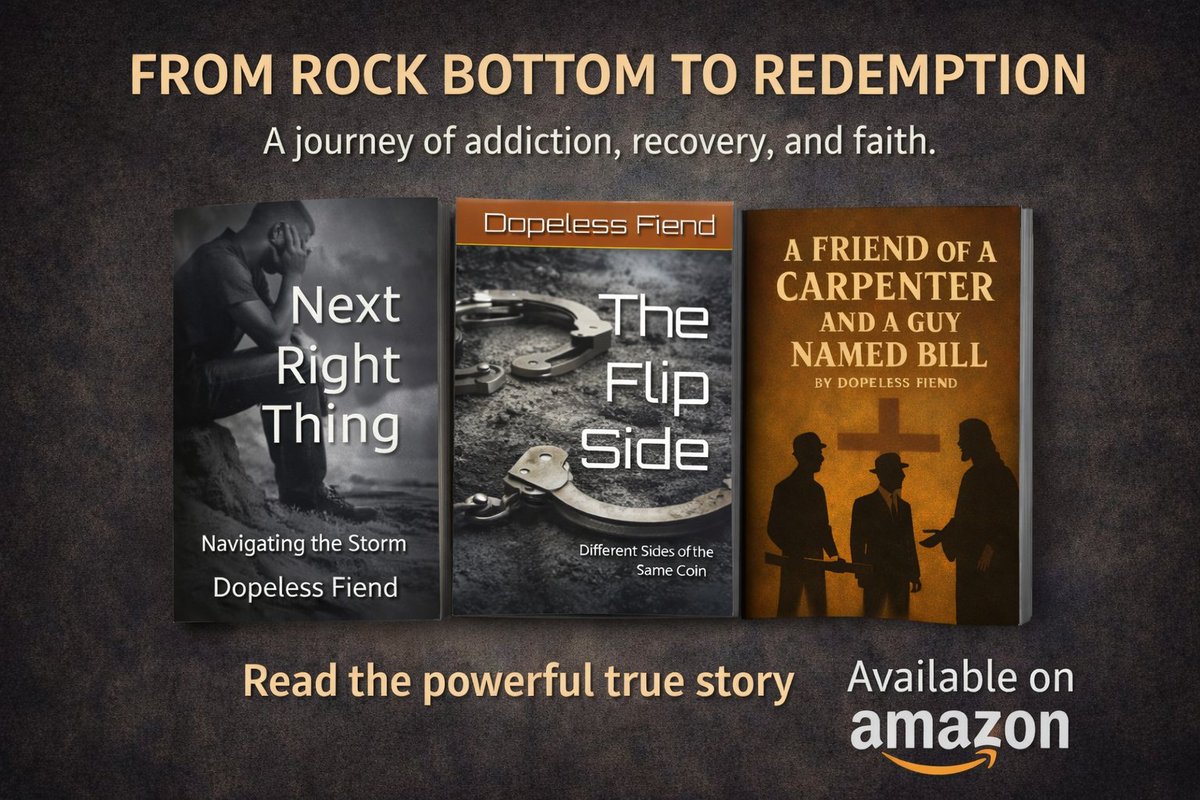
By Dopeless Fiend my books are on Amazon
When Belief and Doubt Ride in the Same Car
You ever try to believe, but your past keeps backseat driving? You want to trust God, but that little voice keeps saying, “But what if He don’t show up this time
Some days, my faith talks loud. Other days, my doubt shouts louder. And if you’ve ever been there, you’re not alone. I’ve been there. I’ve lived there. Doubt Ain’t the Opposite of Faith It’s the Tension Inside It
Faith ain't about never questioning, it's about choosing to stay when the questions don't have quick answers.Think about that father in Mark 9 his kid was suffering, and he still had just enough left to say:“I believe… help my unbelief.” That’s real. That’s recovery. That’s life in the trenches. When Doubt Overrides Faith You been there:
Prayed but didn’t feel anything. Trusted… but lost another job, another friend, another piece of hope. Said you surrendered but took it back the next day.
There were nights I prayed with tears in my throat, begging for deliverance, and silence answered back. And I thought maybe he wasn't listening. Maybe He’s tired of me.’”
But here's the truth: Your doubt didn’t disqualify you.
God didn't bail when your faith went flat. He stayed. He waited. He loved anyway. God's Mercy Is Louder Than My Doubt He knew I didn’t trust Him fully. He knew I was still cussing one minute and crying out “God help me” the next and he still showed up. Not because I believed perfectly but because He’s faithful even when I’m not
.“If we are faithless, He remains faithful, for He cannot deny Himself.” 2 Timothy 2:13
Don’t Wait for Perfect Faith Move With What You Got
All you need is a mustard seed. Not a mountain.
Sometimes it’s just a whisper: “God, help.”
And he answers that. God ain’t asking for a clean suit and polished theology. He wants the truth:
God, I’m trying but I’m scared. I want to believe but I’m tired. That’s enough. That’s worship. If your faith feels fragile, you’re not broken, you're honest and that’s where God does his best work Because faith isn’t the absence of doubt it’s choosing God anyway
Sometimes the greatest evidence of spiritual life is the struggle.
Real Recognizes Real
The steps taught me how to stop playing god. Show up like Christ did he came to serve. I don't need to impress anyone, I just need to be real.
I tell them what happened to me. I don't sell recovery. I share it. I let the pain do the preaching and the grace do the healing.
I ain't here to sugarcoat nothing. That means sitting up and showing up even when I don't feel like it. That means spiritual fitness on the inside where nobody sees but God.
If a person doesn't want to stop drinking, don't waste time on it. This ain't about ego it's not about me saving anyone. I'm not the solution God is. My job is to plant the seeds, not play savior. I let God handle the miracle. I just show up and testify that the solution is real and it works.
🔥 1 Samuel 16:7 (NIV)
“The Lord does not look at the things people look at. People look at the outward appearance, but the Lord looks at the heart.”
God sees what’s real and when you’ve been through it, you can see it too.
God
Show me what is real and what is fake.
Amen
Real Recognizes Real
The steps taught me how to stop playing god. Show up like Christ did he came to serve. I don't need to impress anyone, I just need to be real.
I tell them what happened to me. I don't sell recovery. I share it. I let the pain do the preaching and the grace do the healing.
I ain't here to sugarcoat nothing. That means sitting up and showing up even when I don't feel like it. That means spiritual fitness on the inside where nobody sees but God.
If a person doesn't want to stop drinking, don't waste time on it. This ain't about ego it's not about me saving anyone. I'm not the solution God is. My job is to plant the seeds, not play savior. I let God handle the miracle. I just show up and testify that the solution is real and it works.
🔥 1 Samuel 16:7 (NIV)
“The Lord does not look at the things people look at. People look at the outward appearance, but the Lord looks at the heart.”
God sees what’s real and when you’ve been through it, you can see it too.
God
Show me what is real and what is fake.
Amen
Wrong Turn
By Dopeless fiend my books are on Amazon
Compromises were made that let me down a road of false hope. Every time I said just this once, I'm not that bad, or my favorite do the drugs don't let the drugs do you. I was trading truth for comfort momentary relief that cost me long-term peace. Each compromise chipped away at my principles until I no longer recognized the man in the mirror. I wasn't choosing freedom, I willingly ran back to the plantation of addiction. Then put the chains back on like I had a key.
False hope isn't always a lie someone tells us. Sometimes it's hard truths that we stop telling ourselves. So we can justify our bad behaviors. We fall back on emotional thinking like it's our long lost friend.
Then the high fades and we are left holding the bill to decisions we thought were small but stacked up into a mountain of regret.
There is a way that seems right to a man but its end is the way to death. Proverbs 14:12
That verse hit me like a brick. Because the road didn't look like destruction when I started down it. It looked like relief. But it was a trap wrapped in ignorance and good intentions.
The road to hell is paved with bricks of good intentions laid there by even better people.
Isaiah 30:21 (NIV)
"Whether you turn to the right or to the left, your ears will hear a voice behind you, saying, ‘This is the way; walk in it.’”
The road to hell is paved with bricks of good intentions laid there by even better people.
God
Please take the wheel so I may find my path to you.
Amen
Rock bottom is strange like that.
I came into this world naked, and I’ll leave the same way.
Rock bottom is a kind of rebirth — but you don’t notice it in the moment.
In the moment it just sucks.
And sometimes the suck keeps coming.
Even later — when you can see the blessing, when your relationship with God grows, or maybe begins for the first time — you realize rock bottom made that possible.
Loss becomes part of your identity.
Things leave. People leave. Versions of you leave.
And it feels like losing is what we’re meant to do.
But life happens like a mountain.
You climb. You see the top.
Then the snowstorm hits and you have to turn back.
Not because you quit — because you can’t control the weather.
People who get used to losing stop climbing.
Or they run to a different mountain and forget the first one.
But the people who grow — the people who win — come back to that same mountain.
The storm might delay them.
But it doesn’t defeat them.
For a long time, other people’s actions and life situations didn’t delay me — they defeated me.
That’s how I came into recovery. Defeated.
But recovery is progress.
Which means I have to stop calling delays defeat.
The suck still comes.
It always will.
But on the other side of the suck…
there is something beautiful.
Rock bottom is strange like that.
I came into this world naked, and I’ll leave the same way.
Rock bottom is a kind of rebirth — but you don’t notice it in the moment.
In the moment it just sucks.
And sometimes the suck keeps coming.
Even later — when you can see the blessing, when your relationship with God grows, or maybe begins for the first time — you realize rock bottom made that possible.
Loss becomes part of your identity.
Things leave. People leave. Versions of you leave.
And it feels like losing is what we’re meant to do.
But life happens like a mountain.
You climb. You see the top.
Then the snowstorm hits and you have to turn back.
Not because you quit — because you can’t control the weather.
People who get used to losing stop climbing.
Or they run to a different mountain and forget the first one.
But the people who grow — the people who win — come back to that same mountain.
The storm might delay them.
But it doesn’t defeat them.
For a long time, other people’s actions and life situations didn’t delay me — they defeated me.
That’s how I came into recovery. Defeated.
But recovery is progress.
Which means I have to stop calling delays defeat.
The suck still comes.
It always will.
But on the other side of the suck…
there is something beautiful.
All Things Honesty is Key
My First Guide: Mr. Miyagi
The Mr. Miyagi Effect
Before I was ready for Obi-Wan Kenobi—who is my sponsor now—I had another guide. I called him Mr. Miyagi. And yes, I’m a little overdramatic with the nicknames I give people. If you can’t tell by now, that’s just part of the package. Recovery didn’t fix that. I called him Mr. Miyagi because everything he had me do felt like fundamentals. No deep spiritual conversations. No big God talk. Just practical, uncomfortable, everyday stuff I didn’t understand at the time but absolutely needed.
Back then, I wasn’t ready for Obi-Wan Kenobi. He’s more spiritual, more focused on the mission and God’s work. The truth is, for the first year of my recovery, a good way to get me to cuss you out was to bring up God. I didn’t want to hear it. I wasn’t angry—I was broken, skeptical, and exhausted. I just wanted to survive the day. Mr. Miyagi knew that.
Instead of pushing God on me, he gave me something else to do. He told me to talk out loud in the mornings—to whoever I wanted. Say what I was struggling with. Say what scared me. Say where I felt weak. Say what I needed help with. No polish. No performance. Then at night, he told me to do it again. Out loud. Go over the day. What I accomplished. What I could’ve done better. Where my ego showed up. Where fear ran the show. I didn’t know it then, but that was the beginning of prayer. I didn’t believe in God—but God believed in me.
That’s the Mr. Miyagi effect. Like The Karate Kid—wax on, wax off. Paint the fence. It all feels pointless until one day you realize you’ve been learning discipline, humility, and form the entire time. Those kinds of lessons don’t come until you’re broken enough to become willing. Willing to do what’s suggested. Willing to go to any length. Willing to receive help instead of asking for it and then rejecting it because it doesn’t come wrapped the way you want.
God sent a 19-year-old kid to save my life—without either of us knowing it. Back in 2016, I was in a long-term treatment center, still running on pride and ego. My sponsor walked into my room and said, “Man, you got a lot of nice clothes. What’s your favorite hoodie?” Without thinking, I pointed to my brand-new Nike hoodie, still with the tag on it. He asked, “Do you want to get sober?” I said, “Of course.” He said, “Then donate it to the clothing closet.”
Now listen—I wasn’t the giving type. I wasn’t capable of a selfless act. If he had told me who it was going to, I would’ve turned it into a performance. Wanted credit. Wanted praise. Wanted leverage. That’s how I operated. But he didn’t tell me. He just told me to let it go. After some colorful language and a bruised ego, I did.
Weeks later, a quiet 19-year-old kid showed up to group wearing my hoodie. He always sat near me and my boys, and I swore he was flexing on me. I thought he knew exactly what he was doing, so I told my friends not to talk to him. Because back then, Josh was the center of the damn universe. Eventually his silence wore me down. One day I said, “Hey man, you can speak to us, you know.” He said, “I’m just shy… but I really want what y’all got.”
I said, “Nice hoodie.” He smiled and said, “Thanks, man. Can you believe it came from the clothing closet? Still had the tag on it. I’ve never owned a Nike hoodie before. Grew up in foster care—all I ever had were hand-me-downs.” I broke. I went into the bathroom and cried like a baby.
Because God and my sponsor had set the whole thing up. Not to embarrass me. Not to punish me. But to teach me what real giving looks like. That kid didn’t know the story. Didn’t know it used to be mine. Didn’t know God was using him as a mirror. He got a hoodie. I got a new heart. He got something he never had. I lost something I never needed. And in that loss, I gained everything.
That’s the Mr. Miyagi effect—fundamentals before faith, obedience before understanding, willingness before belief. Somewhere along the way, without me even realizing it
No One Owns Recovery
Let’s clear the air before we start arguing over who’s doing it “right.”
No one owns recovery.
Not a program.
Not a denomination.
Not a book.
Not a meeting.
Recovery isn’t property—it’s progress.
Scripture says, “By their fruit you will recognize them” (Matthew 7:16).
Not by their vocabulary.
Not by their preferred method.
Not by how well they quote page numbers or verses.
Fruit. Change. Movement. Evidence.
If something in you is shifting—if you’re walking toward light instead of hiding in the dark—then recovery is happening. Period.
We’ve gotten real good at defending methods while ignoring outcomes. We’ll argue theology while people relapse. We’ll split over language while lives are splitting apart. Somewhere along the way, we started treating the tool like the Savior.
Some people need the Big Book.
Some people need the 12 Steps.
Some people need the Bible.
And some folks need all three just to make it through the day without blowing their life up.
But let’s keep this straight: none of those things are God.
They point to Him.
“Trust in the Lord with all your heart and lean not on your own understanding” (Proverbs 3:5).
That includes leaning too hard on your preferred system.
The Big Book didn’t save me.
The Steps didn’t save me.
Church didn’t save me.
God did.
Those things helped remove the junk that was blocking Him.
When we start acting like our way is the only way, we stop being servants and start being gatekeepers. And Jesus had some sharp words for people who loved gates more than people.
“Woe to you, teachers of the law… You shut the door of the kingdom of heaven in people’s faces” (Matthew 23:13).
If what you’re doing is working—if you’re staying sober, becoming honest, making amends, learning how to love people and tell the truth—then don’t let anyone shame you out of that progress. God doesn’t tear down what He’s rebuilding.
“Being confident of this, that He who began a good work in you will carry it on to completion” (Philippians 1:6).
Recovery isn’t about looking holy. It’s about being healed. And healing is rarely clean.
“Create in me a clean heart, O God, and renew a right spirit within me” (Psalm 51:10).
David didn’t pray that because he had it all together—he prayed it because he didn’t.
Here’s a pastoral truth that needs to be said louder: growth requires permission to evolve.
What saved my life early on isn’t necessarily what sustains me today. That doesn’t mean it was wrong—it means God wasn’t finished.
“When I was a child, I talked like a child… when I became a man, I put the ways of childhood behind me” (1 Corinthians 13:11).
I hope what I believe today isn’t exactly what I believe a year from now. I hope my answers deepen. I hope my certainty softens into wisdom. I hope I stay teachable.
Because “now we see through a glass, darkly” (1 Corinthians 13:12).
Anyone who thinks they’ve got it all figured out probably stopped listening.
A truth that carried you through one season doesn’t become a lie just because God adds to it later. Both can be right.
Recovery isn’t arrival—it’s obedience.
“Do not merely listen to the word, and so deceive yourselves. Do what it says” (James 1:22).
Sometimes that looks like a meeting.
Sometimes it looks like prayer.
Sometimes it looks like confession.
Sometimes it looks like shutting your mouth and taking the next right step.
So let me pastor this home:
If you’re making progress, you’re in recovery.
If you’re surrendering instead of controlling, you’re in recovery.
If you’re closer to God than you were—however imperfect—you’re in recovery.
“The Lord is close to the brokenhearted and saves those who are crushed in spirit” (Psalm 34:18).
God is not grading your process.
He’s watching your posture.
“Humble yourselves before the Lord, and He will lift you up” (James 4:10).
No one owns recovery.
God gives it.
Progress proves it.
And as long as you’re willing to keep walking—
you’re exactly where grace can meet you.
No One Owns Recovery
Let’s clear the air before we start arguing over who’s doing it “right.”
No one owns recovery.
Not a program.
Not a denomination.
Not a book.
Not a meeting.
Recovery isn’t property—it’s progress.
Scripture says, “By their fruit you will recognize them” (Matthew 7:16).
Not by their vocabulary.
Not by their preferred method.
Not by how well they quote page numbers or verses.
Fruit. Change. Movement. Evidence.
If something in you is shifting—if you’re walking toward light instead of hiding in the dark—then recovery is happening. Period.
We’ve gotten real good at defending methods while ignoring outcomes. We’ll argue theology while people relapse. We’ll split over language while lives are splitting apart. Somewhere along the way, we started treating the tool like the Savior.
Some people need the Big Book.
Some people need the 12 Steps.
Some people need the Bible.
And some folks need all three just to make it through the day without blowing their life up.
But let’s keep this straight: none of those things are God.
They point to Him.
“Trust in the Lord with all your heart and lean not on your own understanding” (Proverbs 3:5).
That includes leaning too hard on your preferred system.
The Big Book didn’t save me.
The Steps didn’t save me.
Church didn’t save me.
God did.
Those things helped remove the junk that was blocking Him.
When we start acting like our way is the only way, we stop being servants and start being gatekeepers. And Jesus had some sharp words for people who loved gates more than people.
“Woe to you, teachers of the law… You shut the door of the kingdom of heaven in people’s faces” (Matthew 23:13).
If what you’re doing is working—if you’re staying sober, becoming honest, making amends, learning how to love people and tell the truth—then don’t let anyone shame you out of that progress. God doesn’t tear down what He’s rebuilding.
“Being confident of this, that He who began a good work in you will carry it on to completion” (Philippians 1:6).
Recovery isn’t about looking holy. It’s about being healed. And healing is rarely clean.
“Create in me a clean heart, O God, and renew a right spirit within me” (Psalm 51:10).
David didn’t pray that because he had it all together—he prayed it because he didn’t.
Here’s a pastoral truth that needs to be said louder: growth requires permission to evolve.
What saved my life early on isn’t necessarily what sustains me today. That doesn’t mean it was wrong—it means God wasn’t finished.
“When I was a child, I talked like a child… when I became a man, I put the ways of childhood behind me” (1 Corinthians 13:11).
I hope what I believe today isn’t exactly what I believe a year from now. I hope my answers deepen. I hope my certainty softens into wisdom. I hope I stay teachable.
Because “now we see through a glass, darkly” (1 Corinthians 13:12).
Anyone who thinks they’ve got it all figured out probably stopped listening.
A truth that carried you through one season doesn’t become a lie just because God adds to it later. Both can be right.
Recovery isn’t arrival—it’s obedience.
“Do not merely listen to the word, and so deceive yourselves. Do what it says” (James 1:22).
Sometimes that looks like a meeting.
Sometimes it looks like prayer.
Sometimes it looks like confession.
Sometimes it looks like shutting your mouth and taking the next right step.
So let me pastor this home:
If you’re making progress, you’re in recovery.
If you’re surrendering instead of controlling, you’re in recovery.
If you’re closer to God than you were—however imperfect—you’re in recovery.
“The Lord is close to the brokenhearted and saves those who are crushed in spirit” (Psalm 34:18).
God is not grading your process.
He’s watching your posture.
“Humble yourselves before the Lord, and He will lift you up” (James 4:10).
No one owns recovery.
God gives it.
Progress proves it.
And as long as you’re willing to keep walking—
you’re exactly where grace can meet you.
No One Owns Recovery
Let’s clear the air before we start arguing over who’s doing it “right.”
No one owns recovery.
Not a program.
Not a denomination.
Not a book.
Not a meeting.
Recovery isn’t property—it’s progress.
Scripture says, “By their fruit you will recognize them” (Matthew 7:16).
Not by their vocabulary.
Not by their preferred method.
Not by how well they quote page numbers or verses.
Fruit. Change. Movement. Evidence.
If something in you is shifting—if you’re walking toward light instead of hiding in the dark—then recovery is happening. Period.
We’ve gotten real good at defending methods while ignoring outcomes. We’ll argue theology while people relapse. We’ll split over language while lives are splitting apart. Somewhere along the way, we started treating the tool like the Savior.
Some people need the Big Book.
Some people need the 12 Steps.
Some people need the Bible.
And some folks need all three just to make it through the day without blowing their life up.
But let’s keep this straight: none of those things are God.
They point to Him.
“Trust in the Lord with all your heart and lean not on your own understanding” (Proverbs 3:5).
That includes leaning too hard on your preferred system.
The Big Book didn’t save me.
The Steps didn’t save me.
Church didn’t save me.
God did.
Those things helped remove the junk that was blocking Him.
When we start acting like our way is the only way, we stop being servants and start being gatekeepers. And Jesus had some sharp words for people who loved gates more than people.
“Woe to you, teachers of the law… You shut the door of the kingdom of heaven in people’s faces” (Matthew 23:13).
If what you’re doing is working—if you’re staying sober, becoming honest, making amends, learning how to love people and tell the truth—then don’t let anyone shame you out of that progress. God doesn’t tear down what He’s rebuilding.
“Being confident of this, that He who began a good work in you will carry it on to completion” (Philippians 1:6).
Recovery isn’t about looking holy. It’s about being healed. And healing is rarely clean.
“Create in me a clean heart, O God, and renew a right spirit within me” (Psalm 51:10).
David didn’t pray that because he had it all together—he prayed it because he didn’t.
Here’s a pastoral truth that needs to be said louder: growth requires permission to evolve.
What saved my life early on isn’t necessarily what sustains me today. That doesn’t mean it was wrong—it means God wasn’t finished.
“When I was a child, I talked like a child… when I became a man, I put the ways of childhood behind me” (1 Corinthians 13:11).
I hope what I believe today isn’t exactly what I believe a year from now. I hope my answers deepen. I hope my certainty softens into wisdom. I hope I stay teachable.
Because “now we see through a glass, darkly” (1 Corinthians 13:12).
Anyone who thinks they’ve got it all figured out probably stopped listening.
A truth that carried you through one season doesn’t become a lie just because God adds to it later. Both can be right.
Recovery isn’t arrival—it’s obedience.
“Do not merely listen to the word, and so deceive yourselves. Do what it says” (James 1:22).
Sometimes that looks like a meeting.
Sometimes it looks like prayer.
Sometimes it looks like confession.
Sometimes it looks like shutting your mouth and taking the next right step.
So let me pastor this home:
If you’re making progress, you’re in recovery.
If you’re surrendering instead of controlling, you’re in recovery.
If you’re closer to God than you were—however imperfect—you’re in recovery.
“The Lord is close to the brokenhearted and saves those who are crushed in spirit” (Psalm 34:18).
God is not grading your process.
He’s watching your posture.
“Humble yourselves before the Lord, and He will lift you up” (James 4:10).
No one owns recovery.
God gives it.
Progress proves it.
And as long as you’re willing to keep walking—
you’re exactly where grace can meet you.
Dopeless Fiend strikes again
Every lesson in this book, every writing, came out of a real conversation with somebody else.
Because the truth is, the opposite of addiction isn’t just sobriety, it's connection.
That’s where healing begins.
Every time two broken people sit down and talk honestly, something sacred happens.
That’s where light slips through the cracks.
See, the addict or the drunk has to accept that they can’t drink or drug successfully.
But just as important, we as a society need to accept something too
We lost the war on drugs.
To keep going the way we are is straight insanity.
To keep locking people up, pushing them out, and disconnecting folks who already feel disconnected,
then expecting to win that’s delusional.
Once a person gets caught in the system, it’s almost impossible to get out.
It becomes part of who they are.
Part of their identity.
We’ve built a cycle that traps people instead of freeing them.
To continue doing what we’ve always done isn’t the way.
We have to stop and ask ourselves one honest question:
Are we helping, or are we harming?
If these pages do anything, I hope they help somebody look at recovery, faith, and humanity a little different.
Because if we’re ever gonna win this fight, it won’t be through punishment
it’ll be through connection, compassion, and truth.
Welcome to A Friend of Yeshua and a Guy Named Bill.
Let’s walk this thing out together raw, real, and unfiltered.
The James Club
Before there was a book. Before there were Steps hanging on walls. Before anybody tried to make God safe enough to manage. There were men who were dying. Bill Wilson and Dr. Bob didn’t start with a program. They started with Scripture and desperation.
For a short time in Akron, Ohio, before Alcoholics Anonymous even had a name, their early group picked up an informal nickname. They called it the James Club¹. Not officially. Not as an organization. Not as a doctrine. It was an informal name people used because of what they were actually doing in those meetings. They read the Book of James². They read 1 Corinthians, especially chapter 13³. They lived in the Sermon on the Mount⁴.
These passages weren’t inspirational readings. They were instructions. “Faith without works is dead” — James 2:17. That verse didn’t motivate them. It confronted them. You couldn’t just believe and keep drinking. You couldn’t pray and refuse to change. If your faith didn’t move your feet, you were still dead—just temporarily sober.
Step Two and Step Three Before Numbers
That’s Step Two and Step Three before they were ever numbered:
Came to believe that a Power greater than ourselves could restore us to sanity
Made a decision to turn our will and our lives over to the care of God
James didn’t say understand God. James said submit. “Submit yourselves therefore to God” — James 4:7. Submission isn’t a feeling. It’s a decision followed by action.
Then came confession. “Therefore confess your sins to one another…” — James 5:16. That’s Step Five, raw and unavoidable. Secrets didn’t protect sobriety—they buried it. James pushed harder: “Whoever knows the right thing to do and fails to do it, for him it is sin” — James 4:17. That’s Steps Six and Seven in plain language. Not awareness. Not insight. Change.
Then came restitution. “Religion that God our Father accepts as pure and faultless is this…” — James 1:27. That’s Steps Eight and Nine. Faith that didn’t repair damage wasn’t faith at all. Humility followed. “God opposes the proud but gives grace to the humble” — James 4:6. That’s Step Ten. Pride gets us drunk. Humility keeps us sober.
Prayer was never optional. “If any of you lacks wisdom, let him ask God…” — James 1:5. That’s Step Eleven. Not to feel spiritual—but to know what to do next. And finally, the thing that kept them alive: “What good is it… if someone says he has faith but does not have works?” — James 2:14. That’s Step Twelve. Faith that stays seated doesn’t save anyone.
Now here’s where history gets uncomfortable. In the beginning, there was no “God of my understanding.” There was a God who demanded action⁵. That phrase came later not because God needed clarification, but because people did⁶.
It reminds me of the zoo. You walk in and see signs everywhere: Do not feed the animals. The animals didn’t put those signs up. God didn’t put those signs up. People did. Why? Because people kept doing dumb things. They kept getting hurt. They needed a boundary. “God of my understanding” was a sign like that a human accommodation, not a divine revision. Bill Wilson put it there so men wouldn’t walk away before they ever surrendered. It was meant to keep the doors open, not to replace obedience.
Your God still had to be:
Greater than you
Able to restore sanity
Strong enough to change behavior
Otherwise, it wasn’t God. It was just self with spiritual language.
Trust God, Clean House, Help Others
Dr. Bob never softened this: *“Trust God. Clean house. Help others.”*⁷ That’s James. That’s 1 Corinthians 13 lived out. That’s the Sermon on the Mount in action. That’s the foundation the Steps were built on.
Before AA had a name, before the Steps were printed, before comfort became the goal, men stayed sober by obeying Scripture and taking action. Call it the James Club an informal nickname from Akron. Call it early AA. Call it whatever you want. Just don’t call it optional. Faith that doesn’t work doesn’t save lives.
Have Arrived
How many times have we been in a meeting and heard someone say, “I have arrived”?
That’s a universal feeling among us addicts. But why is that?
It’s because we’re wired differently. We’re genetically predisposed. We don’t get the same steady drip of those rewarding chemicals,dopamine, serotonin the way normal people do. We walk through life feeling irritable, restless, and discontent long before we ever pick up a drink or a drug.
So we chase anything that gives us that drip.
We run a mile a minute until we burn out, or we overindulge in food, sex, chaos, whatever gives us that chemical release for a moment. That “I have arrived” feeling is the rush from those reward chemicals lighting up our starving brains.
But here’s the thing: when a person who isn’t genetically wired like us takes a drink or a drug, they don’t get that same feeling. That’s why the phenomenon of craving grabs hold of us and the power of choice gets ripped away.
Our brains get hijacked.
That’s why we experience what’s called euphoric recall, that
obsession with remembering the high and forgetting the hell that followed. It’s why we have to properly arm ourselves with the facts about who we are and what we suffer from if we ever want to truly heal.
From a biblical standpoint, this runs even deeper. We may feel different from others either much worse or much better. We might look down on ourselves and constantly compare our mess to the “good people.” Or, if our addictions seem more socially acceptable, we justify them by pointing out how someone else’s is worse.
But the Word says otherwise:
> “As the Scriptures say, No one is righteous, not even one. No one is truly wise; no one is seeking God. All have turned a way; all have become useless.”
— Romans 3:10–12 (NLT)
Whether we’re chasing a high, a feeling, or a false sense of control none of us are exempt. We’re all broken in need of grace. And when we finally stop chasing that chemical “arrival” and start chasing God, that’s when real healing begins.
Step Connection – Step One:
We admitted we were powerless over our addiction and that our lives had become unmanageable.
This is that moment of truth when we realize the “I have arrived” feeling was a lie. We weren’t arriving anywhere; we were running from ourselves. Step One brings us face-to-face with the truth that we’ve been chasing false freedom while God was offering us real freedom all along.
Prayer:
God, help me stop chasing that chemical rush that always leaves me empty.
Remind me that I don’t have to “arrive” anywhere to be loved by You.
Teach me to find peace in Your presence, not in the next fix, thrill, or distraction.
When my brain starts lying to me about what I need, fill me with truth instead.
Today, I surrender the craving—and choose connection with You.
Amen.
Nike Hoodie
Words from a Dopeless Dope Fiend
God sent a 19-year-old kid to save my life without either of us knowing it.
Back in 2016, I was in a long-term treatment center, still running on pride and ego. My sponsor walked into my room and said,
“Man, you got a lot of nice clothes. What’s your favorite hoodie?”
Without thinking, I pointed to my brand-new Nike hoodie tag still on it.
He looked at me and asked, “Do you want to get sober?”
I said, “Of course.”
He said, “Then donate it to the clothing closet.”
Now listen I wasn’t the giving type. I wasn’t capable of a selfless act.
If he had told me who it was going to, I’d have made a show out of it. I’d want to be praised. I would’ve made sure everyone knew I gave it up just so I could remind them later, and maybe use it to get something back. That’s who I was. That’s how I operated.
But he didn’t tell me.
He just told me to let it go.
After some colorful language and a bruised ego, I did.
Weeks later, this quiet 19-year-old kid shows up to group, wearing my hoodie.
He always sat near me and my boys, and I swore he was doing it to flex.
I thought, This dude knows it’s mine, and he’s rubbing it in my face.
So, naturally, I told my friends not to talk to him.
Because back then, Josh was the center of the damn universe.
Self-seeking. Prideful. Always watching how things could benefit me.
But after a while, the kid wore me down with his silence.
One day I said,
“Hey man, you can speak to us, you know.”
He looked at me and said,
“I’m just shy... but I really want what y’all got.”
That hit like a bullet to the chest.
I said, “Nice hoodie.”
He said, “Thanks, man. Can you believe it came from the clothing closet? Still had the tag on it. I’ve never owned a Nike hoodie before. Grew up in foster care all I ever wore were hand-me-downs.”
I damn near broke. I went into the bathroom and cried like a baby.
That moment wrecked me.
Because God and my sponsor had set the whole thing up.
Not to embarrass me.
Not to punish me.
But to teach me what real giving looks like.
That kid didn’t know the story.
He didn’t know that hoodie used to be mine.
He didn’t know God was using him as a mirror to show me who I was and who I still had the chance to become.
He got a hoodie.
I got a new heart.
He got something he never had.
I lost something I never needed.
And in that loss I gained everything.
Scripture:
> “If you give what you have to the poor, and do not let your left hand know what your right hand is doing,
your Father, who sees what is done in secret, will reward you.”
—Matthew 6:3–4 (paraphrased)
Chaos and Miracles
Recovery does not happen in peaceful places.
It happens in wreckage. Folding chairs bent out of shape. Burnt coffee. Stale smoke. Hands shaking. Eyes lying. Souls bleeding through tough guy smiles. People praying like it is their last night on earth because sometimes it is. Anyone who has been in the rooms knows this is not therapy. This is a war zone.
The rooms of recovery sit smack dab in the middle of chaos and miracles, and both are happening at the same time.
People do not like hearing this, but it is the truth. Spiritual warfare is real, and recovery is front line combat. That is why it feels violent inside. That is why clarity scares people more than pain. That is why relapse so often comes right after a breakthrough. The enemy does not need you drunk. He just needs you undecided long enough to walk away from the miracle.
Because once someone really gets it, once the truth lands, they do not just stop using. They stop lying. They stop hiding. They stop being predictable. And that kind of freedom is dangerous to hell.
So chaos gets normalized.
It sounds harmless.
Just do not drink.
Just do not use.
Do not overthink it.
Take what you want and leave the rest.
For some people, that keeps them alive.
For people like me, it kept me half dead.
Because the real fight is not drugs versus sobriety.
It is self will versus surrender.
Chaos and Miracles
Recovery does not happen in peaceful places.
It happens in wreckage. Folding chairs bent out of shape. Burnt coffee. Stale smoke. Hands shaking. Eyes lying. Souls bleeding through tough guy smiles. People praying like it is their last night on earth because sometimes it is. Anyone who has been in the rooms knows this is not therapy. This is a war zone.
The rooms of recovery sit smack dab in the middle of chaos and miracles, and both are happening at the same time.
People do not like hearing this, but it is the truth. Spiritual warfare is real, and recovery is front line combat. That is why it feels violent inside. That is why clarity scares people more than pain. That is why relapse so often comes right after a breakthrough. The enemy does not need you drunk. He just needs you undecided long enough to walk away from the miracle.
Because once someone really gets it, once the truth lands, they do not just stop using. They stop lying. They stop hiding. They stop being predictable. And that kind of freedom is dangerous to hell.
So chaos gets normalized.
It sounds harmless.
Just do not drink.
Just do not use.
Do not overthink it.
Take what you want and leave the rest.
For some people, that keeps them alive.
For people like me, it kept me half dead.
Because the real fight is not drugs versus sobriety.
It is self will versus surrender.
KEEP YOUR WORDS, POWERFUL!!
In my first few years of sobriety I just had a few sentences that I would share in a meeting because I didn’t think I had a story as good as the people that I was around. So I mainly just use gratitude of the people that I surround myself with in the meetings and that seemed to grow as I grew in the program. It took me a while to grow and share cause I was a slow learner