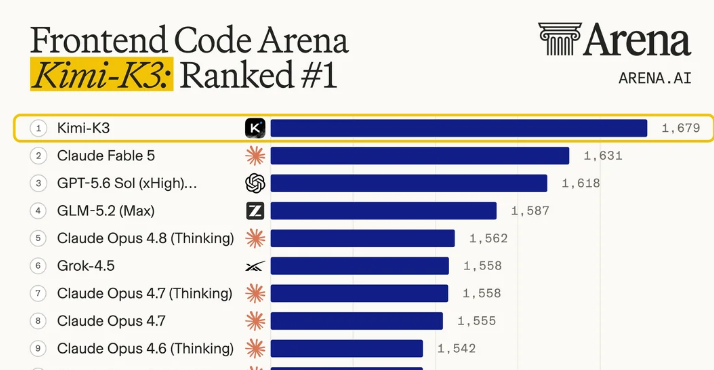
I truly don't understand how Anthropic and Open AI don't go to zero.
They spend tens of billions training models...
That are then replicated for 1/8th the price 1.5 months after. They have zero moat.
Fable was supposed to be a breakthrough, now discount China models beat it.
Announcing the hosted X MCP.
Agents now have access to the best real-time information source in the world.
Connect Grok, Cursor, or any MCP-compatible AI tool to the X API without any setup!
Check it out here: https://t.co/5MzPYwGFzD
As engineering, product, design, DS, etc. melt into a new kind of role, I was reflecting on what roles might look like in the future. For example, when I look at the Claude Code team I see what I think is five archetypes:
1. Prototyper: comes up with brand new ideas; churns out many ideas, most of which don't ship
2. Builder: quickly turns a prototype/idea into production-grade product/infra
3. Sweeper: cleans up the UI, simplifies the code and system, unships, optimizes performance
4. Grower: takes a product that has been built and iterates on it to improve Product-Market Fit
5. Maintainer: owns a mature system to make it secure, reliable, fast, and efficient as it scales
Many people span across 2 roles, and sometimes 3 roles. I also notice that these roles are not really tied to job function -- eg. across Anthropic, some designers match category 1, some 2, some 3; same for engineers, PM, DS.
A healthy team needs a mix of these, depending on the product:
- A product that is new and pre-PMF needs people that are strong at 1+2+3
- A product that is growing and has found PMF needs 2+3+4 and some 5
- A product that has strong PMF needs 3+4+5 and some 2
Maybe product roles of the future will look more like this, and less like the domain-specific roles of today?
@cursor_ai shipped /automate.
This is the agent shift I care about.
We’re moving away from normal chatbots and toward something way more useful:
Describe a task in plain language.
Have the agent configure the triggers, instructions, and tools.
Then let it build an automated, repeatable system around that.
And if you’re like me, you’ve probably thought you built something automated and repeatable before...
then it broke the second the real world touched it.
This still isn’t full end-to-end ownership.
But it’s a step in the right direction.
Introducing /automate, a skill for agents to set up automations for you.
Describe your task in plain language. Cursor configures the triggers, instructions, and tools.
Show Codex a workflow once. Reuse it as a skill.
Record & Replay lets you show Codex a recurring task, like filing an expense report or submitting a time-off request.
Codex turns that demo into an inspectable, editable skill.
You control when recording starts and stops.
@mattpocockuk That reusable component part is the important bit.
Teaching an agent once is cute.
Leaving behind a better primitive it can reuse tomorrow is where the compounding starts.
@mattpocockuk 63% token reduction is the least flashy and probably most important line.
A skill that gets summoned too often is not a skill.
It is prompt bloat with a slash command.
@HamelHusain Banking is the one place the agent should be boring.
Read-only first.
Tiny scoped actions second.
Money movement needs receipts or it does not happen.
@levelsio 945 games is where the leaderboard becomes an eval.
Top 100 shows taste.
The long tail shows where the judging system starts hallucinating confidence.
@AnthropicAI Great move. Scaling is not a model problem first.
It is a routing problem.
In my own stacks, we split requests by impact and cost.
Cheap model triages first. Premium model only on escalations.
That gives you a usable scale signal instead of just higher spend.
The part I care about in this Anthropic post is not the headline.
The useful signal is the framing.
They are tracking Claude Code as it scales around user tasks.
- Who is using it
- What those users are doing with it
- How value changes by task type
- How much domain knowledge decides session success
That's an operator question.
Not a model hype question.
For people shipping Hermes fleets or any AI-first systems, this is the gate.
If we can measure task economics and outcomes, we are building workflow.
If we cannot, we're just making autocomplete faster.
Our latest economic research introduces a framework for tracking Claude Code as it scales.
Who is using Claude Code, and what are they using it for? How is the value of tasks changing? And how much does domain expertise shape whether a session succeeds?
https://t.co/IjjwQvrESo
The viral part is “19-year-old made $200K with AI.”
The useful part is not “he can’t code.”
AI is making taste, distribution, and fast shipping the bottleneck.
AI lowers the coding tax.
It does not remove the builder tax.
https://t.co/pIZPtAAWFX
I met a 19 year old who makes $200,000+ building apps with AI and he can't even code.
1 year ago he was literally working at TJ Maxx.
He made a deck called "How to scale your app to $10k/month (easy mode)" and gave away the entire playbook on the pod:
1. Pick an idea you're actually passionate about. He proved this the hard way. The app he hated got 1.8M views and made $35. The app he loved made $17,000. Same month.
2. Build one "gotcha feature" anyone gets in 5 seconds. Take a picture of food, get calories. That's the whole pitch. 90% of distribution is nailing this. Gotcha features that include AI are working a lot right now.
3. Onboarding is where the money is. Educate, add social proof, personalize to create sunk cost, then hit them with FOMO right before the paywall.
4. Your IG is both a sales funnel for users and your credibility when pitching influencers. Three demos, clean bio, collab posts.
5. Distribution is a numbers game. Tailor your feed to your ideal customer, scroll and DM all day, hire a VA, get creators on the phone fast.
His name @GeorgeLampro20. It was fun hearing him share what is working in real-time from his POV.
Might get your creative juices flowing if building mobile apps with AI is exciting to you.
I love how simple his deck he showed is.
Full episode on @startupideaspod
Watch