Options Seller | Made $19,112.57 in Sep |CEO of multimillion $ company. Saved by Grace through Faith in Jesus Christ-Ephesians 2:8-9 ↓ Join for live trades!
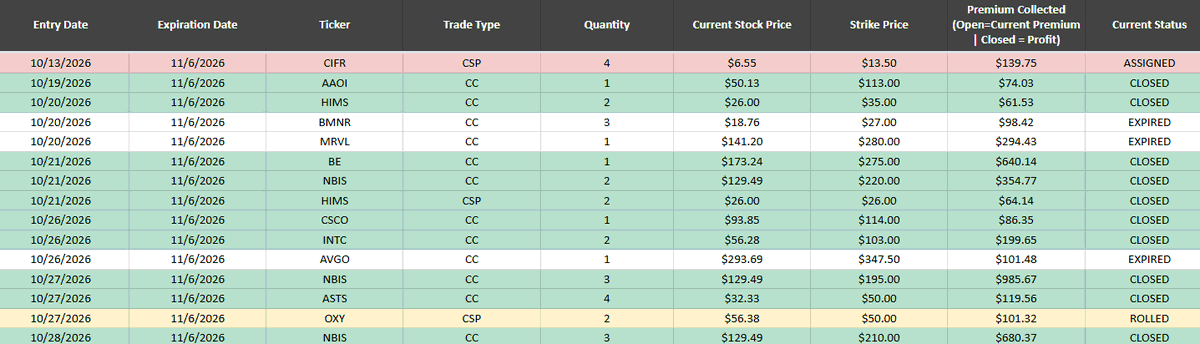
Josh's Results from the week of 11/6/2026
I made $4,001.61 this week selling options.
Another tough week! The AI trade is under extreme pressure right now. We've got some deep ITM puts to manage this week, likely taking assignment on some.
*Total Trades closed: 15
*Closed Winners: 13
*Rolled: 1
*Assigned: 1
*Losses: 0
Want to learn how? Join me! https://t.co/DMsfaTC9m2
I traded great names that include:
$AAOI $CSCO $OXY $ASTS $BE $HIMS and many more.
$TSLA is a great stock for a covered-call lesson right now. Here is why.
Stock context: Tesla rose about 1.7% on Thursday. Bloomberg reported that merger talks between SpaceX and Tesla are moving forward. Earlier reports said the goal is a deal by mid-2027. Together, the two are valued near $3.7 trillion. No terms are set yet.
That means big headline risk. News like this can make the stock jump or drop in a day.
The idea: if you own 100 shares, sell a covered call on a green day.
Why this structure:
- Headlines pump up option prices. That means more premium for the call you sell.
- You pick a strike above the price. A price you would be happy to sell at.
- You get paid while you wait.
Possible outcomes:
1. Stock stays below my strike. The call expires. I keep the premium and my shares.
2. Stock rises past my strike. My shares get sold at my price. I keep the premium too.
3. A big merger pop blows past my strike. I miss the extra gain. That is the real cost of covered calls.
My decision: I only sell calls on green days. I pick a strike I am fine selling at. And I keep it short dated, so one headline does not lock me in for months.
No strike or premium here. It changes by the minute. Check the live chain.
Not financial advice. Do your own research.
Constellation Energy is the AI power play I keep watching. Here is my simple $CEG checklist.
What it does: Constellation owns nuclear power plants. Nuclear makes clean power all day and all night. AI data centers need exactly that.
Why it matters: AI needs power. Lots of it. And big tech wants power that never shuts off.
3 facts to know:
1. Q3 profit beat big. Adjusted EPS was $5.06. Wall Street expected about $3.90.
2. It raised its 2026 profit guide to $12.50 to $12.80 a share.
3. It now has about 4,560 MW of nuclear deals signed. Three were added since its last report.
Bull case: Big tech keeps signing long power deals. Those deals lock in sales for years. And the stock closed at $276.09 on Nov. 9. That is well below its 52-week closing high of $378.60.
Bear case: Politics. After the Nov. 3 midterms, CEG fell about 8% in one day. The market read the result as bad for power stocks. At least 10 towns have approved data center bans or limits. And high rates make big power projects cost more.
My take: Strong business. Real deals. But politics add noise. I would rather sell a put near support on a red day than chase a green one.
Save this checklist for the next AI power headline.
Not financial advice. Do your own research.
$CBRS jumped about 18% after hours last night. Here is why.
Cerebras makes giant AI chips. It also rents out AI computing power. It reported Q3 results after the bell on Thursday.
The big news: its sales forecast for this quarter came in above what Wall Street expected. That is what lit the move.
Why it matters: this stock has been crushed. It traded near $261 after its prior report. By Nov. 4 it was near $98. The fear was thin margins. A strong forecast pushes back on that fear.
It also landed on a wild day. Nvidia lost its CEO the same morning. Some traders are hunting for other AI chip names.
Confirmation: the stock holds most of the after-hours gain through the first hour today. Volume stays heavy. That says real buyers showed up.
Failure: a big gap up that fades by lunch. That would say the move was relief, not a new trend. Watch the gap. Gaps that fill fast tell you a lot.
Risk: this is a young and very volatile stock. Margins are still the big question. And chip stocks are shaky until Nvidia reports on Tuesday. Do not chase the open.
Is this the start of a turn for Cerebras, or a one-day pop?
Why $ANET right now?
Arista Networks builds the network gear that links AI chips together. Think of it as the roads inside an AI data center. More AI chips need more roads.
On Thursday, Nvidia lost its CEO. Money moved into other AI hardware names. Arista rose about 5% that day.
Key positives:
- Q3 sales were $3.66B. That is up about 58.5% from a year ago. Wall Street expected about $3.33B.
- Profit beat too. Adjusted EPS was $1.20.
- The Q4 sales guide is $3.9B to $4.0B. The Street was near $3.6B.
- Gross margin was about 64%. That is strong for a gear maker.
Main risk? A few giant cloud companies buy a lot of its gear. If one of them slows down, Arista feels it fast. Deferred revenue also dipped last quarter. That was the first drop since mid-2023. I want to see that turn back up.
What I watch: AI spending news from the big cloud names. And whether the stock can hold its gains if chip stocks stay shaky into Nvidia's report on Tuesday.
Are you buying the AI picks and shovels, or waiting for a pullback?
Not financial advice. Do your own research.
4 stocks I am watching today as an option seller.
It has been a rough week for nerves. Nvidia lost its CEO. The 10-year yield closed near 5.1% on Thursday. Small caps fell hard. Bitcoin slid under $70,000. On days like this, I do not rush. I let the stocks come to me.
$PLTR: CSP candidate. Palantir grew sales about 96% last quarter. But it fell seven days in a row in early November. It was about 19% off its Oct. 9 high as of Nov. 10. It still trades at a rich price. If it holds support, I like a put below that level. I would be fine owning it there.
$VST: Covered-call watch. Vistra sank about 14% the day after the midterms. Then it bounced about 7% on Nov. 9. Power names swing hard on politics. If I own shares, a big green bounce is my day to sell a call.
$MSTR: Watch only. MSCI plans to drop Strategy from its index after Nov. 30. Funds that track that index may have to sell. And bitcoin is weak. The premium looks juicy. That is the risk talking. I will not touch it until the dust settles.
$WMT: Needs a red day. Walmart is a slow, steady name I would own. But it reports next Thursday. I do not sell puts right into a report. If it dips after the news, that is my red day.
My rule is simple. Red days are for selling puts. Green days are for selling calls. Patience is the edge.
Which one is on your list today?
Market Read for option sellers, Friday Nov. 13.
The theme today: interest rates. And they may not be done rising.
The 10-year Treasury yield closed near 5.1% on Thursday. That was a big jump for one day. Traders now see a Fed rate hike in December as very likely. Some Fed leaders said more tightening may be needed. And on Tuesday, October consumer prices came in hotter than expected.
Today we get producer prices at 8:30 AM ET. That is one more inflation check. Several Fed speakers talk today too. A hot number could push yields up again.
You can already see high rates bite:
- Small caps fell about 1.7% on Thursday. Smaller companies feel high rates more.
- Home sales fell to their slowest pace since 2010.
- Only one S&P sector finished green Thursday: energy. Oil jumped after attacks on Saudi energy sites.
What this means for selling puts:
- High rates hit growth stocks the hardest. I want a deeper red day before I sell puts on them.
- I sell below support, not right at it.
- I keep size small. A hot inflation print can move the whole market in minutes.
- I wait until after the 8:30 data and the first hour.
What this means for covered calls:
- Energy has been the strong group. If you own energy shares, a green day there can be a good day to sell a call.
One more thing. Nvidia reports on Tuesday. That is a big event on top of the Fed. Be careful with size.
Patience is the job today. Not financial advice.
Selling options in an IRA is not the same strategy in a different account. The account rewrites the strategy.
In a taxable margin account, a short put is backed by flexible margin. You can defend it, hedge it, and if a year goes bad, you can wire in more capital.
Most IRAs allow none of that. No margin borrowing, no naked puts, no short stock. At most brokers you get cash-secured puts, covered calls, and defined-risk spreads. That limit changes the math before you place the first trade.
Real numbers. Your IRA holds $30,000. You like a $200 stock and sell the $185 put for $2.20, 40 days out. Cash-secured means about $18,500 of collateral is locked for that one contract, over 60% of the account for $220 of premium.
If you are assigned, the cash is gone, the shares sit there, and your only income tool left is a covered call. There is no margin line to defend the position with.
Three rules for selling premium in an IRA:
1. Price the stock before the premium. A cash-secured put on a $200 name can own your whole IRA. Lower-priced underlyings or put spreads keep one trade from becoming the account.
2. Size smaller than in taxable, because losses cannot be refilled. Annual contribution limits mean a $5,000 loss is not replaced with a wire next week. In an IRA, capital preservation is not caution. It is arithmetic.
3. Remember the trade-off you actually made. You gain tax-deferred compounding and no yearly tax bill on premium. You lose tax-loss harvesting and flexibility. That trade favors boring, defined, survivable trades, not your most aggressive ones.
The IRA is a great place for your most disciplined premium selling. It is a terrible place for your largest.
Do you sell premium in your IRA, or do you keep that account in plain stock and funds?
I collected $378.58 TODAY from options premiums!
Our Trades:
• (1) $SPCX 11/27 $170.00 Covered Call → $104.73
• (1) $HOOD 11/27 $71.00 Cash-Sec Put → $84.38
• (1) $AVGO 2/19/27 $440.00 Covered Call → $189.47
We trade live, every single day right here on X.
Real positions, real results, real-time updates.
Join us FREE! Join via my subscribers section or grab the Discord link in my profile or here: https://t.co/HstTVnUpYJ #OptionTrade #CoveredCalls #CashSecuredPuts
Why I do not sell puts right before earnings.
Today is a big earnings day. Nebius and Intuitive Machines report before the bell. Applied Materials reports after the close. So let's talk about earnings and option premium.
Here is the big idea. Before earnings, option prices puff up. Nobody knows what the report will say. So buyers pay more. That extra price comes from something called implied volatility, or IV. Think of IV as the fear level baked into the option.
When you sell an option, high IV looks great. You get more cash up front. But the market is not dumb. That bigger premium is there because a bigger move is likely.
After the report, IV often drops fast. Traders call this IV crush. The fear is gone, so the option shrinks. Sellers love that part.
So why not sell right before every report? Because the stock can gap. It can open way lower the next morning. Your strike does not help if the stock jumps right past it overnight. There is no time to react.
Here is how I handle it:
1. I check the earnings date before every trade.
2. Most of the time, I wait until after the report.
3. Then I sell into the calmer setup, after the gap.
4. If I do hold through earnings, I go small and far below support.
Patience costs me a little premium. It saves me from the big gaps.
Options have risk. Not financial advice.
You can always join us for free to trade alongside us: https://t.co/DMsfaTC9m2
Evening Market Wrap: Thu, Nov 12
Nvidia lost its CEO today. Jensen Huang quit after a run of bad news about his private life. Colette Kress is now the interim CEO. The board is looking for a new one.
$NVDA got hit hard at the open. At one point it was down about 13%. Then buyers stepped in. It closed down about 4.3%. That is still a big drop for the biggest chip name out there. But it was a lot better than the low.
Here is the twist. Some chip names went up. $AMD closed up about 5%. Broadcom ($AVGO) closed up about 5.5%. Some folks think business could move to them while Nvidia sorts things out. Money did not leave chips. It moved around inside them.
The wider market slipped. The Dow closed down about 0.4%. The S&P 500 was down about 0.4% too. The Nasdaq fell as well. Rates did not help. The 10 year yield pushed above 5% during the day. Traders still see a rate hike in December as very likely.
So what was the tone? Shaky, not scared. A huge CEO shock, and the S&P 500 lost well under 1%. That tells me buyers are still around.
What I am watching next: Friday morning we get the PPI. That is a read on prices at the wholesale level. Another hot number could push rates up again. Then Nvidia reports earnings on Tuesday, Nov 17. Now it reports with no Jensen. That call will be a big one.
My take? I would not try to catch $NVDA in a hurry. Big news like this can swing a stock for days. If I want in, I would rather sell a put well below the low and get paid to wait. Small size. There is still real risk here.
Not financial advice. Do your own research.
Do you buy $NVDA here, or wait for earnings? Tell me below.
Want more end of day breakdowns like this? Follow me @joshtradeoption.
Give me 60 seconds and I'll show you how I stop guessing on wild news days.
Last night was a wild one. The Wall Street Journal said Nvidia's board is getting ready to push out its CEO. The stock fell more than 8% after hours. Nasdaq futures slid too.
Days like this make people panic. They sell at the open. Or they buy a "cheap" dip with no plan. I do neither. Here is my plan.
1. I do not trade the first 30 minutes. The open is loud. I let it calm down.
2. I only sell puts on stocks I want to own. If I get assigned, I am fine with it.
3. I pick my price first. Then I wait for the stock to come to me.
4. I keep my size small. One headline should never wreck my account.
5. I check the calendar. Earnings and big news make premium fat. But they make risk fat too.
That is it. No guessing. No chasing. Just a plan I use on calm days and crazy days.
Selling options is lower risk than buying them. But it is not no risk. You can still lose money if a stock drops hard.
Follow me @joshtradeoption for more simple option-selling tips.
Bullish trade idea.
Premium-Funded LEAP Idea
Sell 17 contracts $SOFI Dec 24, 2026 $14 puts. Collect $340 in premium.
Buy 1 contract $SOFI Jun 16, 2028 $20 calls. Cost $340.
If $SOFI never gets above $20, the calls can expire worthless.
If $SOFI stays above $14 by Dec 24, 2026, the puts expire and you keep the cash.
Risk? If it trades under $14 on Dec 24, 2026, you buy the shares at $14 each.
Potential upside?
$SOFI at $25 = calls worth $500 to $975.
$SOFI at $30 = calls worth $1,000 to $1,381.
$SOFI at $40 = calls worth $2,000 to $2,268.
What do you all think?