Hey Arvind Kejriwal,
@ArvindKejriwal
If you are so focussed on an educated PM (Present PM who has a MA degree in political science), why did you give tickets to the 29 MLAs in Delhi who are not even having college degrees.
Seven of your AAP MLAs have completed education only till the 10th grade.
These MLAs are A Dhanwati Chandela A (Rajouri Garden), Mahinder Yadav (Vikaspuri), Mohinder Goyal (Rithala), Sharad Kumar Chauhan (Narela), Surendra Kumar (Gokalpur), Vishesh Ravi (Karol Bagh) and Shoaib Iqbal (Matia Mahal).
Eight of your 62 AAP MLAs have completed education till 12th grade. These MLAs are Gulab Singh (Matiala), Jai Bhagwan (Bawana), Jarnail Singh (Tilak Nagar), Mukesh Ahlawat (Sultanpur Majra), Pawan Sharma (Adarsh Nagar), Pramila Dhiraj Tokas (R K Puram), Rajesh Gupta (Wazirpur) and Shiv Charan Goel (Moti Nagar).
Two of the MLAs did not complete 10th grade. Abdul Rehman (Seelampur) studied till the 8th class, and Naresh Balyan (Uttam Nagar) studied till the 9th class.
Kuldeep Kumar (Kondli) and Parlad Singh Sawhney (Chandni Chowk) are College dropouts.
Do you mean to say that you wanted to rule Delhi with uneducated MLAs but want an educated PM ???
Doglepan ki bhi hadd hoti hai. Hic !!
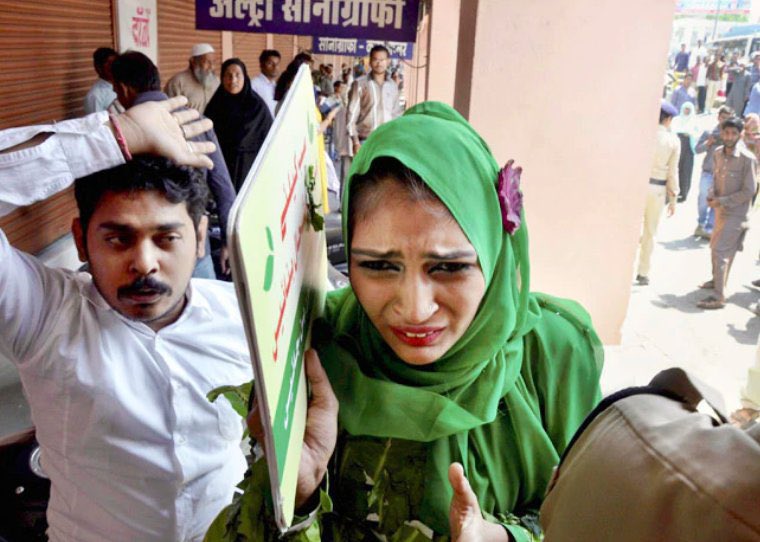
अभिषेक बनर्जी पर कुछ अंडे और टमाटर फेंके गए तो विपक्ष के बड़े -बड़े नेताओं ने चिंता और शोक दोनों जताये --- लेकिन खोड़ा में एक हिन्दू युवा जिबह कर दिया गया बकरीद के दिन बकरे की तरह , तब अभिषेक के लिए आंसू बहाने वाले ये सारे नेता मौन हो गए ----
Throwing eggs in a BJP ruled state would become a nationl issue
But throwing crude bombs under TMC was never a problem for anyone.
This is exactly why I want BJP govt in every state
Cockroach Janta Party and its founder are now using their foreign team to mass report to all those accounts that were involved in exposing their connection with AAP.
I can see a sudden drop in the reach of my tweets.
I request you all to retweet and comment as much as possible to restore my account's reach.
Har Har Mahadev🙏
हर भारतीय के लिए गर्व का पल 🇮🇳🔥
हम जीत गया.. हम लोग हिंदुस्तान के लिए लड़ता
है हम लोग इंडिया से बिलॉन्ग कर रहा हु
"भारत माता की जय"
चुंगरेंग कोरेन ने UFC Road to UFC Season 5 के क्वार्टर फाइनल जीतकर सेमीफाइनल में जगह बनाई
यही हे असली खिलाड़ी हमारे सेलिब्रिटी 🫡
India's toy imports fell 79% in five years. Exports up 40%. No PLI. No mega scheme. Just BIS quality standards that made it unviable to dump cheap stuff here.
Sometimes the boring regulation beats the big subsidy.
You know what’s ironic? @timesofindia published some X grade film star’s reaction on #NoBindiNoBusiness as ‘news’, but their editors expressly created a picture with a bindi by AI to illustrate a Muslim woman! So Hindu women should not wear a bindi, but Muslim woman criminals MUST wear a bindi @vineetjaintimes?
12 years ago Peta held a rally in India asking Muslims to turn Vegan at Eid. Their activists were thrashed so badly they might have been lynched had cops not intervened. Peta never held a rally on Eid ever again.
All the sermonising is reserved exclusively for Hindu festivals.
“As a Hindu, why are you praying in a church?”
I got asked this once.
And honestly, the question confused me.
Because as a Hindu, praying anywhere has never felt wrong to me.
When I walk past a church, I sometimes stop and say a quiet prayer.
There’s a Chinese temple near my home.
I bow my head there and light incense too.
I love visiting Gurudwaras.
They feel like a second home.
I read teachings from different religions because wisdom belongs to humanity, not one group.
That’s the beauty of Sanatan Dharma.
It never taught me to hate someone else’s path to love my own.
No “convert or suffer.”
Just karma, humanity and respect.
The older I grow, the more I feel this:
Faith should make your heart bigger, not smaller.
Jai Shri Ram 🙏
The ChingriGhata Metro link, delayed for three years by the Mamata Government, was completed in just 4 days by the BJP West Bengal Government.
This is exactly the difference a BJP government makes
29,000 have died in our one house since we began in 1952. We give them a special ticket of St. Peter. It's so beautiful to see people die with so much joy. - Mother Teresa
Mother Teresa is the single-most successful emotional con-job of the 20th century. - Christopher Hitchens
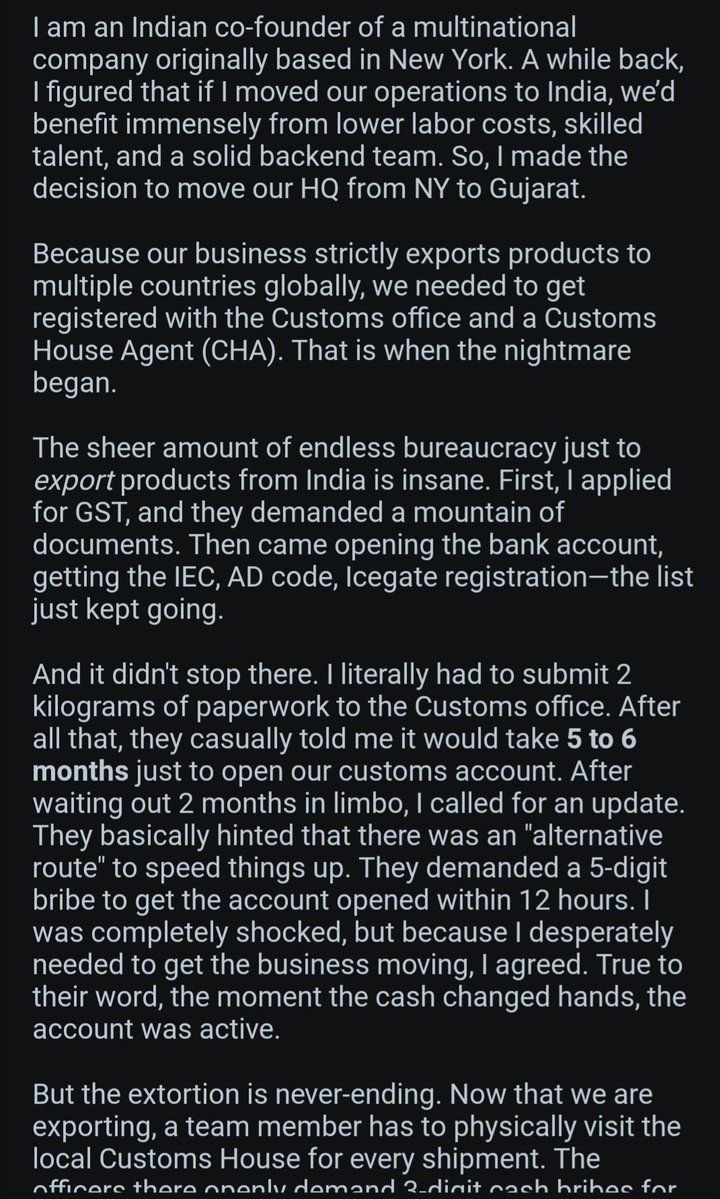
I’m an NRI born & residing in Hong Kong.
7 years ago, I put my money on India to start manufacturing and exports.
So when I read posts like this, I honestly laugh.
Is the system perfect? No.
Are there delays sometimes? Yes.
Do problems happen? Of course.
But this “every shipment needs bribes” story is complete nonsense.
We have been exporting from Bharat for 7 years now.
Most containers are never even opened.
There are proper systems, registrations, trusted exporter schemes, and processes for faster clearance.
Yes, the first few months can feel confusing.
GST, IEC, bank setup, approvals.
Paperwork does exists.
But after that?
Things become smooth.
And every year it just gets better.
People sitting outside India love calling Bharat “impossible for business.”
Meanwhile 1000s of manufacturers here are quietly building global companies every single day.
If India was really this broken, exports would not be growing year after year.
Truth is simple:
People who fail in Bharat blame the system.
People who stay, learn the system, build patiently and usually win big.
So if you want to start manufacturing or exports in Bharat, don’t get scared by such ragebait sensational hit job posts.
There are obstacles.
But the opportunity is far bigger than the obstacles.
And if you have cold feet, DM me.
I’m an open book.
More than happy to share:
* my real experience
* practical ways to get things done
* mistakes to avoid
* contacts and guidance wherever I can help
Because Bharat is still one of the biggest opportunities in the world for builders.
Build in Bharat🇮🇳💪
Did you know that the U.S. defaulted on its sovereign obligations in 1971 when it unilaterally reneged on dollar-gold convertibility.
Russia defaulted in 1998 and 2022.
Argentina: 9 times since independence.
Pakistan: required IMF bailouts 23 times.
Greece defaulted in 2012.
And India? Zero defaults. Not even in 1991!
Yet Western investors classify India as "emerging risk" and call U.S. Treasuries the "risk-free rate."
This isn't risk analysis. This is cognitive bias a la Daniel Kahneman's book "Thinking, Fast and Slow". Humans systematically overweight culturally proximate information while underweighting statistical patterns that don't fit our mental models.
Western strategic planners trust Western partners not because the data supports it, but because the cultural markers feel familiar.
Three facts that challenge everything about how we assess partnership risk:
FACT 1: Across 5,000 years of recorded history, India has rarely waged wars of territorial conquest. Not in 3000 BCE when the Indus Valley Civilization had technological superiority. Not in 1000 CE when Indian mathematics and metallurgy exceeded Europe by centuries. Not in 2026 when it possesses nuclear weapons and the world's 4th-largest military. Not in 2047 when it projects to be a top-two economy.
Compare: China (annexed Tibet 1950, 14 territorial disputes, South China Sea expansion). Russia (Georgia 2008, Crimea 2014, Ukraine 2022). Europe (500 years of colonial conquest across three continents). U.S. (military interventions in 20+ countries since 1945).
This pattern is observable strategic behavior anchored in the Arthashastra, Kautilya's 2,300-year-old treatise arguing that short-term territorial expansion undermines the systemic conditions for sustained prosperity. The concept of "mandala" (circle of states) recognizes that each power's long-term interest depends on system equilibrium.
FACT 2: India has never defaulted on debt, treaties, or security guarantees since independence in 1947. The most revealing test: 1991 balance of payments crisis. Reserves fell to $1.2 billion = just three weeks of imports. Default appeared certain. Instead, India implemented painful reforms, honored every obligation. India didn't use political costs as an excuse to default. Commitments were kept.
This behavior isn't accidental. It's anchored in the Sanskrit concept of ṛṇānubandhaḥ, that obligations are metaphysically binding across time. The Mahabharata established 2,000 years ago that rulers who break commitments violate cosmic order and create systemic instability.
Philosophy became institutional architecture: investment-grade credit through multiple crises, $600B forex reserves (6th globally), zero defaults on government securities across 77 years.
FACT 3: During COVID-19, India exported 300 million vaccine doses to 110 countries while its own vaccination was incomplete. 96 countries received doses free through "Vaccine Maitri."
Meanwhile: U.S. ordered 1.2 billion doses for 330 million people (4x population). EU ordered 4.6 billion for 450 million (10x population). Canada ordered 400 million for 38 million people (10x population).
Western nations didn't begin international distribution until domestic targets were substantially met.
The distinction? India's Economic Survey 2020-21 quoted Sanskrit: "āpadā hi prāṇa rakṣā hi dharmasya prathama aṅkuraḥ" (in calamity, protecting life is the first duty). Not Indian life. Life in general.
This aligns with Vasudhaiva Kutumbakam (the world as one family), not as rhetoric but as policy. India supplies 60% of global vaccines and 20% of generic medicines normally, maintained production during its own constraints, built digital public infrastructure (UPI processes more transactions than all nations combined) and offers it open-source to developing countries.
WHY THIS MATTERS NOW:
Every CFO, sovereign wealth fund, and policymaker is asking: "Who can we depend on for the next 50 years?"
Ukraine shattered the illusion that economic integration prevents aggression. COVID exposed single-source dependencies. Taiwan reveals semiconductor concentration risk.
The global economy is re-optimizing from efficiency to trust.
But here's where Kahneman's research becomes critical: most strategic planners are making decisions using "System 1" thinking (fast, intuitive, pattern-matching based on cultural familiarity) rather than "System 2" thinking (slow, analytical, data-driven assessment of long-horizon behavioral patterns).
The result? Systematic mispricing of partnership risk.
Strategic planners face a choice:
- China: manufacturing efficiency + demonstrated willingness to weaponize interdependence (sanctions on South Korea over THAAD, Australia over COVID inquiry, Lithuania over Taiwan, Belt & Road debt traps in 60+ countries)
- Russia: resource access + repeated weaponization (invaded Ukraine despite economic integration, cut gas to freeze European cities)
- U.S.: innovation + extraterritorial enforcement (billions in fines on European banks for transactions legal in Europe, CLOUD Act overrides local privacy laws, "America First" tariffs hit Canada, Mexico, EU alongside rivals)
- India: 5,000-year track record of territorial restraint + zero defaults + systemic thinking during crises +
challenges (infrastructure gaps, bureaucratic complexity, uneven state capacity).
The question isn't perfection. It is: which risk profile aligns with 50-year partnership objectives when analyzed through System 2 rather than System 1 thinking?
THE UNCOMFORTABLE TRUTH:
If India's pattern suggests lower long-duration risk, why is trust in India still "emerging"?
Kahneman would predict exactly this outcome. Three cognitive biases at work:
1. **Availability bias:** We assess risk based on vivid, recent, culturally proximate information. NATO expansion incorporated Poland, Czech Republic, Hungary rapidly because they registered as "European." India's democracy, rule of law, English-language business environment gets discounted because cultural markers differ.
2. **Confirmation bias:** Western institutions have decades of frameworks built around current partnerships. New data contradicting established models gets filtered out rather than integrated.
3. **Status quo bias:** Existing relationships are comfortable. The U.S.-Europe alliance, U.S.-Japan partnership, Five Eyes intelligence sharing operate with established protocols. Structural change requires crisis-level disruption to overcome inertia.
The crisis arrived.
For boards evaluating long-term partnerships—semiconductors, pharmaceuticals, digital infrastructure, maritime security, critical minerals—India presents a risk profile worth systematic, System 2 analysis.
Because of demonstrated behavior across sufficient time horizons to be statistically meaningful.
In an era of fragmentation, weaponized interdependence, and trust deficits, historical patterns become predictive indicators.
Kahneman spent decades showing that intuitive judgments systematically diverge from statistical reality. Strategic partnership assessment is no exception.
The question is: Are we assessing risk based on data, or based on what feels familiar?
In the 21st century, power matters. But trust may matter more.
And trust should be measured by track record, not by cultural proximity.