The best part of building non-custodial: @DFX_Swiss doesn't replace your wallet, it plugs into it. MetaMask, Ledger, Trezor, BitBox, Rabby, 300+ more via WalletConnect. Swiss-regulated, independently audited, and the code is open source if you want to check.
@Cointelegraph And so it begins!
Just buy Cybersecurity Stocks and look that you secure your own data as much as possible!
AI is coming for the governments after crypto
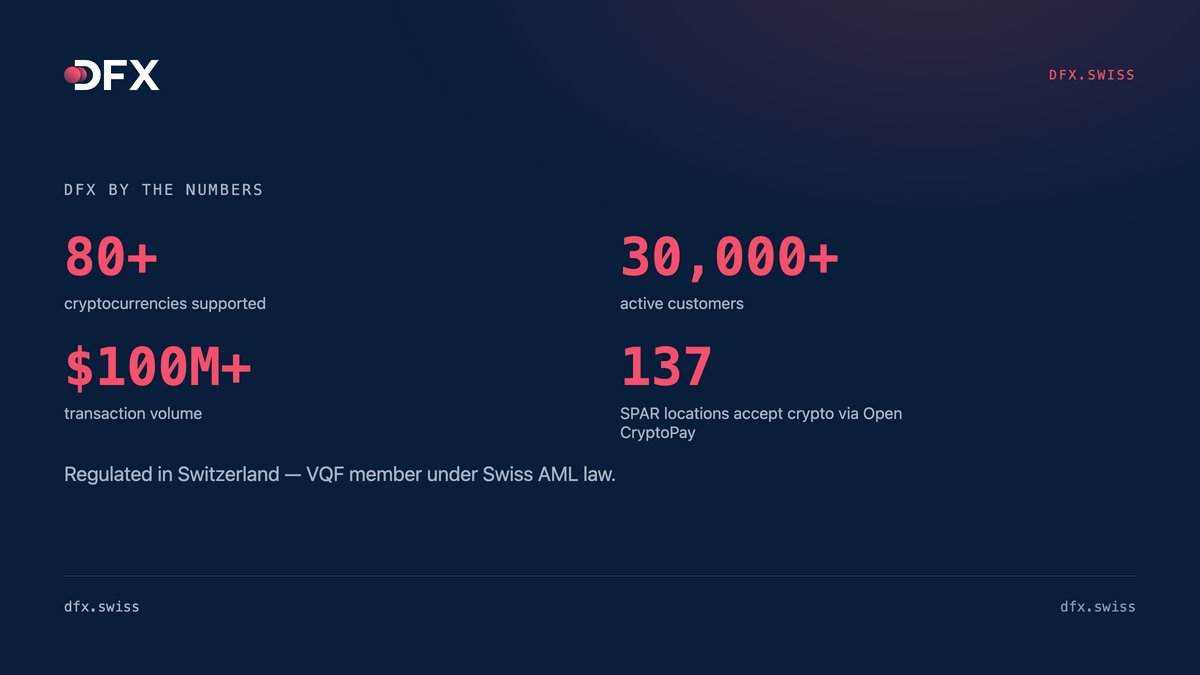
Still find it a bit surreal that you can pay for groceries with crypto at 137 SPAR locations in Switzerland. That runs on Open CryptoPay, which we built at @DFX_Swiss. Adoption isn't a conference demo — it's the checkout line.
A BTC-backed token whose exit needs nobody's permission
The zkBTC specification is public. It defines token standard 3 on zkCoins: lock Bitcoin, hold a private token meant to be backed one-for-one by it, and redeem back into on-chain BTC without asking a central party.
An optional gatekeeper can screen the source of new deposits at mint time. It can never freeze, seize, block or reverse anyone's coins, transfers or exit.
This is a design specification. There is no implementation code, the design is unaudited, and it is not production-ready.
The moment @zkcoinsbtc clicked for me: your wallet keeps the spend key and signs, your node builds the proof, a publisher writes one tiny marker to Bitcoin, and the receiver re-checks everything on their own node. Nobody ever holds your keys. Verify, don't trust.
How does an oracle free protocol handle liquidations? ⚖️
dEURO does not depend on an external price feed to decide what collateral is worth. Anyone can challenge a position they believe is no longer sufficiently collateralized. The challenge starts a public auction where market participants bid for the collateral. The auction result discovers the market price and provides the value used to settle the position.
My favourite way to explain @DFX_Swiss: it feels like paying a bill. Connect your wallet, send a SEPA transfer in CHF or EUR, and the coins show up in your own wallet. No exchange account, no withdrawal step, nothing parked with a middleman.
Validity, publication and proving are separate protections
The proof relation rejects an invalid state transition. A publisher still chooses whether and when to inscribe a valid nullifier, so publication liveness comes from permissionless choice and self-publication.
The selected prover is a different boundary. A thin wallet cannot independently confirm that the proven output root matches the outputs it requested, so a foreign prover is trusted for send-intent correctness.
Self-hosting does more than improve privacy. It removes that foreign-prover trust trade-off.
Honestly, the thing I trust most about the @zkcoinsbtc spec is what it doesn't hand-wave. Even the ugly case is written down: a reorg of any depth is replayed in canonical order, and a transition whose dependency got orphaned degrades to a no-op. Nothing gets stranded.
Anchored to Bitcoin has a concrete verification path
The receiver decrypts the CoinProof and checks recursive validity and coin inclusion. It then verifies that the on-chain nonce commits to that proof, and that the corresponding rotating key is the first accepted occurrence in the Bitcoin-derived log.
Its own coin history also rejects the coin if it was already credited or spent, so a courier or node can never force a double-credit.
Finally, every transition the coin depends on must be completed with at least six confirmations.
A node may gather the data. The receiver's own node verifies the result against Bitcoin.
Learn more about how new dEURO is created 🏗️
Borrowers create dEURO by depositing approved crypto collateral into a smart contract position. Every position has a borrowing limit and remains overcollateralized, which means the collateral value must stay above the amount of dEURO created. Repaying the dEURO unlocks the collateral. Borrowing costs combine the Leadrate with a position specific risk premium.
Completed is a verified state
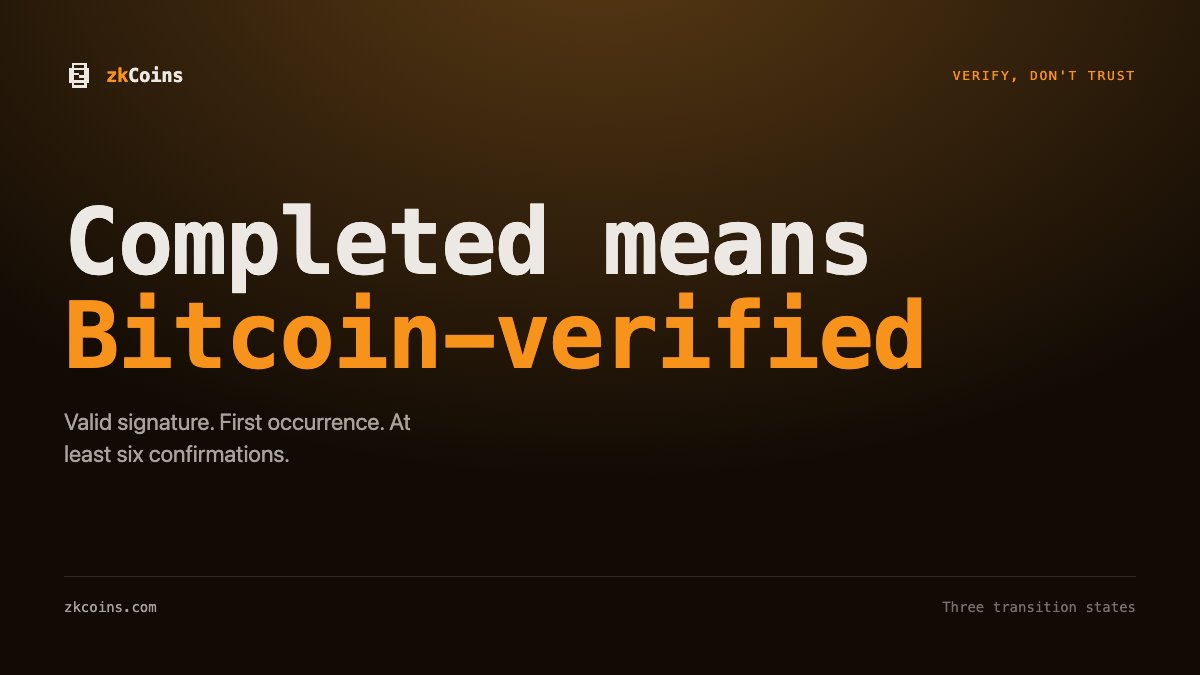
A zkCoins transition is completed only when the verifier's own Bitcoin scan finds a valid signature, confirms that the rotating key is the first occurrence and counts at least six confirmations.
Fewer than six confirmations is pending. A malformed inscription, an invalid signature or a losing repeat occurrence is failed. Those are the three transition states.
A mint follows the same state machine as a send or receive. There is no separate mint-only state.
Quietly proud of what we've built at @DFX_Swiss in Zug: more than 30,000 people now buy and sell 80+ cryptos by simple bank transfer, over $100M has flowed through — and not a single coin ever sat in our custody.
They use your own desires against you.
The dream of getting rich without putting in much work.
Instead of doing real DYOR.
Instead of buying stronger, more established projects.
You choose to gamble.
And the truth is:
The casino always wins.
In the end, everyone makes that choice for themselves.