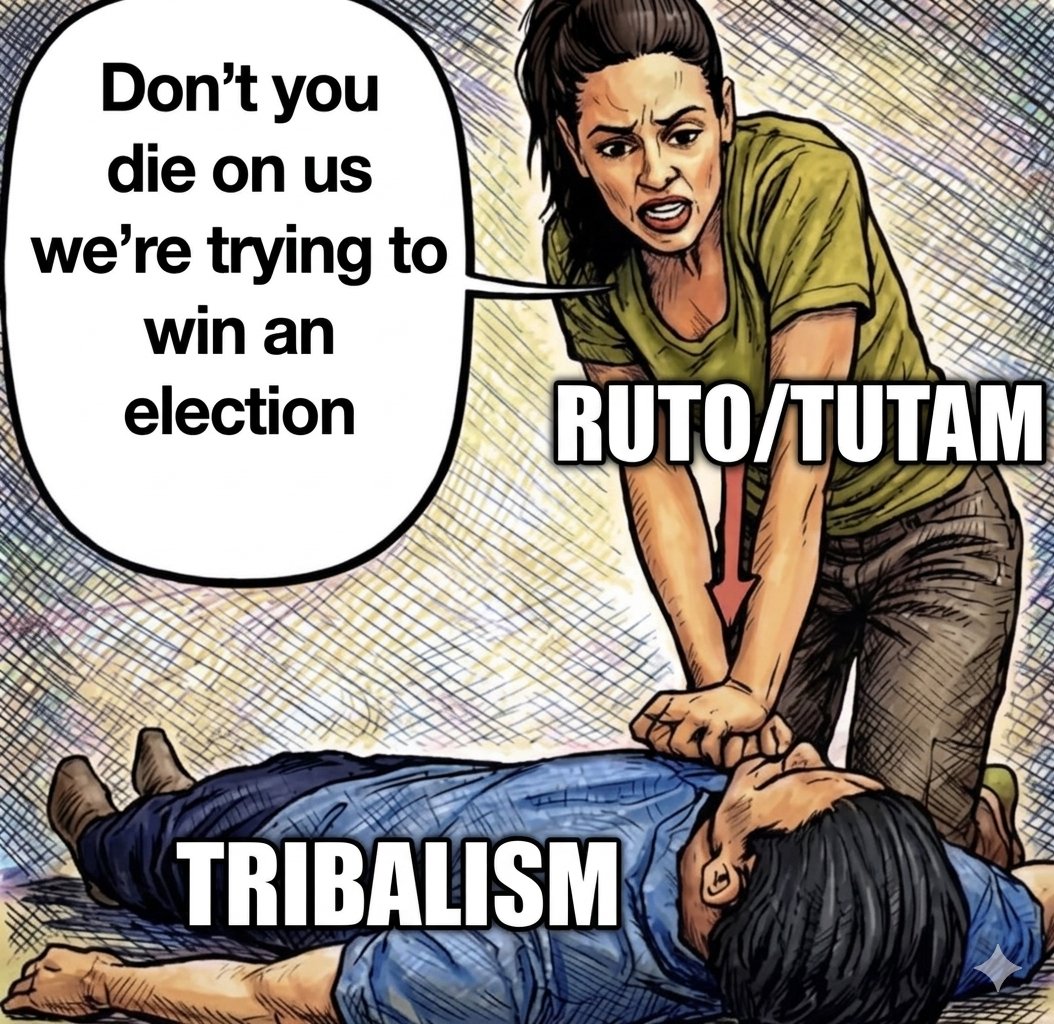
The story of NdidI Nyoro and the MPs who missed parliament on the Finance Bill voting day should teach us that not participating in an election has the same consequences as voting for bad leaders and bills.
When you mention Odious Debt, the looters tremble. In just 4 years, Ruto has borrowed more than Uhuru did in 8. The silence of beneficiaries is deafening.
#OdiousDebt#DeniBandia
Buda, usitubebe ufala.
It is becoming a recurring pattern that whenever Parliament is confronted with consequential votes that directly affect the livelihoods of millions of Kenyans, you are conveniently outside the country.
After months of fiery rhetoric, media appearances, and vehement opposition to the Finance Bill, your conspicuous absence at the decisive moment raises legitimate questions about your sincerity and political fortitude. Were the interviews merely performative? Was the outrage simply a public relations exercise?
The cabro being installed in Nairobi will never be completed. It is a forever Project designed to create hopeful chaos. Material everywhere, excavated dirt on footpaths etc. to create an illusion of a city that is under construction but in reality is to mask incompetence
Kenyan FARMERS, a severe El Niño is forecast for Kenya from mid-2026 through Q1 2027, potentially worse than 1997. In '97, flooding killed 2,000+ people, wiped out 300,000 ha of crops, and killed over 600,000 livestock.
Here's a 14-step action plan. Start this week. 🧵
X is a public platform.
Public participation now!
It is a legal requirement .
If you want me to impeach the dumb guy!
Retweet and like.
24k likes guarantee progress .
Lets do this for our nation.
Kenya needs a renaissance !
NO 'EXCESSIVE DANCING' IN KENYA. HOW GLOBAL COLONIAL & SLAVER POWERS BANNED 'NATIVE' DANCING, BOOZE, DRUMS, AND PARTYING
Colonial rulers and slave owners often saw music, dance and simple pleasures as dangerous sparks of rebellion. In Kenya local chiefs wielded powers under the Chiefs’ Authority Act, a law rooted in the 1920s and kept after independence. They could ban “excessive dancing” if it seemed too lively, went on too long, or risked stirring up a crowd.
The same rules let them crack down on village brews that brought people together. These controls only ended with democratic reforms in 1997 - 24 years after independence!
In South Carolina the Negro Act of 1740 came straight after the Stono Rebellion. It outlawed drums, horns and any loud instruments among enslaved Africans, along with unsanctioned gatherings. Planters and magistrates enforced it ruthlessly, convinced the beats could help people plan revolts or hold on to their culture.
British officials in India took aim at living traditions too. Devadasis (girls dedicated as children to temple service and trained in sacred song and dance as offerings to the gods), saw their art condemned. In 1910 the Madras Presidency banned dancing inside Hindu temples, calling the graceful performances immoral.
Nautch dancers, professional women who performed intricate storytelling routines with music at private gatherings and courts, faced fierce campaigns by missionaries and reformers that ruined many livelihoods.
Everyday drinks suffered as well. Toddy, the fresh mildly fermented sap tapped from coconut or palm trees, was a traditional village refreshment. Heavy colonial taxes and licensing crushed small tappers while favouring imported liquor.
Under French rule the Code de l’Indigénat, introduced in 1881 and used across Algeria, West Africa and Indochina, gave local administrators power to punish “insolence” or unsanctioned gatherings. They often used it to shut down traditional dances, drumming sessions and celebrations judged too noisy or defiant.
Portuguese authorities in places like Cape Verde suppressed batuku, a vigorous women’s group dance full of clapping, drumming and swaying rhythms. They labelled it primitive and indecent, fearing it encouraged resistance to colonial order.
In the United States the 1883 Code of Indian Offenses, banned indigenous peoples' ceremonies such as the Sun Dance and Ghost Dance together with their songs and feasts. Agents withheld rations or locked people up, seeing these events as obstacles to Christian conversion.
Across these places the goal was the same: to weaken cultural ties, kill collective joy and impose outsiders’ rules on how people should move, sing and celebrate. A drumbeat, a dance or a shared drink carried memory and solidarity, exactly what rulers dreaded. Most of these restrictions only faded in the 20th century under pressure from independence and civil rights movements.
📸This licence is a parody.
Hate how as a Kenyan, everyday feels like we are parenting Kipchirchir through his presidency because he's a toddler that wants to mess up everything.
It's all "Wacha!" "Usiguze hio" "Usiuze hio" "Usiibe hio" "Usikule pesa ya education" "Nisikupate na terrorists" for fucks sake!
Never decouple William Ruto and Uhuru Kenyatta.
They are Siamese twins of political treachery and economic devastation.
Anything else is narratives.
End.
@Gitz__ "Films, football, beer, and above all gambling, filled up the horizons of their minds. They could only focus on petty specific grievances. The larger evils invariably escaped their notice. To keep them in control was not difficult."
From the book 1984 by George Orwell.
For the sake of this Nation’s unity and prosperity, please make David Maraga the president in 2027.
I assure you, you will not regret that decision because if you don't, we will be back to the same issues.
Let us meet in 2028 here and see if you learnt or you didn't.
PPP tax exemption is just completely insane as a clause in the finance bill.
public funds derisk your investments and then you’re exempt from contributing to the public kitty, even as you use our roads, ports, fuel, labour in order to generate your profits.
Ridiculous clause.
This one will require a stiff drink.
In the early 1990s, the government came up with a clever idea. Instead of borrowing money cheaply to build hospitals, schools, and roads, it would get the private sector to build them and then pay the private sector back over 25 to 30 years. The Private Finance Initiative. PFI.
The attraction was obvious. You got a shiny new hospital today. The bill didn't show up on the government's books. The cost was deferred into the future. Politicians got ribbon-cutting ceremonies without the awkward conversation about borrowing.
It was, in effect, the nation's credit card. Buy now, pay later. Except the interest rate was extraordinary.
The total capital value of everything built under PFI was around £50 billion. As of March 2024, there were 665 PFI contracts still running across the UK, with roughly £136 billion in remaining payments stretching out to the early 2050s. These are payments public bodies are contractually locked into. Hospitals, schools, councils, government departments. Paying for buildings that in many cases were constructed twenty or thirty years ago.
And the terms are extraordinary.
PFI contracts were structured so the private sector would not just build the facility but manage its services. Cleaning. Maintenance. Catering. Portering. These services are bundled into long-term contracts with built-in inflation increases that the public sector cannot renegotiate, cannot exit without paying massive penalties, and often cannot even fully scrutinise because of commercial confidentiality clauses.
In one case raised in Parliament, a hospital was charged £333 to change a lightbulb. That isn't an urban myth. It was cited in Hansard.
The NHS has been hit hardest.
According to parliamentary analysis, the capital cost of NHS PFI projects was around £13 billion. The total repayments are estimated at around £80 billion. And the peak of NHS PFI annual repayments isn't even here yet. It arrives in 2029. The bills are still going up.
In 2020-21, NHS trusts paid £457 million purely in interest charges on PFI contracts. Not services. Not maintenance. Interest. In the last five years, NHS trusts have handed over more than £1.8 billion in PFI interest alone. We Own It calculates that money would have covered the starting salaries of over 50,000 new doctors.
One NHS trust, Essex Partnership, has reportedly paid back 27 times what was originally borrowed. Some hospitals are spending more on PFI repayments than on medicines for patients. And remember, these repayments come out of the same NHS budget that's supposed to fund patient care, staff, and equipment.
Scotland got it just as badly. Audit Scotland reported that Scottish taxpayers will pay a cumulative £40 billion for PFI assets worth just £9 billion. North Ayrshire Council will have paid £440 million by 2038 for four schools that cost £83 million to build.
Now here's what makes this worse.
Many of these contracts are starting to expire. The buildings are being handed back to the public sector. And the NAO has warned of significant risks around the handback process, including cases where public bodies were dissatisfied with the condition of assets being returned to them. Decades of payments. And some of these buildings may come back needing significant further investment.
So what actually happened?
The government could have borrowed money at significantly lower rates to build these hospitals and schools itself. Sovereign borrowing has always been cheaper than private finance. Instead, it paid the private sector to borrow at a premium and passed the inflated cost on to the taxpayer. The private sector took the profit. The taxpayer took the risk. The buildings are now ageing. The debts are still being paid. And the services that were supposed to benefit are being squeezed partly because so much of their budget is locked into contractual obligations they cannot escape.
PFI wasn't investment. It was an accounting trick. A way for governments to build things without the borrowing showing up in the national debt figures. It made politicians look fiscally responsible while loading future generations with obligations they had no say in and no ability to renegotiate.
Both parties did this. The Conservatives created PFI in 1992. Labour massively expanded it after 1997. More than 700 projects were signed. The coalition eventually wound it down. The current government scrapped the latest version. But the contracts remain. The payments continue. And the damage is already done.
This is what it looks like when a country chooses to buy its infrastructure on hire purchase instead of investing properly. You lock in above-market rates for decades. You lose control of the assets. You tie the hands of future governments. And when the bill keeps coming due, you're told there's no money for doctors, teachers, or social care.
There was always money. It just went somewhere else.
82 years ago, on December 1st 1944, African soldiers who fought and bled to help defeat the Nazis were massacred by the French army at Thiaroye massacre after demanding the salary they were promised. They survived Hitler, only to be murdered by the empire they defended.