📖 Comparative Politics is published quarterly in October, January, April, and July.
Don't miss out on our latest issue, subscribe to the journal here: https://t.co/nq2CGQfKfj
Comparative Politics is published quarterly in October, January, April, and July.
For access to our latest issue, subscribe to the journal here: https://t.co/nq2CGQfKfj
Israel's Prime Minister Netanyahu said he had ordered the military to prepare for a full lockdown of the West Bank, beginning later today.
@peterjpkrause & @EhudEiran analyze the Israeli settlement movement in the West Bank from 1967-present.
Read: https://t.co/geabKAepOJ
Former Deputy Prime Minister of Canada Chrystia Freeland recently argued that no president has been more beneficial for China than Donald Trump.
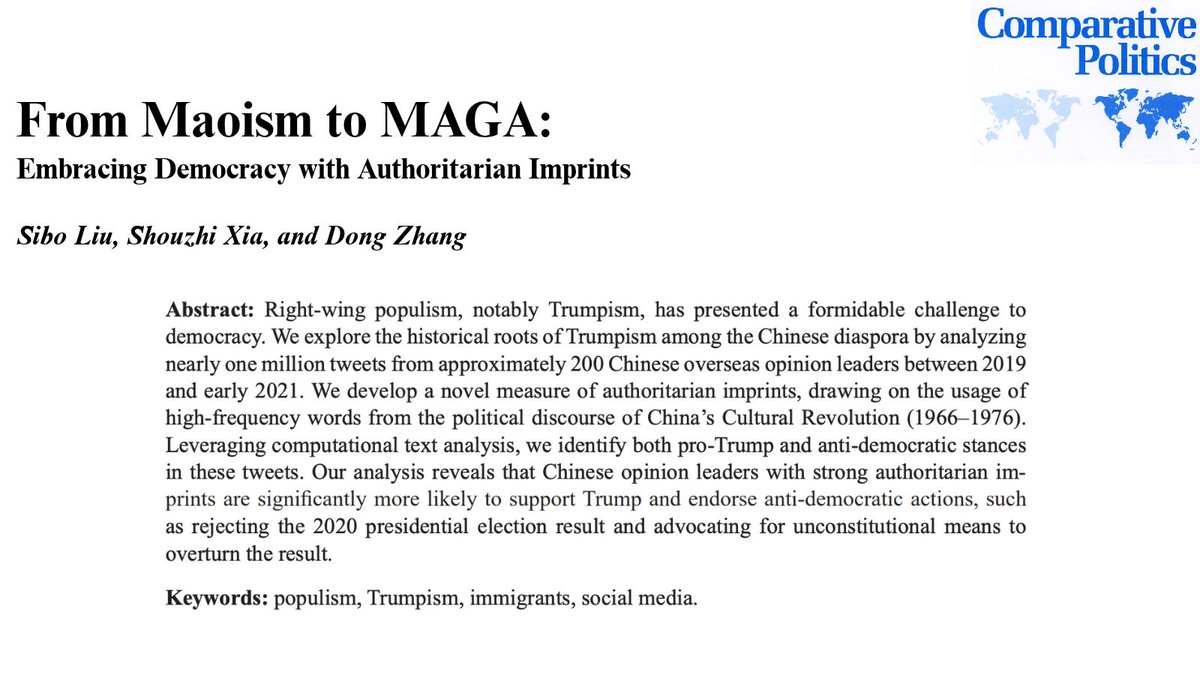
@liu_sibo, Shouzhi Xia, & Dong Zhang explore the historical roots of Trumpism in the Chinese diaspora.
Read: https://t.co/jKWPDWbBxE
Labor unions and other campaign groups have increasingly joined the recent student demonstrations in France.
Mark I. Vail, Sara Watson, & Daniel Driscoll analyze in their past article the changing patterns of worker protest and mobilization in France.
📖 https://t.co/1DITlggfoU
In our latest issue, @_emilyrains uses original household survey data from over 200 Indian informal settlements, with social network data from a subset, to argue that hyper-local neighborhood context conditions politically relevant outcomes.
📖 Read: https://t.co/6IOZolqzp8
✍️ Interested in making a submission to the journal?
Check out our guide on how to submit research articles, research notes, and review articles.
➡️ https://t.co/85FdXCF87z
ICYMI | Fast Track Article
Sometimes militaries defect during protests against democratically elected leaders. Why?
Kara Kingman Neu argues in her recent article that executive self-coups are an important factor.
📖 Read: https://t.co/77BtZCVqxq
‼️ Open Access Article ‼️
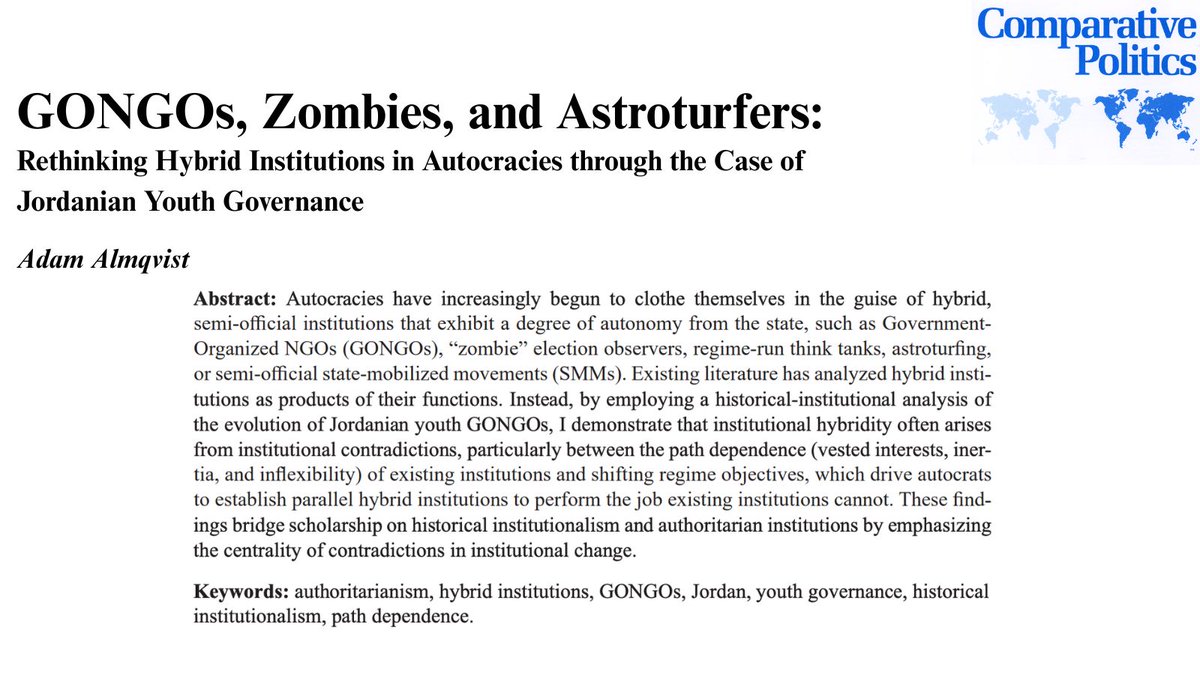
Be sure to check out our open access article by Adam Almqvist where he demonstrates that institutional hybridity often arises from institutional contradictions.
📖 Read: https://t.co/Qu3zlJKBAg
ICYMI | Latest Fast Track Article
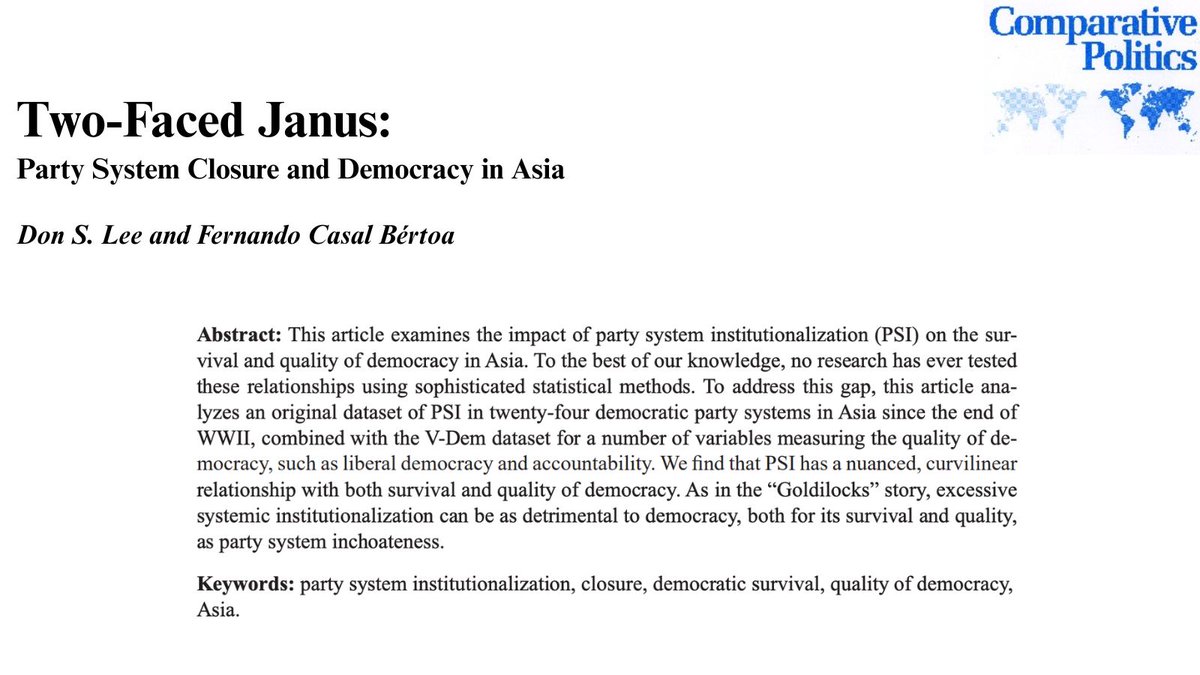
Don S. Lee & @casalbertoa examine the impact of party system institutionalization (PSI) on the survival and quality of democracy in Asia, finding that PSI has a nuanced, curvilinear relationship with both.
Read: https://t.co/mUJ898edPr
✍️ Are you teaching a course or researching issues around social movements?
Check out our latest resource compilation, with links in the thread below to our articles on the subject. 👇️
ICYMI | Latest Fast Track Article
Sometimes militaries defect during protests against democratically elected leaders. Why?
Kara Kingma Neu argues in her recent article that executive self-coups are an important factor.
📖 Read: https://t.co/77BtZCVqxq
📣 New Fast Track Article
Don S. Lee & @casalbertoa examine the impact of party system institutionalization (PSI) on the survival and quality of democracy in Asia, finding that PSI has a nuanced, curvilinear relationship with both.
Read: https://t.co/mUJ898edPr
@whogovernseu
@Neiloughlin@sashadevo@liu_sibo@emreceyhun1 Loyalty Signaling, Bureaucratic Compliance, and Variation in State Repression in Authoritarian Regimes by Jingyuan Qian and Steve Bai
https://t.co/AUPs0RSC6Z
✍️ Are you teaching a course or researching issues around authoritarianism?
Check out our new resource compilation, with links in the thread below to our articles on the subject. 👇️