@ZoranLutovac Bravo što ste se setili ovih hrabrih žena i njihovog doprinosa u Prvom svetskom ratu! Dodao bih još jednu izuzetnu Australijanku, Olive Kelso King, koja je služila u srpskoj vojsci u činu narednika i svojom hrabrošću i požrtvovanošću ostavila trag u našoj istoriji.
I believe the decision to allow nations that are not full members of International Rugby League (IRL) to participate in Rugby League World Cup qualifiers is a very negative development for the future of our sport.
I say this from personal experience, having worked within the international Rugby League system for almost 18 years.
Without naming the country, out of respect, I can give you a very revealing example. One nation participated in three consecutive Rugby League World Cups: 2013, 2017 and 2021 (played in 2022 because of the COVID-19 pandemic).
But what was the actual legacy of those three World Cup appearances?
That nation initially made progress and achieved full membership of the IRL. However, the obsession with international results and recruiting heritage players came at the expense of genuine domestic development.
Today, that country has dropped to affiliate membership and is at risk of falling further to observer status because it no longer has a functioning domestic competition.
Three World Cups, yet no sustainable domestic competition. Is that what we call international development?
Unfortunately, these new eligibility rules risk encouraging exactly the same approach. Instead of building clubs, developing domestic players, establishing competitions and expanding Rugby League in their own countries, national federations will once again focus on tracing family trees and searching for eligible players in Australia.
We will become genealogists and archaeologists rather than sports development professionals!
And then there is another extraordinary decision concerning the United States.
We have already seen the introduction of the great-grandparent eligibility rule, which I believe is highly unusual in international sport. Now we have another remarkable situation: a country hosting World Cup matches will not automatically qualify for the tournament.
I personally cannot recall another comparable example in international sport where a host nation was required to qualify for its own World Cup.
Just imagine the damage if the USA fails to qualify for a tournament being staged on American soil.
How do we expect to attract American spectators, develop local interest, secure media coverage and build a lasting legacy if the United States national team is not even participating?
What would be the point of bringing a Rugby League World Cup to the United States without giving the American public the opportunity to support their own national team?
We need to ask ourselves a fundamental question:
Are we genuinely trying to develop Rugby League as a global sport, or are we simply creating international teams populated by players developed in the Australian Rugby League system?
Because these are two very different things.
International Rugby League development must be measured by the number of countries with functioning domestic competitions, clubs, registered players, government recognition and sustainable structures not simply by how many heritage players can be recruited to compete at a World Cup.
Quite the opposite, mate... I would argue that Touch Football has much stronger historical and organisational links with Rugby League than with Rugby Union.
In fact, Rugby Union has generally developed its own noncontact variations, including Tag Rugby and different forms of Touch Rugby.
Look at Australia, the strongest Touch Football nation in the world. Touch Football Australia (TFA) has been in a formal strategic partnership with the NRL since 2013. Just look at the TFA logo it literally says NRL Touch Football!
The relationship goes much further than branding. The NRL even appoints a director to the TFA Board. In March 2025, rugby league legend Brad Fittler joined the Board as an NRL appointed Director.
Another interesting development is the growing connection between national Rugby League governing bodies and the Federation of International Touch (FIT). Greece and Ukraine have recently joined FIT, with Ukraine providing a particularly interesting example of Touch Football being developed through rugby league structures.
We also need to look at changing participation trends. Younger generations, particularly Gen Z and Gen Alpha, are increasingly attracted to accessible, inclusive and less physically demanding sporting formats. Touch Football fits perfectly into that space.
There is a reason American Football is entering the Olympics through Flag Football rather than a fullcontact format. The NFL clearly understands the opportunities that noncontact versions offer for international expansion and Olympic participation.
Now, here is where things become particularly interesting.
I have heard suggestions that Rugby League might still find a way into Brisbane 2032 through Touch Football. I have absolutely no evidence to confirm this, and I am not presenting it as fact. However, having followed developments across international Rugby League for many years, I am simply connecting the dots and trying to understand the bigger picture.
Perhaps there is more happening behind the scenes than we realise.
I agree that the ship may have already sailed for Brisbane 2032. But perhaps it hasn't disappeared over the horizon just yet.
Maybe there is still a chance for that ship to return to port and pick up one last passenger... Rugby League...
What we are doing here is extremely important for the future of international Rugby League.
Let's look at basketball, a sport that is far bigger, more globally established and more widely recognised than Rugby League, yet one that offers some striking similarities.
The NBA is basketball's equivalent of the NRL, the strongest professional competition in the world, attracting the very best talent.
Europe has the EuroLeague, widely regarded as the second strongest club basketball competition in the world. Yet, commercially and financially, it is nowhere near the NBA.
Now the NBA is looking to reshape European basketball through its proposed new competition, NBA Europe, developed in partnership with FIBA, while discussions about possible cooperation with the EuroLeague continue.
Does this sound familiar? The NRL and Super League?
But here is where the comparison becomes particularly interesting.
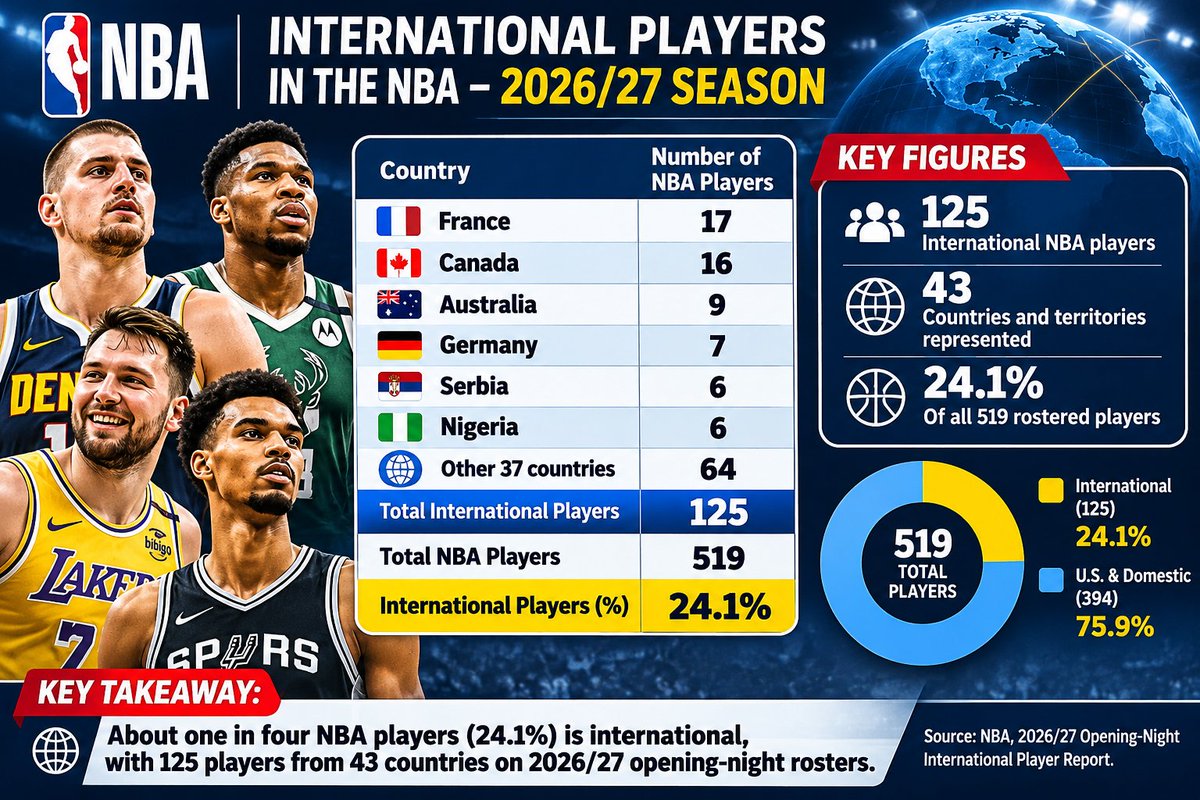
The NBA attracts the best basketball players from around the world. In the 2026–27 season, there are 125 international players from 43 countries and territories, representing approximately 24% of all NBA players.
And here is the crucial difference.
Many of these players were not developed within the American basketball system. They are products of their own countries' basketball structures their local clubs, academies, domestic competitions and national development programmes.
Think of Nikola Jokic from Serbia, Luka Doncic from Slovenia or Victor Wembanyama from France.
They did not become international stars simply because they qualified to represent another country through their ancestry. They developed as basketball players within established basketball systems before reaching the NBA.
And that is precisely what makes basketball's international development model so powerful.
The NBA benefits enormously from this global talent pool. International stars attract millions of fans in their home countries, helping the NBA expand its international television audiences, broadcasting revenues, sponsorship opportunities and commercial partnerships.
But, equally importantly, these players demonstrate the value of strong domestic basketball structures around the world.
The NBA does not need to manufacture international basketball through ancestry rules. It benefits from basketball genuinely being played, developed and supported internationally.
That is the fundamental lesson I believe Rugby League must understand.
We should be developing Rugby League players in Serbia, France, Ukraine, Greece, the Netherlands and other emerging nations creating strong domestic competitions, developing coaches, gaining government recognition and building sustainable national federations.
If those players eventually reach the NRL or Super League, everyone benefits: the players, their countries, their national federations and the professional competitions themselves.
The ultimate objective should not simply be to create stronger national teams by recruiting players with ancestral connections. It should be to create stronger Rugby League nations capable of producing their own players.
That is how you build a genuinely global sport and, ultimately, a much bigger global market for the NRL and Rugby League as a whole.
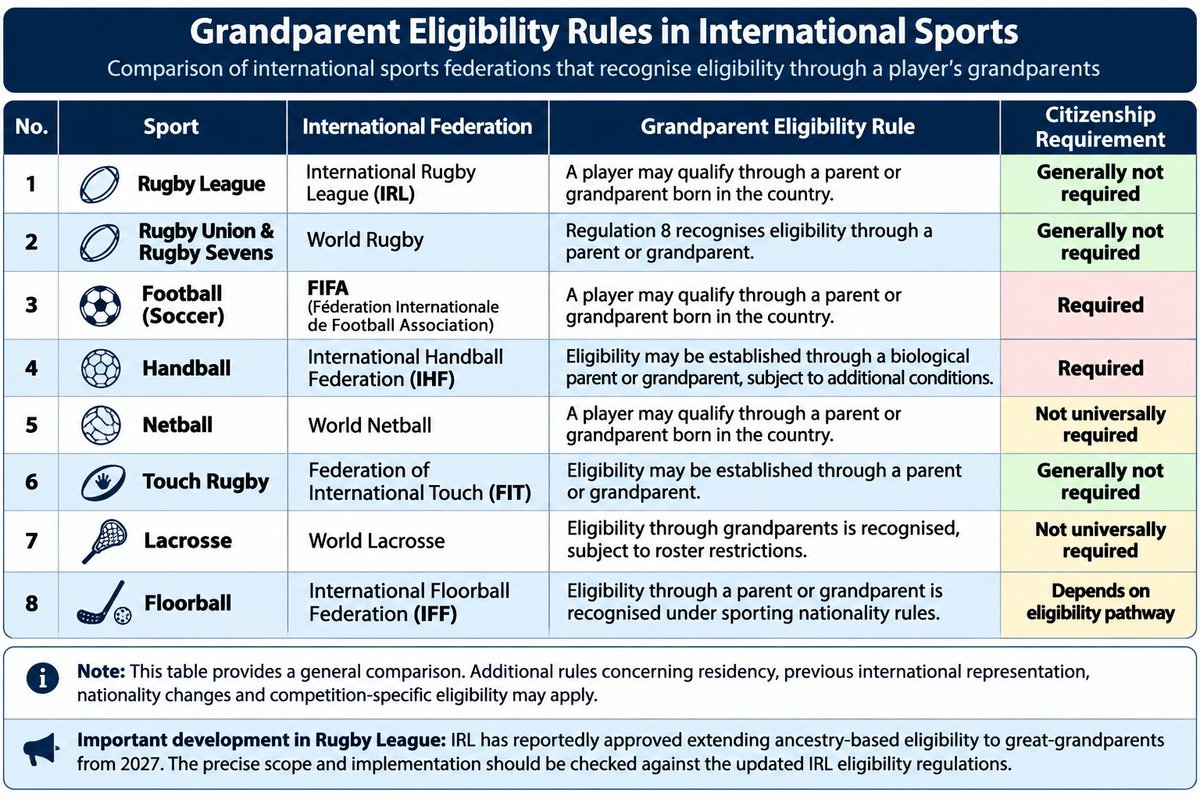
Rugby League may become the only major international sport to introduce the great-grandparent eligibility rule, and in my view, this is a very worrying development.
Instead of investing in domestic player development, national federations may increasingly focus on recruiting players with ancestral connections from the NRL and other Australian competitions. We could soon see nations advertising for eligible players rather than developing their own talent.
This risks undermining grassroots development, weakening national competitions, and discouraging investment in local players and coaching structures.
International eligibility rules should encourage the sustainable development of the sport, not turn national teams into recruitment projects based on increasingly distant ancestry.
I also believe this decision moves Rugby League further away from the eligibility standards and principles generally associated with Olympic sports.
I couldn't agree more!
The last time Australia hosted the Olympic Games was Sydney 2000. It will have taken 32 years for the Olympics to return to Australia, and this time they are coming to Brisbane, right in one of Rugby League's greatest heartlands, alongside New South Wales and the North of England.
This represents an extraordinary, perhaps once in a generation opportunity for Rugby League to gain a foothold within the Olympic movement, potentially through alternative formats such as Rugby League Nines or touch football.
We all understand that, with the Olympic Games limited to approximately 17 days, traditional formats of Rugby League, Rugby Union and American football are simply not practical. The physical demands of these sports require recovery periods of five, six or even seven days between matches.
That is precisely why shorter formats such as Rugby Sevens, flag football and T20 cricket have become attractive Olympic options.
The Olympic competition itself might not be particularly important for Rugby League. However, Olympic recognition could fundamentally change the future of our sport.
It could open an entirely new dimension: international recognition, stronger legitimacy with national governments, and significantly greater access to public funding, sporting infrastructure and development programmes.
This is particularly important for emerging Rugby League nations, where the lack of official recognition often means little or no access to government funding.
American football has understood this opportunity. Flag football will feature at Los Angeles 2028, with the NFL actively supporting and investing in its Olympic inclusion.
The accompanying graphic illustrates the financial impact that Rugby Sevens' inclusion in the Olympic programme has had on national rugby union federations. Olympic status has helped create new opportunities for government investment in those countries, reducing their dependence on direct funding from World Rugby.
Imagine what even a fraction of those opportunities could mean for Rugby League nations struggling to develop the sport with almost no resources.
Brisbane 2032 is a historic opportunity that Rugby League simply cannot afford to ignore.
Unfortunately, with less than six years remaining until the Games, I am increasingly concerned that we may be witnessing yet another missed opportunity for our sport.
The real prize is not an Olympic medal. It is the opportunity to secure Rugby League's long term recognition, funding and sustainable development worldwide.
Rugby league still lacks full recognition as an independent sport within the global sporting system. International Rugby League (IRL) never achieved full membership of the Global Association of International Sports Federations (GAISF), which voted to dissolve in 2022 and completed its liquidation in 2023.
Today, SportAccord has taken over many of GAISF's former responsibilities, while the Alliance of Independent Recognised Members of Sport (AIMS) provides a pathway towards recognition within the Olympic Movement. Unfortunately, rugby league is still not an AIMS member.
Without international recognition, genuine global development will remain extremely difficult. National federations will continue to struggle to secure government funding, access public sports facilities, enter schools and establish themselves as legitimate, independent sporting organisations.
And we must not ignore another longstanding challenge: rugby union (RU). Historically, rugby union has actively obstructed the development of rugby league in numerous countries. Such opposition may no longer be as open or aggressive as it once was, particularly given modern legal protections and human rights standards, but I remain convinced that resistance continues behind the scenes, often below the radar.
Until rugby league achieves genuine institutional independence and international recognition, we will continue fighting the same battles rather than building a truly global sport.
Without official government recognition, it is virtually impossible to achieve anything significant in terms of developing the sport. There is no access to public funding, limited or no access to publicly owned sports facilities and infrastructure, and serious difficulties gaining access to schools, which are essential for introducing and promoting the sport among young people.
Government recognition is not just a formality, it is the foundation for sustainable development and long term growth.
I strongly disagree that little progress has been made in Europe over the past 18 years. Quite the opposite.
Rugby League was introduced and developed in around 20 European countries where it had previously been virtually unknown as a sport, often facing strong resistance from Rugby Union. That alone is a major achievement, especially considering that it was accomplished on a shoestring budget, with extremely limited resources and almost no serious investment.
We also need to look seriously at the lack of television exposure across Europe.
According to the NRL's official international broadcasting information for 2026, only six European countries have designated local TV broadcast partners: the UK, France, the Netherlands, Germany, Austria and Switzerland.
Even more interesting are the figures for Germany, Austria and Switzerland, which together have approximately 102 million inhabitants.
NRL and Super League matches are broadcast through Sportdigital1+, a specialist pay-TV channel. Sportdigital reports just over 7 million subscriptions across its entire group of channels in these three countries combined. That figure is not the audience for Rugby League, nor does it represent 7 million subscribers specifically to Sportdigital1+.
In fact, SPORT1+, the predecessor to Sportdigital1+, reported approximately 1.89 million subscribers at the end of 2024.
Think about that: three of Europe's wealthiest sporting markets, with more than 100 million inhabitants, yet the potential television audience for our two biggest professional competitions remains extremely limited.
Super League has additional agreements in the UK, France and Catalonia, but mainstream television exposure across most of Europe remains very limited.
Yes, people can subscribe to Watch NRL or SuperLeague+, but paid international streaming is not the same as regular television exposure, widespread public awareness or effective promotion.
How can we expect a sport to grow rapidly when millions of potential fans have little exposure to its highest-level competitions?
Building a sport from scratch, establishing clubs, developing domestic competitions, gaining government recognition and creating sustainable structures is a process that takes decades, not just a few years.
The NRL has every right to pursue its commercial expansion strategy, particularly in the Pacific. However, we should not confuse commercial expansion with genuine international development.
Creating stronger national teams by recruiting heritage players from Australia is not the same as developing Rugby League as a sport in those countries.
And this brings me to what I consider the most important point.
Europe, together with North America, is absolutely essential if Rugby League genuinely wants to become a global sport.
These regions represent enormous populations, major sporting economies, commercial opportunities, television markets and established sporting institutions. Without building a sustainable presence in these markets, Rugby League risks remaining primarily an Australian and Pacific sport with an international competition structure built around heritage qualified players.
What Europe has achieved with almost no financial resources deserves recognition, not dismissal.
Imagine what could have been accomplished with meaningful investment, proper media exposure and a coordinated international development strategy over those same 18 years.
International development should be measured by how many people actually play, watch and support Rugby League in their own countries, not simply by how competitive their national teams become.
@TomislavHorva20 U HRT-ovom „Varoškom amarcordu“, kada se pojavi Mišo Kovač, ispod njegovog imena piše samo „Legenda“. I zaista jeste... I otišao je na večni počinak u legendu...
Sećam se detinjstva i dolazaka kod bake u šibenski Dolac, kada bi Mišo svratio kod svoje tetke Tone...
Pored Beograda, Šibenik je grad mog detinjstva, moja baka je Šibenčanka.
Legendarna klapa Šibenik, uz koju su pevali Arsen Dedić i Mišo Kovač, prethodila je Maslini. Muziku je pisao Dušan Šarac, stihove Krste Juras.
Milutin Dedić u sjajnom HRT-ovom „Varoškom amarcordu“:
https://t.co/hyCsB4UTUC