Problem with Mohan Bhagwat ji is that he has never commented on Qur'an 8.39 which wants all other religions erased. This one way gyan will not work in today's India. Nobody needs a certificate from the RSS to be a Hindu - neither socially nor constitutionally.
“Oneness.” “Same DNA.”
Beautiful words.
But while we’re being lectured on unity, somewhere in Bharat, Hindus are facing intimidation, displacement or violence.
Before preaching oneness, confront the persecution.
Before discussing DNA, defend the living.
#RSSinUSA
Same DNA may explain ancestry, not morality.
Shared roots are a reason for coexistence, not an excuse for violence.
DNA doesn’t radicalise. DNA doesn’t wield swords. People make choices.
Judge choices. Demand accountability. Spare us the genetics lecture.
#RSSinUSA
#UniversalOneness.
Humanity is one.
Wonderful. Nobel Prize in genetics pending.
But, Humanity doesn’t stop radicalisation, “oneness” doesn’t stop a sword, and ancestry doesn’t excuse violence.
If the sword is being sharpened, perhaps the genetics lecture can wait.
#RSSinUSA
@surajitdasgupta Rosogolla is Bengal’s pride.
When it comes to Bengal, Kolkata and the iconic, spongy Banglar Rosogolla, we have absolutely nothing to apologise for.
Different traditions. Different GI products.
One unmistakable Bengali icon.
Settling the rasgulla debate once and for all:
The off-white, cream or light brown Odia rasagola is a different recipe from the milk-white Bengali rôsogolla. The Odia product is not entirely sweet; it has a hint of sourness. It is also a bit harder than the Bengali variety you can buy from shops (not the tinned, spongy variety).
The Odia sweet is cooked in lightly caramelised sugar syrup, giving it a creamier or light brown colour, a firmer and denser bite, and a less cloying, more balanced taste profile rooted in temple traditions.
The Odia rasagola relies on a milder, less sugary syrup that lets the rich, fresh taste of chhena shine through, sometimes carrying a traditional, slightly rustic tang if made fresh daily.
The Bengali rôsogolla gets its unique airy, bouncy texture through a meticulous cooking technique designed to trap steam and prevent the sugar from changing colour. Confectioners focus heavily on extreme elasticity and temperature control rather than caramelisation.
Both variations hold separate Geographical Indication (GI) tags— Banglar Rôsogolla for West Bengal and Odisha Rasagola for Odisha—acknowledging their unique recipes and distinct culinary histories.
Shocking and disturbing visuals from Shillong.
Such hostility towards outsiders also reeks of xenophobia and intolerance.
Tourists must never become targets. Mob violence, intimidation and xenophobia have no place in Meghalaya, or anywhere in India.
…What is meant by science is that the explanations of things are in their own nature, and that no external beings or existences are required to explain what is going on in the universe.
- Swami Vivekananda
{CWSV-3 :Lectures From Colombo to Almora : Reason and Religion}
#VivekanandaKendra #Spirituality
Sweden turned to conservative economics around the same time that India did. It is now reaping the fruits of capitalism, with a much healthier economy than France or Italy.
The next time a communist cites Sweden as a socialist El Dorado, tell him his information is outdated.
In the united Bengal that was proposed, we Bengali Hindus would have been slaughtered mercilessly until we went extinct as a distinct Bengali culture.
The proposers were Huseyn Shaheed Suhrawardy, the Muslim League premier, and Abul Hashim, the secretary of the Bengal Provincial Muslim League, while Sarat Chandra Bose supported it.
Syama Prasad Mookerjee put his foot down. Jawaharlal Nehru and Vallabhbhai Patel supported his resistance once it became clear that a united independent Bengal lacked broad consensus and could destabilise the region.
Hindu-majority district representatives in the Bengal Legislative Assembly voted explicitly for partition on 20 June 1947, ensuring West Bengal remained part of India.
This history of Bengal is priceless, deserving of inclusion in the curricula of both the CBSE/NCERT at the Centre and the West Bengal Board of Secondary Education, as well as various universities in the country.
Kind attention: Hon’ble Minister of Education @JoshiPralhad, Hon’ble Minister-in-Charge for School Education in West Bengal is Dipak Barman & Hon’ble Minister for Higher and Technical Education is @iamJagannathC
The essence of what the knowledgeable* video presenter says in Bengali, translated into English:
During the era of Alexander the Great, the Bengal region was known to Greco-Roman historians as Gangaridai, a formidable independent power or region along the lower Ganges. Classical writers recorded that reports of Gangaridai’s massive war-elephant and infantry forces helped trigger the mutiny of Alexander’s exhausted troops at the Beas River, effectively halting his advance into eastern India.
Megasthenes: The Greek ambassador recorded Gangaridai's immense military strength and dominance over the Ganges delta.
Diodorus Siculus: Noted that the kings of Gangaridai and the Prasii (Nanda Empire) awaited Alexander with thousands of war elephants.
Plutarch: Wrote that the terror inspired by Gangaridai's elephant forces forced the Macedonian army to turn back.
Ptolemy: Described the geography and designated the capital or royal port city of Gangaridai near the mouth of the Ganges.
*I have differed with Nilanjan Saha in the past on a few occasions, but the content of this video is authentic.
My additions (not a part of the attached video):
It’s a shame that the education above is missing from academic curricula.
Delhi-centric focus: Mainstream school history textbooks in India have historically prioritised northwestern and north-central imperial capitals like Pataliputra, Hastinapur, or Delhi.
Lack of indigenous texts: Early Bengal political formations relied on oral traditions or materials that lacked contemporary centralised literary records explicitly naming the Greek encounter, unlike western Greek accounts.
Colonial and post-colonial frameworks: Syllabi favoured pan-Indian dynasties like the Mauryas and Guptas, leaving localised proto-historic identities like Gangaridai mostly to academic research and regional archaeology (such as at Chandraketugarh and Wari-Bateshwar) rather than foundational school textbooks.
Tagging two men of letters, in case the message does not reach the authorities: @KanchanGupta da, Hon’ble Finance Minister of West Bengal @swapan55🙏🏻
A real students’ movement does not demand a scalp. For it is not a regime-change operation. It demands reforms:
The Hemant Soren government cancelled the Jharkhand Staff Selection Commission Combined Graduate Level (JSSC-CGL) exam and multiple other tests tied to private agencies amid corruption allegations.
Jharkhand students demanded a CBI probe into repeated exam irregularities, while the state government gave them a CID investigation. Sonam Wangchuk had demanded reforms, which the union government accepted.
Lambodar Mahto in Jharkhand called off the fast, as Sonam Wangchuk had done in Delhi.
But Jharkhand students have gone back home, whereas Abhijeet Dipke, Saurav Das et al have refused to end their agitation.
Once genuine demands are met, even partially, the youth go back home. When it’s the deep state’s doing, they don’t.
The difference between Jharkhand protesters and the CJP. Or the difference between Gen Z and Gen Zero!
We must say, "Not I, but Thou," and then we should give up everything but the Lord. He, and He alone, should reign.
- Swami Vivekananda
{CWSV-1 : Lectures and Discourses : What Is Religion?}
#VivekanandaKendra#Spirituality
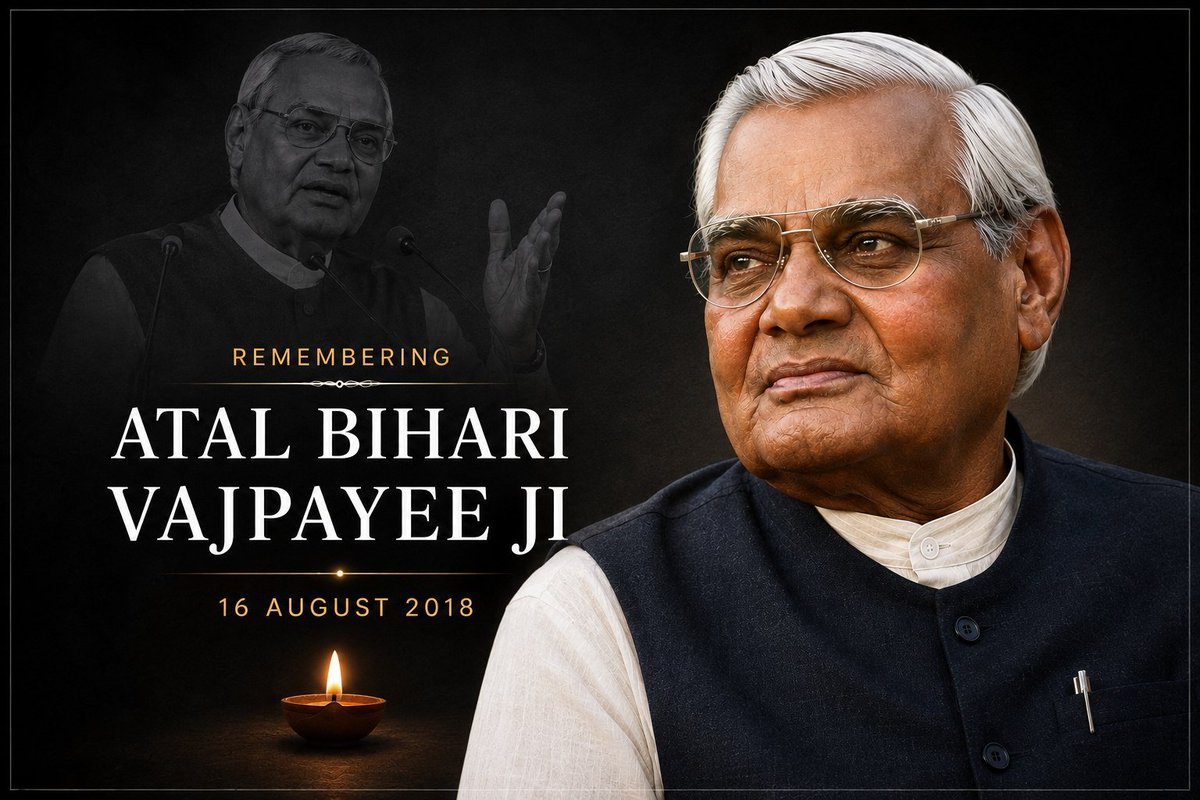
Remembering Atal Bihari Vajpayee Ji
On his Punyatithi, Bharat remembers a statesman, a visionary leader whose words, leadership and unwavering love for the nation left an indelible mark on India.
A leader who inspired generations.
A legacy that continues to endure....
16 August 1946.
Calcutta (now Kolkata) became a killing ground.
Thousands were killed as communal violence engulfed the city during #DirectActionDay.
The #GreatCalcuttaKillings must be remembered, not sanitised, minimised or forgotten.
@RSSorg They refused to bow. They rose against oppression. They chose sacrifice over submission and freedom over fear.
Today, we remember those who gave everything so that India could stand free.
Vande Mataram. 🇮🇳
जय हिन्द!
स्वतंत्रता दिवस की हार्दिक शुभकामनाएँ।
#IndependenceDay
राष्ट्रीय स्वयंसेवक संघ के सह सरकार्यवाह श्री कृष्ण गोपाल जी ने केशवकुंज में किया ध्वजारोहण
नई दिल्ली, 15 अगस्त 2026। भारत के 80वें स्वाधीनता दिवस के अवसर पर शनिवार 15 अगस्त 2026 को दिल्ली के केशवकुंज में श्री केशव स्मारक समिति के तत्वावधान में आयोजित स्वतंत्रता दिवस समारोह में राष्ट्रीय स्वयंसेवक संघ के माननीय सह सरकार्यवाह श्री कृष्ण गोपाल जी ने ध्वजारोहण किया तथा उपस्थित जनसमुदाय को संबोधित किया। समारोह के प्रारंभ में राष्ट्रगीत वन्दे मातरम तथा ध्वजारोहण के बाद राष्ट्रगान जन गण मन का गायन किया गया। केन्द्रीय औद्योगिक सुरक्षा बल (CISF) के दल ने ध्वज को सलामी दी।
देशवासियों को स्वतंत्रता दिवस की हार्दिक शुभकामनाएँ देते हुए माननीय सह सरकार्यवाह श्री कृष्ण गोपाल जी कहा कि भारत अपनी स्वतंत्रता की 80 वीं वर्षगांठ मना रहा है। आज ही के दिन 15 अगस्त 1947 को अपना देश सदियों की पराधीनता के बाद स्वतंत्र हुआ। अपनी स्वतंत्रता के पीछे लगभग एक हजार वर्षों की स्वतंत्रता का संग्राम है। इसके लिए हजारों लाखों लोगों ने बलिदान दिया है।
उन्होंने कहा कि आज सबसे पहले उन महान पुरुषों एवं महिलाओं को स्मरण करें जिन्होंने अपने प्राणों की आहुति दी अथवा जीवन भर कारागारों के पीछे रहे। सिंध के राजा दाहिर, दिल्ली के राजा अनंगपाल, पृथ्वीराज चौहान, राणा सांगा, शिवाजी महाराज, महाराणा प्रताप, छत्रशाल महाराज, दक्षिण भारत की चिन्नमा एवं विजय नगर साम्राज्य के वे लोग जो स्वतंत्रता के लिए लड़ते हुए बलिदान हुए। देश के भिन्न-भिन्न स्थानों पर स्वतंत्रता के लिए यह संघर्ष जारी रहा। अंग्रेजों के आने के बाद यह संघर्ष फिर प्रारंभ हुआ। लोकमान्य बाल गंगाधर तिलक, लाला लाजपत राय, बिपिन चंद्र पाल, डॉ केशव बलिराम हेडगेवार, भगत सिंह, राम प्रसाद बिस्मिल, अशफाकुल्ला खान, चंद्र शेखर आजाद एवं लंबे समय तक संघर्ष करते रहने वाले देश के प्रत्येक प्रांत के बंधुगण, माताएं एवं बहने, हम उन सभी का स्मरण करते है जिनके बलिदानों के कारण यह स्वतंत्रता प्राप्त हुई।
डॉ कृष्ण गोपाल जी ने कहा की स्वतंत्रता के बाद देश ने तेजी से प्रगति किया। हमारा देश अब महान देश के रूप में आगे बढ़ रहा है। इस स्वतंत्रता दिवस पर मैं सभी देशवासियों को शुभकामना देता हूँ कि सारा देश एकजुट होकर आगे बढ़े और विश्व के सामने एक सुंदर आदर्श प्रस्तुत करें।