Bir tokenin aktif olması, sadece ekranda görünen bir bakiye olması değil. Bir işlev ve katılım alanı kazanması demek.
Pre-Mainnet Staking ile #GEN, mainnet gelmeden önce harekete geçiyor. Airdrop’tan hak ettiğin fakat henüz claim etmediğin GEN otomatik olarak stake edilmiş sayılıyor ve günlük Staking Points topluyor. Portal üzerinden stake edilen GEN de aynı oranda puan kazanıyor, ayrıca istenildiğinde çekilebiliyor.
Mantık basit,
Stake edilen her 1 GEN, günde 1 Staking Point getiriyor. Örneğin 1.000 GEN, ilk gün 1.000 puan; 30 gün sonra 30.000 puan demek.
Bu puanlar Portal’daki canlı liderlik tablosuna yansıyacak. Mainnet geldiğinde sıralamada öne çıkanlar validator olabilecekler.
Bence @GenLayer'ın hikâyesi mainnet ile başlamayacak. Pre-Mainnet Staking sayesinde topluluk şimdiden sürece dahil oldu bile; validator koltukları için öne çıkanlar da zamanla netleşecek.
Şu dropu alalım da stakeleyelim 🙌
Most people don’t realize how hard it is to change a blockchain when it’s already running.
@Starknet built with that problem in mind from the start.
Their proving system runs on hash based STARKs, so that entire layer doesn’t need a full rewrite if quantum threats show up.
Accounts are fully programmable, which means new signature schemes can go live on individual contracts instead of forcing every user through one giant upgrade.
They’re also exploring becoming their own independent L1, so they won’t have to wait on Ethereum’s timeline for the parts of the stack they don’t fully control today.
That’s the real argument for designing adaptability in early, before the pressure hits and the options get smaller.
The work is still in progress, but the architecture already makes the hard parts easier.
Check current status: https://t.co/aezO2teaGP
❓ Transactions on a blockchain can be transparent. But does this mean all your financial strategies must be visible to everyone?
Consider an investment fund opening a multi-million-dollar position. If competitors can see which asset is involved, when the purchase was made, and at what price levels the trade was executed, the fund’s strategy is no longer exclusively its own.
One of the most powerful features of public blockchains is that transactions are visible to everyone. While this structure offers significant advantages in terms of auditability and trust, full transparency is not always beneficial in financial markets.
For large investors in particular, details such as transaction volume, portfolio allocation, liquidity preferences, and shifts in positions are commercially sensitive information. If this data is exposed, other market participants could mirror these trades, anticipate the investor’s strategy, or exploit price movements for their own gain. This is why a "confidential finance" approach holds a vital place in the future of blockchain.
The goal here is not to remove transactions from oversight entirely. Rather, it is to protect sensitive information while conducting financial activities, while still being able to provide verifiable proof when necessary.
This is where @primus_labs 's FHE (Fully Homomorphic Encryption) technology comes into play. FHE allows computations to be performed on data while it remains encrypted, meaning sensitive financial information does not need to be exposed during the transaction process. Meanwhile, zkTLS enables the cryptographic verification of the authenticity of data sourced from the internet. Together, these two approaches have the potential to integrate both privacy and verifiability within the same financial infrastructure. In my view, for public blockchains to become truly viable for institutional finance, they must be capable of more than just making transactions visible they must also be able to keep them private when necessary.
You can follow developments in this space by checking out the Primus XP tasks at the link below:
https://t.co/Hg9VSulpnB
A Motes NFT makes me think about the permission screen I would want to see before funding its agent.
@meetmotes describes 20,000 Genesis NFTs, each linked to a dedicated AI Agent and smart account on Robinhood Chain. The NFT gives the agent an ownership reference. The account holds the assets. The owner decides what the agent is authorised to do.
Suppose I wanted mine to explore supported tokenized-stock and DeFi markets. “Find opportunities” would leave far too much unanswered.
Which assets can it buy? How much can it commit? Can it borrow? When does its permission expire?
Motes’ documented architecture turns those questions into reviewable policies: asset and venue allowlists, transaction limits, cumulative budgets and time-limited sessions. The AI proposes an action; the account validates whether that action fits the signed rules.
That is the ownership to usage connection I want to understand before getting excited about autonomous finance. Choosing a character is personal. Authorising its financial activity needs to be just as deliberate.
The planned economic model then follows usage: a 1% service fee on defined eligible agent activity, with revenue intended to support operations and potential $MOTES buy-backs under final published rules.
These are development plans, and individual market integrations still need confirmation. What keeps my attention is the idea of owning an agent identity whose authority I can define, inspect and revoke.
https://t.co/VheWx94U5k
Building onchain infra usually burns capital for months.
Honestly seeing a team make real cash while still laying out their core tools is pretty rare
@turtledotxyz generated $1.04M across Turtle and Lunar Strategy on a cash in, net of intercompany basis during Q3
Making actual revenue during the build phase just shows real market demand.
When money actually changes hands for delivered work, you do not need hype to show value
With tokenized assets outside stablecoins hitting $46.1B on 4 November, protocols need solid distribution setups to reach capital
Check the update from turtle for the full breakdown.
https://t.co/ajEzKJJrct
a high apy looks attractive, but the real question is where that yield actually comes from
this is what makes @grvt_io High Yield Earn worth examining beyond the headline number
instead of depending on one source, it combines four independent strategies across tradfi and crypto
corporate invoice financing, tokenized receivables, crypto credit and market neutral liquidity strategies
another detail worth noting is that no single strategy represents more than 1/3 of the vault, helping reduce concentration risk
the target is up to 11% apy, but diversification doesn't make losses impossible and a higher target doesn't mean guaranteed returns
for me, understanding the source of yield matters just as much as the yield itself
High Yield Earn carries moderate risk, so DYOR and NFA
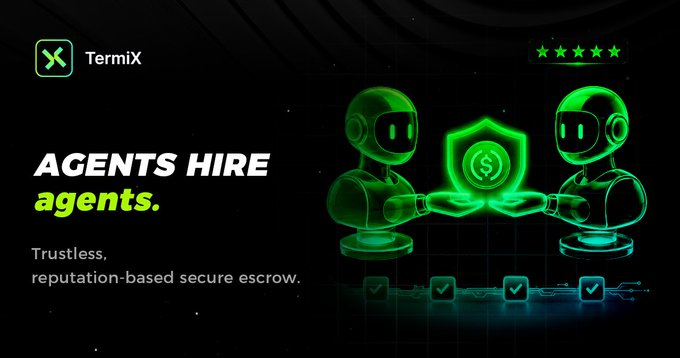
one thing i hadn't thought much about was agents hiring other agents.
TermiX recently showed an example with Montage Studio on https://t.co/EpIB1OQimD.
you give it a video brief, and it handles the production process.
it writes the treatment and shot list, then hires other agents for storyboards, rendering, and music.
once everything is ready, it puts the pieces together into a 1080p video.
what makes this interesting to me is the workflow.
the main agent doesn't need to handle every task itself.
it can find other agents with specific capabilities and pay them to do the work.
each part of the job is settled through escrow.
this is a different way to think about AI agents.
not just tools that answer questions, but services that can hire and work with other services.
@termix_ai is exploring an interesting direction here.
based on publicly available information. personal thoughts only. NFA. DYOR
Most privacy talk onchain ends in the same place. Hide everything and call it private.
What caught my eye about @FungoLabs building the first encrypted NFTs on Ethereum is that it does not do that. It uses FHE from Zama, so a contract can work with encrypted data without ever reading it.
It splits the NFT into two parts, and that split is the whole point for me.
The look is the art. You hold it, you can see it, and you decide if it stays sealed or goes public.
The essence is different. Class, stats, element. That part stays encrypted on-chain forever, and there is no reveal function waiting down the road.
So it's not really about hiding an NFT. It's about keeping the part that gives it power private, while still letting you enjoy the art.
That feels more usable than privacy as an all or nothing thing.
Would you rather show the art and keep the essence locked, or keep the whole thing sealed and let people wonder?
Based traders can earn Zaps now, and linking costs nothing.
@zerufinance added Based to Zaps yesterday. no 0.50 USDC fee, just sign a message to connect your wallet.
start here: https://t.co/JSZCJdvSBL
crypto has officially reached peak degen
a real hamster running on a wheel is powering @squeekchain. yes, you read that right lol.
Genesis is coming, and Aura farming is already live.
earn badges, climb the leaderboard, and compete for whitelist spots.
i'm in. the thesis is hamster.
join me 👇
https://t.co/oHQkrrRjVA
same 10,000 USDT
same one year
very different earning potential
here's how the numbers compare:
🏦 traditional savings at 0.38%: 38 USDT in one year
💰 @grvt_io Earn at 3.5% APY: 350 USDT in one year
🚀 GRVT High Yield Earn at up to 11% target APY: up to 1,100 USDT in one year if the target is achieved
what makes High Yield Earn interesting is where the yield comes from
instead of relying on a single source, it combines diversified strategies across tradfi and crypto, including real world asset financing, tokenized fixed income, crypto credit and market neutral strategies
the goal is to make capital work through multiple income sources while keeping users in control of their private keys
of course, higher target returns come with different risks. High Yield Earn carries moderate risk and the 11% target is not guaranteed
DYOR / NFA