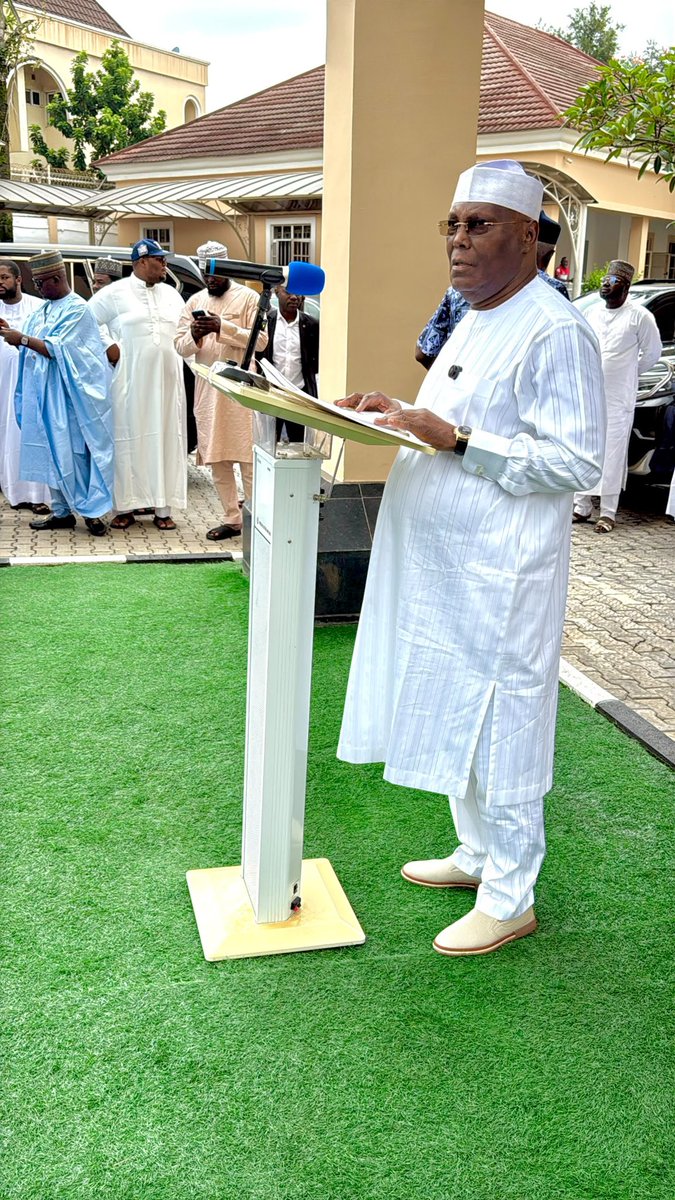
ADDRESS ON FUEL PRICES, PALLIATIVES AND THE COST OF LIVING
By His Excellency Atiku Abubakar, GCON
Fellow Nigerians,
Since May 29, 2023, Nigerians have lived with the consequences of the removal of petrol subsidy without adequate protection for families, workers, farmers and businesses during the transition.
For more than three years, that burden has travelled from the petrol station to the bus stop, from the bus stop to the market, and from the market to the family dining table.
When petrol becomes expensive, transportation becomes expensive. When transportation becomes expensive, food becomes expensive. Farmers pay more to move produce. Traders pay more to stock their shops. Workers pay more to get to work. Businesses pay more for logistics and energy.
In the end, the Nigerian family receives the bill.
When government makes energy expensive, it makes life expensive.
This is no longer an argument between economists. It is the daily reality of millions of Nigerians.
These are the real tests of an economic policy.
When I first argued that government should review its approach to the withdrawal of petrol subsidy and consider responsible intervention to bring down the cost of fuel, Mr. Bola Tinubu dismissed my proposal as demonstrating “serious ignorance” of governance and the economy.
My dear Bola, events since then have raised a simple question.
Is the Nigeria Labour Congress also ignorant when it calls for urgent intervention to cushion workers from rising petrol prices?
Are petroleum marketers ignorant when they call for policies that strengthen domestic refining and help moderate pump prices?
Are Nigerian manufacturers ignorant when they warn that power-related expenses now consume more than half of operating costs?
And are the millions of Nigerians crying out because they can no longer afford transportation, food and other basic necessities also ignorant?
When workers, producers, marketers and ordinary families are all raising the alarm, government must listen.
If everybody who questions your policy is ignorant, while only the President is presumed to be wise, then we have a leadership problem on our hands.
Leadership requires the humility to confront the consequences of policy and the courage to change course.
Across our factories, production costs are rising while unsold goods pile up in warehouses. Manufacturers struggle to keep producing; families struggle to afford what they produce.
The goods are there. The need is there. What is missing is the purchasing power.
Government celebrates GDP growth, higher revenues and bigger allocations. But Nigerians judge the economy by what their money can buy.
If government receives more naira while the citizen���s naira buys less food, less fuel, less electricity and less transportation, then bigger government revenues mean little to the family struggling to survive.
Economic growth must enter the home.
It must enter the market basket.
It must show up in the purchasing power of the worker.
A government collecting more money while its citizens can afford less cannot declare victory on the strength of bigger numbers alone.
Reform must ultimately be judged by what it does to the lives of the people. It should expand production, create opportunity and improve living standards. It cannot become an endless explanation for hardship.
That is why I am calling on Mr. Bola Tinubu to act now.
He has approximately eight months remaining in office.
Bola, I want you to Use those 8months to give Nigerians relief.
And let me say this plainly:
Bola Tinubu should not be ashamed to do what is necessary to lower the price of petrol simply because Atiku Abubakar proposed a government intervention.
He should just take the idea.
Rename it if he wishes
And even take the credit.
What matters to me is that, Nigerians pay less.
A sensible idea does not become a bad idea because it came from your opponent.
Took time to read and digest Atiku’s subsidy plan.
THE POLICY - Restore subsidy, but only as a production subsidy, not an import subsidy i.e. Subsidise Nigerian production, not foreign importation.
IN SHORT - Produce here. Refine here. Create jobs here. Pay less here (put cheaper fuel into Nigerian pockets).
HOW?
�� Restore subsidy, but move it from importation to production.
• Support is tied only to crude refined in Nigeria. If you do not refine here, you do not qualify.
• Government reduces the cost of crude feedstock into qualifying domestic refineries through a capped, transparent, independently verified mechanism.
• Lower input cost leading to lower production
I entered the Nigerian Military School at the age of 11. I started receiving military training from JSS1, crossing obstacle courses, doing service jobs, participating in military drills, and learning discipline from a very young age.
By JSS3, around the age of 13–15, I had already started going for bush camping. I endured rigorous flogging and punishments, learned to adapt to difficult situations, and developed the ability to take care of myself under challenging conditions.
By SS1, I started going to the shooting range, where I was trained to handle weapons such as the AK-47, FN rifle and GPMG. We also had proper bush camping, shooting blanks, learning fieldcraft, and being exposed to experiences that shaped us at a very young age.
Then there was the whole culture of serving our seniors. In JSS2 and JSS3, I used to shine my seniors' boots, iron my master's uniform, arrange my room and carry out various duties. It taught me responsibility, discipline, humility and how to manage myself even when things weren't convenient.
By Class 6, I became a White Man, I had more freedom, especially within the hostel, but officers and soldiers were still there to keep you disciplined and make sure you stayed on your toes.
Throughout all these years, I made friends who became more like brothers. We covered for each other, motivated each other, endured difficult situations together and still found ways to laugh, even when the situation didn't permit it. Those experiences created bonds and memories that don't simply disappear because you graduated.
After everything I experienced, you expect me not to carry it for head?
I carry am for head dieeeee.
And mind you, this is only a fraction of what I experienced at the Nigerian Military School.
Even Generals who graduated 30 or 40 years ago still carry the NMS identity with pride. Look at the calibre of people the school has produced, from senior military officers to accomplished individuals in the civil and political sectors, both in Nigeria and abroad.
So yes, I carry it with pride.
Long live the Nigerian Military School.
I am damn proud to be an EX-Boy.
One thing I found intriguing about Umar Bahaushe’s story is that when the Fulani found out they couldn’t beat him militarily, they decided to whip up ethnic sentiment, saying he couldn’t rule because he wasn’t “Fulani.” It shows how much they had already been corrupted and forgotten what the jihad set out to achieve in the first place. It wasn’t that he was less learned or less pious; it was about his ethnic background.
Umaru Bahaushe (c. 1847 to 1856) – The Etsu Nupe That Never Was
By 1833, the death of Mallam Dendo at Raba marked the official appointment of Usman Zaki, the second-oldest son of Dendo, as the first Fulani Etsu (Emir of Nupe) in 1833, as Dendo founded the Fulbe dynasty at Raba.
No sooner had Usman Zaki emerged as the first Fulbe Etsu at Raba than the problem of consolidation arose within the Dendo family. Intra-dynastic rivalries emerged among Dendo’s sons over the rights and legitimacy of leadership in the newly established dynasty. Mohammad Saba, popularly known as Masaba, the youngest son of Dendo, strongly opposed Usman Zaki’s appointment, leading to a civil war among members of Dendo’s family.
The precarious political situation in Nupe attracted the attention of Gwandu under whose sovereignty Nupe was. The Intervention of Gwandu upheld the right of Usman Zaki to rule. Masaba was to return to Lade. However, this and other interventions of Gwandu were far from finding solutions to the political crisis in Nupeland.
The implications of these turbulent situations were multi-dimensional. First, the unity and political stability in the newly established Fulbe dynasty were far from being achieved among the Dendo sons. Secondly, members of the old Nupe dynasty had continued to launch campaigns against the new Fulbe dynasty with the hope of regaining their lost political independence. For instance, Majiya’s son and successor is reported to have declared, “I wish to tear Nupeland from the Fulbe clutches and restore it to the children of Edegi.” Thirdly, the uprisings from other Nupe sub-groups also created a consolidation problem. The situation provided an opportunity for certain ambitious people to take advantage of the situation and take over the leadership position. One such personality was Mayaki (War Commander) Umaru Bahaushe.
Umaru Bahaushe is believed to have come to Raba as a fugitive after serving under the Borno army, which set out unsuccessfully to overrun some of the eastern emirates of the Sokoto Caliphate.
Umaru Bahaushe joined the army of the first Fulbe Etsu, Usman Zaki, in Raba under the command of Mayaki Andi Boshi. He is said to have learnt a lot of military tactics from his master, Andi Boshi. After the death of the latter, Umaru became the Mayaki (war commander), under whom the two surviving sons of his master, Muhammad Shafiyi and Muhammad Balko, served. He led several successful expeditions under Usman Zaki and Masaba respectively.
Gradually, Mayaki Umaru became very powerful and popular due to his bravery, courage, and tactics on the warfronts. He, no doubt, attracted more and more followers to his side, which appeared to have made him self-dependent, such that he is reported to have started defying orders and directives from the new Etsu, Masaba—his master. For instance, the former’s directive to fight Mu’azu Isa and Maza, the descendants of Tsoede (the previous Nupe dynasty), who were causing a serious threat to Masaba at Yeti, was disobeyed. Another instance of Mayaki Umaru’s disobedience to Masaba was the former’s request to send a beautiful captive woman to him, as he directed, before Mayaki’s return to the base from the warfront. Masaba did not take this lightly.
Not unexpectedly, a strained relationship developed between Masaba and Umaru Bahaushe. The former is said to have enjoyed the support of the Nupes and the Fulani alike, as they flocked to him in droves for protection against Masaba’s "high-handedness". Following this development, a civil war broke out between Masaba and Usman. The latter led his troops from his campaign camp to Lade—Masaba’s capital. In the ensuing battle, Masaba was defeated. Many of his supporters are reported to have left him, joining forces with Umaru’s. The defeat forced Masaba to flee to Ilorin to seek refuge with his co-Jihadists there.
The political atmosphere in Nupe became highly charged and confused. A leadership vacuum was created as Dendo’s sons now became scattered—Masaba at Ilorin, Usman Zaki at Gwandu, and Umaru Majigi at Birnin Kebbi.
Mayaki Umaru seemed to show his unwillingness, at least initially, to assume the leadership position in Nupe. He appointed Yusuf Tsado Dzuru, one of the grandsons of Dendo. This appointment was resented by the Nupes—Tsoede descendants, who appeared to have been waiting for an opportunity to stage their comeback to power in Nupeland. This led to a series of campaigns by Mayaki Umaru against the Nupe Etsuzhi, including those who initially joined forces with him to defeat Masaba at Lade.
The Mayaki eventually became victorious over the Nupe Etsuzhi at the Yeti encounter, in which one of the Etsuzhi, Maza, was killed, while Mu’azu Isa, the other Etsu, managed to escape. The situation now became ripe and appropriate for an ambitious Mayaki Umaru Bahaushe to proclaim himself the “undisputed leader.”
This development did not go down well, not only with the descendants of Tsoede, particularly Etsu Mu’azu Isa, but also with the sons of Dendo who were then in exile.
News of Mayaki Umaru’s proclamation as Etsu (Emir) and apparent recognition by Emir Halilu of Gwandu went far and wide. The years between 1845 and 1857 witnessed the alignment of forces against Umaru to challenge his candidature. For instance, Umaru Majigi, Dendo’s grandson, was dismayed at Mayaki’s assumption of power as the Emir. In a desperate move, Majigi arrived from Birnin Kebbi/Gwandu, where he had been in exile with Usman Zaki, to declare war on the “usurper.”
Umaru Majigi settled on the eastern part of the Kaduna River, a stronghold of the Nupe Bini sub-group. At Bida, then a war camp, Majigi sought and received the support of Etsu Mu’azu Isa (c. 1849–1872) to challenge Umaru Bahaushe.
In the first encounter, which took place at Ezhigi and Sakpe, Mayaki inflicted heavy defeats on the allied forces of Umaru Majigi. After this, Majigi adopted a strategy of whipping up kinship sentiment against Bahaushe. The former told people that the latter was not of Fulbe stock, since he was not a descendant of Mallam Dendo, and therefore was not eligible to become Emir. Messages to this effect were sent to other Fulbe, both living within Nupeland and those in exile outside the kingdom. He called on them to return to Nupe for the purpose of eliminating the “foreigner” and “usurper” and restoring the “true” Fulani aristocratic dynasty in Nupe.
Umaru Majigi is reported to have pleaded to his fellow Fulbe:
“Come now, victory will soon be ours. There is no king of Nupe……. we will sink our differences. The Emirship of Nupe is a matter which concerns every Fulbe (Fulani). Therefore thy brother Usman Zaki must now be made Emir. The victory will be won very soon. Come therefore.”
Following the above summons, Usman Zaki returned from Gwandu, where he had been in exile, to join Umaru Majigi, who had earlier returned to Nupe. Zaki was accompanied by a large number of soldiers led by the Waziri of Gwandu, Dan Adama, representing the Emir of Gwandu. The army was to secure the re-establishment of the Fulbe hegemony under the descendants of Mallam Dendo at Raba.
The allied Fulbe forces engaged Mayaki Umaru Bahaushe, pursuing him until they got to a small Bini settlement called Bida, a walled city-state serving as a war camp. In a series of encounters, lasting for several years, the rebel was eventually defeated in 1857. He was either killed on the battlefront or drowned while trying to cross the Gbako River near Badeggi, along the Agaie–Lapai road. His body is reported to have been recovered by the pursuing party, and his head was decapitated and exhibited for public viewing on the walls of Bida or Raba, as some sources say. Wherever the exhibition took place, the fact remains that the Mayaki was killed.
With this defeat, the descendants of Dendo, in alliance with the Nupe Bini settlements and the shadow Nupe Etsu, Mu’azu Isa, around Bida, had destroyed their most dangerous enemy in Nupe—Mayaki Umaru Bahaushe, “The Etsu Nupe That Never Was.”
Ikr. You’d struggle to find a City fan around, you rarely see them.
And club size isn’t defined by trophies alone. It’s a combination of history, influence, fan base, global appeal, cultural impact and overall reach. By those measures, City is nowhere near the level of the other big clubs.
Not too long ago, the traditional “big four” were Manchester United, Liverpool, Arsenal and Chelsea. City only really entered the conversation when people started talking about the “big six” and even Spurs were being mentioned before City became a permanent part of that discussion.
And let’s be clear: Manchester United isn’t just the biggest club in England. United is the biggest football club in the world.
Nigeria’s Insecurity Is Not Beyond Us. We Have Normalised Failure.
I have followed Nigeria’s insecurity more closely than many Nigerians. I come from a state devastated by insurgency. I have built much of my career reporting conflict, accessing non-state actors and places where state authority barely exists, interacting with successive security leaders, and mediating crises, many of which will remain untold.
My conclusion after all these years is uncomfortable: many of the solutions are already at the doorstep of our security leaders.
We are better equipped, better educated, better resourced and possess far greater intelligence capabilities than every terrorist, insurgent, bandit, kidnapper or separatist organisation confronting the Nigerian state. Yet men in the underground repeatedly stay ahead of us.
They organise. They observe us. They listen. They learn. They adapt. Then they strike where and when we least expect them.
Our institutions too often fail to do the same.
Part of the problem is consequence. When mass abductions happen, communities are massacred or intelligence failures cost lives, who answers for failure? Too often, commanders change, governments condemn the attack, committees are constituted, and the country moves on. We have gradually normalised what should be intolerable.
There is also a deeper societal problem. We have conditioned ourselves to believe that only God solves our problems, that somehow we do not have to work hard enough at solving them, we only need to pray harder. I am a person of faith. I believe profoundly in prayer. But faith cannot become an alibi for human failure. God has given us intellect, knowledge, agency and responsibility. Prayer should strengthen our resolve to act, not relieve us of the obligation to act.
Nigeria needs to institutionalise security away from personalities and informal relationships. We must discard transactional security management, preserve institutional memory, reward competence and impose consequences for failure, especially when human lives are lost.
And our leaders must become adaptive. Terrorism in Borno is not armed violence in Zamfara. Kidnapping in the North-Central is not separatist violence in the South-East or organised predation in our cities. Different threats require different intelligence, policing, political and socio-economic responses.
Nigeria does not lack brave people, intelligence or solutions. We have failed to organise, observe, listen, trust and invest in ourselves sufficiently to stay ahead of those trying to destroy us.
That is a failure within our power to correct.
K-Pop = Korean Language Pop
J-Pop = Japanese Language Pop
YoruPop = Yoruba Language Pop
If they say it’s Yorupop then it’s Yorupop.
You're not the one being boxed in, it's their career and they can define it how they choose.
Me personally I’m tired of the generic Afrobeats labels. Nigeria is diverse, let alone Africa. Yorupop to the world.
This woman is literally spitting in the face of ordinary Nigerians, and the very citizens she is mocking are predictably lining up in the comment section, holding hands, jumping up and down, and clapping passionately for her.
This tragic reaction is not surprising, considering that our cash-and-carry media houses continue to heavily, deliberately localize all of our structural problems.
Every Nigerian has been practically lobotomized and brainwashed to believe that the only reason we do not have robust domestic industries and stable electricity grids is because the President, the 36 state governors, the 774 local government chairmen, and various agency heads are all inherently corrupt and stealing money. 1/5
@Fuadoluwadamil1@egtapere Ilorin is a military garrison town of the Oyo empire so therefore they can not have a king. This is painstakingly documented throughout history
@Ibrahim96270385@Bahaushe_Zalla The person I replied understood exactly what I meant and you can see from his reply. I didn't shade him nor did he shade me in his reply. You, on the other hand, just jumped into the Convo without understanding the context.
@Ibrahim96270385@Bahaushe_Zalla Are you talking about me or Bahaushe zallah?
He acknowledged my observation and instead of you to say something meaningful you are here with your conspiracy theory. What does John or James have to do with your name being khaleel instead of a real Hausa name?
The naming issue was mostly religeous names of proohets & Sahaba (mostly Arabs) that were Hausanized like Abubakr- Bakari, Yusuf- Isuhu etc Random Arab names is a recent phenomena that is being tackled. Still the average Hausa man embodies his native culture more than any other ethnicity in Nigeria.