A next-generation solar panel production company delivering Grade A solar panels and high-performance solar street lights, built for durability and efficiency.
Electricity costs keep rising. Solar is a long-term solution.
Our panels are engineered to deliver consistent output and dependable performance for years.
Would you switch to solar if the ROI made sense within 2-3 years?
#CleanEnergy
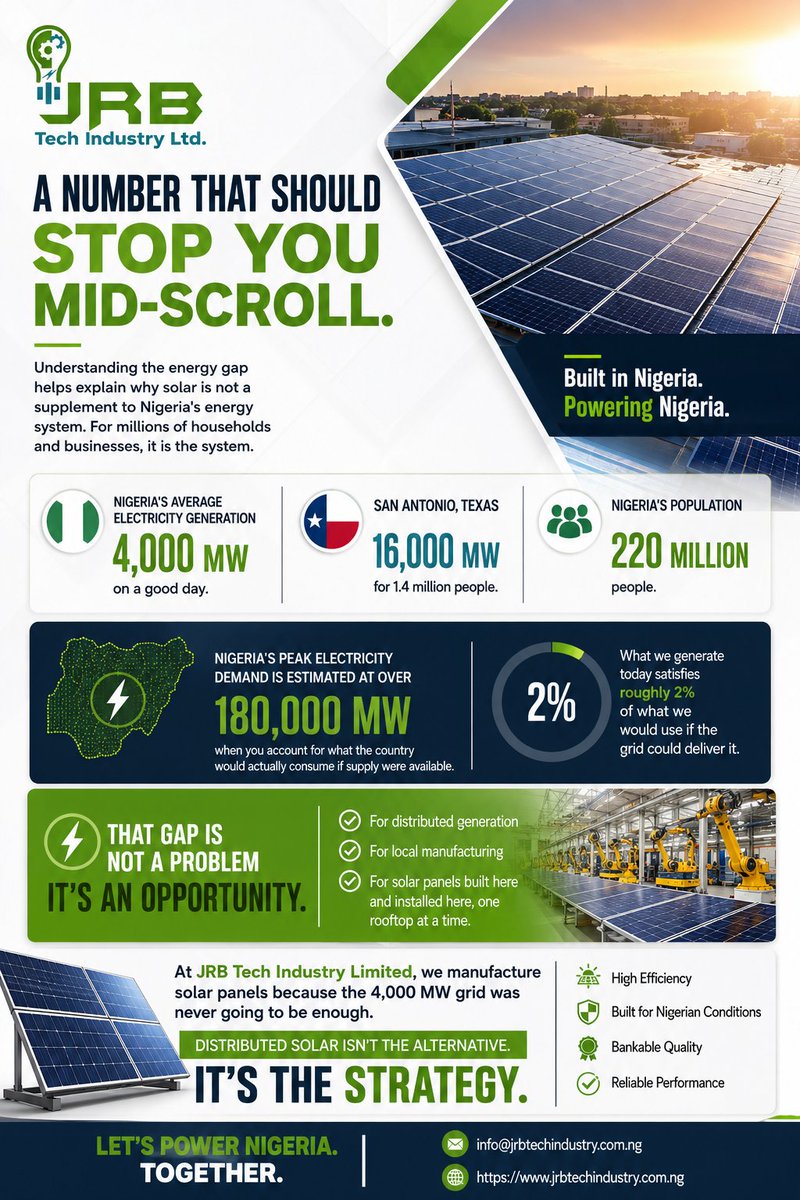
Nigeria generates ~4,000 MW of electricity for 220 million people.
San Antonio, Texas (pop. 1.4 million) has access to 16,000 MW.
This is why solar isn't a backup plan in Nigeria.
It's the plan.
JRB Tech manufactures it locally.
#NigeriaEnergy#JRBTech#SolarNigeria
Choose OFF-GRID if:
→ No grid connection exists
→ Grid supply is effectively useless
→ You need guaranteed autonomy
Both need quality panels at the foundation.
JRB Tech makes them.
#HybridSolar#OffGridSolar#JRBTech
Hybrid or off-grid solar — quick decision guide:
Choose HYBRID if:
→ You have any grid connection, even unreliable
→ You want Net Billing 2026 eligibility
→ Budget flexibility matters
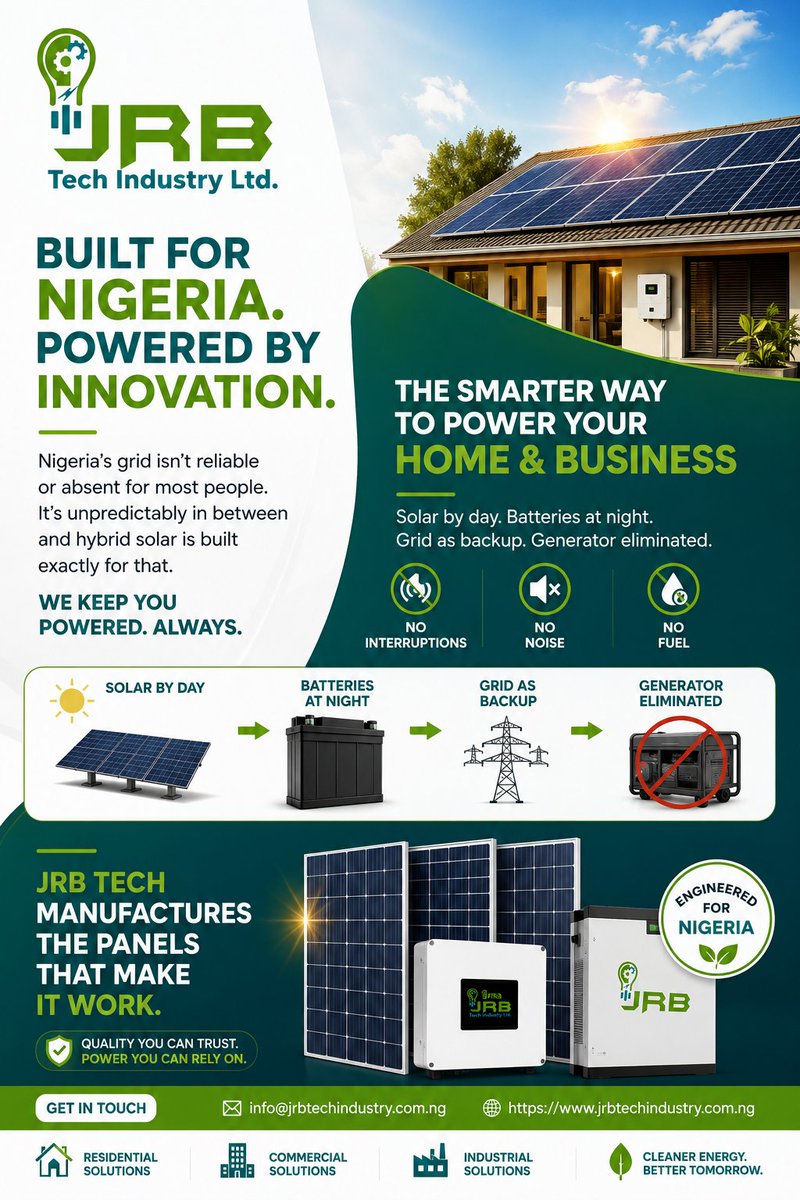
Nigeria's grid isn't reliable OR absent for most people.
It's unpredictably in between and hybrid solar is built exactly for that.
Solar by day. Batteries at night. Grid as backup. Generator eliminated.
No interruptions. No noise. No fuel.
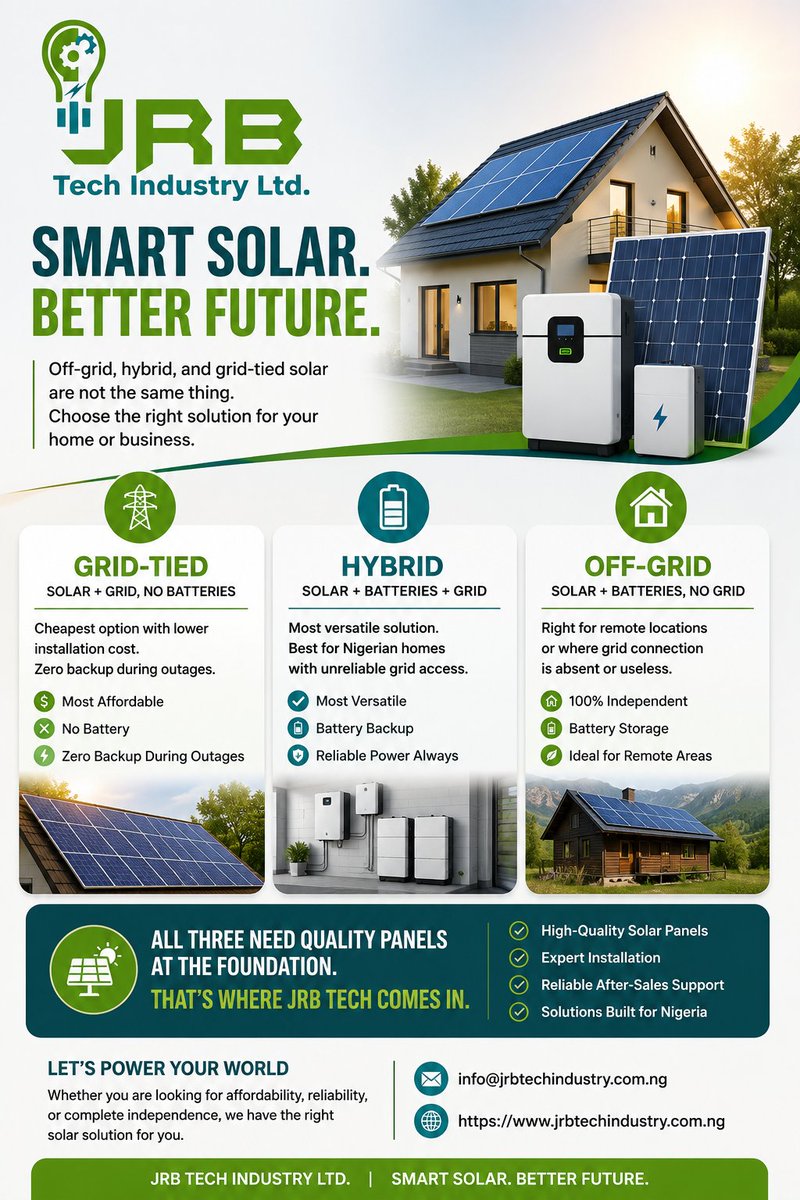
Off-grid: solar + batteries, no grid at all. Right for remote locations or where grid connection is absent or useless.
All three need quality panels at the foundation. That's where JRB Tech comes in.
#OffGridSolar#HybridSolar#JRBTech
Off-grid, hybrid, and grid-tied solar are not the same thing. Quick definitions
Grid-tied: solar + grid, no batteries. Cheapest. Zero backup during outages.
Hybrid: solar + batteries + grid. Most versatile. Best for Nigerian homes with unreliable grid access.
Home solar costs in Nigeria, honestly:
Small system (essentials): ₦800k–₦1.8M
Medium system (+ AC, washer): ₦2M–₦4.5M
Large system (multiple AC, big battery bank): ₦5M+
Compare that to ₦600k–₦1.2M/year on generator fuel, with nothing to show for it.
This is what energy independence actually looks like. Not a kilowatt number — an evening that finally feels normal.
Drop a 🙏 if you know exactly what this feels like.
A Nigerian household's evening — before and after solar.
BEFORE:
Generator running loud. Diesel smell. Kids doing homework near the noise. Lights off by 10pm to save fuel.
AFTER:
Quiet house. Lights on as late as needed. No diesel smell. No fuel rationing decisions.
Common mistake: sizing your home solar system based on what a salesperson recommends instead of what you actually consume.
List your essential loads. Estimate daily kWh. Account for your usage pattern. Size with a buffer, not a guess.
JRB Tech does proper load assessment first
✅ Manufacturer support based in Nigeria — reachable in year 3, year 5, year 10
✅ Developer pricing for project orders
Getting us involved at the design stage saves cost and avoids complications later.
📩 DM JRB Tech today to start the conversation.
Happy Friday.
Developers — here's exactly what working with JRB Tech looks like.
✅ Pre-design panel specification consultation
✅ Bulk supply manufactured in Nigeria — no import delays
✅ Full QC documentation for NERC & ESG compliance
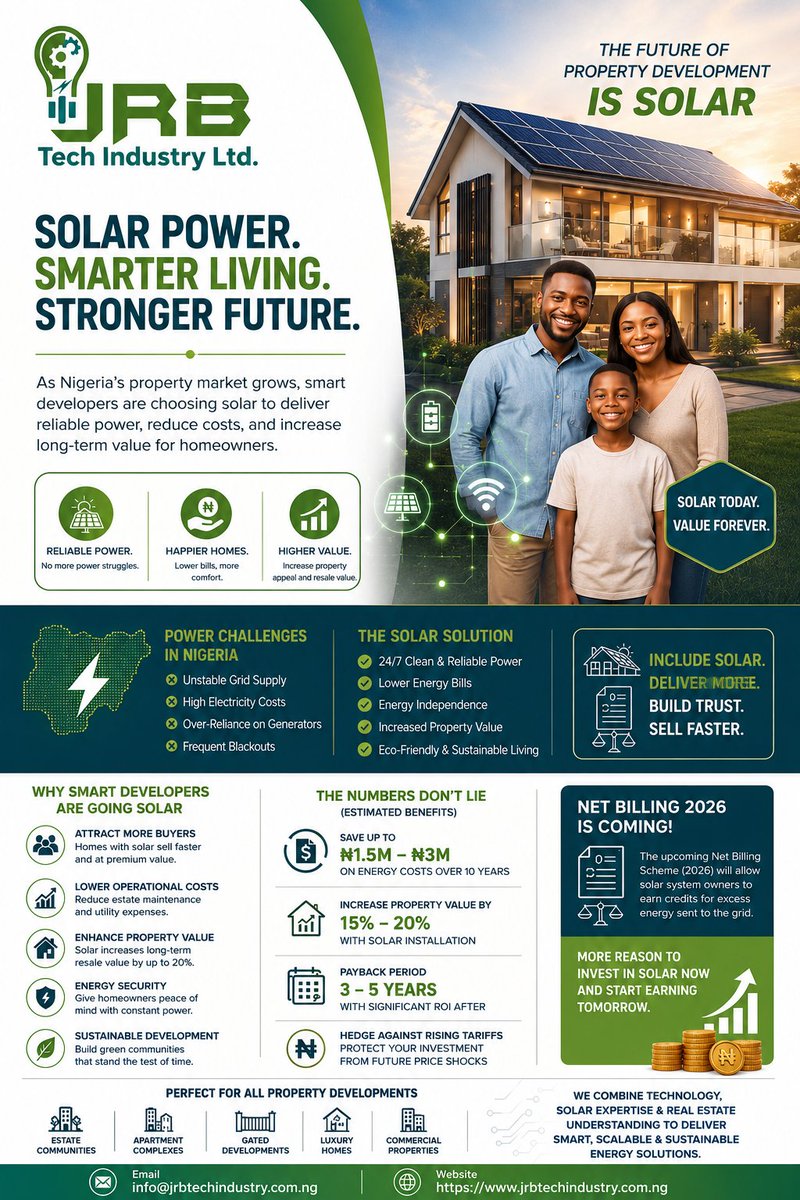
The first question Nigerian property buyers ask in 2026 is no longer just about location.
It's: "What is the power situation?"
Energy reliability is now a primary purchase criterion for residential buyers, corporate tenants, and institutional investors across Nigeria.
An energy-positive development generates more electricity than it uses — and earns from the surplus.
With NERC Net Billing 2026 now live, this is buildable in Nigeria today.
Not a concept. Not a future aspiration. A design decision.
Does solar add property value in Nigeria?
Yes — but not because of future savings like in the US.
It adds value because it removes the problem every Nigerian buyer faces after handover:
"Now I have to spend ₦3–8M sorting out power myself."