So Guys
I found one of the weirdest things being built on Robinhood Chain.
It’s called FLUSH. @flushfun
Lets look at the idea behind what this team built?
Poker, but every card is a company.
At first, I thought it was just another crypto game.
Then I started looking into it.
Instead of getting normal playing cards, you get companies.
You keep the ones you want, redraw the others, and try to build the strongest hand.
And the interesting part:
Winning hands can pay out in the corresponding Robinhood Stock Tokens.
So a company like Apple isn't just something you hold.
In this game, it can become a card.
And that's where this got interesting for me.
We talk about tokenization all the time:
Stocks onchain.
RWAs.
Programmable assets.
Composability.
But those words can get pretty abstract.
@flushfun makes the idea much easier to see.
Robinhood puts financial assets onchain.
Then developers get to experiment with what those assets can actually become.
A lending asset.
A trading asset.
A collateral asset.
Or apparently...
a poker card.
The builder behind FLUSH is @dt_obrien , and the project is still extremely early.
But its launch attracted a surprising amount of attention for something this small.
I'm not particularly interested in predicting what happens to $FLUSH.
I'm more interested in the experiment itself.
Because maybe the interesting part of tokenization isn't simply putting stocks on a blockchain.
Maybe it's what people start building once they're there.
And if that's the case...
FLUSH might be a very small preview of a much bigger idea.
What else will people build when real-world assets become programmable?
next phase already coming at me with tasks and new roles to smash
got my focus on shipping growth funnels for early rwa's & onchain consumer brands.
5 industries i'm locked in on:
- rwas:
tokenized real businesses, starting with edibles & stocks.
- onchain money:
self custody, stablecoin spending, identity without borders.
- trading infrastructure:
ai native terminals for traders/degens.
- collectibles:
graded cards and pack culture on hyperliquid.
- cronos:
a chain becoming the settlement layer for tokenized markets.
I'm heavy on research, content, community mechanics and campaigns that turn attention into real users.
there's a lot of collabs and community activations already in the pipelines.
more soon. 🏄♂️
New testnet opportunity 👀
@ordinetwork recently launched its highly anticipated testnet, and if you’re actively exploring new ecosystems, this one is worth exploring early.
Getting early reps on new Bitcoin ecosystem testnets can be useful for building your on-chain footprint and understanding how the ecosystem works.
Here’s a simple guide to getting started with OrdiNetwork:
➠ Claim faucets
Head over to the OrdiNetwork platform and connect your wallet.
You can claim testnet assets such as paper BTC, USDT, and USDC from their faucet. The faucet can be claimed every 24 hours, so make sure to come back regularly.
➠ Trade on the spot market
Once your wallet is funded, put those testnet tokens to use.
Head over to the spot markets and execute a few trades. This allows you to interact with the platform and generate on-chain activity while testing out the trading experience.
➠ Create or buy tokens
You can go a step further by creating your own tokens directly on the testnet.
You can also explore tokens created by other users and interact with them by buying existing ones.
This gives you another way to explore the network and test its functionality.
➠ Explore the ecosystem
Don’t stop at trading and token creation.
Take some time to explore other parts of the OrdiNetwork ecosystem, including their Bitcoin Settlement System and SubAgents marketplace.
The more you understand the ecosystem, the easier it becomes to identify other opportunities to interact with it.
Pro tip: Consistency matters.
Bookmark the faucet and check back regularly. Instead of doing everything once and forgetting about it, try to interact with the testnet a couple of times each week.
As always, do your own research before spending significant time or funds on any opportunity.
Early reps + consistent activity = a stronger on-chain footprint.
Thank you for taking your time to checkout my piece, lob y’all.🫂
how to deal with comparison
when you catch yourself comparing:
• identify what you’re actually jealous of
• turn it into information
• focus on your own next step
• stop checking constantly
• remember you’re seeing one part of their life
Original content doesn’t always mean discovering something nobody has ever said.
Sometimes it’s taking an existing idea and explaining it through your own experience.
Your perspective is the differentiator.
@variational_io has confirmed that 32% of its $VAR supply will go to points holders.
But before you start trading for it, there's something you should understand.
I spent some time looking into how the points actually work.
Here's what I found.
Variational is building Omni, an onchain derivatives platform where users can trade crypto, stocks, commodities and indices.
And its points program rewards activity on the platform.
So, how do you get started?
1. Set up your account
Visit the official Omni platform and connect a compatible wallet.
You'll need USDC on Arbitrum to fund your account. Omni handles the trading experience without requiring you to pay separate gas fees for each transaction.
Here is a link to the guide >>
https://t.co/X072CwUvzK
2. Understand how points are earned
Points are distributed weekly, based on activity from the previous week.
Trading volume is one factor, but it isn't the whole story.
Variational says it considers several metrics, including organic platform activity.
The exact allocation formula hasn't been made public.
You can check it out here > >
https://t.co/3EpMkPR5l4
3. Know what the extra boosts do
There are a few ways to increase your points:
→ Early traders receive a permanent 10% boost.
→ Referrals earn you 1 point for every 10 points generated by your referred users.
→ Higher reward tiers provide additional points boosts, ranging from 0.5% to 5%.
But don't confuse a points boost with a guaranteed allocation.
4. Keep track of your points
You can check your points through the Omni Points page.
The important thing is to make sure you're using the same wallet. Points and trading history are tied to your wallet address and cannot be transferred to another one.
Now, here's the part I really want you to pay attention to.
The 32% allocation is real.
But your eventual share depends on your points relative to the total eligible points, not simply how many you accumulate.
And because the formula is undisclosed, nobody can reliably tell you what a particular points balance will be worth.
Trading also carries real risks. Spreads, funding costs, leverage and market movements can easily outweigh any potential token reward.
My take?
Understand the product before chasing the points.
If you were already interested in using Omni, the rewards are worth keeping an eye on.
But don't risk money you can't afford to lose just because a token allocation has been announced.
The opportunity is worth researching. The outcome is not guaranteed.
GUYS HERE IS A POTENTIAL AIRDROP TO LOOK AT :
For months, people have been farming @variational_io points without knowing what they were actually worth.
Now we finally have an answer.
Variational just confirmed that 32% of the total $VAR supply will go to its Genesis Distribution.
And the tokens will be 100% unlocked at TGE.
Here's why I'm paying attention.
Variational is building an onchain derivatives platform called Omni.
Users trade on the platform and earn points through their activity.
Until now, the big question was:
What do these points actually turn into?
We finally have part of the answer.
The 32% Genesis Distribution will be shared among eligible points holders based on their points balance.
The token launch is planned for Q4 2026.
And the points program isn't ending yet.
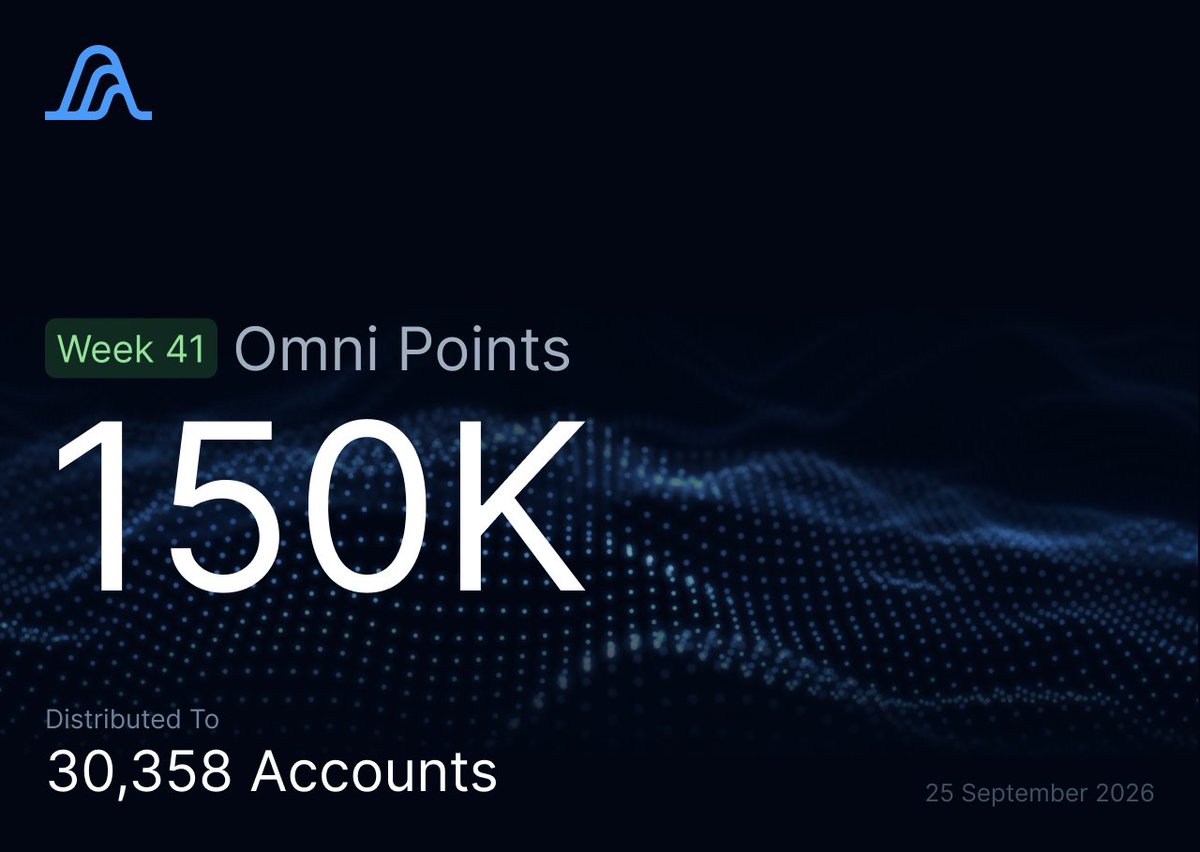
Variational says it will continue distributing 150,000 points every week until TGE.
There is one important detail:
You need at least 1 point to be eligible to sign the $VAR Terms of Service and receive a share of the Genesis Distribution.
Unclaimed tokens will be burned.
The rest of the initial supply looks like this:
→ 32% — Genesis Distribution
→ 18% — Ecosystem Reserve
→ 50% — Team & Investors
Team and investor tokens are locked for 12 months after TGE, followed by at least three years of vesting.
So yes, the 32% number is big.
But I'm more interested in what happens between now and TGE.
How many points will exist by then?
How will the final distribution look?
And how much activity will it take to earn a meaningful share?
I'm digging into Variational this week.
Because now that we know what the points are for, the real question is whether they're actually worth chasing.
GUYS HERE IS A POTENTIAL AIRDROP TO LOOK AT :
For months, people have been farming @variational_io points without knowing what they were actually worth.
Now we finally have an answer.
Variational just confirmed that 32% of the total $VAR supply will go to its Genesis Distribution.
And the tokens will be 100% unlocked at TGE.
Here's why I'm paying attention.
Variational is building an onchain derivatives platform called Omni.
Users trade on the platform and earn points through their activity.
Until now, the big question was:
What do these points actually turn into?
We finally have part of the answer.
The 32% Genesis Distribution will be shared among eligible points holders based on their points balance.
The token launch is planned for Q4 2026.
And the points program isn't ending yet.
Variational says it will continue distributing 150,000 points every week until TGE.
There is one important detail:
You need at least 1 point to be eligible to sign the $VAR Terms of Service and receive a share of the Genesis Distribution.
Unclaimed tokens will be burned.
The rest of the initial supply looks like this:
→ 32% — Genesis Distribution
→ 18% — Ecosystem Reserve
→ 50% — Team & Investors
Team and investor tokens are locked for 12 months after TGE, followed by at least three years of vesting.
So yes, the 32% number is big.
But I'm more interested in what happens between now and TGE.
How many points will exist by then?
How will the final distribution look?
And how much activity will it take to earn a meaningful share?
I'm digging into Variational this week.
Because now that we know what the points are for, the real question is whether they're actually worth chasing.
GUYS HERE IS A POTENTIAL AIRDROP TO LOOK AT :
For months, people have been farming @variational_io points without knowing what they were actually worth.
Now we finally have an answer.
Variational just confirmed that 32% of the total $VAR supply will go to its Genesis Distribution.
And the tokens will be 100% unlocked at TGE.
Here's why I'm paying attention.
Variational is building an onchain derivatives platform called Omni.
Users trade on the platform and earn points through their activity.
Until now, the big question was:
What do these points actually turn into?
We finally have part of the answer.
The 32% Genesis Distribution will be shared among eligible points holders based on their points balance.
The token launch is planned for Q4 2026.
And the points program isn't ending yet.
Variational says it will continue distributing 150,000 points every week until TGE.
There is one important detail:
You need at least 1 point to be eligible to sign the $VAR Terms of Service and receive a share of the Genesis Distribution.
Unclaimed tokens will be burned.
The rest of the initial supply looks like this:
→ 32% — Genesis Distribution
→ 18% — Ecosystem Reserve
→ 50% — Team & Investors
Team and investor tokens are locked for 12 months after TGE, followed by at least three years of vesting.
So yes, the 32% number is big.
But I'm more interested in what happens between now and TGE.
How many points will exist by then?
How will the final distribution look?
And how much activity will it take to earn a meaningful share?
I'm digging into Variational this week.
Because now that we know what the points are for, the real question is whether they're actually worth chasing.