Few Nigerians know this.
In 2007, Femi Otedola and Aliko Dangote formed the Blue Star Consortium to acquire the Kaduna and Port Harcourt refineries.
The agreement: 20% for Otedola, 51% for Dangote.
They were ready to take over and transform Nigeria’s downstream oil & gas sector together.
Then the incoming government cancelled the deal. Otedola later called the cancellation “utterly obnoxious.”
If that deal had gone through, Nigeria might have had a very different fuel story for the last 18+ years.
Almost two decades later, Dangote built his own refinery from scratch. Otedola called it “a feat that is nothing short of miraculous.”
Some battles are won by walking away and building bigger.
At one point, he had already committed to a shipment when oil prices suddenly crashed.
The potential loss to his company was close to ₦1 billion.
His partners expected him to back out of the deal.
He didn’t.
“My word is my bond,” he said.
That single decision earned him even deeper trust from his partners.
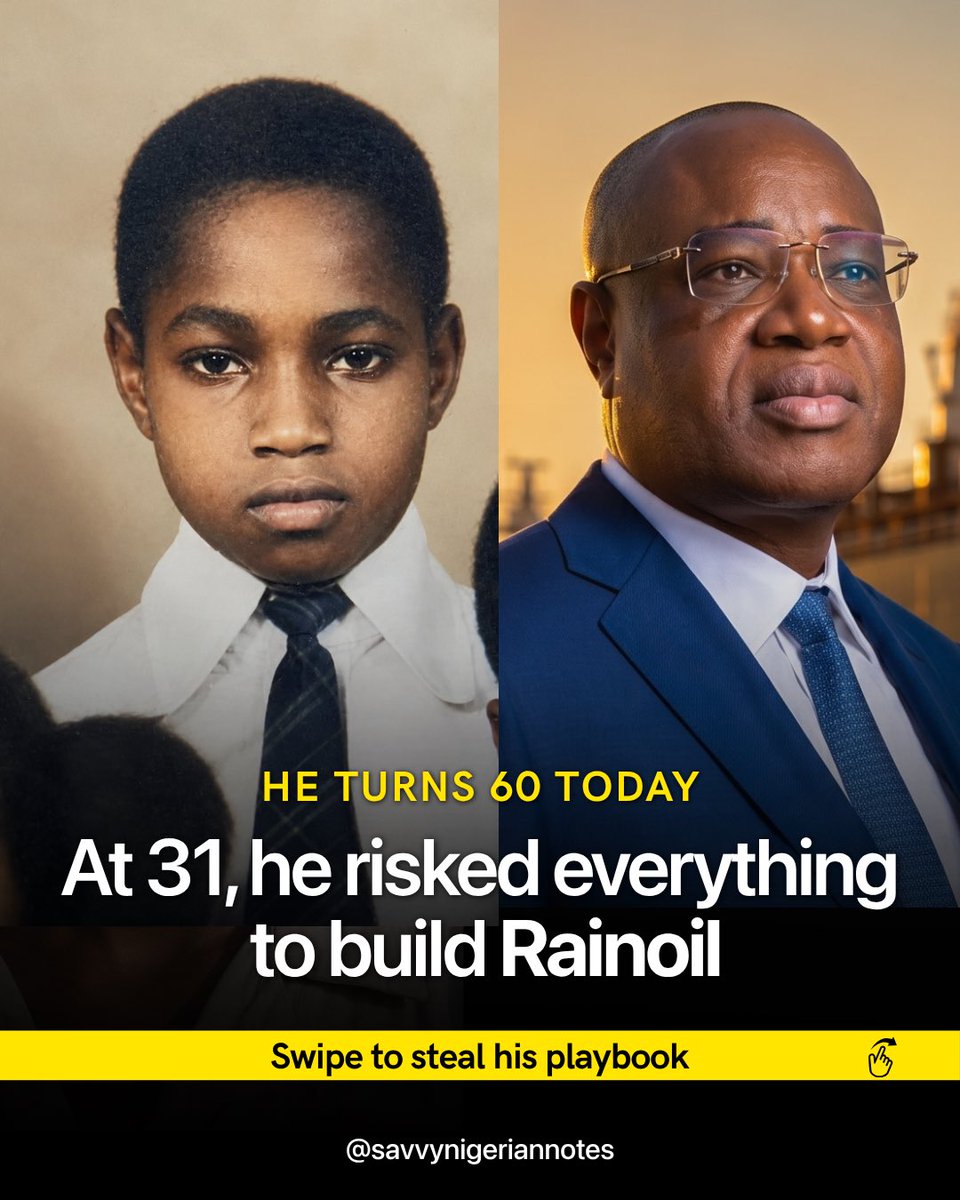
In 1997, a thirty-one-year-old engineer resigned his thirty-thousand-naira-a-month job.
Today, he owns one of the largest indigenous oil companies in Nigeria.
The Gabriel Ogbechie story — founder of Rainoil.
#savvynigerian
“How dare Adekunle Gold go and send somebody to jail for two years for writing something we all know that it’s not true. Someone posted my wife and children have d!3d and I didn’t even reply to it.”
— Omoyele Sowore.
He Was Called the World's Poorest President. He Didn't Mind One Bit.
Most heads of state move into palaces. José Mujica moved out of one. When Uruguay elected him president in 2010, he refused to live in the official presidential residence, declined the security detail, and continued commuting to work in his battered Volkswagen Beetle, the same car he'd owned since 1987. He donated roughly 90% of his $12,000 monthly presidential salary to charity and housing programs for the poor, keeping only about $1,250 for himself, roughly the average Uruguayan wage.
This was not a PR stunt. It was, for Mujica, simply the continuation of a life lived entirely on his own terms, a life that had included bullets, imprisonment, and years of solitary confinement long before it included the presidency.
Born in Montevideo in 1935 to a family of modest means, Mujica became politically radicalized in the 1960s as Uruguay descended into social crisis, spiraling debt, inequality, and a government increasingly hostile to the poor. He joined the Tupamaros, a left-wing urban guerrilla movement that robbed banks and distributed food to slums, inspired by the Cuban Revolution and convinced that armed struggle was the only path to justice.
In the 1960s, he participated in raids, prison breaks, and operations targeting the wealthy elite. In 1970, he was shot six times by police during a confrontation. He survived. He was captured and imprisoned. From 1972 to 1985, he was held as a political prisoner during Uruguay's military dictatorship, spending most of that period in near-total solitary confinement, sometimes at the bottom of a well. He emerged after 13 years.
He spent nearly 13 years in prison, much of it in solitary. He was held in conditions designed to break him, isolated, cut off from news, deprived of books. Instead of breaking, he developed the philosophical calm that would define his presidency. "I survived," he later said, "because I didn't hate."
After Uruguay's return to democracy in 1985, he was released, renounced armed struggle, and entered electoral politics. In 2009, he was elected President of Uruguay with 52% of the vote on the Frente Amplio (Broad Front) ticket.
Mujica's critics, both left and right, dismissed him as a romantic populist. The numbers tell a different story. During his five-year term (2010–2015), Uruguay underwent one of the most comprehensive progressive reform programs in Latin American history, while maintaining economic stability that many of its neighbours could only envy.
Poverty fell by roughly 50% during his term, from around 20% to under 10%. Extreme poverty, which had stood at over 30% in 2004, fell to under 1% by 2013. Uruguay's GDP grew at an average of 5.1% per year between 2010 and 2014. Inequality, measured by the Gini coefficient, fell from 0.455 in 2006 to 0.379 in 2014, one of the steepest drops in the region. By the end of his term, Uruguay ranked third in Latin America on the Human Development Index and first in the region on Transparency International's corruption index.
He expanded the Ceibal Plan, distributing a free laptop and internet connection to every single primary school child in Uruguay, achieving 100% coverage. He passed landmark legislation giving full labour rights, pensions, sick leave, and formal contracts to domestic workers, 95% of whom were women. And he invested so aggressively in wind and solar energy that by 2015, over 94% of Uruguay's electricity came from renewable sources, one of the highest rates anywhere in the world.
In 2012, Mujica addressed the United Nations Conference on Sustainable Development in Rio de Janeiro. He was the last scheduled speaker. He ignored his prepared text. For eleven minutes, he spoke without notes, without pretension, and without any apparent concern for diplomatic protocol, directly challenging the assembled world leaders on consumerism, inequality, and the meaning of development.
You will always think N2m will solve your problems until you make N2m. You will think traveling abroad will solve your financial problems until you start living abroad.
You will struggle from getting student visa to looking for a good job, permanent residency, worrying about mortgages, insurance premiums, taxes and stuff,even though you might be more comfortable than when you where in your home country.
When you’re single, you will think marriage will remove loneliness until you get married.
The future and goals are deceptive.
They appear as final solutions to life’s struggles. But they’re mere junctions in the long, complex journey we’re into on earth.
Life is in phases…. but struggle is constant. No matter the money, passport or location, everyone is battling pains per time.
Nothing will take away all struggles. You can only get NEW struggles. Our wish and prayers is that the new struggle should be less brutal than the former, but we must have some discomfort.
It’s an existential principle.
Orderliness is a fantasy, chaos is the rule of nature.
What History Keeps Trying To Teach Us:
1. Empires fall from within first
Rome, the Ottomans, the British,all collapsed because of internal corruption and division long before any enemy finished the job. No empire has ever been destroyed purely from outside.
2. Propaganda works on smart people
Intelligence does not protect you from manipulation. Educated populations have followed the most dangerous leaders in history. Critical thinking is rarely taught, which is exactly why propaganda works on people who believe they are immune to it.
3. Debt collapses powerful nations quietly
No nation announces its own collapse. It happens slowly through borrowed money, inflated currency, and promises governments can no longer keep. By the time people notice, the damage is already irreversible.
4. Revolutions rarely deliver what promised
People revolt against one form of control and almost always end up under another. The French Revolution promised liberty and delivered Napoleon. Passion starts revolutions but power-hungry individuals almost always finish them.
5. Silence enables most historical atrocities
The Holocaust, the Rwandan genocide, the Cambodian killing fields,none happened in complete secrecy. Ordinary people knew and stayed quiet. Silence in the face of injustice has always been the most common human response.
6. Leaders shape culture more than laws
Laws can be written and ignored. But a leader who models courage or cruelty shapes how millions behave in daily life. Culture flows downward from whoever holds power.
7. Technology always disrupts existing power
The printing press broke the church's monopoly on knowledge. The internet broke the media's. Every major technology transfers power away from old gatekeepers and creates entirely new ones in their place.
8. Pandemics reshape societies permanently
The Black Death ended feudalism in Europe. The 1918 flu built modern public health systems. Diseases do not just kill people they break existing social structures and force societies to rebuild in previously unthinkable ways.
9. Trade creates peace between enemies
Countries that depend on each other economically rarely go to war. Trade raises the cost of conflict significantly. The longest periods of relative peace have almost always followed the expansion of trade routes.
10. History ignored always repeats itself
When societies stop teaching what went wrong and why, the next generation has no immunity against the same mistakes. Ignorance of history is not neutral. It is dangerous preparation for repetition.
11. War enriches few and destroys many
Every major war follows the same pattern. Ordinary people fight and die. A small group of financiers and elites accumulate wealth and power. The gap between who starts wars and who pays for them has never changed.
12. The poor always pay for elite mistakes
When kings made bad decisions, peasants starved. When banks collapsed in 2008, working people lost homes while executives kept bonuses. Those with the least power always absorb the consequences of decisions made by those with the most.
13. Free speech disappears gradually not suddenly
No government announces it is ending free expression. It happens through small steps,a law here, a censored journalist there. By the time people realize what has been lost, the mechanisms to fight back are already gone.
14. Every fallen civilization believed it was invincible
The Romans thought their city eternal. The British believed their empire permanent. Every civilization that collapsed was filled with people who could not imagine its end. Confidence in permanence is almost always the first sign of decline.
15. Education determines the fate of nations
Every society that invested in educating its people has risen. Every society that kept its people ignorant has eventually declined. Knowledge is not just personal power. It is the only reliable foundation any civilization has ever built on.
This is cope. You can discourage people from yahoo without lying about reality. Yahoo is simply financial crime and the bulk of the world money is gotten from financial crime. London itself is the financial crime capital of Europe.
Many yahoo boys diversified their assets, cleansed their money and are living on investments. How you make money is irrelevant to the world system, it is what you do with the money you make that determines if you live in wealth or poverty. You can make money legally and still go broke.
When we say actions have consequences - even the right ones, it means that making good decisions and living your life right does not mean the universe will reward you with wealth. Most times, it means you won't make money, but you'll be able to sleep because your conscience is clear and you wake up holding the full measure of your integrity. To make money in this world, most times, you need to dead your conscience. It is a dog eat dog world.
The whole point of living right, is because it is right, not because it will fetch you money. Many times, it won't because you convince yourself that all money is not good money. That is the consequences of making the right action. The world system itself rewards ruthlessness. If you get caught and punished- that is consequences. If you never get caught, and you live large - that is consequences.
Actions have consequences- you just never know which one is yours.
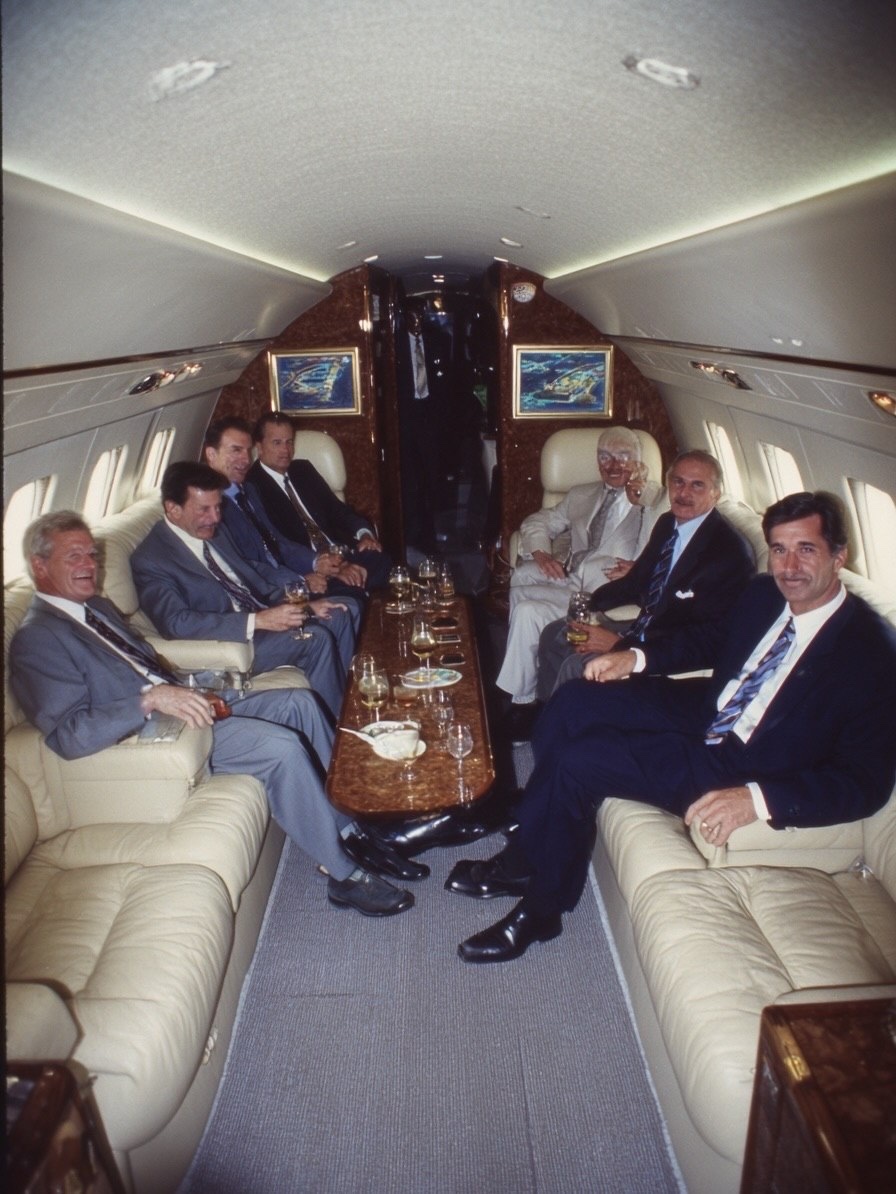
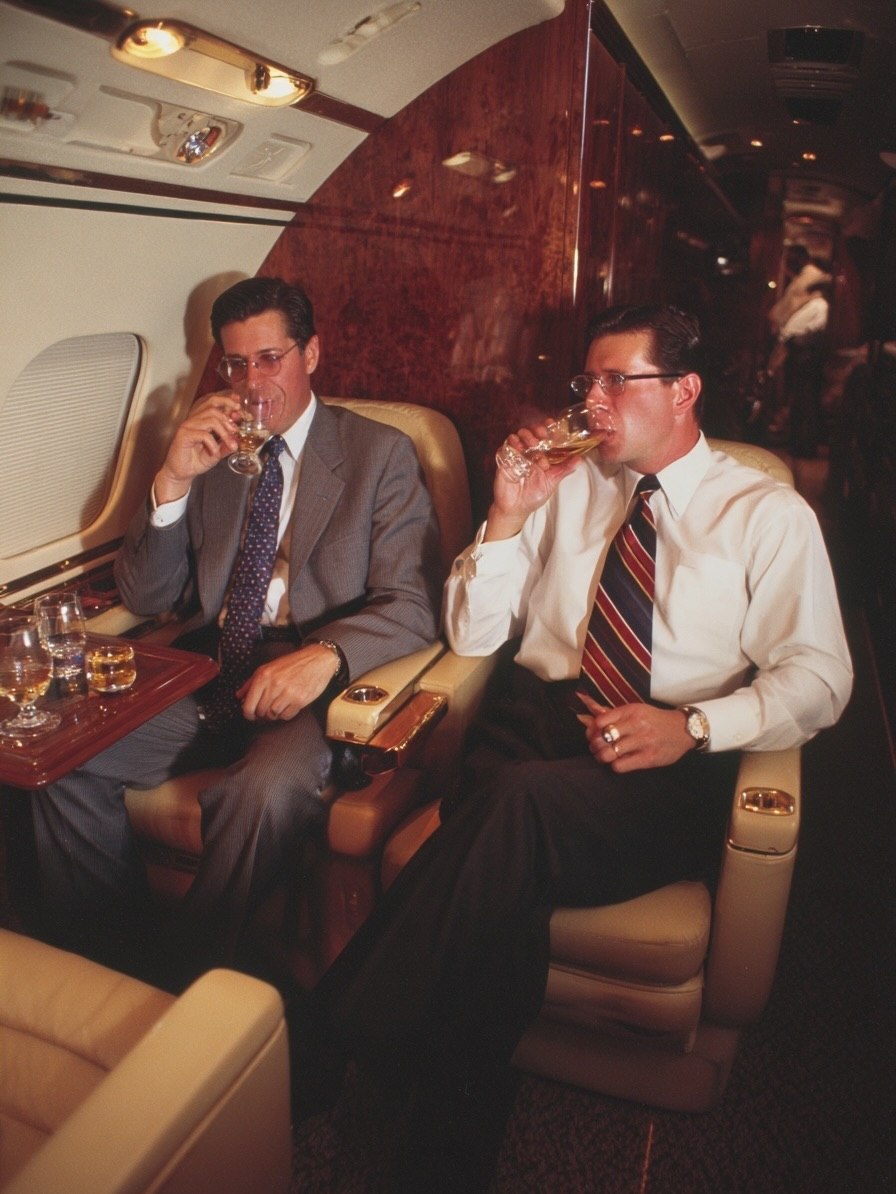
In the 1990s, bankers and businessmen who traveled by private jet moved through a world that felt fast, exclusive, and full of opportunity. These trips were often tied to major deals, expansion into new markets, or high level negotiations that required face to face meetings. It was not unusual for them to travel with trusted colleagues and long time partners, people they relied on to handle different parts of a transaction and to provide advice during critical moments.
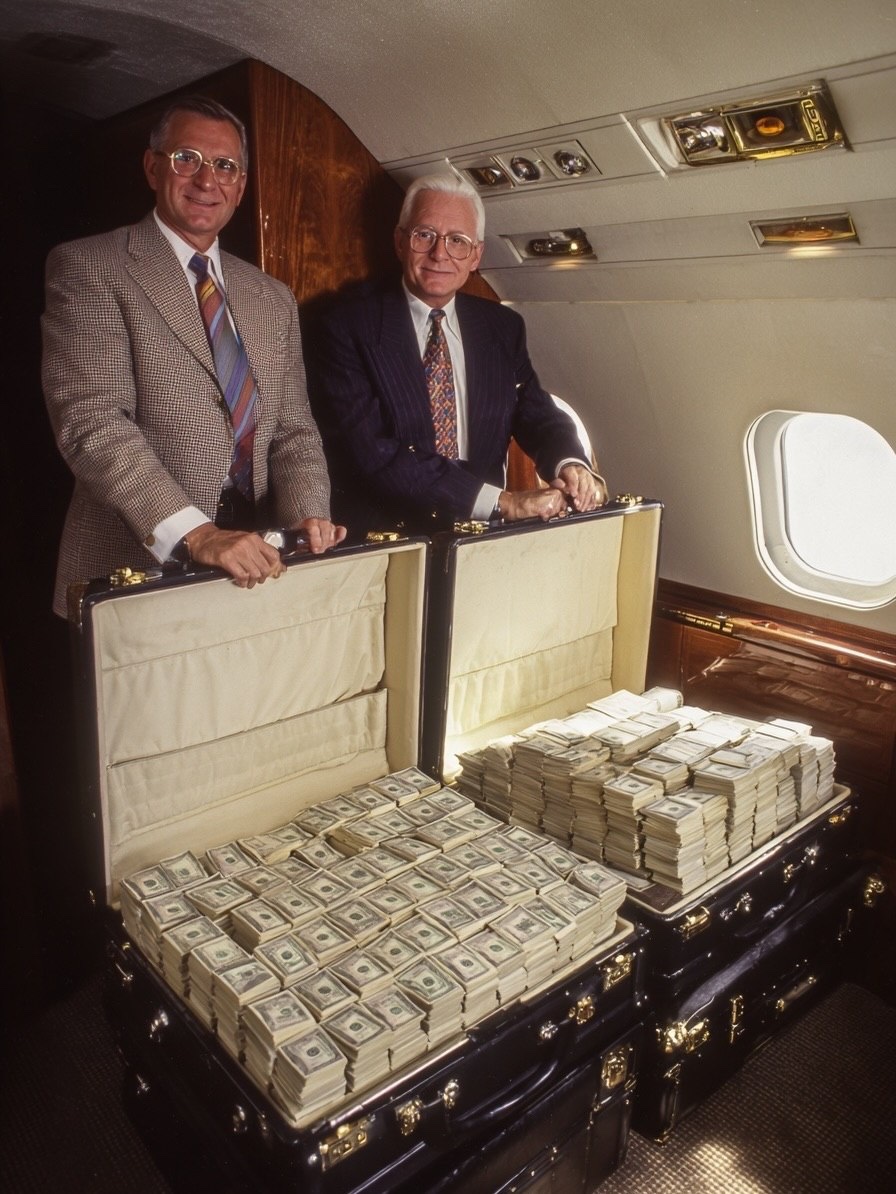
On some occasions, they carried large suitcases filled with cash, especially when working in places where banking systems were slower or less reliable. Having immediate access to money could help secure agreements quickly and show seriousness in negotiations. The cabin of the jet became a private space where sensitive discussions could happen without risk.
Life on board combined business with comfort. They sat in wide leather chairs, sometimes reviewing documents, other times simply leaning back to rest.
Champagne was often served, marking a successful deal or just easing the tension of constant travel.
Cigars added to the atmosphere, with slow conversations drifting between business and personal stories.
Meals were carefully prepared, offering a proper lunch even while in the air. After eating, some would sleep, using the quiet cabin to recover before landing and heading straight into meetings. Traveling this way allowed them to stay efficient, maintain strong relationships, and move quickly in a competitive environment.
I remember I did this post in 2014;
US Army Colonel who died in Lagos, Nigeria in 1922.
He was buried by the British Colonial authorities at the European section of the Ikoyi Cemetery.
The United States Army and Col Young's family didn't like the idea.