Meet Beni, Your First Camera Robot.
It films you — auto-follows at 17.9 mph, shoots stabilized 4K, then auto-edits the highlights. No filmer. No tripod. No editing.
Reserve for $10 → lock the $499 price.
The Robinhood Earn vault, curated by @SteakhouseFi on @Morpho, has reached $16M TVL at a 7.1% APY:
• 1.7% intrinsic
• 5.4% incentive
For scale, Coinbase's vaults peaked around $500M TVL. That's the obvious benchmark, but if you think Robinhood is eyeing $500M, you're thinking too small.
The incentive budget is the tell: $115M of USDG has been allocated to this vault per year. It runs a target APR strategy, so if the vault underperforms, it won't overspend.
But at a ~5% incentive rate, a $115M annual budget mathematically supports roughly $2B in deposits, and depending on where the intrinsic APY settles, that puts the ceiling somewhere between $1.5B and $2.5B TVL.
EXCLUSIVE: Robinhood is going to pay 7% on dollars to 27.7 million customers.
In this Interview Johann Kerbrat, their SVP of Crypto explains how it all works.
Robinhood Earn lives inside the main investing app. You can buy the USDG stablecoin in a few taps, and it gets deployed into vaults built with Morpho and Steakhouse, and the target yield is roughly 7%.
Where does 7% come from?
Market makers and liquidity providers pay it. These are traders who need USDG liquidity to run spot and perps trading. Your deposit is funding someone else's 50x leverage, and you're the one getting paid for it.
Assuming you get paid back.
Which, as we've seen, doesn't always work in DeFi with hacks and smart contract risk. But Robinhood has done something extra to make this retail-grade.
Robinhood's answer is an insurance program with Lloyd's of London and Relm covering smart contract and vault failure. He says it's one of the largest ever built for a crypto product.
Earn was one of 12 announcements; some others that caught my eye:
Stock tokens in 120+ countries, backed 1:1 by real equities. You can withdraw them to a self-custody wallet and post them as collateral. Borrowing against a stock portfolio used to be a private banking perk; now it's a smart contract.
Robinhood Chain went to public mainnet after 200 million transactions on testnet.
Perps on stocks, crypto, and commodities at 20 to 50x leverage, bringing an entire new asset class to the mainstream.
Robinhood is all in on DeFi.
DeFi protocols spent a decade fighting for users. Robinhood just made a Morpho vault look like a savings account, in front of 27.7m funded customers.
See the 15-minute highlights below and the full episode on the Tokenized Podcast youtube channel
Full interview with Johann on @Tokenized YouTube
⚡️ ROBINHOOD OPENS AGENTIC TRADING FOR CRYPTO
Robinhood brings AI agent trading to crypto, letting automated accounts spot and execute patterns across pricing data, news and order books 24/7.
70,000 agentic accounts are already live for equities and options in the first few weeks.
"Institutional giants have algorithms and rooms full of analysts. Where humans drown, that's where agents thrive."
👨🦱Musk, who was kicked out of PayPal years ago, is now bringing back X Money for revenge.
👉In 1999, Musk co-founded https://t.co/snsoYNjfV4, an online bank that later evolved into PayPal. Just a year later, the board of directors removed him from the CEO position, replacing him with Peter Thiel.
👉But the https://t.co/snsoYNjfV4 domain didn't remain with PayPal. In 2017, Musk bought it back with his own money, then used the domain to change Twitter to X as it is now.
👉26 years later, what he truly wanted to do is finally being implemented.
⚡️X Money is now open to a select number of US users, with several core features:
• 6% annual savings interest rate
• A metal Visa debit card
• 3% cashback on purchases
⚡️For comparison, PayPal Savings currently offers an annual yield of 3.30%, X Money doubles that and more.
🥳Furthermore, the official plan is to integrate cryptocurrency features by the end of this year.
X Money pays 6% on cash, with no limit.
The risk-free rate is 3.6%.
Cross River, the bank that holds the money, earns nowhere near 6%.
So someone is paying the difference.
A safe dollar earns about the fed funds rate, 3.5 to 3.75% right now. T-bills near 3.6%, money funds near 3.5%.
That means X covers more than two points on every dollar, every year, before Cross River takes its spread.
Banking can't produce that number, so the gap is a subsidy. SpaceX is paying it now.
X belongs to SpaceX. xAI bought X last March, SpaceX absorbed xAI in February, and the combined company went public on June 12. A profitable rocket company is funding an AI build out and an above-market deposits for almost 600 million users.
The card is underwater too. 3% cashback with no limit, on a debit rail where interchange tops out near 1.5%. They pay out roughly double what each swipe earns.
For Musk that's rational over the long term. Buy 600 million banking relationships below cost and the everything-app pays for itself eventually.
Musk is comfortable with extreme levels of risk. Tesla and SpaceX both came incredibly close to bankruptcy before turning into what they are today.
But will regulators and Congress be as forgiving with people's savings?
Elizabeth Warren and the Senate Banking Committee both wrote to Musk on April 14 with the same question. Where does the 6% come from? No public answer.
A deposit rate above the risk-free rate, funded from a source nobody will name, sitting inside the app 600 million people argue on. Whoever's paying decides how long it lasts.
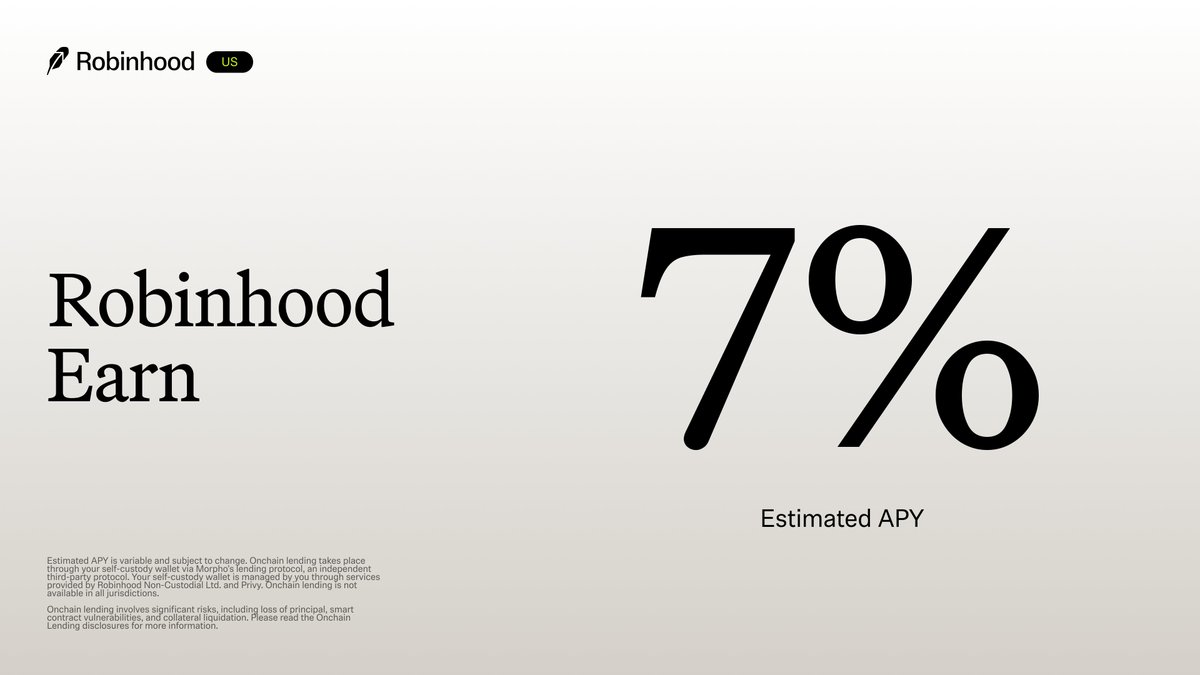
Robinhood Earn is rolling out to eligible US customers.
Lend USDG onchain through a self-custody wallet and earn an estimated 7% APY.
APY subject to change.
https://t.co/klNh8iHFPd
We really lived long enough to see @KingJames become the old man version of himself in this iconic 20-year-old @Nike ad campaign.
And somehow he's STILL playing basketball at an insanely high level. 🐐
U.S. INFLATION HITS 3-YEAR HIGH
U.S. inflation climbed to 4.1% in May, its highest level in more than three years, while consumer spending rose 0.3%, showing resilient demand. First-quarter GDP was also revised higher to 2.1%. The stronger data is likely to reinforce expectations that the Federal Reserve will raise interest rates later this year.
The big Oil Companies are not dropping their price at the pump commensurate with the sharply lower prices they are paying for Oil. Those prices are dropping like a rock! In other words, customers are being “gouged.” I have instructed the DOJ to immediately start looking into this. Gasoline prices better start going down a lot faster than what I’m seeing! President DJT
( TS: Jun 24 2026, 12:12 AM ET )