Researchers at WashU Medicine have created 3D maps of tumor structures, revealing how cancer cells and their environment are organized at a single-cell level. The study, published in Nature, could pave the way for innovative therapies. https://t.co/eyfht8czK0
A team led by Jeffrey Gordon, MD, developed a therapeutic food for malnourished children that boosts growth by supporting gut bacteria. A new study found one particular bacterium produces an enzyme with unexpected biological functions related to health. https://t.co/TmBNm1JFEj
In a new study, researchers at WashU Medicine have reduced scarring and improved heart function in mice with heart failure using a monoclonal antibody treatment, paving the way for potential new immunotherapies for heart attack patients. https://t.co/2UF2ZJoet7
Many thanks to @JuliaStrait of @WUSTLmed for reporting on the work of @ASBMB member Jeffrey Gordon, whose team identified key biochemical components of a new therapeutic food and the important bacterial strains that process these components. https://t.co/DmqxpqOndp
This was a lot of fun to do - thank you Marley Wiemers, @JuliaStrait, and @WUSTLmed for allowing me to tell my story. Looking forward to the bright future of @WashUCardiology!
Congrats to @JuliaStrait and @WUSTLmed for their 2022 Gold Award for "Among COVID-19 Survivors, an Increased Risk of Death, Serious Illness”! Read more: https://t.co/AHE0ux3r6D
Three #WashUMed science writers were honored by the @AAMCtoday for writing excellence. The awards recognize the most creative and effective approaches to promoting academic medicine. Congrats, @sourwine, @JuliaStrait and Tamara Bhandari, PhD!
https://t.co/WOQHhEmo7y
🚨I wrote about what this surge is doing to the healthcare system.
It's bad.
Though less severe, Omicron is spreading quickly enough to inundate hospitals, which can't handle the strain cos so many healthcare workers had quit or are now sick. 1/
https://t.co/1OmtMu1mw7
In our latest #ShowMeTheScience podcast episode, #WashUMed psychiatrists Eric J. Lenze, MD, and Neha Navsaria Kirtane, PhD, reflect on stress and resilience during COVID-19. https://t.co/DwI87SKJJh
Research from #WashUMed scientist Elizabeth A. Salerno, PhD, reveals that exercise could help breast cancer patients ward off cognitive problems. https://t.co/FNNXbbSqcI
New research from #WashUMed suggests that radiation therapy can reprogram heart muscle cells to what appears to be a younger state, reducing irregular rhythms without needing an invasive procedure. https://t.co/ngxd2xaeji
If St. Louis health officials had delayed the March 2020 COVID-19 shutdowns by even two weeks, it could have led to almost seven times the number of deaths, suggests new #WashUMed research led by @elvingeng, MD.
https://t.co/s8F7ldQiv6
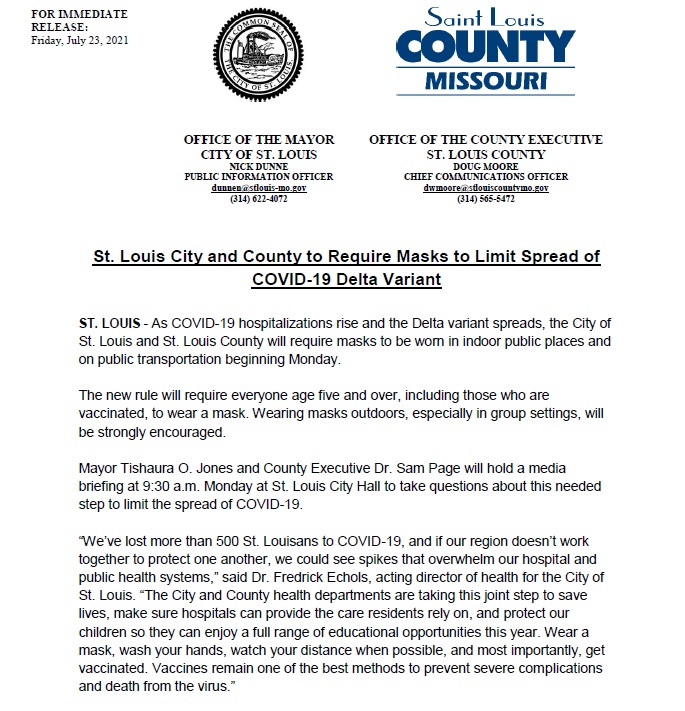
⚠️ INBOX: St. Louis city and county are reinstating their #mask mandates, beginning Monday.
Masks will be required in all indoor public places and on public transportation for ages five and up.
🚨I wrote about what Delta is doing to Missouri. Some hospitals have accrued as many COVID-19 patients in 5 weeks as they got in 5 months last year. Almost all those patients are unvaccinated. HCWs can't believe they're being overwhelmed *again*. 1/
https://t.co/ETETPHfLrA
A "good sign for how durable our immunity is from this vaccine.” @wustlmed immunologist Ali Ellebedy in the @nytimes. He led a study of Pfizer and Moderna vaccines that found immune cells are still organizing to fight coronavirus months after inoculation. https://t.co/Qav7TQOLdg
“This is an unmet need in solid tumor oncology.”
Immunotherapy used to treat blood cancers could also be effective against solid tumors, shows a new #WashUMed study.
Senior authors: @LabFehniger, MD, PhD; Ryan Fields, MD. Published in @CCR_AACR.
https://t.co/WOOis4tya0
#WashUMed researchers have identified ingredients for new snack foods that nurture a healthy gut microbiome.
“We are hopeful we can deliver a snack that people will want to eat while also contributing to a healthier diet.” — Jeffrey Gordon, MD
https://t.co/zweqaxB7mY
Our new Show Me the Science episode explores how to keep kids in schools safe from COVID-19 and how vaccines fit into that equation.
Guests include pediatric cardiologist @orr_williamb, MD, and infectious disease expert @JasonGNewland, MD.
https://t.co/ubd9AJ3XoJ