If our life is to be meaningful, really to matter, it must be extraordinary in some way. Extraordinary in the accumulation of wealth or landing a fantastic career, an athletic trophy, an academic accomplishment, or anything that puts us in the limelight, proclaiming, “Now, look, this person is a cut above the rest!”
That’s the cultural “gospel,” anyway, that is preached from the pulpits of movies, television, and social media.
But it’s all a sham. A sinister lie that leaves many people thinking their ordinary lives are void of meaning and purpose.
The biblical teaching pushes back. God wants us to find joy in sacred simplicity and the ordinary gifts of life.
For instance, in the book we've been reading the last couple of days in Bible in One Year, Ecclesiastes, we see this countercultural truth: “Behold, what I have seen to be good and fitting is to eat and drink and find enjoyment in all the toil with which one toils under the sun for the few days of his life that God has given him” (5:18).
What a refreshing truth this is! We find joy in simple things, such as God’s gift of food, drink, and work. We can expand this list to God’s gifts of spouse, children, and friendship.
Climbing the ladder of success and assuming that will lead to a fulfilled life often lands the person on an upper level full of wheezing souls still chasing after the wind.
Climb “downward” to the daily, ordinary beauty of marriage, children, grandchildren, friends. “Aspire to live quietly, and to mind your own affairs, and to work with your hands” (1 Thess. 4:9). Kiss your spouse. Play a game with your kids. Go out to eat with your friends. Labor at work.
God came to us as the man, Jesus, who got dirt under his fingernails, cooked fish over campfires, ate and drank with friends and students, and told stories about farming and sheep herding. Jesus did more than this, to be sure, but he did these ordinary things in everyday relationships, for that is where God is at work.
The treasures of heaven are wrapped in the brown paper simplicities of life.
@birdchadlouis Before this I had taken Judah for granted, focused on Joseph as the “hero” of the story…But this episode is not just “Joseph and the 11 brothers” like a children’s fable, but a complex tale of a convoluted tangle of relationships, talents and weaknesses.
When we consider Joseph’s position as a slave in the house of Potiphar, we can see that God is preparing him for greater things ahead. That household was as a kind of mini-Egypt, giving Joseph a trial run for his eventual vocation as governor of Egypt.
What unfolds in the home of this Gentile is a small but meaningful fulfillment of the promise made to Abraham: that through his offspring all the nations of the earth would be blessed.
We can see this clearly because we know how the story ends. Joseph did not.
Like all of us, he was a time-bound and situation-bound human being. He knew his past and endured his present, but he had no idea what lay ahead. His earlier dreams likely felt like foolish fantasies.
A slave would never become one before whom brothers bow.
To Joseph, his life had unravelled. He had lost his family, homeland, and freedom. Under such circumstances, he was likely focused on survival, stability, and perhaps modest success. He had not read the later chapters of his life.
Yet, as the psalmist reminds us, all his days were already written in God’s book before any of them came to be (139:16).
As it was for Joseph, so it is for us. I once believed I would spend my career as a seminary professor; instead, I drove trucks for many years. I once imagined watching all my children grow old; then, I buried my son. I once longed for death during a season of deep depression; now I am grateful to be alive.
In every season, my perspective was painfully limited. I saw only a few pages of my story; God authored the whole book.
What I have learned is to hold on loosely to whatever assumptions I make about my future. What God has promised me is not a particular path, but his love, forgiveness, and faithfulness in Christ. The true direction of our lives is deeper into Jesus himself. Everything else is secondary.
As Paul says, forgetting what lies behind and straining forward to what lies ahead, we press on toward the upward call of God in Christ Jesus (Phil. 3:13-14). Press on, friends.
The divine author of your biography knows exactly what he is doing.
____
We read Genesis 39-40 today in Bible in One Year. Join us at https://t.co/XxNvEtNH7e
We really need two faces on this closing day of the year: one to look back and one to look forward. Indeed, for that reason, the first month of the year, January, is named after the two-faced "god" Janus, who had faces looking forward and backward.
We look back to the highs and lows of 2025. Many of us buried family members and welcomed newborns. We laughed with family and friends, and we stumbled through dark valleys that were eroded by tears. We did some things right, many things wrong.
In other words, we lived the human life, punctuated with the good and the bad, the ugly and the beautiful.
We also look forward to 2026. What will it bring? God only knows. But because the God who knows is also the God who loves, we step into the new year with boldness and confidence.
We do not worship a weak god or a deity who’s figuring things out as he stumbles along. He is all-good, all-knowing, and all-powerful. He’s got the whole world in his nail-scarred hands.
And he has me and you.
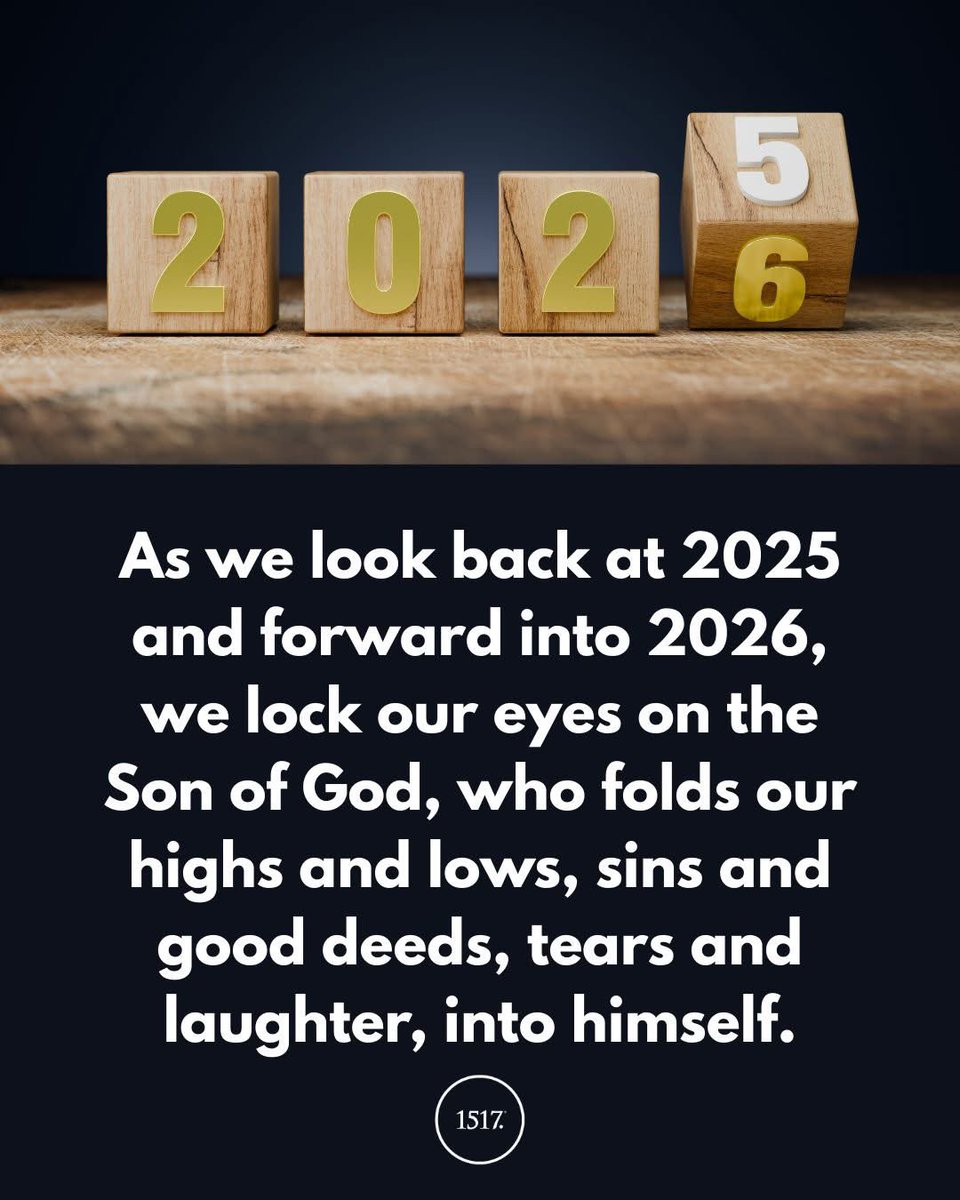
As we look back at 2025 and forward into 2026, we lock our eyes onto the Son of God, who folds our highs and lows, sins and good deeds, tears and laughter, into himself.
All our days and years are lived in him, who loved us and gave himself up for us, that we might be his own.
____
Join in 2026 for Bible in One Year! Sign up at https://t.co/GmXaZBLQth
Every student of the Bible wishes they could have been in the Emmaus “classroom.”
A mysterious professor joined two downcast disciples who believed all their hopes had been dashed on a Roman cross. “We had hoped that [Jesus of Nazareth] was the one to redeem Israel.” But, they went on, “he was condemned to death and crucified” (Luke 24:20–21).
Then the stranger (Jesus) offered a much-needed rebuke: “O foolish ones, and slow of heart to believe all that the prophets have spoken. Was it not necessary that the Christ should suffer these things and enter into his glory?”
Then he delivered the greatest Bible lecture ever given. “Beginning with Moses and all the Prophets, he interpreted to them in all the Scriptures the things concerning himself” (Luke 24:25–27).
Every day of this year, we have tried to replicate that Emmaus road experience as we journeyed through Bible in One Year. Whatever book we were reading, Old Testament or New, we continually asked the same question: How is this about Jesus?
How is Leviticus about Jesus?
What do the Psalms have to do with Jesus?
How are Hebrews, Revelation, or even Obadiah preaching Jesus?
In other words, we have sought to ask and to answer the very question Jesus answered as he walked with those two disciples on the day of his resurrection.
In just a few days, as we begin 2026, we will do it all over again, not as drudgery, but with joy, energy, and a holy curiosity.
Beginning once more with Moses and all the Prophets, we will again ask how, in all the Scriptures, the things concerning Christ are spoken to us. And as we read and study, we will encounter our living and loving Lord, who shows us not only that all the Scriptures are about him, but that he is all about saving us, loving us, forgiving us, and making us his own.
So as we prepare to wrap up this year and look ahead to the next, we do so in the name of the one spoken of from Genesis to Revelation, the one who still speaks, calling us his beloved people.
____
Join us in 2026 for Bible in One Year by signing up at https://t.co/GmXaZBLQth
Jesus works slowly, individually, and tangibly when he interacts with people. And most of the time it goes completely unnoticed, except by those into whose death Christ pours forth life.
People like Harvey.
Harvey and his sons, Randy and Rex, were farriers by trade. You might think of them as cowboy podiatrists of the equestrian world. They cared for the feet of horses. They drove their pickups all over Oklahoma, trimming hooves, pulling off old horseshoes and nailing on new ones. It’s hard, dirty, sweaty, backbreaking labor, made even worse if the horse has a rebellious streak. When I was a teenager, I trimmed my own horse’s hooves. I can’t imagine doing it full-time. But Harvey and his sons did it, day in and day out.
That is, until the cancer came.
The kind of cancer you can attack with radiation or chemo, orthodox or unorthodox treatments, and it goes nowhere but forward. Advances with a relentless violence irrespective of the suffering of the patient. A kind of guerilla warfare that ambushes the body here and there until, finally, there’s nothing left to do but stare at the clock and the calendar and await the inevitable end.
When I entered, the thick shades in the family room were pulled tight. Harvey was propped up on a makeshift bed. Ever the cowboy, he was wearing a faded pair of Wranglers.
“Thanks for coming,” Harvey said.
“Glad to do it,” I said.
“You got everything you need?”
“I do.”
“Alright, then.”
“Give me a second and we’ll get started.”
On the coffee table beside Harvey’s bed I laid a piece of cloth, on top of which I placed a Bible, a small glass of wine, and a tiny silver dish with a wafer of bread on it.
I remember a few of the things I said to Harvey that day. I remember reading a psalm and a passage from the Gospels. We confessed our sins together, and I put my hand on his forehead and pronounced the Lord’s forgiveness upon him. I spoke a few words to try and encourage him, assure him of God’s mercy. And, having repeated what Jesus said in the upper room to his disciples, I took that piece of bread, held it to Harvey’s mouth, and placed it inside, saying, “The body of Christ for you.” And I took the glass of wine, held it to his lips, and let him drink it, saying, “The blood of Christ for you.”
Yes, I remember a few of the things I said to Harvey that day. But I’ll never forget what he said to me. As I prayed a final petition and prepared to leave, Harvey grabbed my hand, held it tight, and said, “Thank you, Lord, for coming to see me.”
Out of the mouths of babes. And dying men. I don’t know if I’ve ever had a moment of greater clarity in my life.
This is the way things are in the kingdom of God. Inside an Oklahoma farmhouse, with a man days from death, the Lord was present not only to talk to him but to touch him, feed him, pour into his mouth the wine of new creation. It was like I wasn’t even there. Only Jesus and Harvey. Only our Father and his child. One last time here on earth before that old cowboy rode away into a paradise awaiting him.
“Thank you, Lord, for coming to see me.” Yes, Harvey, for so he comes. In shadowed rooms where cancer lurks. In lives on a collision course with the grave. He comes bearing gifts pregnant with life. Gifts we can feel and taste and smell. Tangible treasures. Little gifts full of big life—Christ’s life. A life inextricably linked to the blood of death, the body of crucifixion, the very flesh of God.
The Lord came to see Harvey as he comes to see all of us, disguised as a beggar whose pockets bulge with gold.
-Adapted from my book, Your God Is Too Glorious (2nd Edition), available at https://t.co/bRbuMBZiXA
When people say of someone, “He is too smart for his own good,” the implication is that intelligence has become a hindrance rather than a help. Smartness is portrayed as a liability rather than an asset. Is this true? Let us look at the life of wise King Solomon for the answer.
Solomon was the wise man, the model of wisdom. “King Solomon excelled all the kings of the earth in riches and in wisdom” (1 Kings 10:23). He solved riddles, studied botany and zoology, composed music and poetry, oversaw vast construction projects, and ruled with such excellence that his fame spread far and wide. Even the Queen of Sheba came to see him.
At the same time, Solomon made fatal errors and undertook idolatrous projects. God had forbidden kings to accumulate great riches, many wives, and a multitude of horses. Solomon did all three. Most notoriously, he built sanctuaries for his foreign wives so they could worship their abominations. This angered God, who punished Solomon with the fragmentation of his kingdom.
So was Solomon too smart for his own good? No. That was not the issue. There was nothing wrong, and everything right, with Solomon’s desire to learn and grow in the understanding God gave him. Just as there is nothing wrong, and everything right, for us to read, study, and learn. Intellectual laziness is not a virtue. Let us kindle curiosity, explore topics, and grow in our grasp of the things of God and things of humanity.
Let us also remember that “he to whom much is given, much is required” (Luke 12:48). The greater the gift God gives, the greater the responsibility to use it well. Intellectual progress can lead to arrogance. Degrees can make us forget the unacademic gifts of life or use our learning in self-glorifying ways. So while we work and strive and learn, we also pray and praise and confess.
Can you read Homer in Greek? Great. Pray, too, the Lord’s Prayer. Can you discuss thermonuclear technology? Wonderful. Also confess your sins and receive forgiveness. Can you speak three languages and read fifty books a year? Impressive. Also get on the floor and play with your children, read Dr. Seuss to them, and take them to church.
We cannot be too smart for our own good, but we can be overly impressed with ourselves. Let us pray for humility, cherish simple joys, and thank God for every gift from his gracious hand.
If you are engaged in Bible study, you are engaged in worship. You might not always think of it that way. Perhaps you think of Bible study as looking for answers or filling your head with biblical facts.
But when you open the Scriptures, you are doing so in the presence of God, and that makes your study an act of worship.
We see this clearly in the life of Ezra. In Ezra 7:10 we are told, “Ezra had set his heart to study [דרשׁ] the Torah of the LORD, and to do it and to teach his statutes and rules in Israel.” The Hebrew verb for “study” is darash, which means to seek, to inquire, or to investigate. But darash also carries the sense of seeking the Lord himself, of making supplication, of worship.
In fact, Ezra 6:21 uses the same verb when describing how the returned exiles celebrated the Passover “to seek the Lord, the God of Israel.” There it is often translated as “worship,” though it is the same darash used for Ezra’s study of the Law. To study God’s Word is therefore to seek him in reverence and devotion.
When you engage in the study of Scripture, you certainly gain understanding and insight. You learn the truths of God, his promises, his commands, and his ways. Yet something even deeper is happening. You are encountering the living God through his Word. You are listening to his voice, receiving his instruction, and offering him the attention and honor he deserves.
So yes, fill your mind with knowledge, ask your questions, and seek understanding. But remember that Bible study is not merely an intellectual pursuit. It is a holy encounter with the God who speaks.
Every time you open your Bible, you are seeking the Lord. And to seek the Lord is to worship him.
_____
We read Ezra 6-8 today in Bible in One Year. For more information and to sign up, visit https://t.co/XxNvEtNH7e
Teach us to number our days, Jesus, that we might remember that “this is the day that the Lord has made,” so that we might “rejoice and be glad in it” (Ps. 118:24).
It was no mistake, no accident, that we awoke on this particular day. This is a day to rejoice because it is another day to follow Jesus, wherever he might lead us.
•To make breakfast for our children? Yes.
•To bring a cup of coffee to our sleepy spouse? Yes.
•To go to work? Yes.
•To speak a word of encouragement to a stressed coworker, a word of forgiveness to someone who hurt us, a word of wisdom to a friend who is confused? Yes and yes.
This is the day that the Lord has made, for us to make something of it, even in the normal and underwhelming ways that populate most of the hours of our lives.
We are disciples on this day, right now, to acts of conduits of divine love for those whom the Lord has placed in our lives, in our vocations, for us to serve.
Lord Jesus, teach us to number our days, especially this day, as the twenty-four hours we live and serve by grace.
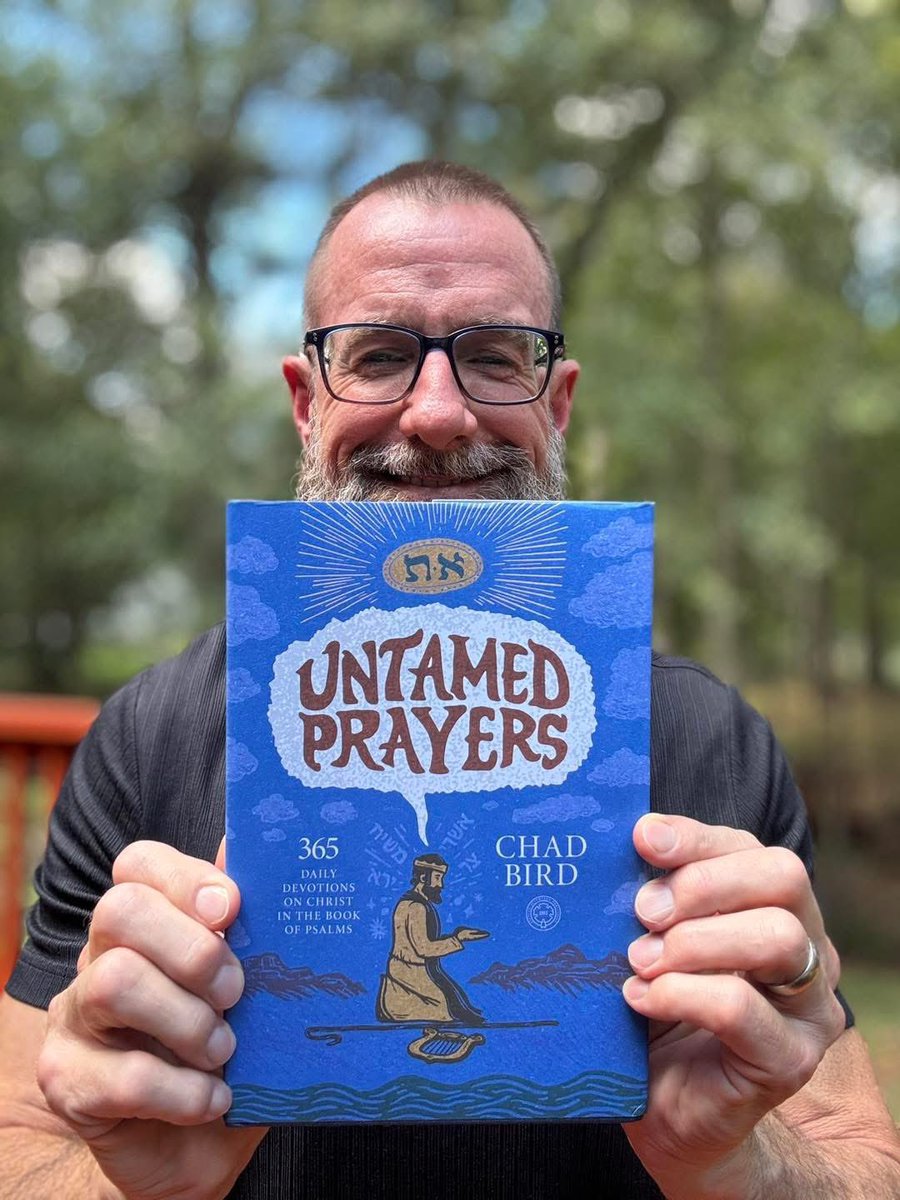
Seventeen years ago, in the dark cab of a semi, in the backcountry of the Texas Panhandle, a man at the end of his rope took the first step on a journey that culminates today.
That man is me. That journey was the Psalms. That culmination is Untamed Prayers.
In the winter of 2008, while my semi was stuck deep in the mud of the oil field, I opened a copy of the Psalms and began to read. At first, I was just bored and looking for something to do. Then, as line piled on line, I became intrigued. Then pulled in. Finally, I was mesmerized.
Here, at long last, were prayers that I could pray without feeling like a liar. Full of grit. Full of fury. Full of brutal honesty.
When you feel like roadkill on the highway of life, there’s a psalm for that.
When you think God’s fist has bloodied your nose, there’s a prayer for that.
When you have been stabbed in the back, there’s a prayer for that.
And, yes, when you feel on top of the world, there’s a prayer for that.
So it began for me. Praying the Psalms. Letting them pray me. Swimming in this sea of sacred words that have broken me, healed me, and pulled me ever more deeply into the mysterious life of God.
Everything I have learned from these prayers, I have poured into these 365 devotions. Nuggets of Hebrew wisdom. Fiery screams of pain. Winged Hallelujahs.
And in them all, every one of them, Jesus. He is The Pray-er of the Psalms. And he prays them all with us and in us.
Untamed Prayers. It’s been a long time coming. It is now here.
Join me in the journey, join me in the Psalms. I’ve love to have you along.
Get your copy at https://t.co/XCGh8okSr4
In the book of Judges, we read, "In those days there was no king in Israel; every man did what was right in his own eyes," (17:6; 21:5). This is commonly seen as suggesting that things were worse in Israel when they had no king. Without a ruler, everyone did whatever they wanted.
Another interpretation of these words is also possible.
The vast majority of the kings of Israel and Judah did what was evil in the eyes of the Lord. They worshiped other gods. Broke the covenant. Led their people astray.
Those verses in Judges might well be saying that Israel did not need kings to lead them into doing what was evil--they managed that just fine on their own!
It's a subtle reminder to us as well, that as much as we might like to blame others (especially our leaders) for the allowance or promulgation of evil, we don't need a scapegoat to blame for evil. We have the person in the mirror to blame.
We are all quite adept at doing what is right in our own eyes without some leader guiding us into sin.
Therefore, we pray for mercy. We repent, confess, and ask the Lord to give us humble and contrite hearts. To remove our hearts of stone and give us hearts of flesh.
Rather than blaming others, let us cast our sins upon the one true Scapegoat, Christ our Lord, who has borne our transgressions upon the cross that we might be forgiven and walk as children of light in a world suffocated by darkness.
Lord have mercy.
Christ have mercy.
Lord have mercy.
Amen.
At Our Wits’ End - Psalm 107. Head to https://t.co/Yrg5F0E7Fx for the reading guide and to catch up on previous posts from the Bible in One Year series. Happy Studying! #BibleinOneYear#BibleStudy
The benefits of living in an age of advanced scientific study are obvious. We know more about the macro and micro elements of our world than any previous human generation. We explore Mars, map the genome, and swallow antibiotics that cure us of ailments that would have put our ancestors six feet under. We have it good.
But living in this age is also a constant challenge for Christians. Our words and beliefs about creation can easily be over-scienced and under-Scriptured. These should stand side-by-side, one teaching about enzymes and astrophysics, the other singing of angels and living waters.
Instead, what happens far too often is that the scientific language about our world that permeates even popular culture overshadows the exalted speech of about creation in the Bible.
Poems like Psalm 89 train our eyes to see the unseen and our ears to hear the unheard of a world alive with the activity of God.
Rather than observing only a solar system as we look into the night sky, we see the heavens praising the wonders of the LORD, and his faithfulness in the assembly of the holy ones (89:5).
When we stand on a beach, instead of just thinking, “In front of me is a massive body of salt water,” we confess to the Creator, “You rule the raging of the sea; when its waves rise, you still them” (89:9).
Or consider mountains. Are they elevated landforms that rise above the surrounding terrain? Yes, but mountains, like Tabor and Hermon, are also lofty singers who “joyously praise [the Lord’s] name” (89:12).
Science is a gift of God for exploring and analyzing what he has made.
Psalms are a gift of God for confessing and praising him for what he has made.
We stand in this world as curious creatures who investigate what we find, but also as participants in a worldwide choir, composed of humans, stars, angels, animals, and rivers that clap their hands, lift their voices, and praise the Father through the Son and in the Holy Spirit for making and sustaining all things, for he is good and his mercy endures forever.
__
This is a sample devotion from my next book, Untamed Prayers: 365 Daily Devotions on Christ in the Book of Psalms. Preorder your copy at https://t.co/zU9d46Pdah
There was a first-century rabbi nicknamed Rabbi Gamzu because whenever adversity came along, he would say, "Gam zu l'tovah," that is, "This, too, is for the good." Those first two words in Hebrew, גם זו (gam zu), mean "This too..." Therefore, he was called Rabbi Gamzu. He was the Gamzu man.
There was also another first-century Jewish teacher who said something similar: "And we know that for those who love God all things work together for good, for those who are called according to his purpose." His name, of course, is Paul, the apostle of Jesus the Messiah. He wrote these famous words to the church in Rome.
Paul, too, was a Gamzu man.
There are times in life when, after something bad happens, we look back and see that God brought good out of it. And there are many times when, after something bad happens, we look back and still do not know what possible good did, or ever could, come from it.
Either way, we are Gamzu Christians because we worship the God who specializes in bringing good from bad, light from darkness, life from death, resurrection from crucifixion.
We do not need to understand how this happens all the time. Rather, what we need to know and confess is that the Lord God of heaven and earth does make it happen, in his own inscrutable and mysterious ways. How he does so is usually above our pay grade.
I am NOT saying that we should stop lamenting, stop questioning, stop beating on heaven's doors with the words of those fierce psalms. Do it. Keep doing it.
I am saying, however, that when the tears cease for a few moments, when that kernel of peace begins to grow in the drought-stricken soil of our souls, we can take a deep breath and say, "Gam zu l'tovah," this too is for the good. We leave the "how" of that to Jesus, but we confess it nonetheless.
We are Gamzu Christians. This too, whatever it is, did not happen in a meaningless universe, but in a world ruled by our good and gracious Father.








![birdchadlouis's tweet photo. Every student of the Bible wishes they could have been in the Emmaus “classroom.”
A mysterious professor joined two downcast disciples who believed all their hopes had been dashed on a Roman cross. “We had hoped that [Jesus of Nazareth] was the one to redeem Israel.” But, they went on, “he was condemned to death and crucified” (Luke 24:20–21).
Then the stranger (Jesus) offered a much-needed rebuke: “O foolish ones, and slow of heart to believe all that the prophets have spoken. Was it not necessary that the Christ should suffer these things and enter into his glory?”
Then he delivered the greatest Bible lecture ever given. “Beginning with Moses and all the Prophets, he interpreted to them in all the Scriptures the things concerning himself” (Luke 24:25–27).
Every day of this year, we have tried to replicate that Emmaus road experience as we journeyed through Bible in One Year. Whatever book we were reading, Old Testament or New, we continually asked the same question: How is this about Jesus?
How is Leviticus about Jesus?
What do the Psalms have to do with Jesus?
How are Hebrews, Revelation, or even Obadiah preaching Jesus?
In other words, we have sought to ask and to answer the very question Jesus answered as he walked with those two disciples on the day of his resurrection.
In just a few days, as we begin 2026, we will do it all over again, not as drudgery, but with joy, energy, and a holy curiosity.
Beginning once more with Moses and all the Prophets, we will again ask how, in all the Scriptures, the things concerning Christ are spoken to us. And as we read and study, we will encounter our living and loving Lord, who shows us not only that all the Scriptures are about him, but that he is all about saving us, loving us, forgiving us, and making us his own.
So as we prepare to wrap up this year and look ahead to the next, we do so in the name of the one spoken of from Genesis to Revelation, the one who still speaks, calling us his beloved people.
____
Join us in 2026 for Bible in One Year by signing up at https://t.co/GmXaZBLQth](https://pbs.twimg.com/media/G9aakaqXYAAClIE.jpg)


![birdchadlouis's tweet photo. If you are engaged in Bible study, you are engaged in worship. You might not always think of it that way. Perhaps you think of Bible study as looking for answers or filling your head with biblical facts.
But when you open the Scriptures, you are doing so in the presence of God, and that makes your study an act of worship.
We see this clearly in the life of Ezra. In Ezra 7:10 we are told, “Ezra had set his heart to study [דרשׁ] the Torah of the LORD, and to do it and to teach his statutes and rules in Israel.” The Hebrew verb for “study” is darash, which means to seek, to inquire, or to investigate. But darash also carries the sense of seeking the Lord himself, of making supplication, of worship.
In fact, Ezra 6:21 uses the same verb when describing how the returned exiles celebrated the Passover “to seek the Lord, the God of Israel.” There it is often translated as “worship,” though it is the same darash used for Ezra’s study of the Law. To study God’s Word is therefore to seek him in reverence and devotion.
When you engage in the study of Scripture, you certainly gain understanding and insight. You learn the truths of God, his promises, his commands, and his ways. Yet something even deeper is happening. You are encountering the living God through his Word. You are listening to his voice, receiving his instruction, and offering him the attention and honor he deserves.
So yes, fill your mind with knowledge, ask your questions, and seek understanding. But remember that Bible study is not merely an intellectual pursuit. It is a holy encounter with the God who speaks.
Every time you open your Bible, you are seeking the Lord. And to seek the Lord is to worship him.
_____
We read Ezra 6-8 today in Bible in One Year. For more information and to sign up, visit https://t.co/XxNvEtNH7e](https://pbs.twimg.com/media/G5TmVH6XEAAffBN.jpg)



![birdchadlouis's tweet photo. The benefits of living in an age of advanced scientific study are obvious. We know more about the macro and micro elements of our world than any previous human generation. We explore Mars, map the genome, and swallow antibiotics that cure us of ailments that would have put our ancestors six feet under. We have it good.
But living in this age is also a constant challenge for Christians. Our words and beliefs about creation can easily be over-scienced and under-Scriptured. These should stand side-by-side, one teaching about enzymes and astrophysics, the other singing of angels and living waters.
Instead, what happens far too often is that the scientific language about our world that permeates even popular culture overshadows the exalted speech of about creation in the Bible.
Poems like Psalm 89 train our eyes to see the unseen and our ears to hear the unheard of a world alive with the activity of God.
Rather than observing only a solar system as we look into the night sky, we see the heavens praising the wonders of the LORD, and his faithfulness in the assembly of the holy ones (89:5).
When we stand on a beach, instead of just thinking, “In front of me is a massive body of salt water,” we confess to the Creator, “You rule the raging of the sea; when its waves rise, you still them” (89:9).
Or consider mountains. Are they elevated landforms that rise above the surrounding terrain? Yes, but mountains, like Tabor and Hermon, are also lofty singers who “joyously praise [the Lord’s] name” (89:12).
Science is a gift of God for exploring and analyzing what he has made.
Psalms are a gift of God for confessing and praising him for what he has made.
We stand in this world as curious creatures who investigate what we find, but also as participants in a worldwide choir, composed of humans, stars, angels, animals, and rivers that clap their hands, lift their voices, and praise the Father through the Son and in the Holy Spirit for making and sustaining all things, for he is good and his mercy endures forever.
__
This is a sample devotion from my next book, Untamed Prayers: 365 Daily Devotions on Christ in the Book of Psalms. Preorder your copy at https://t.co/zU9d46Pdah](https://pbs.twimg.com/media/GyTyKAGWkAQw2pR.jpg)


