GPT-6 Astra represents a step-function change in model capability for interactive reasoning problems. It scores 66% on ARC-AGI-3 using our standard harness, and nearly 100% with a continuous conversation harness and custom compaction, at a cost of roughly $360 per game.
In fact, the continuous harness version significantly outperforms our human baseline in action efficiency across almost all levels. When we examined the reasoning chains to understand how the model operates, we found it performing highly efficient, on-the-fly symbolic world modeling for each game and level. It goes as far as developing its own shorthand DSL to represent in-game situations -- essentially a game-specific algebraic notation.
Overall, Astra exhibits symbolic modeling behaviors we had previously only seen with sophisticated harnesses -- so harness capabilities are increasingly shifting into the model itself.
We see Astra as a major breakthrough in model intelligence.
Read our post on Astra and what these results mean: https://t.co/wJnYxEqYNI
Last week at #FOSDEM 2026, we presented tract and torch-to-nnef!
Excited to have shared how we're making neural network deployment more efficient across platforms 🚀
Thanks to @aifoundry_org and @rhatr for the invite!
📽️ https://t.co/J2BzV6jVbk
#OpenSource#NeuralNetworks
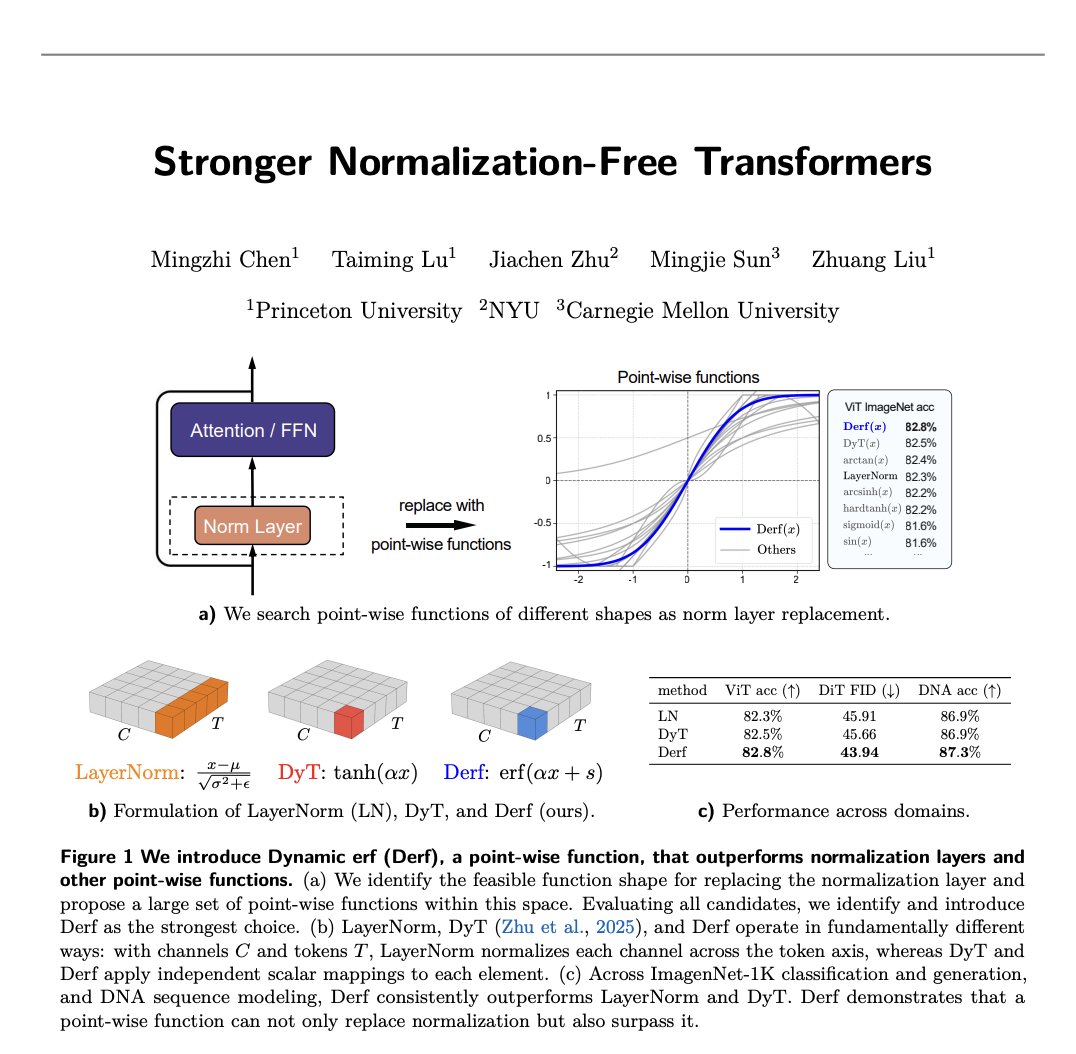
Stronger Normalization-Free Transformers – new paper.
We introduce Derf (Dynamic erf), a simple point-wise layer that lets norm-free Transformers not only work, but actually outperform their normalized counterparts.
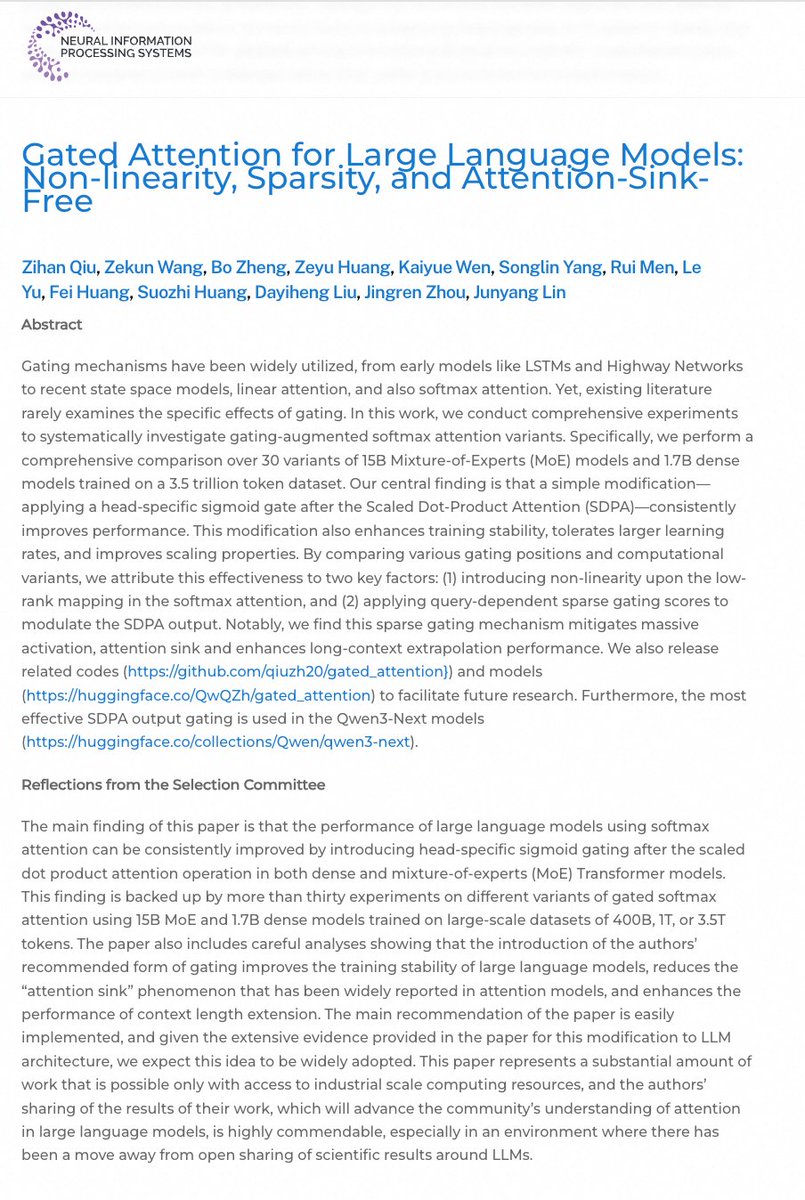
🏆 We are incredibly honored to announce that our paper, "Gated Attention for Large Language Models: Non-linearity, Sparsity, and Attention-Sink-Free" has received the NeurIPS 2025 Best Paper Award!
A huge congratulations to our dedicated research team for pushing the boundaries of AI.
Read more: https://t.co/qu3ERa3pH5
Large Behavior Models and Atlas Find New Footing!
Boston Dynamics shared a deep dive into how Atlas is evolving with Large Behavior Models.
The blog shows how far humanoid robots have come in learning long, complex behaviors from human demonstrations.
Blog: https://t.co/SICNEhnXis
Paper: https://t.co/sK9gqntYMx
Still many challenges to go. Grateful to be working alongside an incredibly fun and talented team. ❤️
This seems like a major breakthrough for AI advancement
Tencent and Tsinghua introduced CALM (Continuous Autoregressive Language Models), a new approach that replaces next token prediction with continuous vector prediction, allowing the model to think in ideas instead of words.
Key results:
~4× fewer prediction steps
44% less training compute
🤯 Think better visuals mean better world models? Think again.
💥 Surprise: Agents don’t need eye candy— they need wins.
Meet World-in-World, the first open benchmark that ranks world models by closed-loop task success, not pixels.
We uncover 3 shocks:
1���⃣ Visuals ≠ utility
2️⃣ Action data > bigger models
3️⃣ Scaling test-time compute = more success
🤗 https://t.co/OXn4WfnuTU
🌍 https://t.co/AKRgXhSCJV
📄 https://t.co/izyjaKTHgO
https://t.co/hd6F9VPGQ2
@free 1 semaine sans co internet dans 1 très grande ville. Une connexion tél 5G hyper instable et maintenant votre service ����🦺 tombe en panne. Je pense à sérieusement changer d'opérateur...
The Impact of Initialization on LoRA Finetuning Dynamics
a clean bit of scientific exploration and one of the better papers i've read all year. (and yes i am pretty much LoRA-pilled)
in Low-Rank Adaptation, we typically train adapters A and B that are added to weights as W + BA. we need to initialize either B or A to zero to preserve the network behavior at init
TLDR it's better to set B to zeros. learns faster, lets you use larger learning rates. pretty surprising to me
I’m excited to be the Chief AI Officer of @Meta, working alongside @natfriedman, and thrilled to be accompanied by an incredible group of people joining on the same day.
Towards superintelligence 🚀
Today, we're unveiling two new open-source AI robots! HopeJR for $3,000 & Reachy Mini for $300. DM me if you want to be added to the waitlist 🤖🤖🤖
Let's go open-source AI robotics!
OK, ByteDance Seed is now firmly a top tier lab in my mind. Congrats on many solid works recently, continuously publishing and even releasing models.
A shame that I am really really bad at remembering individual Chinese names though :-/
Could a major opportunity to improve representation in deep learning be hiding in plain sight? Check out our new position paper: Questioning Representational Optimism in Deep Learning: The Fractured Entangled Representation Hypothesis. The idea stems from a little-known observation about networks trained to output a single image: when they are discovered through an unconventional open-ended search process, their representations are incredibly elegant and exhibit astonishing modular decomposition. In contrast, when SGD (successfully) learns to output the same image its underlying representation is fractured, entangled - an absolute mess!
This stark difference in the underlying representation of the same "good" output behavior carries deep lessons for deep learning. It shows you cannot judge a book by its cover - an LLM with all the right responses could similarly be a mess under the hood. But also, surprisingly, it shows us that it doesn't have to be this way! Without the unique examples in this paper that were discovered through open-ended search, we might assume neural representation has to be a mess. These results show that is clearly untrue. We can now imagine something better because we can actually see it is possible.
We give several reasons why this matters: generalization, creativity, and learning are all potentially impacted. The paper shows examples to back up these concerns, but in brief, there is a key insight: Representation is not only important for what you're able to do now, but for where you can go from there. The ability to imagine something new (and where your next step in weight space can bring you) depends entirely upon how you represent the world. Generalization, creativity, and learning itself depend upon this critical relationship. Notice the difference in appearance between the nearby images to the skull in weight space shown in the top-left and top-right image strips of the attached graphic. The difference in semantics is stark.
The insight that representation could be better opens up a lot of new paths and opportunities for investigation. It raises new urgency to understand the representation underlying foundation models and LLMs while exposing all kinds of novel avenues for potentially improving them, from making learning processes more open-ended to manipulating architectures and algorithms.
Don't mistake this paper as providing comfort for AI pessimists. By exposing a novel set of stark and explicit differences between conventional learning and something different, it can act as an accelerator of progress as opposed to a tool of pessimism. At the least, the discussion it provokes should be quite illuminating.