Our new piece in @PLOSGPH:
"#Cholera vaccines for the rich, cholera for the poor: While the global cholera vaccine stockpile runs dry, a booming market for high-income countries exemplifies the chasm between commercial interests and global health needs" https://t.co/Kb1sDO6scD
Sars-CoV-2 : l’omerta doit cesser.
5 ans après le confinement, la France doit mener une commission d'enquête sur l'origine du Covid et le désastre de la coopération franco-chinoise.
Nous avons bâti le P4 de Wuhan. Au mieux il n'a servi à rien, au pire il est lié à la catastrophe.
Kala Azar is a life-threatening disease affecting adults & children. Treatment grants lifelong immunity, offering hope to those affected. MSF supports the MOH by treating Kala Azar in 2 projects in Gedaref state, in Um Rakuba & Tanedba gathering sites.
Dr Amer explains more
Did you know? Scorpions farms do exist. Each scorpion produces about 2 milligrams of venom daily, which is milked using a pair of tweezers and tongs. A liter is worth $10 million, used for cosmetics and medicines
[📹 efre812]
In sub-Saharan Africa, patients face a “Wild West” of #antivenoms that are badly made, badly marketed and badly regulated. Some are as useless as injecting water, experts said.
Excellent reporting by @TBIJ, including original evidence not published before. https://t.co/X2f4xSOrV8
Two types of ineffective antivenoms were found by the reporters:
- Antivenoms against Indian snake species that were still shipped to African markets.
- Antivenoms against African snake species, but with a very low mass of active ingredient.
Last year, researchers addressed the challenges of diagnosing Buruli ulcer, a devastating necrotic skin disease.
They evaluated LAMP, a rapid molecular test, as a potential alternative to PCR—offering a faster, more accessible solution for low-resource settings.
🎥 See the highlights and check out the full video here: https://t.co/nu4Ati4RFM
#WorldNTDDay #BuruliUlcer #NTDs #GlobalHealth
In 2024, at MSF Scientific Days, experts discussed the urgent need for a better treatment for eumycetoma, a highly neglected fungal disease.
Eumycetoma patients face limited, ineffective treatments, often requiring surgery.
Their research examined fosravuconazole as a potential alternative to the long, poorly adapted itraconazole regimen.
🎥 This video summarizes key findings. Watch now, and check out the full video here: https://t.co/8HliHlVfwM
#WorldNTDDay #Eumycetoma #NTDs #GlobalHealth
In 1922, a group of scientists went to the Toronto General Hospital where diabetic children were kept in wards, often 50 or more at a time. Most of them were comatose and dying from diabetic ketoacidosis. Others were being treated by being placed on an extremely strict diet, which inevitably led to starvation.
This is known as one of medicine's most incredible moments. Imagine a room full of parents sitting at the bedside waiting for the inevitable death of their child.
The scientists went from bed to bed and injected the children with a new purified extract: it was called insulin.
As they began to inject the last comatose child, the first child injected began to awaken. Then one by one, all the children awoke from their diabetic comas. A room of death and gloom became a place of joy and hope.
In the early 1920s Frederick Banting and Charles Best discovered insulin under the directorship of John Macleod at the University of Toronto. With the help of James Collip insulin was purified, making it available for the successful treatment of diabetes.
In the same year, Banting, Collip, and Best decided to sell the insulin patent to the University of Toronto for $1.
Banting and Macleod earned a Nobel Prize for their work in 1923.
Photo Credits: Library and Archives Canada
Save the Date 🗓️
World Neglected Tropical Diseases Day 2025 is coming soon: 30 January 2025. #WorldNTDDay
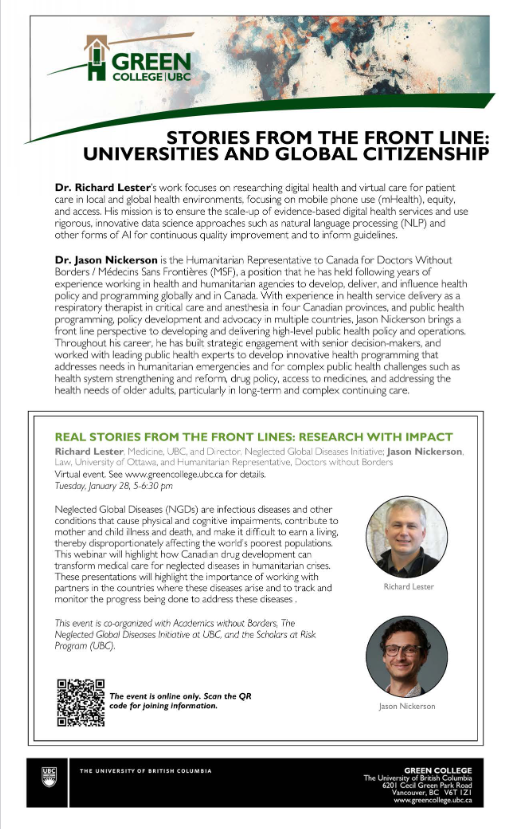
This 🧵 lists public-facing events all around the world at that period of time (29Jan-2Feb).
#BeatNTDs
https://t.co/EQLzjS2M4T
We are excited to announce our first Open Grants call has now gone live!
These grants will focus on the burden and treatment of snakebite venoming in Africa. If you are interested please check out our website for more details!
https://t.co/CIRzVNlvI4
#beatNTDs#snakebite
Visceral leishmaniasis, the "silent killer" is deadly in more than 90% of cases when untreated. Read about the effort to curb a surge in cases in Turkana, Kenya. https://t.co/BI0xSOa8E3