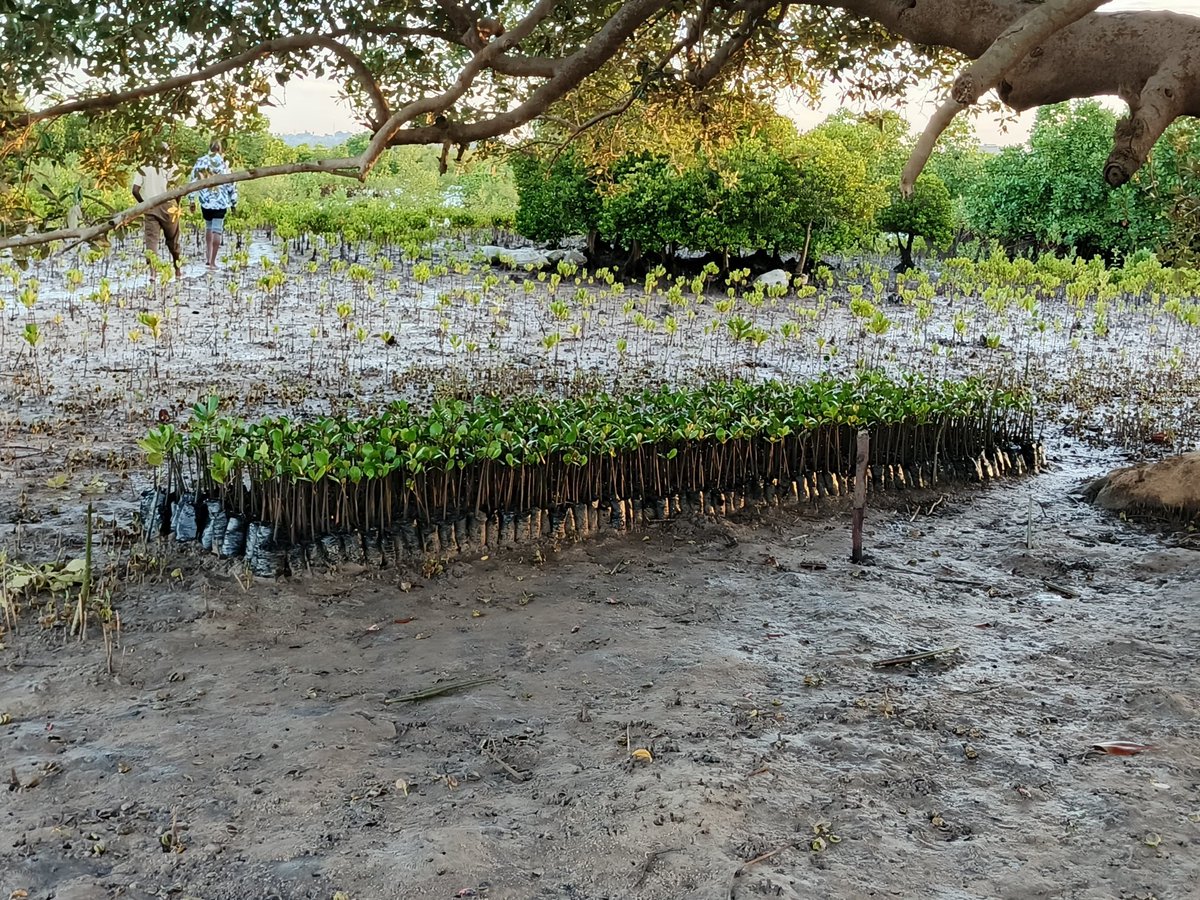
Addressing Mangrove Restoration Concerns at the MiraraniSite in Tudor
This brief responds to concerns raised about the ongoing mangrove restoration activity at the Mirarani site in Tudor, particularly regarding site suitability and species selection.
The Kenya Forest Service (KFS) has applied a stepwise, science-led restoration process. Technical experts conducted assessments of tidal hydrology, elevation, salinity gradients, and historical ecosystem conditions to determine site suitability. This approach aligns with global best practice, which holds that successful mangrove restoration depends on understanding ecological and hydrological conditions before planting. Consequently, species selection at Mirarani has been matched to specific microhabitats within the site, ensuring ecological compatibility and adherence to the principle of “right species, right site.”
KFS is implementing this activity in full alignment with the Mangrove Ecosystem Restoration Guidelines (2025) and the National Mangrove Ecosystem Management Plan (2017–2027), which prioritise ecosystem functionality, hydrological integrity, and longterm monitoring over shortterm planting targets. This approach is consistent with international guidance, which recognises that restoration success is achieved when ecological processes are restored and supported over time, rather than through planting alone.
Global case studies reinforce the validity of this approach while demonstrating that largescale planting efforts can complement restoration when guided by science. In Senegal, communityled initiatives have planted over 79 million mangrove trees across more than 350 villages, illustrating how scale can be achievedthrough coordinated, communitydriven efforts. In Pakistan, the Sindh Forest Department, together with partners, planted over 847 million mangroves between 2013 and 2021, contributing to one of the largest mangrove afforestation efforts in the world. These examples demonstrate that highvolume planting is not inherently problematic when embedded within structured, sciencebased restoration frameworks.
The Mirarani intervention forms part of a broader restoration strategy under the Adopt a Forest initiative, integrating stakeholder participation with strong technical oversight. KFS therefore maintains a clear focus on longterm ecological performance, including survival rates, ecosystem recovery, and resilience.
In summary, the Mirarani mangrove restoration activity reflects a policyaligned, scientifically grounded, and globally validated approach. By combining technical expertise, national policy frameworks, and lessons from international case studies, KFS ensures that restoration efforts remain credible, effective, and sustainable. At the same time, KFS leverages public participation to strengthen long‑term ecosystem stewardship.
References
• Diouf, D. (2019). Communitybased mangrove restoration in Senegal: The Oceanium experience. In: Mangrove Ecosystems of Africa – A Regional Review. UNEPWCMC / FAO. Alternative source: IUCN (2017). Mangrove restoration in Senegal – scaling up community action.
• Sindh Forest Department, Government of Sindh (2022). Mangrove afforestation in the Indus Delta: Achievements and lessons (2013–2021). Karachi: Sindh Forest Department.
Peerreviewed reference: Ahsan, M., & Khan, M. A. (2020). Mangrove restoration along the coast of Pakistan – a success story. Wetlands Ecology and Management, 28(5), 789–802.
• Kenya Forest Service (2025). Mangrove Ecosystem Restoration Guidelines. Nairobi: KFS.
• Ministry of Environment and Natural Resources (2017). National Mangrove Ecosystem Management Plan 2017–2027. Nairobi: Government of Kenya.
• Wetlands International & IUCN (2020). Guidelines for mangrove restoration – learning from best practice. Wageningen: Wetlands International.
@NPSOfficial_KE@DCI_Kenya Stop insulting Kenyans’ intelligence.
This statement is not an investigation it’s damage control.
A teargas canister does not walk into a church by itself. Riot police do not deploy themselves. Police vehicles do not leave stations. Guns, teargas, shields, armoured trucks none of these move without orders. Pretending otherwise is cowardice dressed up as procedure.
You say you “regret” the disruption. Regret is cheap. Accountability is absent.
You claim the same police accused of escorting goons will now investigate themselves. That is not justice it is theatre.
Kenyans have seen this script before: delay, deflect, dilute, disappear. The outcome is always the same no names, no arrests, no consequences.
You say there were “no injuries.” That is either ignorance or deliberate dishonesty. Children were teargassed in a place of worship. Women were injured. Vehicles were torched. Video evidence shows police presence alongside attackers. Facts do not bend to press statements.
You call churches sanctuaries, yet your officers violated one. You condemn violence, yet armed men operated freely under police watch. You ask witnesses to come forward, yet history shows whistleblowers are punished while perpetrators are protected.
This is not a rogue incident. It is command failure.
The Inspector General knows who issued the deployment orders.
The DCI knows who coordinated security.
The NPS knows which officers were on duty, which units were mobilised, and who gave clearance.
If you were serious, you would publish:
1. Names of the commanding officers on site
2. The Occurrence Book entries
3. The deployment orders
4. The officers who fired teargas
5. The officers who escorted armed civilians
Until then, this statement is an insult.
Police officers should remember one thing: power is rented, not owned.
Ask former bosses who once believed political loyalty would protect them where are they now? Power changed hands, and they were discarded without ceremony.
Today you may be useful. Tomorrow you will be expendable.
Kenya is not asking for sympathy.
Kenyans are demanding names, faces, orders, and arrests.
Anything less is complicity.