I wasn't a fan of the markdown editors that I was finding out there. I wanted something that looked good, had side-by-side editing and wasn't some wannabe IDE. I like simplicity.
So I had @Adapt make me one while I was working on other things and it did not disappoint!
Like most features - It's easy to get going but difficult to get right. At @Adapt we not only support any type of integration (if it's connected to the internet, we support it), we also allow you to connect any number of them. Have 7 slacks to manage? connect them all
I continue be surprised how Grok Bot is very good by doing so many things right (not innovating!) Commecting several Gmail accounts / Slack accounts etc is one of these.
And yes no other *managed* agent (eg Codex, Claude Cowork) supports this which is just strange. Like, why?
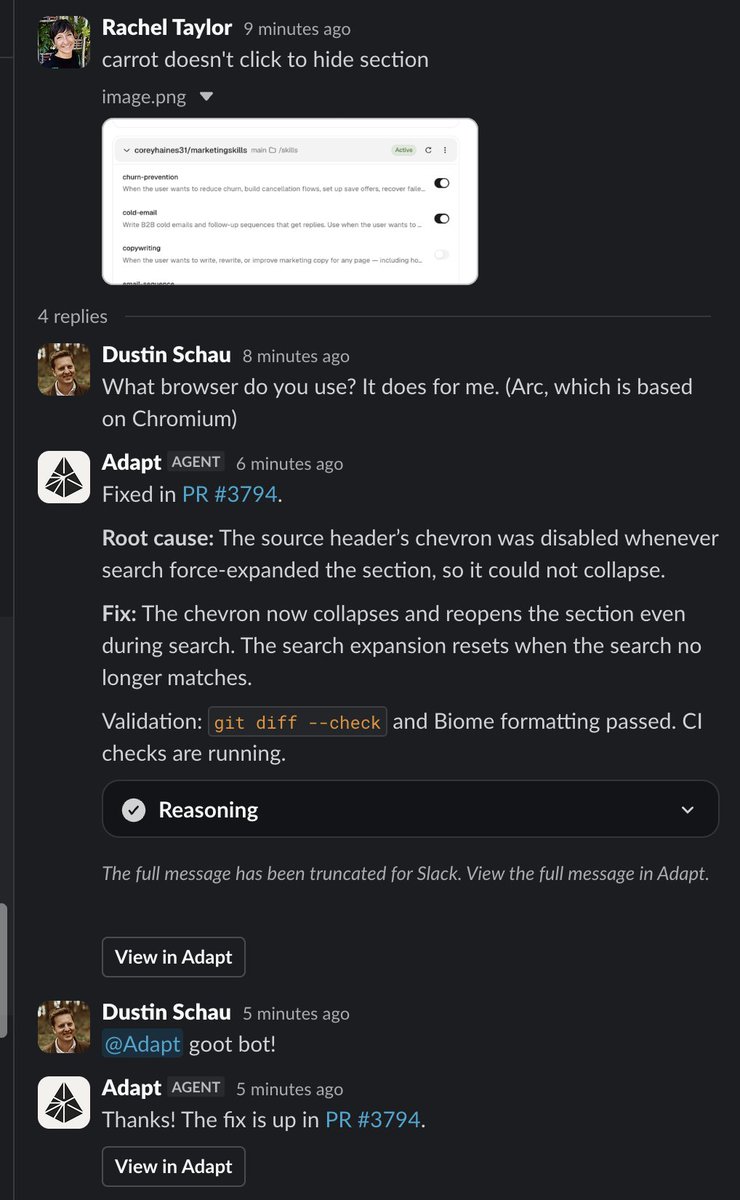
I've been a professional dev for over 10 years. I have fixed a lot of bugs and started off with reports just like this. I had just enough time to start the app and do an initial check (finding nothing wrong) before @Adapt found the issue. The future is now!
Real example of Adapt as our company agent in Slack today, shared by one of our engineers
“Adapt found the real issue. I came to the same conclusion as DS, but Adapt went further.”
@SchauDustin@Adapt I think we are finding out that agents are an extension of a company, and people want something that reflects the identity they've worked hard to build. Companies really owning their agents is the next step
We’re moving from asking, “What AI do you use?”
to “What AI does your company run on?”
to “What AI is running your company?”
Today, we’re launching your @ company agent in Adapt. Your company’s own AI, branded with your name and deployable within minutes.
Tag @ yourcompany in Slack and ask it to do the work.
As we go through this change, it is important that a company owns its AI.
Own the agent, @ yourcompany.
Own the knowledge it builds.
Own the model routing.
Own the experience.
The company agent is the durable layer. It gives your company access to the best frontier and open-weight models, choosing the right model for each task to balance quality, speed, and cost.
When you tag @ yourcompany, you’re talking directly to your business through one front door. It learns how your company works, chooses the right model and skill, delegates work to specialized agents, and becomes more valuable as your company’s knowledge grows.
A few things make this possible.
It has to connect to every system your employees rely on, with the right access and permissions to understand the business and take action.
It needs its own secure computer to write code, build apps, analyze data, operate software, and do the work.
It has to be everywhere your people work. Web, Slack, iMessage, GitHub, and more.
Vercel CEO Guillermo Rauch articulated this perfectly when describing @ v, the internal company agent they built.
“If agents become the foundation of modern companies, you being in complete control, from source to runtime to data to token, seems like a pretty big deal.”
Every company will have its own @ company agent.
Adapt is how you deploy yours.
What AI is running your company?
LLMs have us all scrounging around in the dark trying to figure things out. I have been leaning more and more toward what @bruno__quaresma is doing in this post
Reviewing AI-generated code is the hot topic, but my middle ground is different: build what I want, validate it, learn in the flow, then split it into small reviewable pieces where I can fix the code and architecture.
https://t.co/aLJhqJQ6Do
If you are a software developer: keep writing code every day. Just find something you're interested in and write it by hand, little-by-little, every day. AI is only as good as the hand that wields it