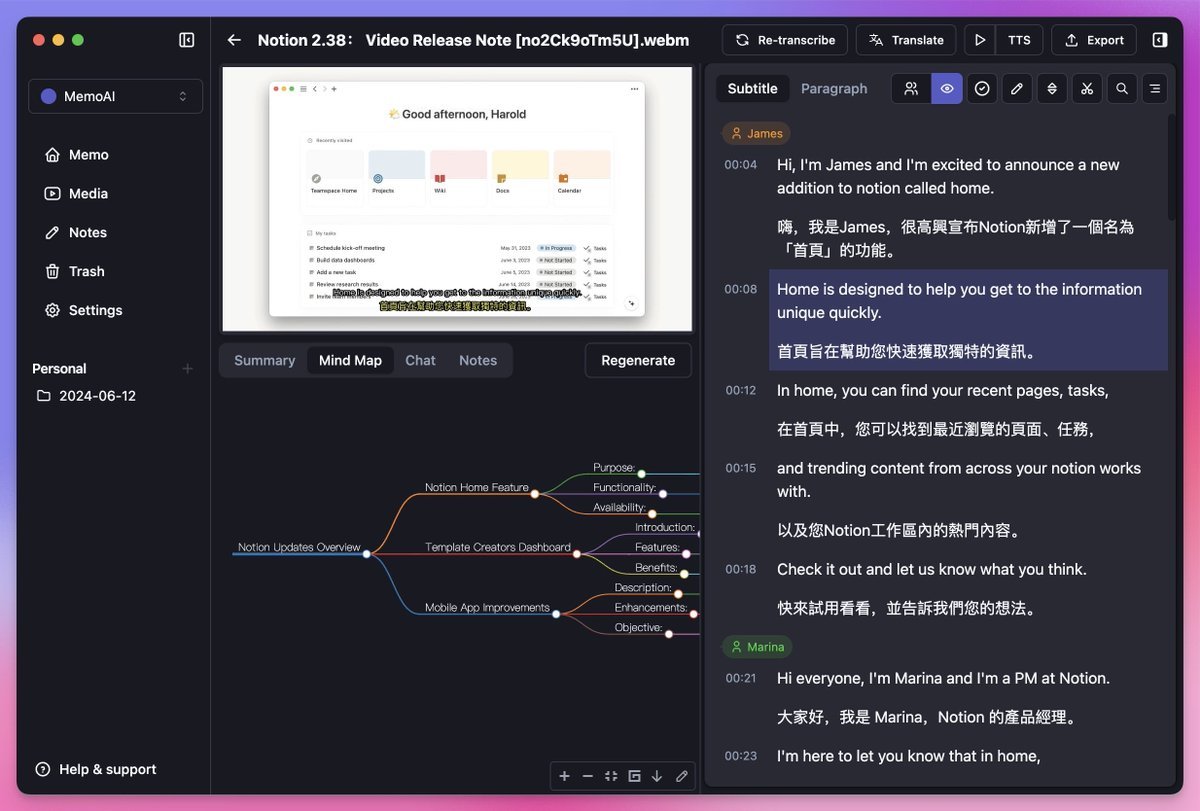
2-bit Gemma 4 12B GGUF, only 4.66 GB on disk, managed to cite 15 sites from a single prompt.
Try this locally on >6GB RAM via Unsloth Studio.
GitHub: https://t.co/aZWYAtakBP
We love seeing what you build with Gemma! 🚀
Like this incredible community project that helps you fine-tune Gemma 4 with audio, text, and images on Apple silicon. 🧵👇
Everyone is sleeping on this new OCR model!
- 85.9% (sota) on olmocr bench
- 90+ language support w/benchmarks
- 4B model (down from 9B)
- Full layout information
- Extracts + captions images and diagrams
- Strong handwriting, math, form, table support
100% open-source.
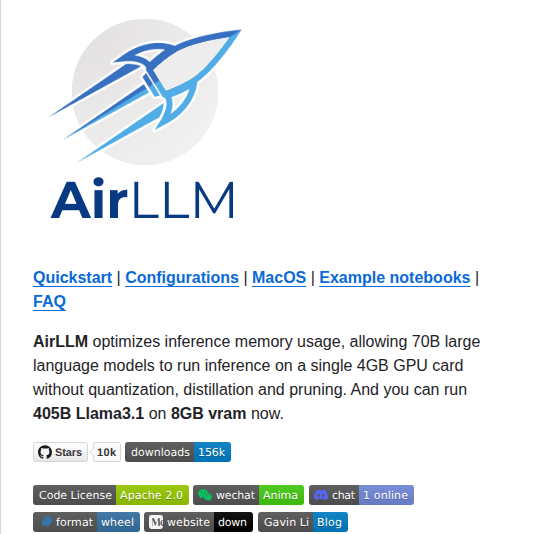
🚨 BREAKING: Someone just made 70B parameter models run on a single 4GB GPU.
It's called AirLLM. No quantization. No distillation. No pruning. Just raw 70B inference on hardware that costs less than a dinner.
You can even run Llama 3.1 405B on 8GB VRAM.
Here's how it works:
→ Decomposes the model layer-by-layer
→ Loads only one layer into GPU memory at a time
→ Runs inference, moves to the next layer
→ Prefetches the next layer while computing the current one
→ Supports 4-bit and 8-bit compression for 3x speed boost
No cloud API. No $10K GPU. Just pip install airllm and go.
Here's the wildest part:
It supports almost every major model — Llama, Qwen, Mistral, ChatGLM, Baichuan, InternLM — and it auto-detects the model type. One line of code to load. One line to generate.
Works on Linux, macOS (Apple Silicon), and even Google Colab free tier.
Your old gaming laptop can now run the same models that needed an A100.
100% Open Source. Apache 2.0 License.
𝗕𝘂𝗶𝗹𝗱 𝗧𝗵𝗶𝘀 𝗘𝗻𝗱-𝘁𝗼-𝗘𝗻𝗱 𝗔𝗪𝗦 𝗗𝗲𝘃𝗢𝗽𝘀 𝗣𝗿𝗼𝗷𝗲𝗰𝘁 (𝗥𝗲𝗮𝗹 𝗣𝗿𝗼𝗱𝘂𝗰𝘁𝗶𝗼𝗻 𝗘𝘅𝗽𝗼𝘀𝘂𝗿𝗲)
You will learn more by building one hands-on project from scratch than by watching 10 YouTube tutorials.
Project Description: An OpenTelemetry-based E-commerce microservices app deployed on AWS with full CI/CD + GitOps.
🟢 Project Architecture (Industry Style)
User
→ Domain (GoDaddy)
→ Route53
→ Load Balancer
→ EKS
→ Kubernetes Services
→ 20+ Microservices
If you build this once interviews become easy.
🟢 Step 1: Infrastructure as Code (Terraform)
Use Terraform to provision everything.
What you will implement:
✅ VPC (public + private subnets)
✅ Internet Gateway
✅ Route Tables
✅ NAT Gateway
✅ Security Groups
✅ EKS Cluster using Amazon EKS
✅ S3 backend for remote state
✅ DynamoDB for state locking
👉 What you will learn:
- Real VPC networking design
- How production EKS clusters are created
- Remote state management best practices
- Terraform backend configuration
- State locking (why it matters in teams)
- This alone gives you real DevOps exposure.
🟢 Step 2: CI/CD with GitHub Actions
Use GitHub Actions
Pipeline Stages You Should Create:
🔹 Build
- Checkout code
- Setup Go
- Install dependencies
- Run unit tests
🔹 Code Quality
- Integrate golangci-lint
- Perform static analysis
🔹 Docker
- Build images
- Push to Docker Hub
🔹 Update Kubernetes Manifests
- Auto-update image tag
- Commit back to repo
👉 What you will learn:
- Automated CI pipelines
- Docker image tagging strategy
- Version control in pipelines
- Secure secret handling
- Production-grade workflow design
This is exactly what companies expect.
🟢 Step 3: Containerization
Use Docker
What you will implement:
- Containerize 20+ microservices
- Multi-stage Docker builds
- Lightweight production images
- docker-compose for local testing
👉 What you will learn:
- Microservice packaging
- Build optimization
- Local vs production environment differences
- Dependency management
🟢 Step 4: Kubernetes on AWS
Deploy everything on Kubernetes using Amazon EKS
What you will implement:
✅ Deployments
✅ Services (ClusterIP, LoadBalancer)
✅ Ingress
✅ Service Accounts (IAM roles for service accounts – IRSA)
✅ Resource limits & requests
👉 What you will learn:
- Pod scheduling
- Service-to-service communication
- Ingress + ALB integration
- Secure workload identity
- Real cluster debugging
- This is real production experience.
🟢 Step 5: GitOps with ArgoCD
Use Argo CD
What you will implement:
- Connect GitHub repo to EKS
- Enable auto-sync
- Maintain desired state = actual state
👉 What you will learn:
- GitOps workflow
- Declarative deployments
- Drift detection
- Production-grade release strategy
- Modern companies are moving toward GitOps.
🟢Step 6: Domain + Traffic Routing
Use:
- Amazon Route 53
- GoDaddy domain
Flow:
User
→ Route53
→ AWS Load Balancer
→ Ingress
→ Service
→ Pod
👉 What you will learn:
- DNS configuration
- Hosted zones
- A records / CNAME
- Real internet traffic routing
Now your project becomes public and production-like.
🎯Final Outcome
If you build this project fully: You will understand:
✔ Networking
✔ CI/CD
✔ GitOps
✔ Kubernetes
✔ IAM & Security
✔ Terraform Backend
✔ Production troubleshooting
✔ Real DevOps workflow
I have documented everything in my GitHub repository.
You can follow it step by step, and if you get stuck, feel free to take help from ChatGPT but make sure you truly understand the concepts.
𝗠𝗮𝗶𝗻 𝗣𝗿𝗼𝗷𝗲𝗰𝘁 𝗥𝗲𝗽𝗼: https://t.co/HoGVLDDXlN
𝗧𝗲𝗿𝗿𝗮𝗳𝗼𝗿𝗺 𝗥𝗲𝗽𝗼: https://t.co/VffpUPOyUn
If you found this helpful, feel free to like, retweet, and share it with aspiring DevOps engineers.
Signing off
@devops_nk 🫡
Backend Development Project Ideas
Beginner Level
• Authentication API
• CRUD API For Users
• Blog Backend
• URL Shortener
Intermediate Level
• Pagination and Search API
• File Upload API
• Rate Limiter API
• Muti User chat Application
Advanced Level
• Multi role user System
• O Auth2 Login API
• Job Queue System
• Recommendation System
Expert Level
• Video Steaming Service
• High Performance API With Caching
• Distributed File Storage System
The Top AI Papers of the Week (February 2-8)
- A-RAG
- InfMem
- xMemory
- TinyLoRA
- OpenScholar
- Agent Primitives
- Heterogeneous Computing for AI Agent Inference
- Semi-Autonomous Mathematics Discovery with Gemini
Read on for more:
As a backend engineer.
focus on mastering:
- System Design (scalability, microservices)
-APIs (REST, GraphQL, gRPC)
-Database Systems (SQL, NoSQL)
-Distributed Systems (consistency, replication)
-Caching (Redis, Memcached)
-Security (OAuth2, JWT, encryption)
-DevOps (CI/CD, Docker, Kubernetes)
-Performance Optimization (profiling, load balancing)
-Cloud Services (AWS, GCP, Azure)
-Monitoring (Prometheus, Grafana)
Pick up a language..
and go deep.
stop hopping between languages every few months.
Fusion of 𝗥𝗔𝗚 (Retrieval Augmented Generation) and 𝗖𝗔𝗚 (Cache Augmented Generation). How can you benefit from it as AI Engineer?
Let’s see what it looks like and what additional considerations should be taken into account.
Here are example steps to implement CAG + RAG architecture:
𝘋𝘢𝘵𝘢 𝘗𝘳𝘦𝘱𝘳𝘰𝘤𝘦𝘴𝘴𝘪𝘯𝘨:
𝟭. We use only rarely changing data sources for Cache Augmented Generation. On top of the requirement of data changing rarely we should also think about which of the sources are often hit by relevant queries. Once we have this information, only then we pre-compute all of this selected data into a KV Cache of the LLM. Cache it in memory. This only needs to be done once, the following steps can be run multiple times without recomputing the initial cache.
𝟮. For RAG, if necessary, precompute and store vector embeddings in a compatible database to be searched later in step 4. Sometimes simpler data types are enough for RAG, a regular database might suffice.
𝘘𝘶𝘦𝘳𝘺 𝘗𝘢𝘵𝘩:
We can now utilise the preprocessed data.
𝟯. Compose a prompt including user query and the system prompt with instructions on how cached context and retrieved external context should be used by the LLM.
𝟰. Embed a user query to be used for semantic search via vector DBs and query the context store to retrieve relevant data. If semantic search is not required, query other sources, like real time databases or web.
𝟱. Enrich the final prompt with external context retrieved in step 4.
𝟲. Return the final answer to the user.
𝘚𝘰𝘮𝘦 𝘊𝘰𝘯𝘴𝘪𝘥𝘦𝘳𝘢𝘵𝘪𝘰𝘯𝘴:
➡️ Context window is not infinite and even while some models boast enormous context window sizes, the needle in the haystack problem has not yet been solved so use available context wisely and cache only the data you really need.
✅ For some business cases, specific datasets are extremely valuable to be passed to the model as cache. Think about an assistant that has to always comply with a lengthy set of internal rules stored in multiple documents.
✅ While CAG has been popularised for Open Source just recently, it is already viable for some time via Prompt Caching features in OpenAI and Anthropic APIs. It is really easy to start prototyping there.
✅ You should always separate hot and cold data sources, only use cold (data that changes rarely) in your cache, otherwise the data will go stale and the application will go out of sync.
❌ Be very careful about what you cache as the data will be available for all users to query.
❌ It is very hard to ensure RBAC for cached data unless you have a separate model with its own cache per role.
Have you used the combination already?
Claude Code now supports the --from-pr flag
Resume any session linked to a GitHub PR by number, URL, or pick interactively. Sessions auto-link when a PR is created!
5 AI projects that will get you hired in 2026:
save & retweet it.❤️
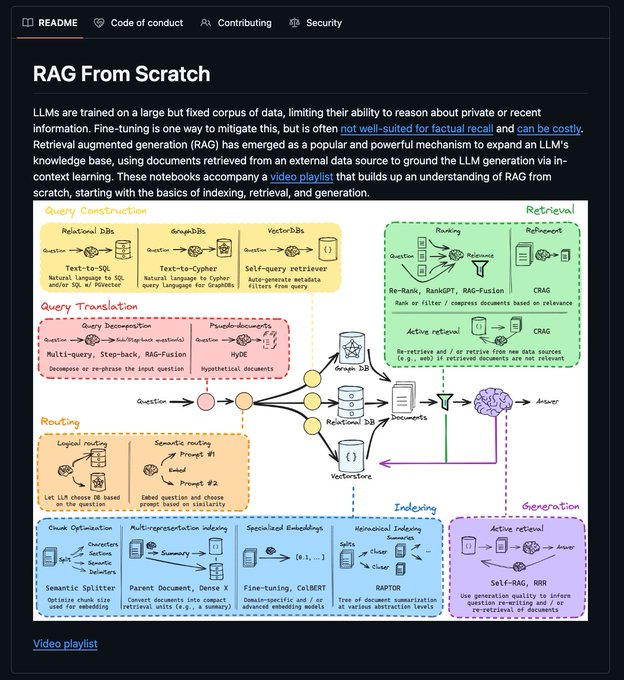
1. RAG from Scratch
GitHub: https://t.co/HaJrX0COwN
2. Al Social Media Agent
GitHub: https://t.co/1BXYaxZTN2
3. Medical Image Analysis
GitHub: https://t.co/MqYgVxHisZ
4. MCP Tool-Calling Agents
Notebook: https://t.co/pA3bMHABjH
5. Al Assistant with Memory
GitHub: https://t.co/LoC4mtW5M0







![EXM7777's tweet photo. turn this thread into instructions for your claude[.]md file
this might just change your life https://t.co/FkmClXtdPg](https://pbs.twimg.com/media/HAF0lbda8AAeurt.jpg)