Even just 3–4 years ago, we didn’t have proper blockchain interoperability.
If you wanted to move funds from one chain to another, you had two options:
1. Use a CEX
2. Use a tool like Orbiter where you’d send money to a contract or address, wait a few minutes (or hours), and receive the funds on the destination chain.
But this wasn’t real interoperability.
Why?
Because most of it was done manually or through centralized systems. Both CEXs and early bridges often charged high fees, took time, and offered limited asset support.
Fast forward to now today, we’ve entered the interoperability era. But is it perfect?
No! Not yet.
.What Is Interoperability?
To most users, interoperability just means “bridging” like moving tokens from one chain to another.
But that’s just one part of it.
Think of interoperability like using a social app WhatsApp, X, Telegram, or WeChat.
With these apps, we can share photos, videos, audio, PDFs, money with anyone, anywhere in few sec.
Before these apps, we had to rely on someone physically carrying the message or data. It was slow, inefficient, limited, risky.
Blockchains were the same isolated islands.
There is hundreds of chains, but they can't talk to each other.
If you wanted to move value or data between them, you had to:
* Use a centralized exchange
* Trust a contract that only supported limited tokens
* And only move token/coins, not complex data or content
Now:
With interoperability, chains can communicate with each other exchanging:
* Tokens
* Text messages
* Complex data
* Audio/video
* Entire smart contract instructions
* Governance Voting from multiple chain. @MitosisOrg mainnet will have this using @hyperlane
All instantly, securely, and decentralized.
Let’s say I build a blockchain-based game, and it becomes so popular that my current chain’s TPS can’t handle the pressure.
Now I have two options:
* Ask users to switch to another chain and we all know that we don't like change and you have to setup another chain and have to move your asset and data
that will create a bad experience for the users.
* Or… build a second chain to offload game data while keeping user profiles and assets on the original chain
But here’s the challenge:
How do I make these two chains talk to each other?
That’s where interoperability comes in.
It connects both chains just like how Ethereum Layer 2s talk to Ethereum mainnet.
Data flows smoothly between them: gaming actions, profile updates, assets all synced, cheap, fast, and decentralized.
.What is the Process of Interoperability Between Two Chains?
Let’s understand it with a simple example:
Suppose I currently have 10 ETH on Ethereum, and I want to receive WETH on BNB Chain.
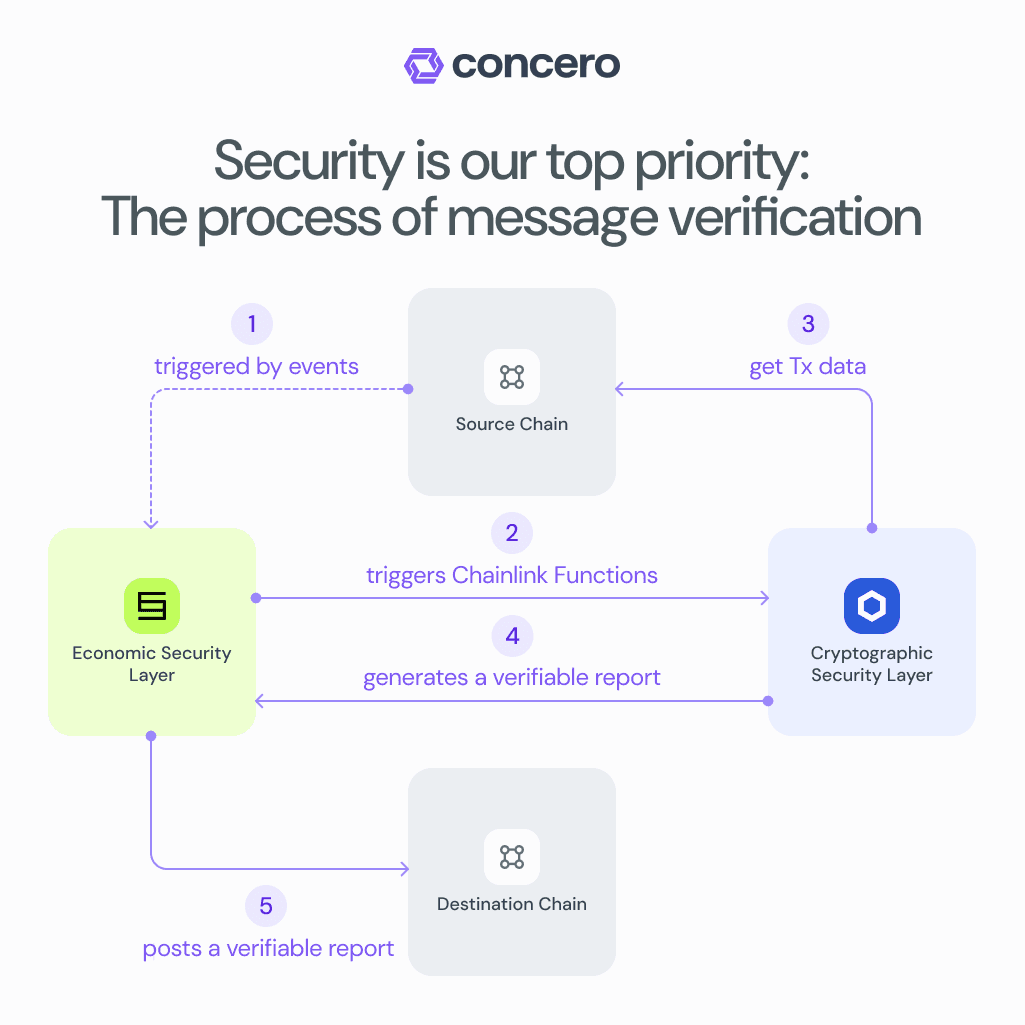
I initiate the transaction from @lanca_io or @concero_io , as the dApps already has liquidity pools on multiple chains. ( parent child poo;)
1. My funds go to the Lanca contract address (Lanca pool) on Ethereum mainnet.
2. The Ethereum pool sends a message to the Concero router stating that it has received 10 ETH and locks it.
3. This message is passed through the settlement layer, where all cross-chain communication is processed and validated.
4. The Concero router then informs the BNB pool/router that the user (me) has sent 10 ETH and requests 10 WETH on BNB Chain.
5. Now:
* If the BNB pool already has 10 WETH, it directly sends it to my BNB address.
* If it doesn't, the router uses a DEX on BNB Chain to swap for WETH, and the transaction is completed.
Another example how Does CCTP Handle This-
Let’s say I want 10,000 USDC on BNB Chain, but my funds are on Ethereum.
1. I send USDC to the CCTP contract on Ethereum.
2. The contract burns the USDC and sends a message to the BNB router.
3. The BNB router mints 10,000 new USDC on BNB and sends it to my address.
In both processes, decentralization is maintained, and the systems save both time and cost compared to traditional bridging methods.
Pretty much all the interoperability protocol uses the same process but in a different way, Examples of Popular Interoperability Models:
* @chainlink: Uses DON (Decentralized Oracle Network) and CCIP
* @wormhole: Uses Guardian network
* @axelar: Uses GMP (General Message Passing) and ITS
* @concero_io: Uses its own trustless router and modular architecture
- In the future, interoperability may go beyond money enabling the transfer of documents, photos, videos, and more across chains.
That's what I personally believe we’re heading toward.
One thing we need to know that there is Two Types of Interoperability Bridges
1. Trusted Bridges
* Run by centralized entities
* Pros: Fast, efficient, easier to implement
* Cons: Security risks, single point of failure
* Example: Binance Bridge, Relay
2. Trustless Bridges
* Fully decentralized using smart contracts and cryptographic proofs
* Pros: Censorship-resistant, no central control
* Cons: Slower, sometimes more expensive (but improving)
* Example: Concero, Chainlink CCIP, Axelar
With @concero_io, developers can deploy trustless cross-chain apps without needing to contact the team.
All they need is gas fees no extra costs, no central permissions. It’s designed to be fully modular and permissionless.
Future Outlook:
Interoperability has already come a long way but it’s not perfect yet. As Concero’s founder @Andy_Bohutsky mentioned,
"in the next 3–5 years, we may see true maturity in this tech and find out who protocol becomes the industry leader."
But at the end we have to keep it in mind that the major concern remains security.
Over the years, billions of dollars have been lost due to vulnerabilities in existing bridge systems.
Challenges in Achieving Blockchain Interoperability:
Blockchain interoperability refers to the ability of different blockchain networks to communicate and share data with one another.
However, achieving this seamless interaction presents several challenges:
1. Diverse Protocols
Different blockchains operate on unique consensus mechanisms and communication protocols,
making it difficult to establish a common ground for interoperability.
2. Data Standards
There is a lack of standardized data formats across networks.
This inconsistency can hinder the smooth exchange of information between blockchains.
3. Scalability Issues
As the number of blockchains grows, ensuring smooth interoperability becomes increasingly complex.
This can lead to performance bottlenecks and limited transaction throughput.
4. Security Concerns
Connecting multiple networks increases the overall attack surface.
Cross-chain bridges and messaging layers may introduce vulnerabilities,
especially if smart contracts are not thoroughly audited.
5. Governance Models
Each blockchain often has its own governance structure.
These differences can complicate coordination, upgrades, and policy enforcement between interoperable systems.
Overcoming these challenges requires:
* Collaboration between blockchain developers
* Standardization of protocols and data formats
* Continuous innovation in secure, scalable interoperability layers
That's all for today, let me know if you have any question and which topic should i write next, thanks. 🙌🙌
Hot take: the main reason why crypto startups rarely see success bcz if you tried to monetize and see real revenue you would be fucked. Crypto should be cheap but making it free what made the industry lose. I said what I said.
This is exactly what is wrong with this industry.
A product got built over years with good UX and actually is orders of magnitude better than competitors, and now, when they are trying to *checks notes* act as a business by charging fees the entire industry tells everyone to rotate?
Absolutely retarded behaviour which will keep decimating many teams
- Site owners get a new revenue stream other than ads which was also disrupted due to AI
- To make the proccess easy and take a bigger market share cloudflare needed a wallet, big brain.
win-win
- @Cloudflare lunch a wallet
- By september AI can't access all the website that use cloudflare.
- Cloudflare blocks them
- AI need data for continious training
- It creats a new monetization
- Site ask money to AI
- AI gives money using x402
- @Cloudflare takes cut
Cash App and Robinhood just had a baby
But It's built for the rest of the world, instead of only USA
IDRX. SGDX. AED. NGN. PHP. & More.
Bank · Pay · Trade on @HyperliquidX · Globally
One app.
We're just getting started
Waitlist → https://t.co/aLCUr3u70S
Cash App and Robinhood just had a baby
But It's built for the rest of the world, instead of only USA
IDRX. SGDX. AED. NGN. PHP. & More.
Bank · Pay · Trade on @HyperliquidX · Globally
One app.
We're just getting started
Waitlist → https://t.co/aLCUr3u70S
Alpha🤝
https://t.co/cHbwqMLadM
Join early to get an early spot, <1000 people joined. Everything is in one place trading, prediction, exchange to fiat, swap, bridge, prediction.
The global financial system is fast for banks.
Slow, expensive, and broken for everyone else.
$120 trillion moves across borders every year.
Most of it through rails built in 1973.
We built something for 2026.
https://t.co/aLCUr3u70S
DeFi has lost billions to exploits.
Not because the tech is broken.
Because there was no standard to measure risk and mitigate it.
Introducing Verdict.