NEW EPISODE: Speaking of Jung, Ep. 169 – The Collected Psychoanalytic Works of Sabina Spielrein with Drs. Michael Gerard Plastow and Christiane Weller.
▪️YouTube – https://t.co/ieZOqQVfei
▪️Audio & Show Notes – https://t.co/nP1XWiAXqC
“With all the above in mind, we may conclude that, whilst psychoanalysis is expensive, it is the most effective way of guarding against further expenses for treatment, because with this therapy, including ‘abortive’ psychoanalysis, relapse is less common than with other forms of treatment. Furthermore, it yields savings in sanatoria and hospital stays, hydrotherapy, electrotherapy, et cetera. All this needs to be considered.”
~Sabina Spielrein, Dr. med., “On Dr. Skalkovsky’s Paper,” Collected Psychoanalytic Works of Sabina Spielrein, Volume 2: Later Works from Lausanne, Geneva, and Rostov-on-Don, p. 152
See my interview with the editors and translators, Drs. Michael Gerard Plastow and Christiane Weller, on the new episode of Speaking of Jung.
Today’s the day we bust myths on Speaking of Jung. Sabina Spielrein was a psychoanalyst and pioneer of psychoanalysis, NOT the crazed fictionalized character depicted in the 2011 Cronenberg film ‘A Dangerous Method.’
🎥: Keira Knightley (Spielrein) and Michael Fassbender (Jung)
I’ll be recording with the editors of Spielrein’s Collected Works later this afternoon (Sunday). The video edition will be uploaded to Patreon (ad-free) on Monday. It should be available on YouTube, our website, and podcasting platforms on Tuesday.
“Spielrein herself succinctly summarises what the object of any successful work from the standpoint of psychoanalysis might be: ‘conscious thought must grasp what subconscious thought offers it, and utilise it.’”
~Michael Gerard Plastow and Christiane Weller, Editors and Translators’ Introductory Remarks on the Translation, Collected Psychoanalytic Works of Sabina Spielrein, Volume 2: Later Works from Lausanne, Geneva, and Rostov-on-Don, p. xiv
📷: Spielrein in Geneva in 1921, International Association for Spielrein Studies | Spielrein with other members of the Institut Rousseau: Godin (centre, with Spielrein on his right), Claparède, Piaget, 1921. Photograph appears by kind permission of Archives Institut Jean-Jacques Rousseau (AIJJR).
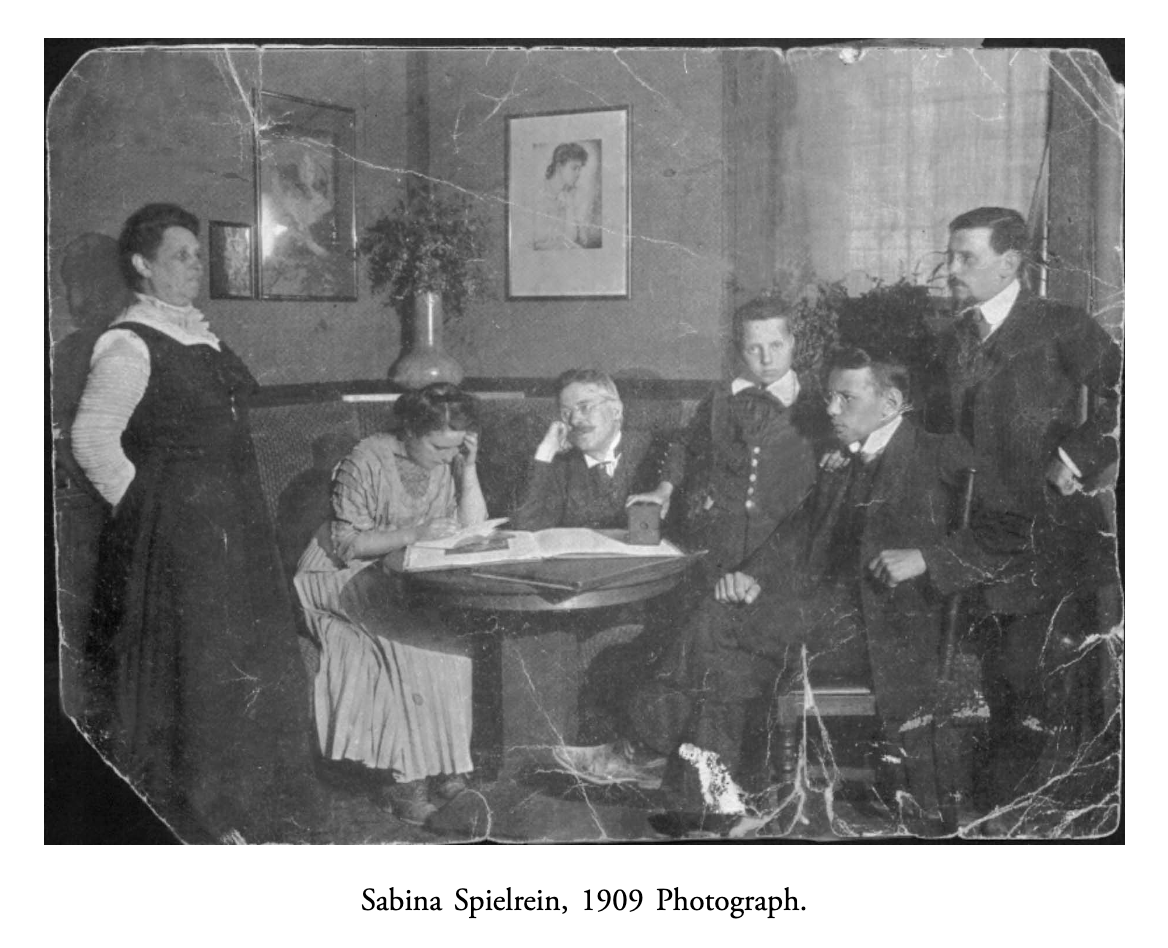
Finally found the caption for this photo: Wedding anniversary of Eva and Nikolai Spielrein, Rostov-on-Don, 1909. From the left: Eva, Sabina, Nikolai, Emil, Isaak, and Jan. 📷: International Association for Spielrein Studies
“Sabina Spielrein (1885–1942) was a psychoanalyst and pioneer of psychoanalysis. Her history with psychoanalysis began when she became a patient of Carl Gustav Jung (1875–1961), in his first psychoanalytic training case at the university clinic Burghölzli, under the direction of Eugen Bleuler (1857–1939). This case history anonymously inaugurated Jung’s correspondence with Sigmund Freud (1856–1939). From the time she was admitted, Spielrein was invited to participate in the scientific activities of the clinic. After her discharge nine months later, she worked as an assistant in clinical practice while studying medicine at the University of Zurich. Her final thesis, of 1910, constitutes the first published psychoanalytic thesis, a study of a woman with schizophrenia hospitalised in the Burghölzli. It was published as an article, ‘On the Psychological Content of a Case of Schizophrenia’ in 1911 in the leading psychoanalytic journal Jahrbuch für Psychoanalytische und Psychopathologische Forschung. Freud referred to this essay as a great work.
Following that, she wrote ‘Destruction as Cause of Becoming’ in 1912, a foundational essay in which she postulated for the first time the concepts of destructiveness, primary masochism and the death drive, nine years before Freud (who cites her in a note in ‘Beyond the Pleasure Principle’ of 1920). In the same year, 1912, she published in the same journal, one of the first writings on child psychoanalysis, ‘Contributions to the Knowledge of the Infantile Soul.’
It is the analysis of these early writings that is present in [Dr. Michael Gerard] Plastow’s seminal book, published in English as Sabina Spielrein and the Poetry of Psychoanalysis: Writing and the End of Analysis in 2019, translated into French as Sabina Spielrein, poésie et vérité: L’écriture et la fin de l’analyse in 2021, and into Spanish as Sabina Spielrein y la poesía del psicoanálisis: Escritura y fin de análisis in 2022. In his book, Plastow displaces the interest in Sabina Spielrein from the axis of her love affair [❤️🔥] with Jung as well as Freud’s intervention in this imbroglio, to what is truly the most important: the literary creation of her essays as a means of parting from the transference relation with Jung. This involves her passage from the place of analysand to becoming a psychoanalyst, with all the conceptual and literary inventions that she managed to make happen in this process. Poetry was what she called her love affair with Jung, and Plastow shifts this word to the poetry of her literary and conceptual creations as analyst, with her own very unique style of writing. These writings were a means of completing her own analysis, and she was the first person to become an analyst through her own analysis, a path that later became necessary for all psychoanalysts.”
~Renata Udler Cromberg, Ph.D., psychoanalyst
From the foreword to Vol. 1 of the Collected Psychoanalytic Works of Sabina Spielrein: Early Works from Zürich, Vienna and Berlin, pp. xi-xii
Emphases added.
The books’ editors, Dr. Michael Gerard Plastow and Prof. Christiane Weller, will join me from Australia next week on Speaking of Jung.
NEW BOOK – The Spiritual Democracy of Moby-Dick: Herman Melville’s Vision for a Divided World
by Speaking of Jung guest, Jungian psychoanalyst Steven Herrmann, Ph.D. (Ep. 151)
“More than 170 years after its publication, Moby-Dick continues to challenge readers with its vastness, ambiguity, and immense visionary power. Yet beneath its tale of whaling, obsession, and adventure lies a profound spiritual quest that speaks directly to the challenges of the post-modern world.
Drawing upon decades of study as a Jungian analyst, poet, and teacher, Steven Herrmann explores Herman Melville’s masterpiece as an epic journey into the depths of the human psyche and the evolving nature of the sacred.
Through close readings of key passages, historical context, dream imagery, mythology, psychology, and symbolism, Herrmann reveals how Melville’s White Whale became one of the most powerful and enigmatic God-symbols in American literature.
This book argues that Moby-Dick presents a deeply democratic and pluralistic vision in which diverse cultures, religions, races, and perspectives participate in a larger wholeness.
At the heart of Melville’s vision is the recognition that ultimate reality can never be exhausted by any single creed, doctrine, or ideology. Instead, the novel points toward a dynamic relationship between unity and multiplicity, suggesting that the many are rooted in the One and that the One reveals itself through the many.
Illuminated by eight iconic illustrations from Rockwell Kent’s celebrated 1930 edition, this study invites readers on a voyage with Ishmael beyond certainty and dogma toward a richer understanding of imagination, nature, psyche, and the enduring mystery symbolized by Moby Dick himself.
This book will appeal to Melville scholars, Jungians, mythologists, spiritually oriented readers, ecopsychologists, and general readers interested in Moby-Dick.”
Now available from Amazon (*aff link) – https://t.co/K6r9tcd67H
@MobyAteAhab This documentary was released in 2002. Spielrein’s Collected Works were just published by Routledge. I will be interviewing the editors and translators on Sunday afternoon. That episode of Speaking of Jung will be released some time next week.
Research notes for Ep 168 of Speaking of Jung with Ruth Williams have been sent to Patreon members and donors. Includes quotes and excerpts from her books, Animal-Human Telepathic Connections, Exploring Spirituality from a Post-Jungian Perspective, and C.G. Jung: The Basics.