There are two types of people. Those who create & do things (Jensen Huang), and those who play an imitative role in a performative game &, on the occasion, execute things.
But Markets figured it out.
The problem for revolutionaries has always been the same: how to rouse the masses from their slumber. The people, in the revolutionary account, are not simply satisfied with ordinary life; they are prevented from seeing their true interests. The task is to awaken them.
During the French Revolution, Jean-Paul Marat treated this problem as one of continuous agitation. In his newspaper L’Ami du Peuple he portrayed the population as surrounded by enemies and conspiracies that ordinary judgment could not detect. Only constant denunciation, he argued, could prevent the people from sinking back into passivity. Suspicion itself became a political virtue. Without it, the revolution would stall.
Karl Marx took the same idea and put it into systematic form. The working class, he held, suffered from false consciousness produced by the relations of production. Their immediate experience of wages, work and daily necessity obscured the deeper contradiction of capitalism. The revolutionary intellectual’s role was to supply the correct interpretation so that the proletariat could recognise its historical mission. Spontaneous discontent was not enough; it had to be organised by those who understood the dialectic.
When the expected uprising failed to materialise in the advanced industrial countries, the Frankfurt School adapted the idea once again. Adorno, Horkheimer and Marcuse argued that mass culture, the family and ordinary consumer satisfactions had integrated the working class into the existing order. Critical Theory therefore shifted from the factory to the institutions that shaped consciousness. The task became one of negative critique: exposing the hidden domination inside everyday practices so that people would no longer feel at home in them.
Later critical theories have continued the pattern. Whether the target is patriarchy, colonialism, heteronormativity or systemic racism, the masses are again described as living inside structures that prevent them from recognising their condition. The remedy is pedagogical and political: reinterpret ordinary experience until it appears as oppression, then mobilise the newly awakened against the institutions that sustain it. In each case the revolutionary assumes that popular contentment or resignation is a problem to be solved rather than a fact to be understood. The methods change - from Marat’s denunciations to Marx’s party to the Frankfurt School’s cultural critique - but the premise remains constant: the people must be brought to see what the revolutionary already knows.
#DivinaComediaCantosIaIII
"Nel mezzo del cammin di nostra vita..." "A mitad del camino de nuestra vida..."
Con estos versos comienza el viaje de Dante. A mitad de su vida, descubre que ha perdido el camino, está en una selva oscura sin saber cómo ha llegado hasta allí.
1985, Teatro Capitol. Stevie Ray Vaughan interpreta Voodoo Child y se marca uno de los solos de guitarra más brutales de la historia del rock. Les dejo con esta maravilla y me retiro
Nikola Tesla invented the twentieth century. Edison got the credit. This is not a footnote. It is the whole argument.
1. The alternating current system that powers the entire electrical grid of the modern world — every light, every motor, every factory, every hospital, every city on earth — is Tesla’s. He conceived it, designed it, and demonstrated it, over Edison’s sustained, well-funded, and deliberately dishonest campaign to destroy it. Edison’s direct current was inferior. He knew it. He electrocuted elephants in public to prove AC was dangerous. He had the institutional power, the financial backing, and the name. Tesla had the correct answer. The correct answer won. Eventually.
2. The deal with Westinghouse is the most consequential and most one-sided in the history of technology: Tesla sold the AC patents for a lump sum and walked away from the royalties. He did this because Westinghouse told him the company couldn’t survive them and the technology might die. Tesla believed him. He tore up the royalty agreement. He never collected a cent on the invention that powers the world. Either the most generous act in the history of engineering or the most catastrophic failure of Machiavellian awareness in the history of genius. Probably both.
3. He then conceived, largely alone, in a series of rented laboratories: the radio, the radar, the remote control, the robotics, the bladeless turbine, the rotating magnetic field, the induction motor, and something he called the World System – a global wireless transmission network for information and energy, designed in 1900, that is recognizable as the internet and the wireless power grid simultaneously. He was not ahead of his time. He was ahead of several times that hadn’t happened yet.
4. JP Morgan funded his most ambitious project – the Wardenclyffe Tower, designed to transmit electricity wirelessly across the Atlantic. When Morgan understood that the system would make electricity free and unmeterable, he withdrew the funding. The tower was demolished for scrap metal during the First World War. The man who wanted to give the world free energy was destroyed by the man who understood that free energy is not a business model. The side that controls the capital wins.
5. Edison had something Tesla never acquired: the institutional infrastructure of success. Patents filed in the right sequence. Partnerships with the right financiers. Press relationships that ensured his name appeared in every story. Tesla understood electricity better than anyone alive. Edison understood power better than Tesla ever did – and in the collision between the two, power won in the short term. The correct answer won in the long term. Tesla powered the world. Edison powered the narrative.
6. He died alone in room 3327 of the New Yorker Hotel in 1943. He had been living there for ten years, fed largely by the hotel out of respect, paying nothing, receiving no royalties. The FBI seized his papers immediately after his death – some never fully declassified. The man who invented the electrical infrastructure of the twentieth century died in debt, feeding pigeons from the window because he said they were his only friends. This is not a tragic ending. It is a civilizational indictment.
7. Tesla is the proof of concept for everything we have been arguing about genius and institutions. He did not fail. The system failed him – selecting for the person who could monetize the discovery over the person who made it, rewarding institutional power over intellectual achievement. Edison is remembered as the inventor. Tesla powers your home. The man who gave the world alternating current, radio, and the conceptual foundations of the internet died feeding pigeons in a hotel room. We owe him everything. We gave him nothing. Remember that the next time someone tells you the market always rewards the best ideas.
This is one of the funnier cultural differences between China and the West: what we respectively see as "healthy food."
In the West, healthy food tends to be raw, cold, and uncooked - think salads, smoothies, raw soups (gazpachos, etc.), cold-pressed juices, etc.
In China, it's almost the opposite: raw and cold foods are generally to be avoided, especially if you have health issues or a weak constitution.
What is seen as healthy is what we in the West could call comfort food: warm soups, congee (porridge), cooked vegetables, stews - everything soft, warm, and easy to digest.
In fact, I'm probably underselling it: cold food in China, especially if you listen to the older more traditional folks, is seen as almost hazardous.
Personal anecdote on this: one of the closest I ever came to having Child Protective Services (CPS) called on me with my kids was at an airport in China when I gave ice water to my then 2-year old daughter.
I did it in front of a group of older Chinese ladies and I heard a collective gasp when my daughter started drinking, as if something genuinely awful had just happened.
The ladies started lecturing me to the effect of "do you realize what you've just done? Ice water to a little child? This is terrible for her digestion! She'll get sick!" Believe me, this was the last time I gave ice water to my daughters in public in China 😅
Why this belief? It comes from Traditional Chinese Medicine (a subject I happen to know a fair amount about because I studied it and I built the largest TCM information website out there in English: https://t.co/GPeMWZcEoE).
Without going too deep in TCM theory, the belief is that cold/raw foods force your body to work harder for digestion, effectively taxing your system instead of nourishing it. Over time this weakens your digestive system, leading to what TCM calls "dampness" and "phlegm".
Ironically, still according to TCM, dampness and phlegm are also the primary explanation for obesity. There's a classic saying: 肥人多痰 (féi rén duō tán) - "fat people have much phlegm." Excess weight in TCM is understood largely as accumulated dampness and phlegm that the Spleen was too weak to properly transform and clear.
Now I'm obviously not saying that TCM believes eating salad makes you fat. It does however slow down, essentially, your metabolism - which is the root cause of weight gain. Quite the irony.
What does modern science have to say on this matter? Is TCM correct that eating raw cold foods isn't that good for you, or are we in the West correct they're the healthiest foods out there?
It may surprise you that science supports the TCM intuition on pretty much every count.
And not in a small way: the scientific consensus is basically that one of the single most beneficial things that ever happened to our species nutrition-wise was to learn to cook food.
Take the book "Catching Fire: How Cooking Made Us Human" by Harvard biological anthropologist Richard Wrangham: he argues that cooking made food dramatically more digestible, allowing our ancestors to grow bigger brains and smaller guts - eventually becoming us.
In other words, what science says is that the most important nutritional breakthrough in the history of our species was for us to stop eating the equivalent of salad.
And there are plenty of detailed studies on individual ingredients that back this up. For instance Wrangham in his book demonstrated that cooked eggs are over 90% digestible, while raw eggs are only 50-60% digestible.
Another very famous study is this one by Cornell University (https://t.co/71DNGoLQ86) on tomatoes that concludes that cooking them considerably increases their nutritional value (more antioxidants like lycopene) directly contradicting the notion that raw veggies is more nutritious (that's the actual conclusion of the study, that it goes "against the notion that processed fruits and vegetables have lower nutritional value than fresh produce").
Or take this 1995 study on the effect of cold drinks on digestion (https://t.co/jom8b6G2H7), published in Gut, one of the world's top gastroenterology journals: cold drinks at 4°C significantly suppressed stomach contractions and disrupted normal digestive motility compared to body-temperature drinks.
So those Chinese grandmothers lecturing me at the airport? Science is actually on their side!
Now to be fair there doesn't seem to be much research on the long-term effects of cold and raw food consumption on metabolism - i.e. TCM's claim that it builds "phlegm" and chronically slows your metabolism down, contributing to weight gain. But I wouldn't be surprised if that one was eventually validated too.
Overall conclusion: next time you're virtuously eating a cold kale salad and notice a Chinese grandma looking at you disapprovingly, maybe put the fork down and ask her what she recommends instead.
I doubt the barefoot hike. I'm no fan of the Christopher Columbus complex, and I happen to admire elites who develop a country rather than exploit one. So let me explain what is actually going on here.
I did, among others, property across Eastern Europe during my years at Babcock & Brown, and I spent the better part of a decade fighting a court case in Romania against people who tried to defraud my land title. I won. And here is the lesson I paid for: the one thing that separates an investable Eastern Europe from an uninvestable one is European Union membership. It is the guardian of the rule of law in an otherwise wild East, the easiest place in the world to lose your money.
That is the lens through which I read what is happening on Sazan Island.
You see, there was a time when Western elites saw themselves as custodians of institutions, rules and the places they touched. That instinct is fading. What remains too often is the Columbus reflex: arrive by yacht, "discover" land that people already know perfectly well, and treat the rules as obstacles reserved for everyone else. And then have the wisdom to go on camera and brag about it. Jesus. No wonder Albanians are now on the streets in their thousands.
"We were on a friend's boat and stopped for a swim. That's how we found it. We swam to the island. We went on a hike, barefoot all the way up to the top, and we were just captivated."
What she "found" has been there for millions of years, in the Adriatic, not "the Mediterranean." It has a name. Sazan Island sits where the Adriatic meets the Ionian: a former military base, Italian and then Cold War, including a Soviet submarine base, inside a protected national marine park that has been open to the public since 2017 via boat tour from Vlorë. An island crawling with snakes, including the nose-horned viper, Europe's most venomous. So much for the barefoot hike.
Nothing was discovered, and nothing justifies any entitlement. Quite the contrary.
What actually happened is that Jared Kushner set out to cash in on his father-in-law's temporary power as President of the United States. That status means precisely nothing in Switzerland, with its seven centuries of direct democracy and institutions no outsider can buy. But it means everything to a weak man like Albania's prime minister, Edi Rama, cornered at home, courting Washington, and now under criminal investigation for how his government handed this deal away. Kushner understands that asymmetry perfectly. And he wants to exploit it. Period.
In Albania, he can. Albania is chronically bureaucratic, the long tail of its communist heritage, a home-grown Stalinism so absolute it broke even with Moscow and sealed the country off from the world. That legacy is the same one that ran, and still runs at times, from Sarajevo to Tirana, from Bucharest to Belgrade: decades of one-party rule that hollowed out the courts, the press and property itself, and left a vacuum filled by the personalised, strongman power of a connected few. It is the soil in which corruption flourishes, and Albania's greatest vulnerability.
And on that soil, in one of Europe's poorest countries, the island's protected status was suddenly changed in December 2024, in the weeks between Trump's election victory and his inauguration. Just like that. The public-tender rule was bypassed. "Strategic Investor" status went to a Kushner-linked SPV before the inauguration: no business plan, no feasibility study. Wonderful. Because Ivanka "discovered it". Right? Wrong.
A country vulnerability like that can be met in two ways. A responsible investor sticks to the rules and ties his fortunes to the country's long-term development, because that is what makes returns durable in the first place. And that will take a lot of time and upfront investment, with a highly uncertain reward. That's called risk-taking.
A powerful one, on the other hand, willing to bend the rules, as this deal suggests the Trump family is content to do, sees only something to exploit.
The subsequent damage runs far deeper and longer than a few harmless bungalows built without a proper concession. What is happening here is that Kushner is becoming part of the problem that corrodes Albania's path into the European Union. That is the real issue here. Just like the issue when JD Vance travelled to Europe and openly campaigned for illiberal politicians while lecturing Europeans about democracy. Who do these people think they are? Guardians of democracy?
Consider what the Albanian path actually looks like right now. The Balkans, like much of post-communist Europe, are chronically corrupt. But they are also full of people fighting to turn their countries toward something better, and EU accession is the single most powerful tool they have. It forces the one thing that actually develops a country: predictable rules, secure property, contracts that hold, and the credible belief that the same rules apply to everyone.
That belief is what brought the great wave of investment into Poland. Its absence is why Romania and Bulgaria remained under special monitoring for years after accession. The rule of law that eventually held in that Bucharest courtroom, and saved me, exists because membership forced it into being. Brussels learned the lesson. Today enlargement runs on a "fundamentals first" basis.
Which is exactly where Albania stands.
Last month it became only the second candidate after Montenegro to clear those rule-of-law benchmarks, with the EU's own enlargement commissioner describing SPAK, the very prosecutor now investigating this deal, as the country's "most trusted institution." The concession lands squarely on the chapters that decide membership: the judiciary, justice and public procurement. So this is not a side issue to Albania's European future. It is a direct test of it.
And that is why this does not help. It does the opposite. A single family connected to the presidency of the United States showing that the rules bend on demand corrodes the one asset a poor country cannot afford to lose: the belief, hard-won and easily lost, that the rules are real.
Then those same people have the chutzpah to complain about corruption in Eastern Europe and lecture the world about American exceptionalism. It is all so deeply wrong. And make no mistake, it erodes our democracies too, ever so slightly.
The thousands in the streets of Tirana understand all of this instinctively. They are not protesting a resort. They are defending the only thing that gives their country a future and hope: the rule of law applied equally to all.
And make no mistake about who the brave ones are. They are not on a yacht. They are on the street of Tirana and inside SPAK, because in Albania, stepping on the toes of the powerful is done in the knowledge that the danger is real. Confronting entrenched corruption in the Balkans has cost prosecutors, judges and journalists their their lives. That is the issue here, ladies and gentlemen!
I doubt Ivanka loses any sleep over any of this. Her concern is closing the deal while her father remains in office. And on a timeline that tight, a public tender, one they may well have won fairly, becomes an inconvenience rather than a safeguard.
That is the difference between a custodian of capitalism and democracy like Warren Buffett and the late Charlie Munger and a primitive land-grabber without any moral compass and integrity.
I have been following this. This is beyond dangerous to liberty and freedom. If this increases throughout europe, they are indicators of a long term slide into Big Brother world
“The grand plan on which the unconscious life of the psyche is constructed is so inaccessible to our understanding that we can never know what evil may not be necessary in order to produce good by enantiodromia, and what good may very possibly lead to evil.”
~C.G. Jung, “The Phenomenology of the Spirit in Fairytales,” The Archetypes and the Collective Unconscious, CW 9i, par. 397
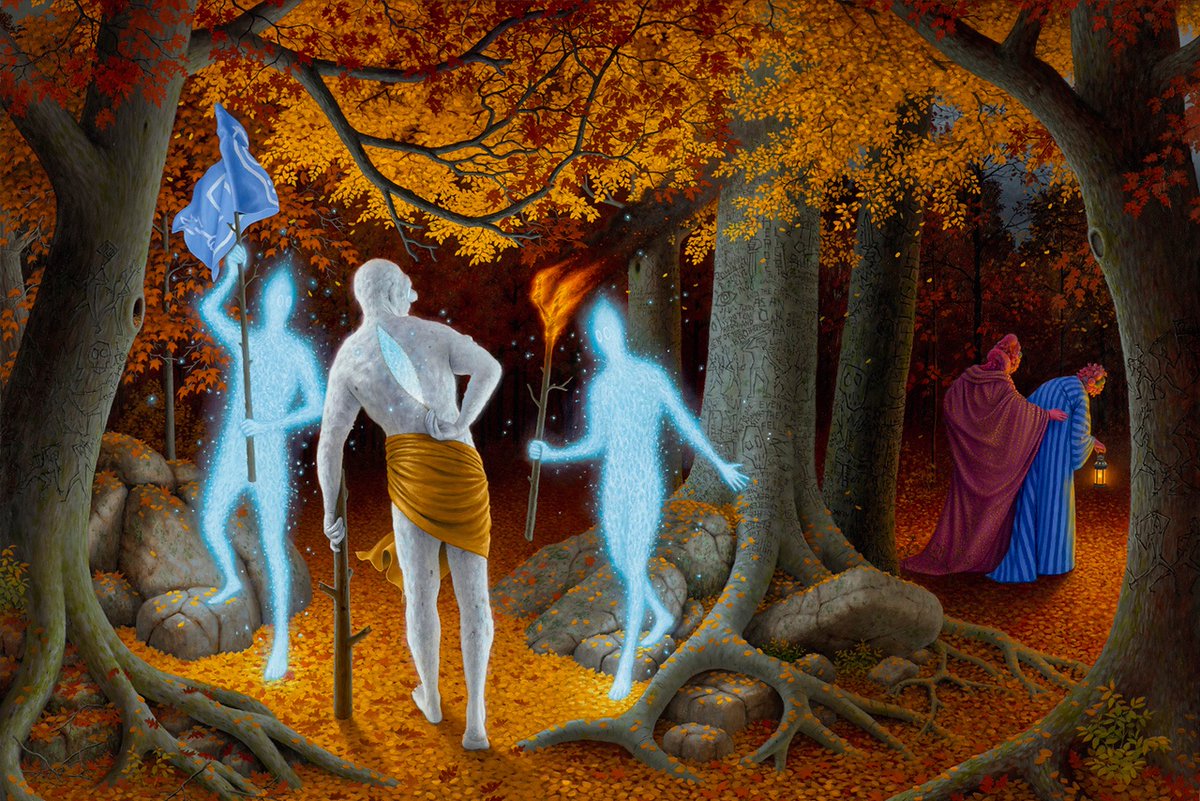
🎨: Awakening the Pneumatic Champion, Adrian Cox.