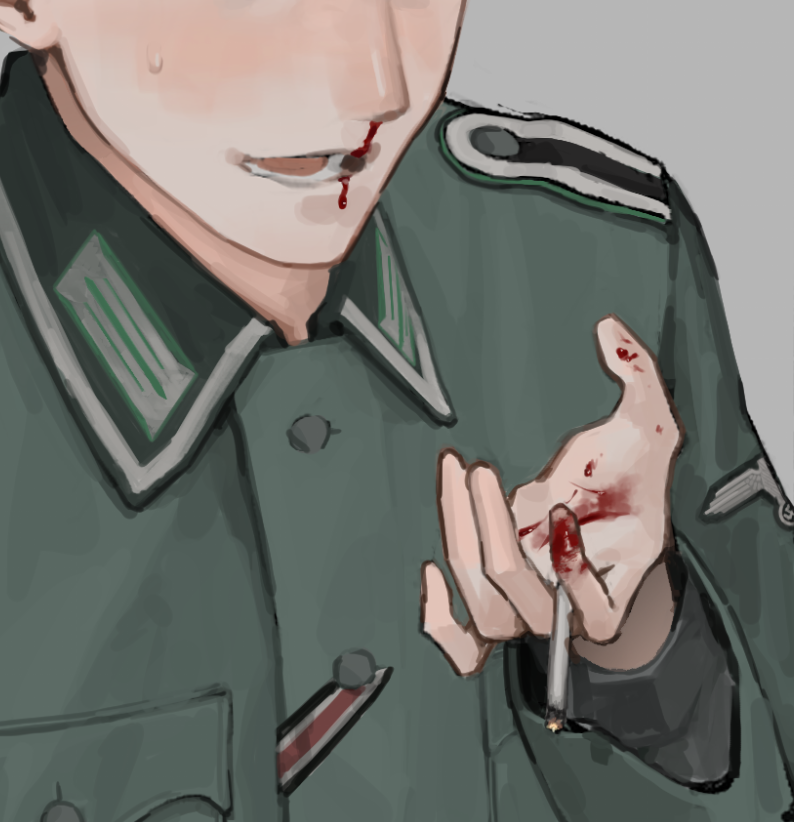
@nikoklausen He's going to show nikolai how to do a great job! There are so many opportunities to prosper, as a hunger games victor. why isn't nikolai more grateful
German prisoners of war (POWs) held in U.S. custody covering their faces and reacting with shock or distress while forced to watch newsreel footage of Nazi concentration camps in 1945....
Following the liberation of concentration camps like Buchenwald, Dachau, and Bergen-Belsen in the spring of 1945, Allied authorities implemented a policy of "forced confrontation". German POWs in camps (including facilities in the United States and Europe) as well as local German civilians were compelled to view documentary compilations and newsreels showing mass graves, emaciated survivors, and crematoria. While responses varied—ranging from deep emotional breakdown and horror among some (particularly younger or conscripted soldiers) to denial or numbness in others—the screenings were designed to dismantle Nazi propaganda and force a collective reckoning with the atrocities of the regime.
. . . .
In 1945, as Allied forces advanced across Europe and liberated Nazi concentration camps, they uncovered overwhelming evidence of mass murd*r, starvation, forced labor, and systematic persecution. The shocking scenes documented by military cameramen and journalists revealed a reality that many outside the camps had never witnessed firsthand. Determined to preserve the evidence and combat denial, Allied authorities compiled films and photographs showing the conditions inside camps such as Buchenwald, Dachau, and Bergen-Belsen.
Following Germany's surrender, many German prisoners of war were required to watch these films as part of the Allied denazification effort. The screenings exposed soldiers to graphic images of emaciated survivors, mass graves, and the devastation left behind by the Nazi camp system. Contemporary photographs from these screenings show some soldiers covering their faces, staring in disbelief, or breaking down in tears as they confronted the consequences of the regime they had served.
The emotional reactions captured in these images became a powerful symbol of Germany's reckoning with the crimes of the Third Reich. While individual responses varied, the screenings were intended to ensure that the atrocities committed during the war could not be dismissed, ignored, or forgotten. By forcing soldiers to witness the evidence directly, the Allies hoped to instill a lasting understanding of the human cost of Nazi ideology and lay the foundation for postwar accountability and remembrance.
These postwar screenings were not intended solely as punishment. Allied officials believed that many German soldiers had been exposed for years to propaganda that concealed or distorted what was happening inside the concentration camp system. As a result, some reeducation programs paired the footage with discussions, lectures, and documentaries designed to confront participants with documented evidence of Nazi crimes. The goal was not only to shock viewers, but to dismantle the beliefs and narratives that had helped sustain the regime.
For many soldiers, it was the first time they had seen uncensored images from camps located within territories controlled by Germany itself, making the screenings an early and controversial experiment in using visual evidence to reshape public understanding after a dictatorship's collapse.
#archaeohistories
11 November 1941 | On a day celebrated in Poland as the Independence Day, the first execution by a shot in the back of the head at a close range using a small-calibre silent gun took place in the German Nazi concentration camp Auschwitz.
It was done in the courtyard of Block 11, at the execution wall, also called “the Death Wall”. The condemned prisoners were led to the wall one by one, naked, with their hands tied behind. Before the execution, each of them had his camp number written on the chest.
Watch a short video about Block 11 and its yard where shooting executions were held: https://t.co/Nf2ozhXD6f
The camp commandant, the camp manager, and the camp doctor were present. The execution was performed by Rapportführer Gerhard Palitzsch.
On that day, the Germans shot most probably 76 people: 27 prisoners who were kept in the cells of Block 11 for different reasons and arrested there between October 10 and November 2, and 49 prisoners called from the camp by the Political Department – camp Gestapo. Almost all of them were Polish prisoners.
On their death certificates, it said: ‘Erschiessung wegen Widerstand gegen die Staatsgewalt’ (shot because of resistance activity against the state authority).
One of the executed was a sculptor and reserve lieutenant Tadeusz Lech. Captain Witold Pilecki mentioned him in his report written in 1945: „In the morning of November 11, 1941, colleague 42 approached me, and said: ‘I had a weird dream, I feel that they will blow me away today. Maybe it is a trifle, and yet, if nothing else, it makes me happy that I’ll die on November 11.’ Half an hour later his number was read out among others at the morning roll-call. He bid me a heartfelt farewell and asked me to tell his mother that he had died in good spirits.”