🤔 How can we efficiently train terminal agents to avoid misbehaviors?
😮 We try error-targeted learning on terminal agents and find that, with < 200 envs in TMax-15K & 35% of TMax's rollout, we can match TMax-4B full recipe.
🚨Introducing MiRL (Misbehavior-driven RL): MiRL first profiles the errors of a policy to find mistakes that recur across many environments, which we call generalizable misbehaviors. It then trains the policy with RL, starting rollouts at the steps where these misbehaviors occur and rewards a rollout only if it passes the tests and avoids the misbehavior.
Key takeaways
🔍 On Qwen3.5-4B, we find that 8 dominant misbehaviors account for 52.1% of wrong steps and appear in 75.4% of the environments.
🔥 MiRL outperforms TMax-4B, the released checkpoint trained with the full TMax recipe on Terminal-Bench Lite (51.8% vs. 47.4%) and matches it on Terminal-Bench 2.1 (21.3% vs. 20.6%), while using 35% of its rollouts and 189 selected training envs.
🧵👇 [1/9]
Introducing Step 5 Preview: Advancing the Pareto Frontier.
Step 5 Preview is our new flagship model for agentic work, delivering frontier-level performance across software engineering and professional knowledge work, with particular strength in finance.
- 600B total / 27B active MoE, with 1M context + Vision
- Substantially lower task cost at comparable intelligence
- Broad software engineering capabilities with sustained execution over long horizons
Try Step 5 Preview: https://t.co/fC7HHlWKFn
Model page: https://t.co/4caJR2YGD3
Open weights on Oct 15.
The essence of harness is transfer of cognitive load.
In our new work, we investigate this through strong2weak scaffolding, where builders recursively refine harnesses for smaller models at test time.
📄 https://t.co/C6Mg6zuHOO
🤗 https://t.co/KwgqIkzMh1
On-policy self-distillation is a promising direction for learning from rich textual feedback. But can it really learn from failed trajectories?
Our answer: not quite -- unless we let the model actively interpret them.
🧵1/N
Can LLMs self-improve without ground-truth rewards?
🔄Introducing Test-time Recursive Thinking (TRT)
Models recursively refine rollout strategies and accumulate knowledge from their own attempts.
🚀 Results:
1. 100% Accuracy on AIME-25
2. 10.4-14.8 pp improvement on LCB Hard
What makes us humans general agents? 🤔
It’s probably not that we’ve mastered every app or UI. New tools appear constantly, yet we become productive quickly. What really transfers are our cognitive abilities: how we perceive, reason, and use memory. 🧠
Introducing CocoaBench, an evaluation framework for general agents with compositional cognitive abilities.
👉 Features
1⃣Complex, realistic tasks🧩
• Human-crafted tasks that are long-horizon, understandable, and span diverse scenarios and domains
• Assume only a small set of general tools (browser, terminal, file system; no per-task APIs)
• Challenging for existing agent systems. ChatGPT Agent reaches only 44% success rate.
• Check out our example tasks on the website (link in reply) and see if you can solve them. They’re fun 🙂
2⃣Covering diverse cognitive abilities 🧠
CocoaBench covers different choices in the following dimensions of cognitive architecture:
• Perception: how the agent gathers and preprocesses information from websites, terminal outputs, files, and images
• Reasoning : planning, deductive/inductive/abductive inference, and both symbolic & visual reasoning skills
• Memory : managing working memory in the long horizon, saving and loading procedural memory (skills), etc.
3⃣CocoaAgent framework🛠️
• Seamless integration with the AIO Sandbox for isolated browser / terminal / file operations
• Easy to plug in any models or your own custom agent
• Flexible evaluation functions
This is just our first release, and we’re actively expanding CocoaBench with more tasks, analyses, and agents. Excited to see what the community builds on top of it!
Project website + more details in the thread👇
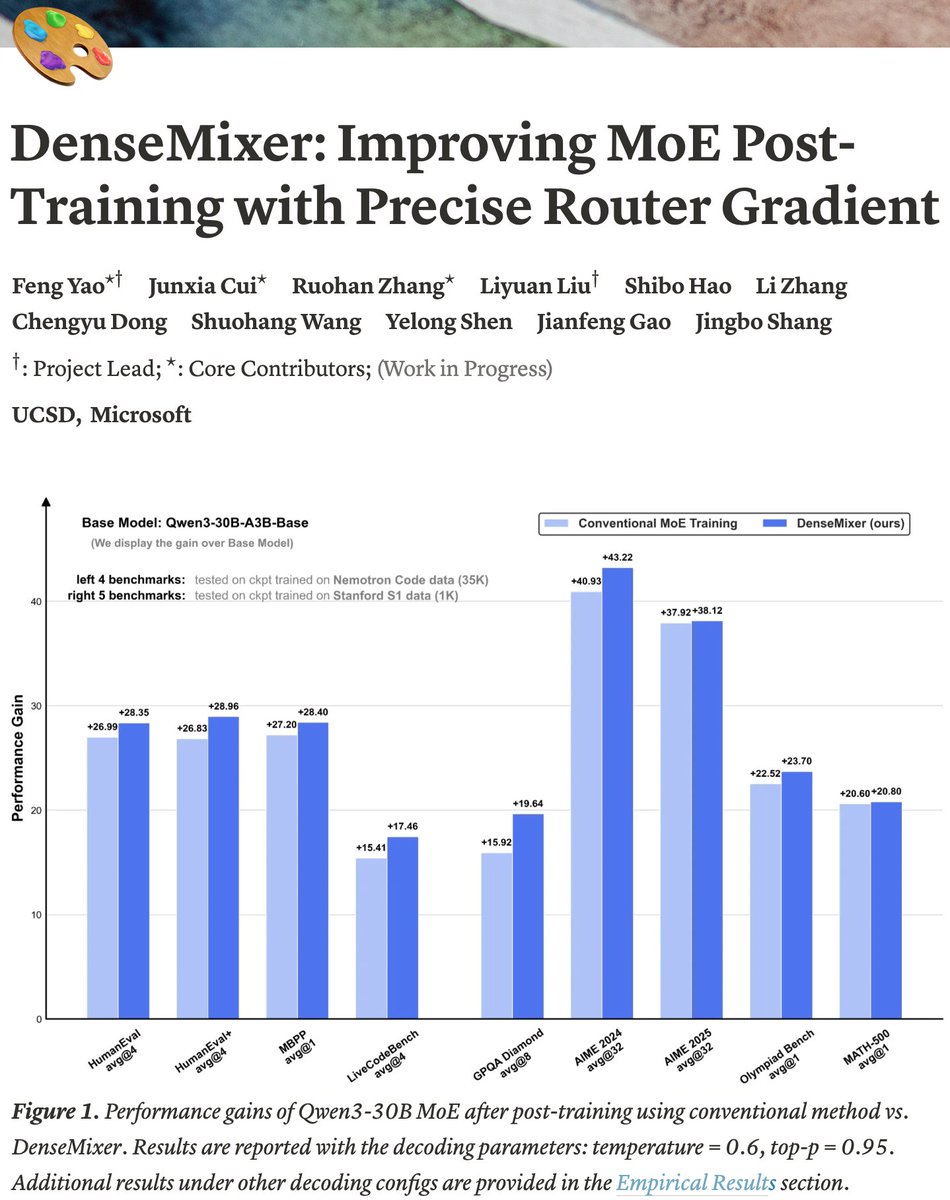
😵💫 Struggling with 𝐟𝐢𝐧𝐞-𝐭𝐮𝐧𝐢𝐧𝐠 𝐌𝐨𝐄?
Meet 𝐃𝐞𝐧𝐬𝐞𝐌𝐢𝐱𝐞𝐫 — an MoE post-training method that offers more 𝐩𝐫𝐞𝐜𝐢𝐬𝐞 𝐫𝐨𝐮𝐭𝐞𝐫 𝐠𝐫𝐚𝐝𝐢𝐞𝐧𝐭, making MoE 𝐞𝐚𝐬𝐢𝐞𝐫 𝐭𝐨 𝐭𝐫𝐚𝐢𝐧 and 𝐛𝐞𝐭𝐭𝐞𝐫 𝐩𝐞𝐫𝐟𝐨𝐫𝐦𝐢𝐧𝐠!
Blog: https://t.co/JBRHyD9t3k
Code: https://t.co/i9OCMlkVj6