Give the finest engineers alive a cow, a blank cheque, and one instruction: build a second one from scratch, the entire working machine, organs and microbes and all.
They will fail.
They can map every cell and still not reproduce the rumen: a warm fermentation reactor running on wild microbes nobody has to sterilise, that seeds itself, repairs itself, and digests the one material on the planet we cannot, turning a thornbush into a fillet.
They cannot match the power supply, which is rain. Or the fuel, which is grass nothing else will eat. Or the production line, which is the animal quietly building the next animal at no cost and asking no one's permission.
It improves the soil it stands on. It carries no patent, no firmware, no subscription. It has been in continuous production since before writing existed and has never once needed an update.
We keep calling it old, which is a peculiar insult to aim at the only food machine that has shipped a billion units and never lost in its category. The nearest competitor is a steel vat of slurry that drinks electricity and reports to a man with a clipboard.
Lightyears ahead, still, and grazing.
Keir Starmer: “there is no such thing as two-tier policing”.
Police chiefs today: “we will review controversial guidance advising officers to treat ethnic minorities differently”.
The absurdity of modern Britain.
I hope Hampshire Police and the CPS have a good explanation as to why Digwa’s brother and father have not yet been charged.
His mother is being sentenced soon for removing the murder weapon from the crime scene.
If his brother and father knew Henry had been stabbed, are they not accessories too?
The brother called 999 to falsely report Henry for racially attacking the murderer.
The father physically detained a dying Henry until the police arrived.
None of them informed the police that Henry had been stabbed. All watched him die, handcuffed, on the ground.
@HantsPolice 'You've been stabbed? I don't think you have, mate.'
Are these officers still on the streets?
That poor lad, hearing his rights as he died.
Utterly heartbreaking.
D.E.I?
Where was the equity here?
“You’ve been stabbed? I don’t think you have, mate,” the officer responded.
The @HantsPolice body camera footage of the arrest of a dying Henry Nowak has been released.
The university student tried desperate to tell police he had been stabbed and that he couldn’t breathe. They turn him around on the ground and handcuff him until he goes limp.
Nowak was killed by an Indian man who lied and said he was the victim of a racist attack, a tactic often used and encouraged by leftists to get an upper hand against others.
@IntrovertProbss Dog, cat, daughter, one day a week job (24 hours but rarely see anybody - and if I do, it's usually an awful shift). One year to retirement and counting the days down...
@DreyfusJames Values?
*Immediately hired a man who said 10 yr old girls were prostitutes and a member of PIE.
I think you've just shown your values. Resign, for the love of God! Resign.
The British cow is a controversial figure in modernity.
She stands on a hillside in Cumbria, in weather that nothing else in the food system can survive, and people would like her to stop. Stop doing what, exactly, is rarely specified. Stop existing, mostly. Stop breathing. Stop being a cow.
She eats grass. Specifically, she eats grass that grows on land where wheat would lie down and weep, where soya would never germinate, where vegetables would be a hobby project rather than a food source. Sixty-five percent of British agricultural land cannot grow human food directly. The cow is the conversion mechanism. She turns sunlight, rain, and cellulose, none of which we can digest, into protein, fat, and minerals, all of which we built our species on.
She stands under rain that was going to fall whether she stood under it or not. The rain hits the grass. The grass photosynthesises. The cow eats the grass. The cow makes manure. The manure feeds the soil. The soil grows the grass. The cycle is roughly ten thousand years old in these isles and was working perfectly well before anyone had a spreadsheet.
She produces a food matrix that no laboratory has ever replicated and no plant has ever come close to. Complete protein. Heme iron in the form your body actually absorbs. B12, which exists nowhere else in nature. Zinc that doesn't fight phytates for the privilege of being absorbed. Vitamin K2 in the precise form that escorts calcium into bone rather than into your arteries. Conjugated linoleic acid. Choline. Selenium. The fat-soluble vitamins in concentrations that grain has spent centuries pretending to match.
She does this on a hillside. In the rain. On her own.
The arguments against her are remarkable for what they leave out. They leave out the topography. They leave out the rainfall. They leave out the soil depth. They leave out the fact that "just grow vegetables instead" is a sentence written by someone who has not seen the Pennines in February. They leave out that the alternative is not a thriving arable landscape but an abandoned one, scrubbing over, the skylarks gone, the wildflowers smothered, the soil compacting under bracken until nothing wants to live there at all.
The cow is not the problem. The cow is the answer to a problem most of her critics didn't know existed.
She has been on this hillside, in some form, since the Bronze Age. She will be on it after the next thirty news cycles have moved on to whatever comes next.
The cow on the hillside is the quiet centre of a system that took ten thousand years to build and could be dismantled in twenty. Worth a moment's thought, before joining the chorus that wants her gone.
@JamesMelville So people living in flats with no gardens or balconies to dry clothes will now have to pay out for a new heat pump alternative or breathe in wet air as their wet clothes attempt to dry indoors? In winter? Bronchial issues, anyone?
A sheep eats grass on a Welsh hillside where nothing else will grow. The slope is too steep for a tractor, the soil too thin for a plough, the rainfall too relentless for crops.
In return it provides:
- Wool (renewable clothing that biodegrades back into soil)
- Meat (complete nutrition in one package)
- Lanolin (waterproofing, cosmetics, leather conditioning)
- Sheepskin (insulation, clothing, rugs that outlast the sofa)
- Bones (tools, broth, fertiliser)
- Manure (soil building, free of charge)
All from grass on terrain that no other food system can touch.
The environmental alternative is petroleum-based fleece that sheds microplastics into every river, synthetic insulation spun from fossil fuels, and food imported from industrial agriculture that's busy turning prime farmland into dust.
But the sheep grazing on a cliff in Snowdonia is the problem.
Make it make sense. I'll wait.
Let's check in on Eduardo, who is failing to be petroleum.
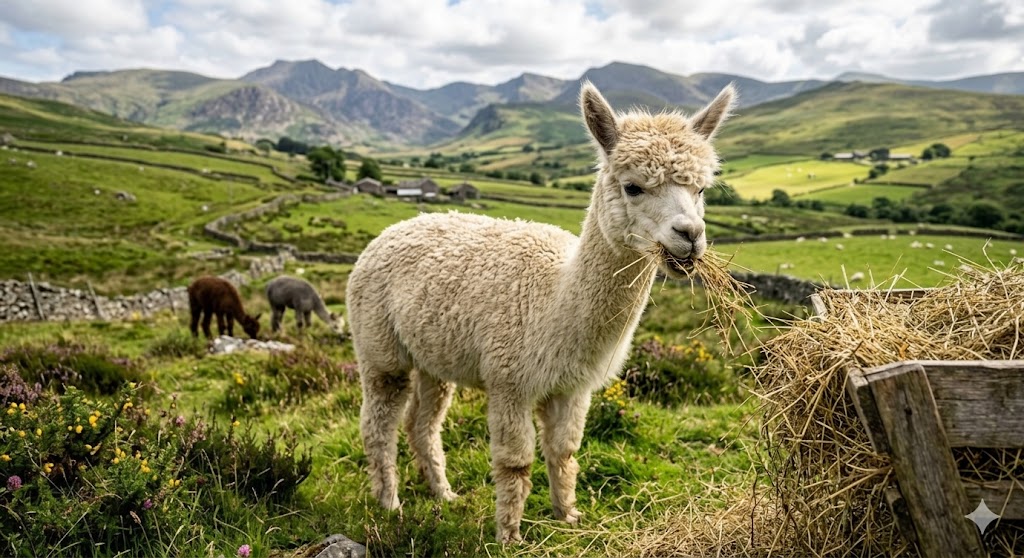
Eduardo is a Huacaya alpaca in the Brecon Beacons. His fleece this year measured 22 microns. For reference, cashmere is typically 14 to 19 microns and is priced accordingly. Eduardo's fleece is finer than most commercial wool, warmer at equivalent weight, and does not require the lanolin scouring that sheep's wool needs before processing. Eduardo produced it by grazing a Welsh hillside on rainfall and rough upland vegetation.
The fleece is removed once a year. Eduardo stands with the specific patience of an animal that has done this before and found it resolves pleasantly. The fibre goes to a mill. The mill produces yarn. The yarn becomes a garment that will last twenty years with basic care.
The polyester fleece currently in approximately 60 percent of outdoor and casual garments sold in the UK:
Crude oil is extracted from geological storage where it has been for roughly 300 million years. It is transported to a cracking facility. The naphtha fraction is polymerised into polyethylene terephthalate at high temperature and pressure. The PET is extruded into filament, texturised, knitted or woven, dyed in a water-intensive process using synthetic dyes, then shipped, typically from East Asia, to a retailer near you.
Each wash of this garment releases an estimated 700,000 synthetic microfibres into the wastewater system. Water treatment facilities do not filter microfibres effectively. They pass through. They reach waterways. They enter the food chain. Microplastics have been found in human blood, in lung tissue, in breast milk, and in the placentas of unborn children. The research into their effects is ongoing. The effects are not yet fully understood. The production continues.
Eduardo sheds nothing into the water table.
Eduardo sheds fleece.
The fleece becomes a garment.
The garment does not shed microplastics.
The garment will outlast every conversation about whether it is sustainable.
Eduardo is grazing the Brecon Beacons.
Eduardo has not been invited to a sustainable fashion conference.
Eduardo would hum.
The conference would not know what to do with the hum.
Ray had run his garage alone for nineteen years and preferred it that way. No apprentices, no partners, no background noise. Just the work and the tools and the satisfaction of a problem solved correctly.
⠀
The only other presence he tolerated was Duke — a Doberman who had arrived as a stray six years ago, made one lap of the property to assess it, and decided to stay.
Duke kept the garage clear of trespassers, teenagers, and the occasional raccoon. He was not a friendly dog. He was an effective one.
⠀
It was a Thursday in November when the storm came in fast, turning the sky dark at two in the afternoon. Ray was on his back under a '98 F-250, flashlight in his teeth, working on a brake line. Duke was in his usual spot near the rollup door, watching the rain.
⠀
Ray heard Duke's nails on the concrete first. Not the aggressive click of a dog moving toward a threat. Something slower. Interested.
⠀
Then the growl that wasn't quite a growl.
⠀
Ray pushed himself out from under the truck fast enough to hit his forehead on the chassis, which he did not notice until later. Duke was in the far corner near the shelving units, and he had something cornered.
⠀
Something very small.
⠀
The kitten was maybe six weeks old, soaked through, with oil already on its paws from the garage floor. It had pressed itself into the corner behind a stack of brake fluid boxes, making a sound too high to register as real noise.
Duke stood over it, large head lowered, very close.
⠀
Ray grabbed a rag and moved toward them, calculating how to get between ninety pounds of territorial Doberman and something that weighed less than a full coffee cup.
⠀
He got three steps away and stopped.
⠀
Duke was lying down.
⠀
He had lowered his entire body flat onto the oily concrete, which was not something Duke did for any reason Ray had observed in six years. Front paws extended on either side of the kitten.
Duke was cleaning it — slow, deliberate passes of his tongue across the wet fur, with the care of an animal that understood it was dealing with something fragile.
⠀
The kitten had stopped making any sound.
⠀
Ray stood in the middle of his garage holding a shop rag and watched his guard dog warm a feral kitten for five minutes before he moved again.
⠀
He spent forty minutes that evening after the last customer left. He found a metal toolbox he wasn't using, lined it with a shop towel, and zip-tied a small work light inside the lid to throw heat without direct glare. He tested the temperature with his hand three times before putting the kitten in.
⠀
Duke supervised the entire process from two feet away, watching Ray's hands.
⠀
The kitten's name is Socket. Ray did not choose this name so much as arrive at it after noticing that Socket had a specific interest in electrical components and had chewed through one wiring harness before Ray learned to cover anything important.
⠀
Duke and Socket sleep in the garage together. Duke near the door, Socket against Duke's side or on his back depending on the temperature.
Ray installed a small cat door in the side entrance, which Socket uses approximately four times a day to investigate the parking lot and then come directly back inside.
⠀
Ray does not describe himself as someone who has a cat. He describes himself as a mechanic whose guard dog adopted a stray, and that he built a bed for it because the alternative was it freezing, which was not a practical outcome.
⠀
This is technically accurate. It is also not the complete picture.
@jeremykauffman My daughter, aged 4, cut another girl's hair *at school*. Fringe up to the roots. Wonky sides. She only got caught out when the other kid was returning the, equally short fringe, favour...
Thankfully, I and the other mum saw the funny side. Hair grows back...