GeoConfirmed Investigation.
Warcrime or not?
This is NOT a potential warcrime.
[Quote from a JAG: This is not even worth discussing. The Law of Armed Conflict (LOAC) is clear on this matter—referring to the video in question.]
In recent days, there has been a lot of discussion regarding the video below. Is this a potential war crime or not?
First of all, we want to address the fact that people should be more thoughtful in their assumptions. It is absurd to suggest that playing something like “Red Light, Green Light” (as seen in Squid Game) with a drone could ever be considered a viable option in war. Yet, it appears that many people genuinely believe this should be possible.
Statements such as, “If he sees me and I have no weapon and I don’t move, he can’t attack me or it’s a war crime,” reflect a misunderstanding of the rules.
Why would this even be possible? Retreating soldiers, barracks, and similar targets are all legitimate subjects of attack under the Law of Armed Conflict (LOAC). Simply believing or wishing something to be true does not make it so.
While we have not yet been able to geolocate the video, we were searching for an answer to the question, "Could this be a potential war crime?" In the process, other questions emerged:
What are the rules for surrendering to a drone?
What are the obligations of the drone operator?
What is possible in such situations?
We asked around for expertise opinions and we were informed by a JAG legal advisor (Judge Advocate General) that the answer is not even a "grey area"—there is no debate: this is NOT a war crime.
The discussion regarding surrendering to drones is not new: this issue first arose when Ukraine introduced the "I Want to Live" project in 2023, which aimed to encourage Russian soldiers to surrender to drones.
A symposium titled "The Legal and Practical Challenges of Surrendering to Drones" can provide guidance in addressing some of the above questions.
It is interesting to note that, at the time of the symposium, the main question under discussion was whether surrendering to drones is even allowed(!)
During the event, experts analyzed how the project intersects with the Law of Armed Conflict (LOAC) and its rules concerning surrender.
1) Is the Russion soldier in the video surrendering according to the LOAC standard?
NO.
In short:
There has to be a “clearly expresses an intention to surrender” , "the enemy must unambiguously express a genuine intent to surrender"
While the precise manner of surrender may vary, the burden of demonstrating the requisite clarity rests on the surrendering party. Without a clear expression of genuine intent, belligerents are not obliged to presume the enemy has surrendered (see Commentary to Rule 103(b)).
The Russian soldier was not moving at all.
He did not make any clear expression of genuine intent to surrender, so the Ukrainian drone operator is not obliged to presume the Russian soldier has surrendered.
Source: https://t.co/xaARAf9xGe
"The 1907 Hague Convention IV, for example, prohibits killing or wounding an enemy “who, having laid down his arms, or having no longer means of defence, has surrendered at discretion” (Annexed Regulations, Art. 23(c)). Similarly, Additional Protocol I to the 1949 Geneva Conventions, to which Ukraine and Russia are parties, proscribes making a person who “clearly expresses an intention to surrender” the object of attack (Art. 41). This standard is widely considered to reflect customary international law (see International Committee of the Red Cross (ICRC) Customary International Law Study, Rule 47 and its related Practice)."
For the obligation to attach, the enemy must unambiguously express a genuine intent to surrender (see U.S. DoD’s Law of War Manual, § 5.9.3.2; Oslo Manual, Rule 103(a)-(b)). While the precise manner of surrender may vary, the burden of demonstrating the requisite clarity rests on the surrendering party. Without a clear expression of genuine intent, belligerents are not obliged to presume the enemy has surrendered (see Commentary to Rule 103(b)).
2) If the soldier was surrendering (which, in this case, he is not), would the drone operator be required to accept that surrender?
It is important to note that once a Russian soldier surrenders, the recipient of that surrender—in this context, potentially the drone operator—becomes responsible for the soldier’s well-being, protection, and other obligations. The surrendering individual should then be taken into custody.
In short:
It must be possible to accept a surrender.
For a drone operator, this presents a very different situation compared to a soldier on the ground.
We don't know if the drone operator was capable to accept the surrender -if he would have surrendered- nor how far it was away from the own lines.
To be legally effective, individuals must offer surrender under circumstances in which it is feasible for the enemy to reasonably accept (DoD’s Law of War Manual, § 5.9.3.3; Oslo Manual, Rule 104; Commentary to AMW Manual, Rule 15(b))
This issue was already a debate before: The issue is whether it is feasible for aircrews to accept the surrender while airborne, as surrender conventionally culminates with the enemy taking personnel into custody.
With respect to feasibility in the Ukraine scenario, assuming surrender to aircraft is not legally ineffective per se, the central issue is whether drones have the necessary capabilities to exercise a sufficient degree of control over personnel purporting to surrender without the aid of nearby ground forces.
If surrendering to a drone is ineffective, Russians attempting to do so would not be considered hors de combat and could technically still be made the object of Ukrainian attacks (see DoD Law of War Manual, § 5.9.3; Oslo Manual, Rules 103-04; AMW Manual, Rule 15(b)).
In contrast to merely expressing an intent to surrender, once Russian personnel effectively surrender, the Geneva Conventions would affirmatively require Ukraine to, for example, protect, feed, clothe, and treat them (see Geneva Convention III, arts. 26, 27, and 30).
Source: https://t.co/xaARAf9xGe
3) If he was not surrendering, was the soldier considered ‘hors de combat’?
Rule 47.
Attacks against Persons Hors de Combat
Rule 47. Attacking persons who are recognized as hors de combat is prohibited. A person hors de combat is:
(a) anyone who is in the power of an adverse party;
--> he was not. (POW)
(b) anyone who is defenceless because of unconsciousness, shipwreck, wounds or sickness;
--> Impossable to check as a drone operator.
(c) anyone who clearly expresses an intention to surrender; provided he or she abstains from any hostile act and does not attempt to escape.
--> he did not clearly expresses an intention to surrender.
= He was not "Hors de Combat"
Source: https://t.co/YKflBqvP2y
Conclusion:
Based on everything what is known this far:
The Russian soldier in this video was not surrendering, nor was he “hors de combat,” and thus he was a legitimate target.
---
During this investigation, we observed that accounts across the far-left, far-right, engagement farmers, and those linked to Russia were particularly outraged about the alleged war crime. It is unlikely that Russian actors were not contributing to this outrage.
Perhaps these critics should instead focus on the indiscriminate targeting of civilians by drone bombings in Kherson—dozens of such incidents are marked on our map.
https://t.co/IJABboi2yG
"UN Commission concludes that Russian armed forces’ drone attacks against civilians in Kherson Province amount to crimes against humanity of murder"
https://t.co/3GJNbjs6Mr
We extend our sincere gratitude to our volunteers and external legal experts who assisted in conducting this investigation.
If you want to support us you can buy us a coffee (https://t.co/xdVy00R7rC) giving us the possibility to improve our servers and buy satellite imagery for our investigations. Thanks for your support!
Source: https://t.co/0eLjaLFze0
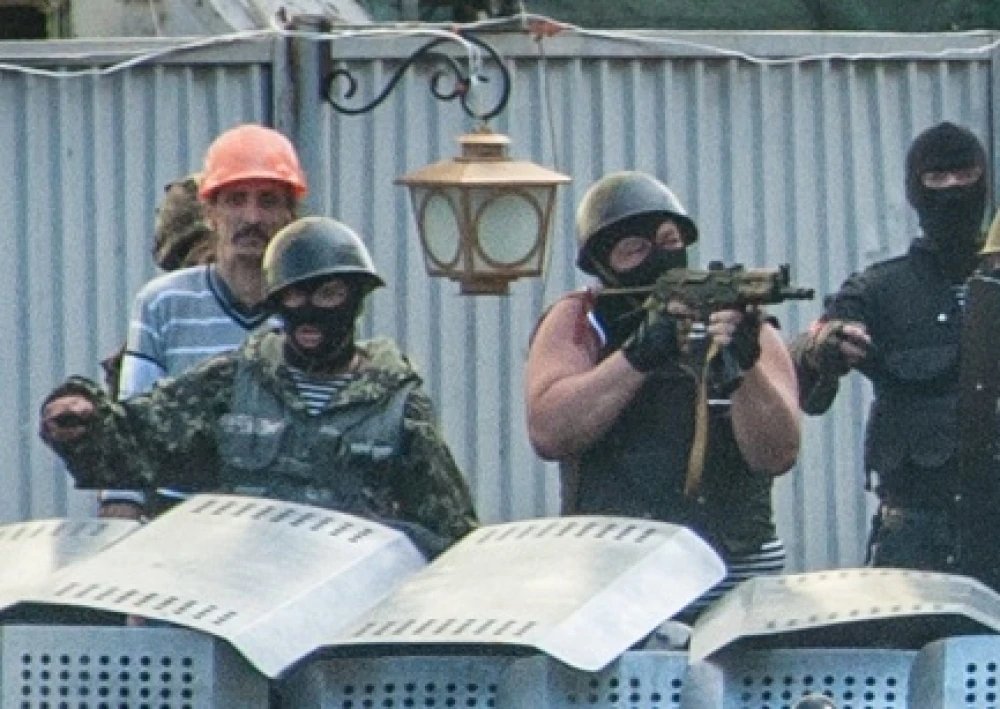
10-ta rocznica tragedii w Odessie, Rosjanie będą to propagandowo nakręcać. Co tam się stało w rzeczywistości? W pożarze Domu Związkowca na Kulikowym Polu zginęło 46 prorosyjskich aktywistów i to jest fakt.
Tylko, że najpierw, wiele godzin wcześniej, na ulicach Odessy ci sami aktywiści zastrzelili dwóch proukraińskich aktywistów. Na zdjęciu Witalij Budko ("Bosman"), który strzelał zza kordonu policji (!) kierowanego przez szefa policji Dmitrija Fuczedżi. Obaj po tej tragedii uciekli... do Rosji. To właśnie te zabójstwa doprowadziły do dramatycznej eskalacji konfliktu, ucieczki Rosjan do Domu Związkowca i jego szturmu.
Ale Rosjanie wcale nie byli bezbronni bo na Kulikowym Polu mieli miasteczko namiotowe, gdzie rozlewali koktajle Mołotowa. Gdy wieść o zabiciu proukraińskich aktywistów się rozeszła, Rosjanie przenieśli swój arsenał do Domu Związkowca i się tam zabarykadowali w oczekiwaniu szturmu.
Gdy tłum proukraińskich aktywistów nadszedł, nie siedzieli tam jak trusie tylko dalej strzelali z broni palnej i rzucali w ludzi na zewnątrz butelki z benzyną.
Pożar Domu Związkowca zaczął się wewnątrz zabarykadowanej klatki schodowej gdzie Rosjanie przechowywali koktajle Mołotowa. W tym momencie budynek wypełnił się kłębami dymu i zaczęła się paniczna ewakuacja przez okna. Ze strony proukraińskich aktywistów na zewnątrz doszło do sporadycznych pobić i sporadycznych aktów humanizmu, niektórzy z nich pomagali w ewakuacji.
Telefony do straży pożarnej miały miejsce praktycznie od razu, ale straż przyjechała dopiero po godzinie. Stało się tak na wyraźny rozkaz szefa miejscowych służb ratowniczych Władimira Bodelana, który blokował wyjazd strażaków, co było jedną z głównych przyczyn tak wielkiej liczby ofiar.
Zaraz potem Bodelan uciekł... oczywiscie, również do Rosji. A z opublikowanych potem podsłuchów rozmów Sergieja Głazjewa (administracja prezydenta Rosji) z prorosyjskimi aktywistami w Ukrainie (Konstanty Zatulin i inni) wiemy, że prorosyjskie protesty w Ukrainie były organizowane, koordynowane i sponsorowane przez Rosję. Ich głównym celem, o czym mówił Głazjew i potem Girkin było właśnie niedopuszczenie do wygaśnięcia "zapału rewolucyjnego" i eskalacja przemocy, która pozwoliłaby Rosji wejść w roli rozjemcy i arbitra.
Dziesiątki godzin nagrań z wydarzeń w Odessie zostały przeanalizowane i opublikowane przez wspólną (!) ukraińsko-rosyjską grupę dziennikarzy na stronie https://t.co/Aj45WqY3Jf
O "taśmach Głazjewa" można poczytać tutaj https://t.co/mktXuGWtui
W miarę szczegółowa chronologia wydarzeń 2 maja 2014 jest opublikowana tutaj https://t.co/LWcAiLmAYo
Na zdjęciu: "Bosman" strzela do proukraińskich aktywistów na wiele godzin przed pożarem
Today is another anniversary of the massacre in Odesa, which Rusian propaganda presents as "a massacre of peaceful supporters of federalization".
To remind you what these "peaceful supporters of federalization" actually looked like. In the video, Gennady Kushnarev, who died on May 2, 2014. "A native of Odesa", who moved to Odesa from Chelyabinsk. He openly called for the killing of Odesa residents who did not agree that "Odesa is a russian city", but in the end he died himself.
It was he and his comrades who initially unleashed the bloody clashes, hoping to win them. They just miscalculated a little. Like putin in 2022.
But Russian TV will never talk about this - @den_kazansky
Продолжаю разоблачать мифы российской пропаганды.
"Одесса, 2 мая 2014. Как злобные бандеровцы заживо сожгли мирных бабушек с георгиевскими ленточками".
@AlphaclassARC@3lfares "Facts don't matter, only my perception of events matters."
If being ethnically Russian was a problem, then they wouldn't have elected a Russian speaker as president in 2019. You just falling for a fake narrative set by Russia
a quick doodle as a gift to my friend @Batookoma who draws very epic win retro anime babes, so I wanted to give one of his a try in a similar style
happy birthday you actual fetus