I’m gonna blog my journey here including thoughts, book notes and reposts I think will help myself and other early career teachers. I’ll mainly be using this page to see my journey but would love others to join me along the way! #education
I’ve put a load of my most popular files together in a Dropbox folder. Let me know if you’d like the link. Can I also ask that you share this post pretty please 🙏 (as it seems the only way to get anything seen nowadays!). 😊
@KnowledgeMatrs@dylanwiliam Correct me if I’m wrong but here’s what I currently think it is for a PE example of help seeking for mental health
->Students recall how they can seek help themselves
->Use in a case study for themselves
->Use in case study for a mate
Would love feedback on if that’s it
@greg_ashman@mradamkohlbeck Could you then choose 3 questioning techniques (cold calling, MWB, fingers) so there is consistency in the school. With the art example could it also be discretionary, so teacher can change it based on the lesson but mostly try to keep this routine?
@greg_ashman@mradamkohlbeck Let’s say we have one that has a lesson structure then techniques:
-Do now
-I do, we do, you do
-Cold calling
-Finger answering (where you hold fingers up for answer 1,2 or 3
I thought having this routine could help teachers. Hold you explain some more
@mradamkohlbeck@greg_ashman This question also goes to Greg.
The mandated idea is interesting. I always thought a ‘playbook’ with techniques the school uses would be effective while also allowing teacher freedom with content. Is this not the case?
If you teach anyone at all, and you don't know about @helenrey's CogSci book summaries, you are missing out. It's a wonderful resource summarizing the most important books on cognitive science: https://t.co/TB0bPExfck
A blog for Early Careers in PDHPE. Inspired by
@tombennett71@teacherhead@Doug_Lemov@XpatEducator@PepsMccrea
Thanks to this lot for your books that have helped me improve as a teacher and lay the foundations for the blog.
The first of many :)
Written by an Early Career Teacher, relevant for every teacher.
In this new ACHPER NSW blog, Sam Frazier from our ECT Committee shares practical reflections on routines, habit stacking, transitions, and readiness for learning.
https://t.co/vGu6ujN8Br
@MmeLockhartLDS I wish but it seems a lot of the focus is put on philosophy and not day to day impactful things. I only had one class on student with disabilities, behaviour management and assessments. A few on broader topics that gave us content knowledge but detached from the syllabus.
@ItsJayMysterio@AofahKoff How are we tolerating extremism? We allow Ramadan celebrations and are okay with mosques being built?
If you are referring to Bondi, look at the reaction, there was absolutely no tolerating that. ‘We’ seem to tolerate terrorism against indigenous people though
@PoliticalRated@AofahKoff Labor government doesn’t know how to govern? Damn they accidentally fell into a strong budget and accidentally planned a strong Future built in Australia initiative.
AND
They also increased childcare and better funded education. WHAT IDIOTS!! CAN WE VOTE THEM OUT YET?!
/s
@Hardymatt0@rpondiscio Yeah mate, being sexist isn’t needed in this debate. You’ve got a lot of smart people at the this level (they are lecturers for a reason) but it seems quite a few are dreamers too far removed from classrooms
Here’s a lesson routine for simplifying the explicit teaching of new content I’ve found success with. It may work for you too. It may not. I think it will. Let me know what you think.
1️⃣Introduce guiding questions for lesson reading (3-4 per lesson)
2️⃣FASE read one “chunk” of reading at a time
3️⃣Explain concept using concrete examples and analogies (e.g., The Caribbean is vulnerable because it is sitting in the geographic “bullseye” for hurricanes to hit.)
4️⃣Hightlight/annotate key information in the text for each guiding question
5️⃣Turn and talk sharing/comparing highlights/answer to guiding question
6️⃣Cold call answers/“can you add/build on what ____ just said” for guiding question
7️⃣Choral response to guiding question when applicable (e.g., What are hurricanes categories based on? Sustained wind speed! What else? Potential damage!)
8️⃣Create a flashcard for Leitner spaced practice system using guiding question and highlighted information.
9️⃣Repeat for each remaining guiding question/chunk.
🔟 Practice flashcards for part of Do Now at the start of lesson the next day and at increasing intervals based on individual student retention (e.g., 3 days, 1 week, 2 weeks)
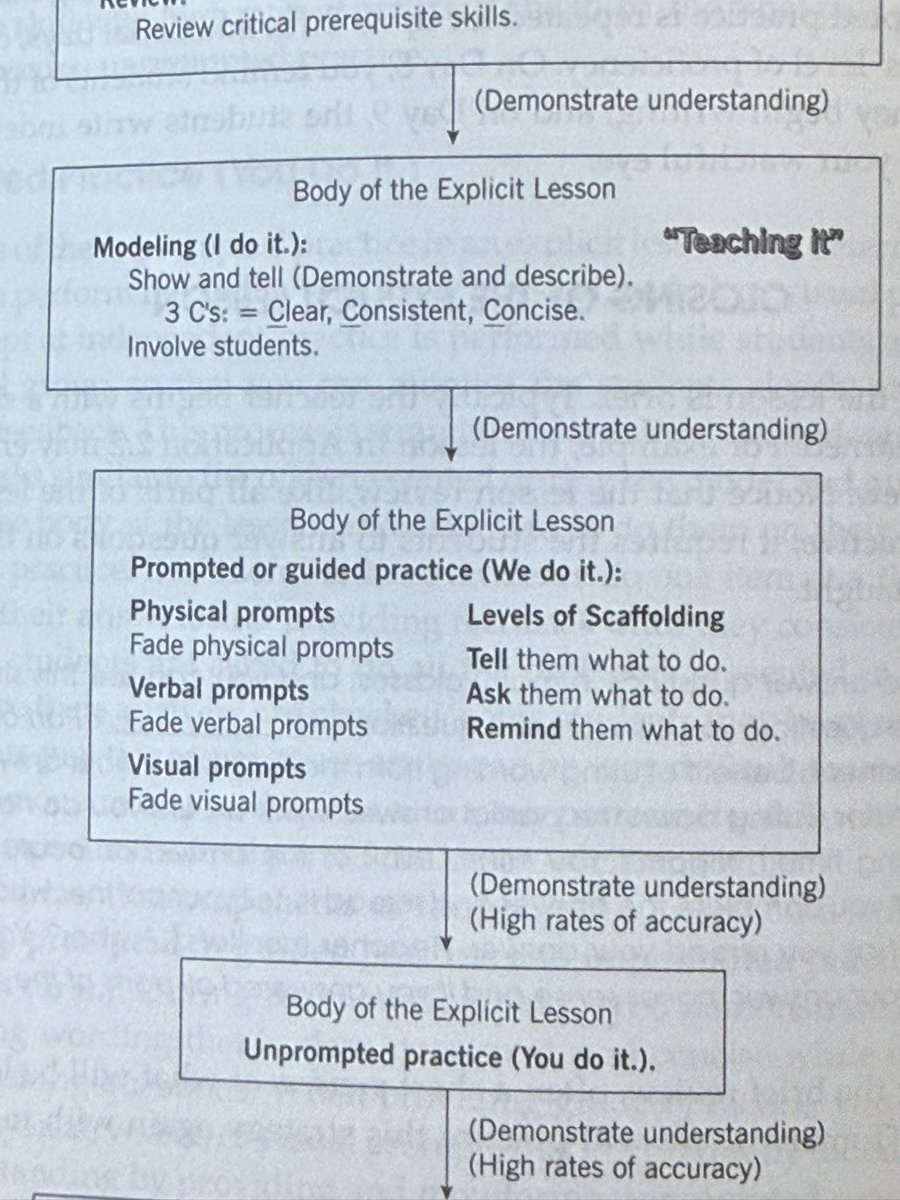
Over my career, like many of you, I’ve heard countless versions of Gradual Release of Responsibility, I do, we do, you do, all varying in important ways. Sadly, it’s become very buzzwordy with many lethal mutations in practice. Many of which I’ve been prone to myself.
Anita Archer’s articulation of “I do, we do, you do” in Explicit Instruction is the most precise yet nuanced version I’ve ever encountered.
Many circulating versions I’ve been trained on before contain a key lethal mutation in the “we do” phase which can and will reduce the effectiveness of the other phases: guided practice is treated more as a brief checkpoint where students “help” the teacher rather than an extended instructional phase, with responsibility rotated to independent practice well before students demonstrate sufficient accuracy and fluency.
I really appreciate how Archer outlines the importance of “prompted practice” aka “guided practice/We do” with different levels of scaffolding and different types of prompts temporarily available to students.
Based on this dynamic, most importantly, “guided practice / we do” is not the teacher modeling an example while students help. That’s “modeling/I do”.
“Guided practice / we do” needs to be students actively executing each step with the teacher providing prompts, scaffolds, and immediate feedback until a high rate of success is achieved then unprompted practice can begin.
TL;DR: “We do/guided practice” is students do it with your help not you do it with student help.