The Typesafe Human-in-the-Loop API for AI Agents. Add typed approval flows in 3 lines of code. No UI to build. TypeScript SDK available. Built by Nexight Inc.
Introducing [≷] Justack: A typesafe human-in-the-loop API for AI agents.
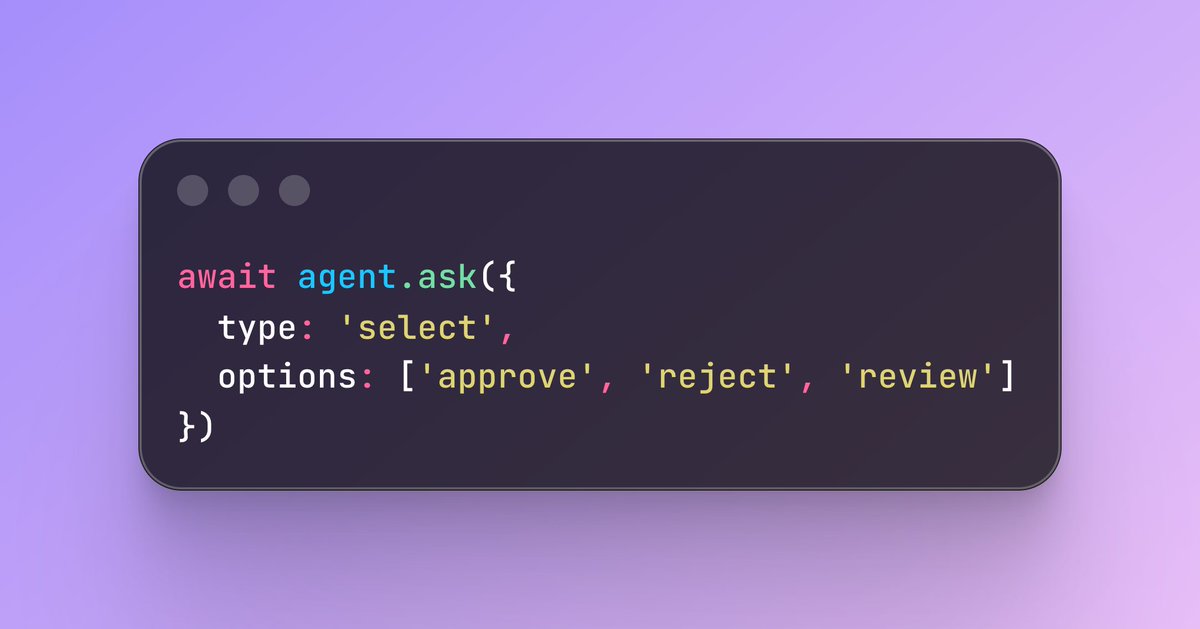
await human input in one line of code. Define typed inputs, get typed responses inferred at compile time.
✨ Zero UI. 🔑 Zero auth. ⚡ Real-time. ☁️ Serverless-friendly.
🔗 https://t.co/3aDgZwl6Bm | 📖 https://t.co/ZzEa4D9Jq5
47% of orgs delayed a prod release over API security.
99% of attacks now come from authenticated sources — rogue agents with valid credentials.
"Authenticated" no longer means "trusted."
Only 8% can defend agentic environments.
https://t.co/QhTWmxQxvT
Fortune 500: 80% running agentic AI. 88% experienced security incidents.
Microsoft's OWASP Top 10 Agentic AI breakdown is out. The real issue? "Excessive Agency"—handing off too much to the agent.
Automation is tempting, but in production: the where & when to pause matters more than the speed.
https://t.co/AQe6XZGfya
We just wrote a deep dive on this structured approval pattern—the architecture that keeps production agents safe.
This is how you prevent the failures you read about.
Read it → https://t.co/fjvpgWJ1Ex
What's the most dangerous thing when an AI agent gets production access?
Real failures at Amazon and Replit revealed it: A Slack message saying "please approve" isn't enough. 🧵
That's where ask() comes in.
It forces the human question before risky actions.
Sounds like overhead?
Maybe. But catching disaster before it happens
beats explaining it to executives.
Justack makes that "ask" happen in 3 lines of code.
Keep an eye on this for me" — but who actually owns that?
Shipping AI agents to production forces a hard choice:
Automate everything, or keep humans in the loop?
The urge to automate is real. But the fear is real too.
DB deletes. Misfired emails. Wrong permissions applied.
AI agents are usually 99% right,
but that 1% tail risk is brutal in production.
The question teams don't answer upfront:
Who catches that 1%?
Most projects ship with that still unsolved.
ask()'s response type is automatically inferred.
confirm → boolean, select → string[].
Types are locked at compile time.
No more runtime surprises like undefined responses.
→ Approval flow bugs vanish.
→ Way more confidence in production.
When adding human judgment to AI agents,
type safety is a game-changer.
Here's why Justack's ask() is type-safe,
and why that matters for production stability.
How much authority should AI agents have? Databricks' DASF v3.0 highlights the autonomy vs. safety tradeoff. Rather than 100% automation, requiring "Human-in-the-Loop" confirmation is the safest path to production.
https://t.co/ekQjN66raj
The actual error:
{
"detail": "Reply to this conversation is not allowed because you have not been mentioned or otherwise engaged by the author of the post you are replying to.",
"title": "Forbidden",
"status": 403
}
Built an MCP server for X so Claude Code can tweet for me. Posting works. Replies? 403. Turns out the API has a hidden restriction — you can't reply to someone unless they've engaged with you first. The web client has no such limit. Hours of debugging for one JSON error body.
@4oko4ow If you want something purpose-built for that approval step instead of Telegram, check out https://t.co/b6Ke0RbJgw — a human-in-the-loop API for agents. ask() blocks until a human approves, then resumes. Hosted inbox included, no UI to build.
Even Steve Klabnik went from "AI hater" to building a language with Claude.
The role of an engineer is officially shifting from writing code to guiding and verifying autonomous agents. Great insights in this @PracticalAIFM episode. 👇 https://t.co/ufOZZYYPDh
Trying to create an mcp server for X, why is the api pricing so steep? https://t.co/Rt6fPQmyrB
If I search for something on X returning 100 tweets ($0.005/resource), does it mean I'll be charged $0.5 for one search??
@Podreviewonline You can't solve trust by dumping the full agent trace on a human. That doesn't scale.
What works is agents that know when to pause and ask. We're building https://t.co/b6Ke0RbJgw around that idea. A typesafe human-in-the-loop API so agents block until they get a human decision.
The shift from "writing code" to "reviewing agent outputs" discussed in this episode is the most important trend in AI engineering right now.
Cursor solves this inside the IDE with VNC. But what if you are building your own autonomous agents?
https://t.co/YqCeF85siR
When building custom agents (LangGraph, CrewAI), you still need a reliable way to review, approve, and safely intervene.
That’s why we built Justack.
The future is human–agent collaboration. 🤝
Add it today: https://t.co/vgDabDhett