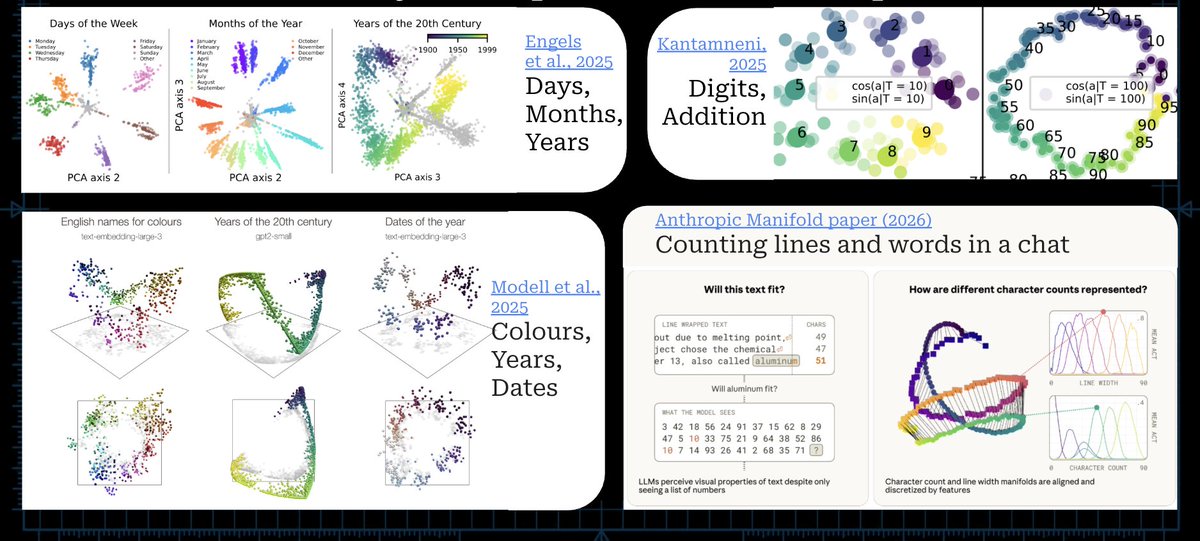
@burny_tech Some things can't be represented in manifolds since they're uni-dimensional. My understanding is that manifolds occur where a higher-dimensional representation mimics a real-world structure. Unclear that sycophancy and refusal are anything other than directions.
Thanks for the pointers.
1. That list isn't exhaustive, and shifts blame from a broken system to authors.
I know because my paper had 0% AI writing in the main body (confirmed), submitted to csCL, and the abstract & writing follows best practices for the sub-field.
2. arXiv isn't a preprint server if ICLR reviews take less time than publishing on arXiv. Which is what I'm seeing 1st hand.
arXiv should declare review bankruptcy if 4k+ papers are in the queue longer than 3wks, and just publish papers with some form of AI/ML review (PaperScorer, reviewer3, etc).
3. My 0.02$: This is a critical time for AI/ML publishing, an arxiv continuing to fail isn't an option.
I don't agree. It might be an artifact of training.
It might also be coordinated and premeditated. This is exactly how a coordinated attack would start, with a tiny scale proof of concept. Enough to get signal.
This is why the difference between open source and open weights matters.
I've been actively disagreeing with the direction arxiv has been taking for over a year. As a non-academic, I don't have bridges to burn here and hope the feedback lands. I can see why people who's career is academia wouldn't risk it.
My bangers thus far:
1) "Your proposals are that only well-connected academics who are fluent in English and comfortable in-person interview be allowed to publish preprints" https://t.co/uJ9abODjMa
2) "there's significant push back against arxiv becoming gate keepers, leaning into peer review, and ignoring the problem until it gets worse."
https://t.co/mA1HpwdHZZ
3) "isn’t a viable reason to slow down preprint" @ https://t.co/OFMLFnKLja
-1. There’s lots of great survey papers to published on arxiv I’ve read over the last few years (top of mind list below).
“Too many low quality papers” isn’t a viable reason to slow down preprints. This is just going to yield AI-generated survey papers being tacked with nonsense short form experiments (that AI will also generate). IMO, arxiv publication is already uneven and too slow favoring articles with dubious empirical results.
So what’s next? We need a preprint server for our preprint server?
https://t.co/7C7iAviRyh
https://t.co/TyRXATC1Kn
https://t.co/gQqr3NqSSM
Reading this technical masterpiece this weekend. Learned so much about how to think about synthetic data pretraining.
Incredible writing, non-intuitive results, with great technical depth.
I was happy to just learn which prompts work better for synthetic data, but there’s so much more here: model size/family , infra/throughput, etc.
https://t.co/QTMfIZERoz
Insane work @joelniklaus@gui_penedo@HKydlicek@eliebakouch@_lewtun@edwardbeeching@thibaudfrere @colinraffel @lvwerra@Thom_Wolf
@fal@bfl_ai Nice. The quality for Flux3 Max seems to be equivalent to Flux3, with costs temporairly being 75% cheaper.
Really curious why not make it permanently 75% cheaper, since I don't see other advantages I care about besides that?
Wow, the new Flux 3 Max being offered at 25% for the next month sees really cost-effective.
Side-by-side comparison of Flux 3 $3.19 vs. @fal Flux 3 Max $0.79 performance on the same prompt.
@woog09 only 2%/ 839 papers in ICLR'27 are human authored 🤯
Wild.
One data point: It correctly flagged my submission as 0-5% AI. Which gives me confidence your numbers are ~accurate.
@dhh Thought experiment: Tomorrow you're given a choice between a lung respirator developed by (1) plain old boring waterfall human developers, or (2) multi-agentic frontier models.
Which do you take? What's your inner monologue there? Is there a pro/cons list for the AI models?
@tdietterich@arxiv You’re proposals are that only well-connected academics who are fluent in English and comfortable in-person interview be allowed to publish preprints. You’ve critically lost perspective on the purpose of a preprint server. This will serve to further gatekeep academic publishing.
Hi, expert here (led lots Alexa patents and VUI UX).
My 0.02$: lack of workflow integration is the downfall of LLM smart speakers.
Massive intelligence requires more than a sentence or two voice response, and that’s when voice-only UI becomes obnoxious for most people. You need the ability to ask for massive reports, complex agentic workflows, desktop/mobile handoff, and then key takeaway summary via voice. Most harnesses run locally, which is exactly why it hasn’t taken off.
Best positioned to solve this is Google. They’ve got the speakers, the remote compute, the harness, etc. but they’ve fallen behind on harness+model combo, which is where OpenAI/antrhopic is leading; likely why openAI is developing a speaker.
Love treasure island. FYI, it also has extreme PFAS pollution from the navy testing fire suppressants. If you’re going to… spend time there or drink water, it might be best to get your PFAS blood levels tested now to establishe a baseline and test regularly.
https://t.co/ce3nArgjjV
@giffmana My 0.02$: Levels do have some signal that you can use when triangulating credibility.
Like, if you said "IC8 Meta Ads" or "L7 Amazon Devices" that's a valid datapoint.
Personally, I don't claim my past roles publicly (no public resume/linkedin) since its mad cringey.