You can work 5 days a week and succeed as a startup.
Mercury has done that from day 0 and we are valued @ $5.2bn 7 years after launch.
I have been an entrepreneur for 20 years and raised 3 kids while doing it.
The point of success is to have a great life not just a startup 😊
Watched a founder finish an 8-month banker-led process last quarter with no deal at the end of it.
Forty page deck. Teaser to sixty buyers. IOIs that came in at half what was originally floated. Top buyers dropped out. Remaining offers came in below his walk-away.
The retainer still got paid.
We've seen the same pattern over and over the last six months. The playbook bankers run was built for $50M+ ARR deals with strategic bidders, complex diligence, and real competitive tension. That structure works at scale. It just doesn't translate when you're at a few million in ARR with a clean business and a handful of natural buyers.
Three to five direct conversations with the right buyers will usually get you a better outcome than sixty teasers to a generic list. The discovery problem is largely solved now. You can use Claude or any research tool to find the holding companies, search funds, PE shops, and operator-buyers active in your space in an afternoon.
Bankers earn their fee on the right deals. For most everyone else at this size, the math doesn't pencil the way it used to.
I recently published a new piece. It's about why hiring a banker is genuinely optional for most founders doing a few million in ARR right now.
Nearly every banker-led process we've seen in the last six months has fallen apart at some stage. Not because the bankers are bad at their jobs, but because the playbook is built for a different size of deal in a different kind of market.
Curious | The Banker-Optional Exit https://t.co/HbMA4NMF2S
SeekLab just launched AI Matches.
Matching your network to open roles just got a whole lot easier.
Here's what's live:
🔍 Auto-match to new roles. We scan your past submissions against every new opening and surface the ones worth a second look. No re-sourcing.
🎯 Match scoring. Each candidate gets ranked Bad, Good, or Great for the role, so you know where to spend your time.
📋 Requirements scorecard. See exactly which requirements a candidate hits and which they miss, pulled from their resume and screening answers.
⚡ One-click submit. Resurface a past candidate and submit them to the new role in a single click.
Roles refresh weekly, so your existing pipeline keeps working for you. Source once, stay matched.
Was talking to a founder recently who'd never run the math on his own cap table.
He raised $15M over a few rounds. Last round was $5M at a 2x liquidation preference. The earlier $10M is standard 1x preferred.
He's now sitting on an offer to sell for $20M and feeling pretty good about it. Seven years of work and a real outcome on the table.
So I walked him through it.
The 2x preferred takes $10M off the top. The 1x preferred takes their $10M. That's the whole offer gone.
He gets zero.
Push it to $25M and there's $5M left after the stack clears. His 25% common share is $1.25M before taxes. For seven years of his life.
$1.25M divided by 7 is about $178K a year. Before taxes.
A senior engineer at Google or Meta would have cleared $400K+ a year over that stretch. Even a senior IC at another startup with equity that actually vested would have done better.
He just sat there.
This isn't an edge case. This is how most venture-backed exits actually math out. And nobody walks you through it when you sign the term sheet.
Some founders feel this and it forges them. Others feel it for ten years and it quietly empties them out. Both are real. The trick is being honest with yourself about which one you're living.
Posts like this can also become their own kind of trap. Your VCs will tell you the only path is to keep grinding because that's what's good for them, not necessarily what's good for you. There are usually more options than you've been shown.
If you ever want to explore what comes next, that's what we do at https://t.co/WC16FOGAgg
You became a founder.
You quit the 9-to-5. You raised a little money. Everyone called you "brave" over drinks. You spent your nights building and your days pitching "the future," convinced that the next launch would change your life forever.
Then a year passes.
Flatline traction. $0 salary. Your co-founder quit via Slack. Your girlfriend left for someone with a 401k and a "stable" future. Your friends are posting house keys while you’re staring at a bowl of ramen, rehearsing the same tired lies to your parents about why the "big break" is just around the corner.
Is this the end? You start wondering if you made a mistake.
No. You keep telling yourself every founders went through this at some points. But you don’t stop.
Logic says quit. Your ego says run. But there’s a sickness in you that won't let go. You’d rather fail at this than succeed at anything else. You tell yourself it’s just one more launch, one more pivot, one more "yes."
You’re not delusional; you’re committed.
You’ll miss this.
Not the stress, but the electricity. The raw doubt that forced you to grow. The quiet fire of building while the world slept. The pure, unrefined dopamine of that very first user.
These aren't just "hard years", they are the years that forge you. One day, when the bank account is full but the mystery is gone, you’ll find yourself wishing you could feel this hungry again.
They all do.
Some founders feel this and it forges them. Others feel it for ten years and it quietly empties them out. Both are real. The trick is being honest with yourself about which one you're living.
Posts like this can also become their own kind of trap. Your VCs will tell you the only path is to keep grinding because that's what's good for them, not necessarily what's good for you. There are usually more options than you've been shown.
If you ever want to explore what comes next, that's what we do at https://t.co/WC16FOG2qI
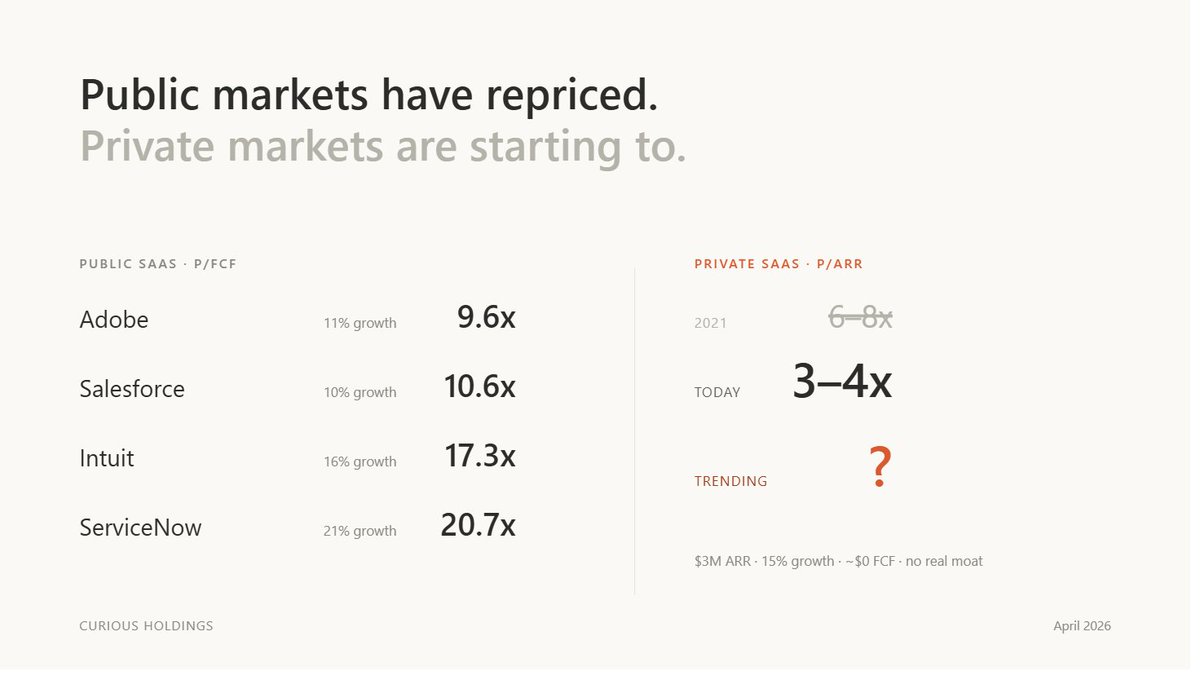
Salesforce is trading at 10x FCF.
Adobe at 9.6x.
ServiceNow at 20x.
Intuit at 17x.
These are the most durable, profitable, moat-protected SaaS businesses on earth, and the public market has decided they're worth low-teens multiples of free cash flow.
Now look at the private markets. A $3M ARR vertical SaaS growing 15% with no real moat still gets pitched at 6-8x ARR like it's 2021.
Private markets lag public markets. They always have. The repricing happens 18-24 months later, deal by deal, until the new reality sets in.
We're in that lag right now. If the best public SaaS companies in the world are trading at 10x FCF, the math on a $3M ARR private SaaS doesn't pencil at 6-8x ARR. That's not us being cheap, that's the public market telling you what these businesses are actually worth.
The hard part is your VC sold you a story from a different cycle. The 50x ARR rounds in 2021 weren't real prices, they were a moment. A lot of founders are still anchored to that number and don't realize the ground moved underneath them.
We all know software has a survivorship bias toward the winners. The losers get forgotten.
But there's another group nobody talks about: the winners who quietly kept working for a decade after the spotlight moved on.
The wireframing tool every designer used in 2011. The CI/CD platform whose logo meant "the build passed." The live chat widget that invented the category before the billion dollar versions showed up.
Still here. Still profitable. Still serving customers who'd be upset if they disappeared.
Surviving that long in SaaS is harder than growing fast for 3 years on venture money. The founders who pulled it off don't get the credit they deserve.
Those are the founders we spend our time with at Curious.
Tech twitter has convinced a generation of founders that $2M ARR is failure.
It isn't.
$2M ARR at 70% gross margin with modest growth is a real business. It's better than 95% of the small businesses in this country by any objective measure. The HVAC company owner down the street would trade you straight up and never look back.
The reason it feels like failure is the venture model needs you to be at $20M to matter. So when you're at $2M, the people who funded you stop returning emails, the people who write about software stop covering you, and the conferences stop inviting you to speak.
That's not your business failing. That's you not being interesting to a specific group of people whose entire job is chasing outliers.
If your customers love you, your team is paid, and you go home at a reasonable hour most days, you didn't fail. You just built a different thing than the one you set out to build.
That's worth something. We think it's worth a lot.
My best advice to venture backed founders stuck at $1M ARR with a heavy pref stack: hard pivot or sell.
Your investors care about the effort. If you tried your best, it's ok to move on.
Grinding it out is the real cost. 5 years of an $80k founder salary while your Series A investors moved on three funds ago. Every year you spend trying to dig out of a cap table that won't let you win is a year you're not building in the fastest growing industries on earth.
I've seen almost zero cases where a founder dug themselves out of this. Maybe it happens. Luck aside, I haven't seen it.
If selling is the right call, that's what we do at Curious. All cash, 30 to 45 days, permanent hold.
Everyone pays attention to the SaaS company that just raised a Series C.
Nobody pays attention to the one that's been quietly profitable for 12 years, serving customers who'd riot if it disappeared.
There's a wireframing tool every designer used in 2011. A CI/CD platform whose logo basically meant "the build passed." A live chat widget that invented the category before the billion dollar versions showed up.
They're all still here. Still running. Still matter.
Software has a survivorship problem, but not the one people mean. We don't ignore the companies that died. We ignore the ones that lived.
Surviving 10 or 15 years in SaaS is harder than growing fast for 3 on venture money. It means real retention, real utility, and a founder who kept showing up long after the spotlight moved on.
Nobody asks these founders what they want next. Keep grinding or shut it down aren't the only two options.
That's why Curious Holdings exists. We buy B2B SaaS companies between $1M and $5M ARR, all cash, and hold them forever. No flip, no earnout, no bridge round dressed up as an exit. Just a real home for the companies that built the categories everyone else is now chasing.
Curious Holdings acquires B2B SaaS companies with $1M to $5M in ARR across the US and Canada. All cash, permanent hold, and we operate what we buy.
When I talk about Curious, a question always comes up: why did we build it?
The simple answer: founders.
The software M&A world is full of models that work fine for capital and poorly for the people who built the thing. Roll-ups optimizing for a flip. PE shops loading companies with debt. Strategics letting products quietly die inside the mothership. We kept looking at how those deals actually landed for founders and kept coming back to the same question.
The real question wasn't "what's the right buy box?" It was "who do we actually want to work with for the next decade?"
The answer was always founders. The people who built something from zero, sold through the hard years, and now need a real home for what they built. Not a process. Not a 3-year earnout. Not a bridge round dressed up as an exit.
Curious sits at the center of that. We buy the company in cash, we run it, and we stay close to the founder after the deal closes. Sometimes they stay on in a new seat. Sometimes they move to the next thing and we pick up where they left off. Either way, the handoff actually works.
That's why we acquired UserVoice, BuildFire, Convox, Polymer, and AvenueHQ. Working with the founders and operators behind each of those companies has been the best part of the job.
More companies and founders coming soon.
Talked to a founder this week:
Raised: $10.4m across seed and Series A
Last valuation: $42m post
Current ARR: $2.1m
Growth last 12 months: 4%
Gross margin: 71%
Team: 9
Runway: 12 months of cash
Years since Series A: 3
This company could be a real business, but it’ll never return the fund.
The founder keeps grinding, thinking his investors care. But his investors have already moved on to companies that are working.
Some founders also like the “founder lifestyle.” They stay stuck with low salaries because they want to be called founders, and not employees.
Nikesh Arora shared what Masayoshi Son told him: “You’re spending too much time on the mistake. Don’t bother. Your time is better spent with the winners.”
The investors keep not writing the company off because it’s a call option for them. If it works, great. If not, they have others.
But the team keeps showing up and grinding to return the invested capital.
Any sale won’t clear the preferred stack, so they don’t sell.
They can’t shut down. It’s a running business with customers and a team.
They can’t raise. 4% growth doesn’t justify it.
They can’t quit. They’ve been underpaid for five years and have no savings.
They’re stuck, metaphorically and structurally.
Curious Holdings is built for founders on the wrong cap table. All cash, 30 to 45 days from LOI, permanent hold. No earnouts, no rollover, no bridge round dressed up as an exit.
The goal isn’t to be the only option on the table. It’s to be one of the good options, so founders can actually choose.