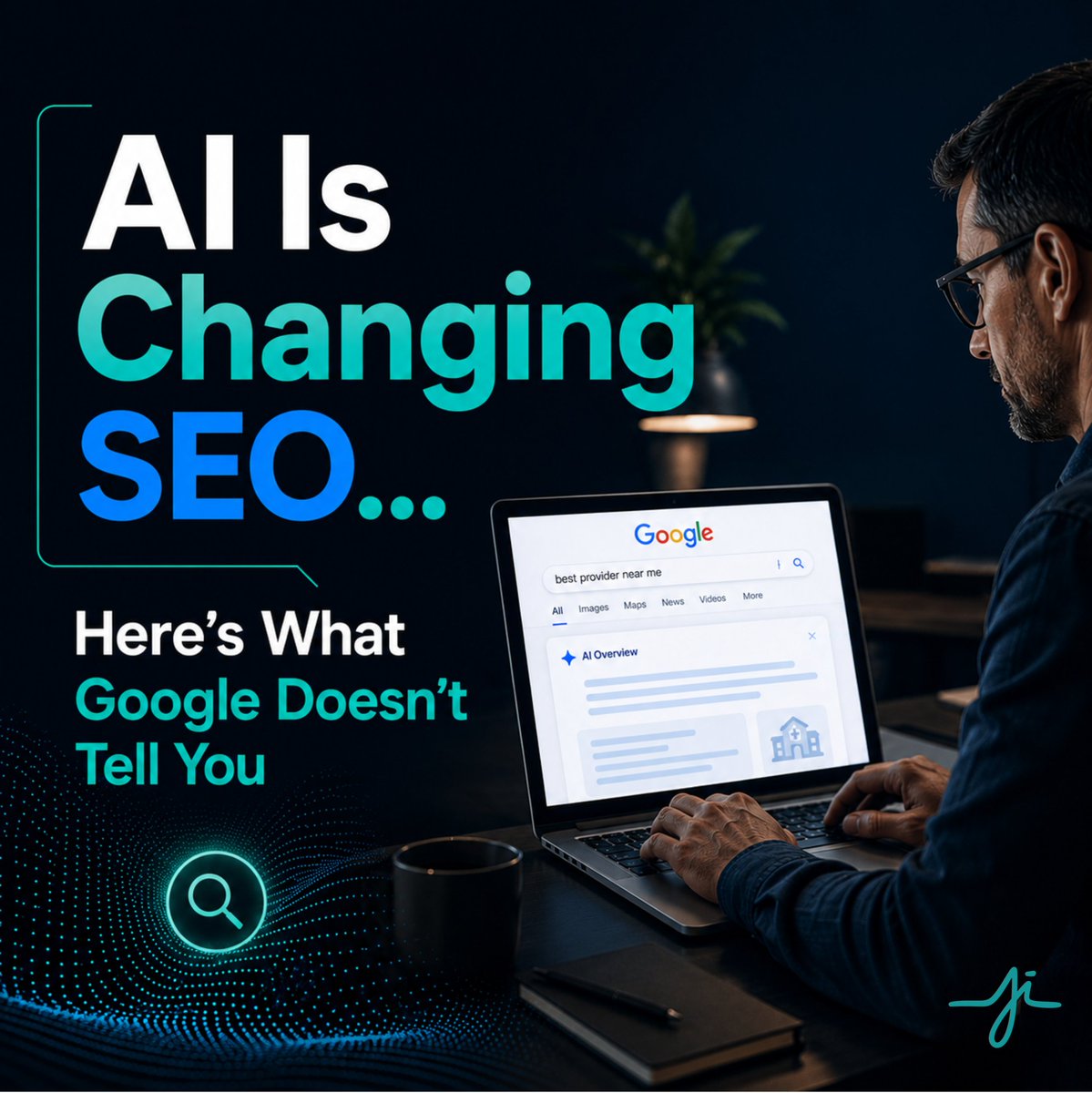
If your marketing company is still telling you that SEO is just about ranking #1 on Google...They're already behind.
Patients aren't searching the same way they were even a year ago.
Today they're using:
• ChatGPT Search
• Google AI Overviews
• Google's new AI Mode
• Perplexity
• Claude
And they're asking complete questions like...
"Who's the best functional medicine doctor near me?"
"What chiropractor specializes in sciatica?"
"Who treats Hashimoto's naturally?"
The AI doesn't simply return a list of websites.
It recommends practices it trusts.
That's a massive shift.
Here's what most agencies aren't talking about...
Traditional SEO is now only one piece of the puzzle.
Today you also need Generative Engine Optimization (GEO).
That means optimizing your practice so AI engines actually understand:
✔ Who you help
✔ Which conditions you specialize in
✔ Your authority
✔ Your content
✔ Your reviews
✔ Your expertise
Because if ChatGPT doesn't understand your practice...
It can't recommend you.
At Justin Healthcare AI, we're helping practices prepare for what's next by focusing on:
• AI-friendly website structure
• Content written for both humans AND AI
• Entity optimization
• AI-readable FAQs and knowledge
• Schema improvements
• Brand authority across the web
• Positioning practices to appear inside ChatGPT Search and Google's AI experiences
This isn't replacing SEO.
It's the next evolution of SEO.
The practices that start optimizing now will have a huge advantage over those waiting another year.
If you're wondering whether your practice is visible inside ChatGPT, Google AI Overviews, or AI Mode...Let's talk.
Or subscribe to my free weekly newsletter where I break down what's actually working in Healthcare AI every week.
https://t.co/lVrnUFmQe4
.
#HealthcareAI #SEO #ChatGPT #GoogleAI #AIMode #MedicalMarketing #PracticeGrowth #HealthcareMarketing #ArtificialIntelligence #Doctors #HealthcareTechnology
One AI-generated email campaign helped re-engage patients who hadn't been back in months...The secret wasn't the copy. It was the order we built the campaign.
Most practices do this:
• Export a patient list.
• Ask ChatGPT to write an email.
• Hit send.
That's backwards.
Instead, we build the campaign in this order:
✅ Segment the patient list first.
(New leads, no-shows, inactive patients, one-time treatment patients, old consultations, etc.)
✅ Tell AI exactly who you're talking to and why they originally came in.
✅ Build an offer or piece of value specifically for that group.
✅ Only then write the email.
The result feels personal instead of mass produced.
We've started using Claude Code to automate much of this process.
It can analyze patient lists, organize them into meaningful groups, and even help generate personalized email campaigns for each audience.
Imagine automatically creating different emails for:
• Patients who came in for knee pain but never returned
• Patients who completed a treatment plan six months ago
• Leads who booked but never showed
• Patients who requested pricing but disappeared
• Patients who haven't scheduled in over a year
Every one of those groups should receive a different message.
I put together a free guide showing exactly how we build these campaigns using AI.
Inside you'll learn:
→ The 4-step framework
→ How we segment patient lists
→ The Claude Code workflow behind it
→ How to dramatically improve reactivation email performance
→ The mistake that makes most reactivation campaigns feel like spam
Comment REACTIVATE and I'll send it over.
(You'll need to follow me so I can DM you.)
.
.
#HealthcareAI #MedicalMarketing #PatientRetention #PracticeGrowth #ArtificialIntelligence #Doctors #MedicalPractice #ClaudeAI
I had Claude analyze over 5,000 of the highest-performing healthcare AI and medical marketing posts to answer one question...
Why do some doctors build authority online while others get completely ignored?
It found patterns I wasn't expecting.
Not just the topics.
The structure.
The hooks.
The reading level.
The formatting.
The CTAs.
Even the post length.
I've been testing these same frameworks while helping healthcare practices implement AI, improve marketing, and attract better patients.
So I decided to package everything into one free guide.
Inside you'll learn:
→ The headline formula that consistently gets doctors to stop scrolling
→ The post structure that keeps people reading to the very end
→ Why educational posts outperform promotional posts almost every time
→ The biggest mistake clinics make when using ChatGPT or Claude to write content
→ The AI prompts I use to create weeks of social media content in a single afternoon
→ How to turn likes and comments into booked consultations instead of vanity metrics
If you're trying to grow your practice online, this will save you dozens of hours of trial and error.
Comment "5000" and I'll send you the guide.
(You'll need to be following me so I can DM it.)
.
.
#HealthcareAI #MedicalMarketing #MedicalPractice #Doctors #PracticeGrowth #ArtificialIntelligence #MedicalOffice #HealthcareLeadership #ContentMarketing #JustinHealthcareAI
We raised $16M to build Claude Code for Meta Ads
Introducing Mark: The only AI built for winning ads
10,000 of the best performance marketing teams use it to scale their ads!
It has persistent brand memory, instant access to your entire assets library, and is trained on millions of winning ads.
Mark can also:
> Create hyper-realistic UGC
> Design motion graphics
> Localize campaigns worldwide
Everything a creative team does. Faster. Better. Autonomous.
Today we're releasing it to all Arcads users
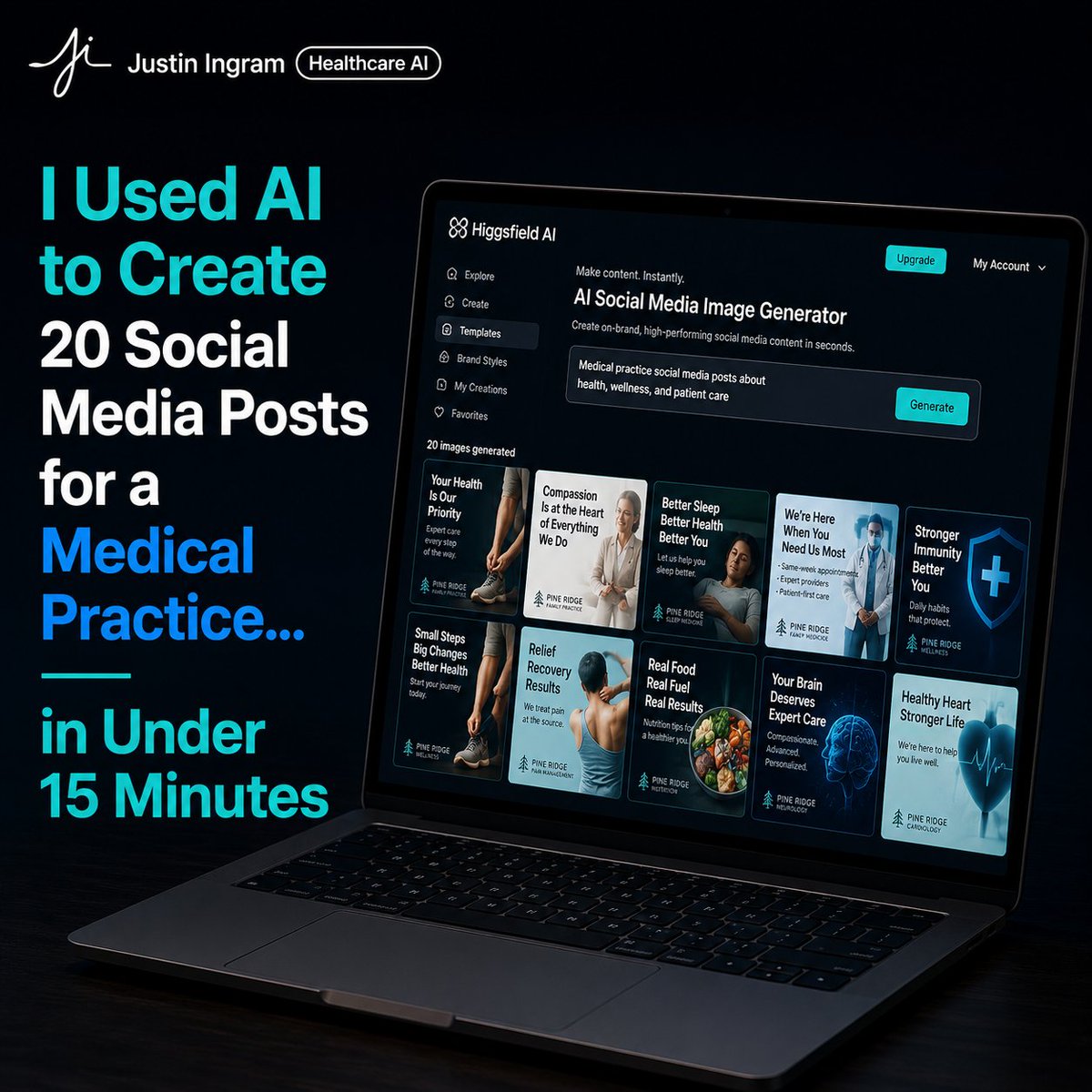
One of the biggest mistakes I see medical practices make with AI is asking it to create one social media post at a time.
It works, but it also guarantees you'll spend hours starting over every week.
Instead, build a content system.
Here's the workflow I use.
Step 1: Create a Claude Project for your practice.
Step 2: Upload everything that teaches Claude about your business, including your website, services, blogs, newsletters, social posts, branding, photos, and brand voice.
Now it understands your practice before it starts creating.
Step 3: Ask Claude to act as your Content Marketing Director and create an entire month of educational content, complete with headlines, captions, graphic ideas, CTAs, and hashtags.
Step 4: Take those ideas into ChatGPT Images and generate matching graphics using your branding.
One extra tip...
Tell Claude to balance the content with educational posts, myths, patient stories, promotions, and authority-building content. Then ask which posts would perform best as carousels and short videos.
Now you've built content for Facebook, Instagram, LinkedIn, blogs, emails, and videos from one workflow.
That's the difference between using AI to make one post and using AI to build a marketing system.
👇 Want us to build this AI workflow for your practice?
Click the link in my below to subscribe to my FREE Weekly Healthcare AI Brief, where I give away FREE Guides every week, & give tips, tricks and advice on everything AI & AI tools for healthcare and dental clinic owners. https://t.co/lVrnUFno3C
.
#HealthcareAI #MedicalMarketing #PracticeGrowth #ArtificialIntelligence #HealthcareInnovation
One of the biggest misconceptions I hear from doctors is, "AI is just another chatbot."
That might have been true a year ago, but it's definitely not true today.
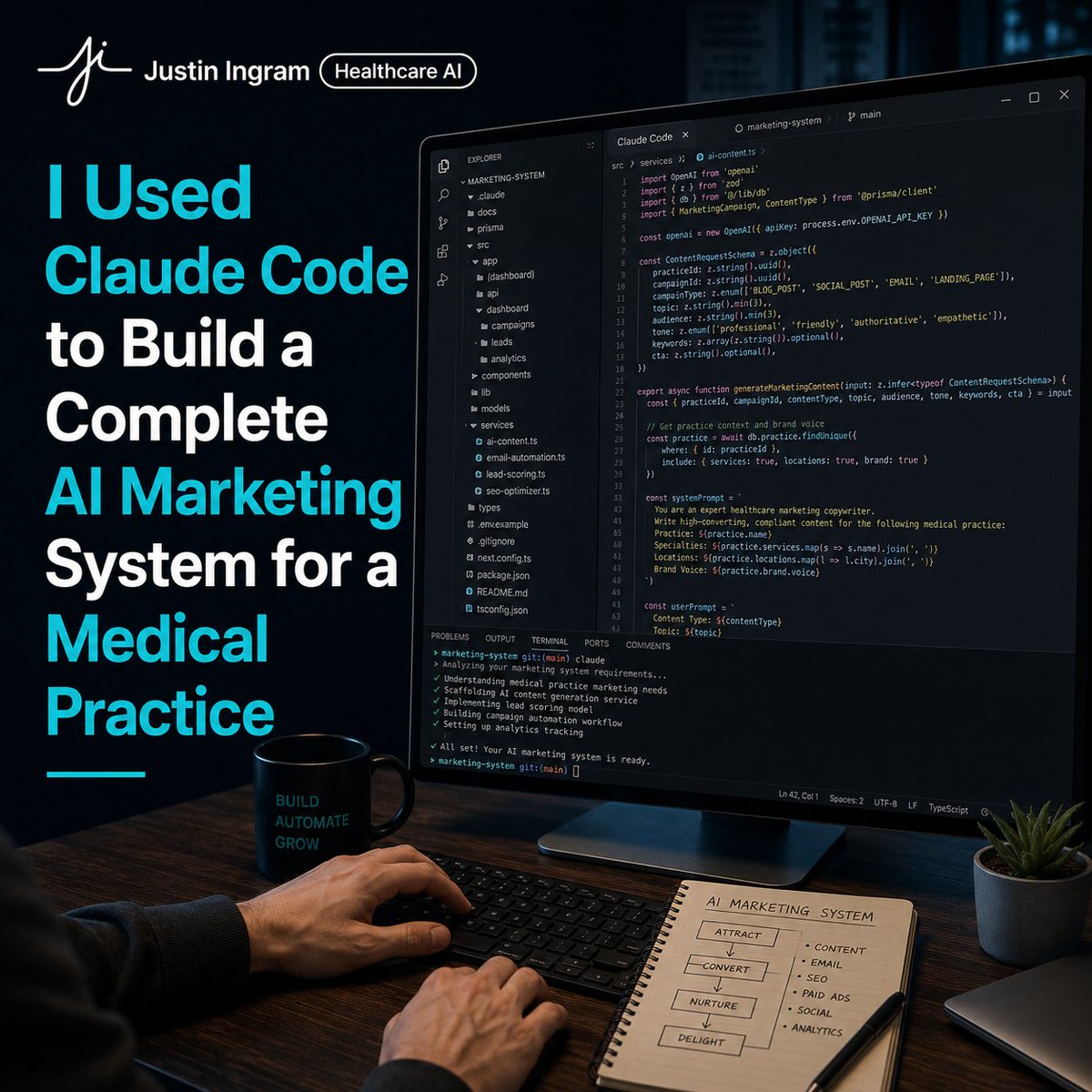
Over the last few weeks, I've been testing Claude Code alongside ChatGPT Images. Instead of asking AI to create one graphic or one email, I asked it to build an entire marketing system for a medical practice.
Here's what it created.
✅ A complete Brand Guide after researching the practice's website, including its messaging, branding, patient avatar, services, and tone of voice.
✅ 30 educational social media posts customized for the practice.
✅ Weekly newsletters, nurture campaigns, patient education emails, and reactivation campaigns.
✅ An SEO content strategy with blog ideas, keywords, outlines, and a content calendar.
✅ Patient handouts and marketing graphics that automatically matched the practice's branding.
Here's what really stood out.
The biggest breakthrough wasn't that AI created all of those assets. It was that it first learned the business.
Once the Brand DNA was built, every new email, blog, social post, patient guide, and graphic already understood the practice's voice, messaging, and ideal patient. There was no starting from scratch every time.
That's the difference between using AI as a chatbot and using AI as part of your team.
This is exactly how we're implementing AI inside medical practices, and I believe it's where healthcare AI is headed.
If you're still opening ChatGPT every morning with a blank prompt, you're making AI work much harder than it has to.
👇 Want to see how we're building AI systems like this for medical practices?
📅 Schedule your FREE AI Strategy Call:
https://t.co/zwmGOLxf4P
📩 Or subscribe to my FREE Weekly Healthcare AI Brief for practical AI tips, workflows, new tools, and a free implementation resource every Tuesday.
https://t.co/lVrnUFno3C
.
#HealthcareAI #ArtificialIntelligence #MedicalPractice #HealthcareInnovation #MedicalMarketing #PracticeGrowth #HealthcareTechnology #AIForHealthcare #Doctors #Dentists #PrivatePractice #MedicalOffice #PracticeManagement #HealthcareLeadership #DigitalHealth #ClinicGrowth #HealthTech #MedicalAI #HealthcareMarketing #JustinHealthcareAI
Big News from Justin Healthcare AI 📷
We're proud to announce that Justin Healthcare AI is now a Certified OpenAI Partner.
Even more exciting...
We're now certified to help businesses advertise through ChatGPT as these new advertising opportunities continue to roll out.
This is a huge step forward for the healthcare practices we work with.
The way patients search for doctors is changing. Instead of only searching Google, more people are asking AI questions like:
• "Who's the best dentist near me?"
• "Find a chiropractor that treats sciatica."
• "What medical practice specializes in Hashimoto's?"
Healthcare marketing is entering a new era, and we're making sure our clients stay ahead of it.
As an OpenAI Partner, we're committed to helping healthcare practices understand what's coming next, build AI-ready marketing strategies, and take advantage of new opportunities as they become available.
The future of patient acquisition won't belong to the practices that wait.
It will belong to the ones that adapt first.
The future is here...and we're excited to help lead the way.
Schedule your FREE AI strategy call with us today! https://t.co/zwmGOLwHfh
.
#HealthcareAI #OpenAI #ChatGPT #HealthcareMarketing #MedicalMarketing #DentalMarketing #AI #ArtificialIntelligence #PatientAcquisition #JustinHealthcareAI
Not every AI tool should answer every clinical question.
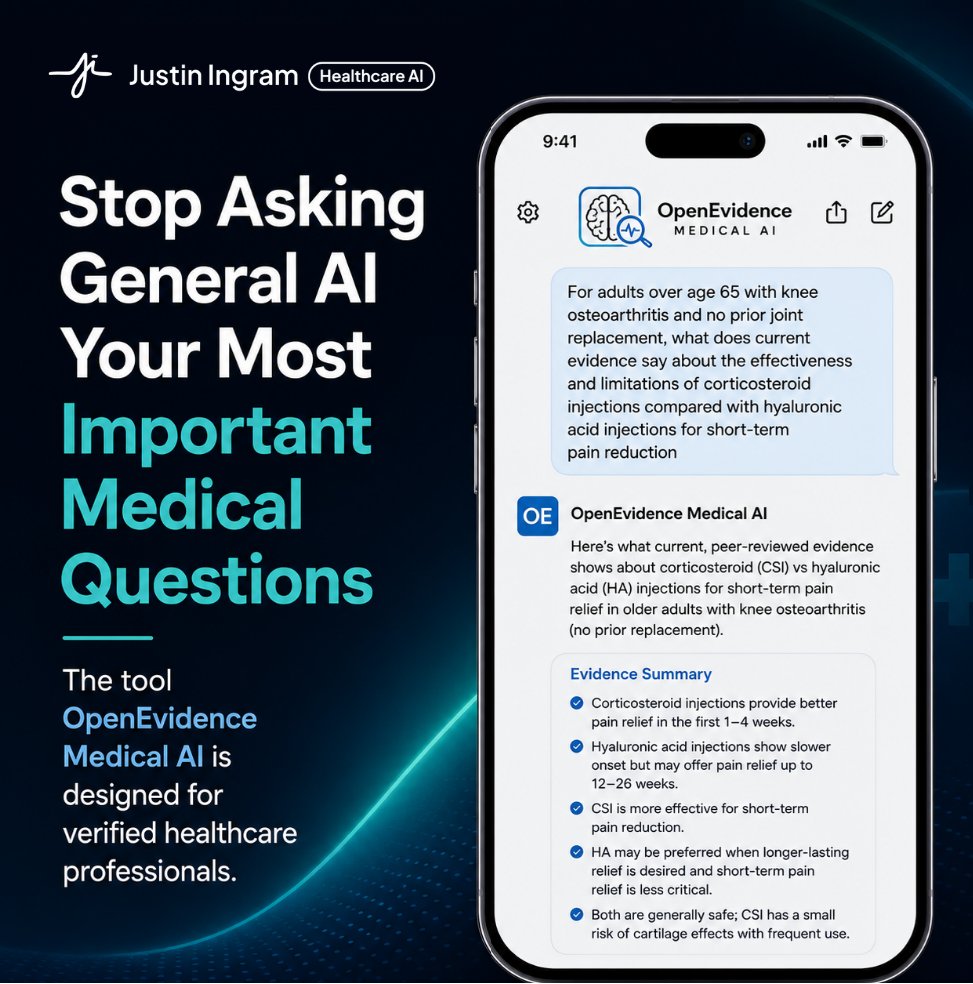
For clinical evidence, you need real citations and visible uncertainty, not just a confident paragraph. That's where a tool like OpenEvidence helps, as a research starting point, not a replacement for judgment.
How to use it well:
Ask narrow questions. Define population, intervention, comparison, outcome. Not "best treatment for chronic pain" but "adults 65+ with knee OA, corticosteroid vs hyaluronic acid injections for short-term pain."
Ask for disagreement: "Show me where guidelines and studies agree, disagree, and remain uncertain."
Ask it to separate: established findings, uncertainty, patient variables, evidence limitations, sources needing full review.
Open the citations. Don't trust the summary. Check the study population and publication date.
Compare against another trusted source. You're checking if evidence is stable or disputed, not taking a vote.
The hack: "Act as a skeptical specialist reviewing your previous response. What's the strongest reason this may not apply here, and what evidence would change it?"
At Justin Healthcare AI, I help orgs build governance around where clinical AI should and shouldn't be used.
#HealthcareAI #OpenEvidence #ClinicalAI
If your staff constantly copies information from one app, pastes it into Claude, creates an answer, and moves it into another app, you have not really automated the workflow.
Claude Connectors can allow Claude to work with approved outside tools and information through MCP, the Model Context Protocol.
In plain English, MCP is a connection layer that lets AI communicate with other software instead of forcing employees to move everything manually.
A practice might eventually use connected AI to review approved project tasks, search a controlled document source, organize meeting actions, or prepare nonclinical reports.
But do not connect everything simply because you can.
Before enabling a connector, ask:
• What data can Claude see?
• Can it read only, or can it make changes?
• Who has access?
• Does the source contain PHI?
• What privacy rules belong to the connector provider?
• Who reviews an action before it becomes final?
The most important trick is to begin with the smallest possible permission. If Claude only needs to read one approved folder, do not give it access to an entire drive. If it does not need to edit anything, do not grant write access.
This is the kind of work Justin Healthcare AI handles for practices: selecting the right connection, defining permissions, testing the workflow, and training the people responsible for it.
#ClaudeAI #MCP #HealthcareAI #MedicalPractice #HealthcareAutomation #PracticeManagement #ArtificialIntelligence #WorkflowAutomation #HealthcareTechnology #JustinHealthcareAI
Gemini can now look at the screen you are sharing while you talk to it.
That makes Gemini Live useful for more than asking general questions. It can become a visual training and troubleshooting assistant for your staff.
You could use it to:
• Walk through a confusing software menu
• Review a spreadsheet or dashboard
• Improve a staff presentation
• Check a public webpage for unclear information
• Build a training checklist from a demo workflow
• Identify what may confuse a brand-new employee
Here is the trick most people miss:
Do not simply ask Gemini to explain the screen.
Ask:
“Pretend you are a new employee seeing this for the first time. Identify anything that may be confusing, easy to miss, or likely to cause an error. Then create a five-step training guide.”
That changes Gemini from a screen reader into a workflow reviewer.
Only use nonconfidential screens, demo accounts, public webpages, blank templates, or properly de-identified examples. Do not expose PHI, passwords, payment details, or sensitive internal information through a general AI session.
I put the exact setup steps and three prompts in the first comment.
At Justin Healthcare AI, I help practices turn features like this into safe, repeatable training systems their teams can actually use.
Schedule a FREE 30-minute 1:1 AI Strategy Call directly with me if you want help implementing AI inside your practice.
https://t.co/zwmGOLxf4P
.
#GeminiAI #HealthcareAI #MedicalPractice #StaffTraining #PracticeManagement #ArtificialIntelligence #HealthcareTechnology #MedicalOffice #AIForHealthcare #JustinHealthcareAI
A medical practice doesn't gain much from an AI assistant that knows everything except how the practice actually operates.
That's the problem with most generic implementations. The tool can write an email or answer a broad question, but it doesn't know your policies, software, approval process, or the point where a staff member must take over.
A useful practice AI assistant needs 5 layers.
A clearly defined job
"Help our practice" isn't a job description. Give it a narrow responsibility: find approved SOPs, train new front desk staff, turn meeting notes into tasks, or organize patient education resources. Narrower first versions are easier to test.
Approved knowledge
The assistant should know which sources are authoritative. If three versions of a cancellation policy exist in Drive, AI can't decide which one management intended. A human has to settle that first.
Guardrails
Define what it may do, may not do, and when it must escalate. Example: "Do not invent a policy. Do not interpret clinical information. If the source is unclear, escalate to the office manager."
A repeatable workflow
A strong assistant follows a process, not just generates text. For training: identify the role, select approved SOPs, build a learning plan, create scenarios, score answers, flag areas for supervisor review.
Testing and ownership
Someone must own the assistant after launch. Policies change, staff find edge cases, software updates. It needs ongoing review.
Quick audit to try today: Ask your AI assistant 10 real questions from your staff. For each answer, check if it was accurate, backed by an approved source, and escalated when uncertain. If you can't explain where its answers came from, it isn't ready to guide your team.
At Justin Healthcare AI, I help practices define the workflow, organize the knowledge, design the guardrails, build the assistant, test it, and train the staff who use it.
Want help building this inside your practice? Schedule a FREE 30-minute 1:1 AI Strategy Call directly with me here: https://t.co/zwmGOLwHfh
.
#HealthcareAI #AIAssistant #MedicalPractice #PracticeManagement #HealthcareAutomation #ArtificialIntelligence #MedicalOffice #PracticeOperations #HealthcareTechnology #JustinHealthcareAI
Trying to keep up with healthcare AI can feel like a second full-time job.
Every week there is another tool, another update, another pricing change, and another company claiming its platform will transform your practice.
Most doctors do not need more AI news.
They need someone to tell them:
Is this tool actually useful?
What does it cost?
How do I use it?
Will it work with my current systems?
Can it save my staff time?
Can it help us bring in more patients or make more money?
That is exactly what I cover in my FREE Weekly Healthcare AI Brief.
I have spent more than 17 years helping doctors and healthcare practices grow, improve their systems, and implement better technology. Each week, I share what I am learning, what is working for my clients, and the AI strategies I believe healthcare professionals should know.
You will get:
• AI tool tutorials
• Step-by-step implementation tips
• Prompts, shortcuts, and hidden features
• New AI updates explained in plain English
• My honest opinion on what is worth using
• Pricing and feature comparisons
• Ideas to improve patient acquisition, follow-up, scheduling, and operations
• A FREE downloadable resource in every issue
The download may be a prompt pack, checklist, workflow, template, cheat sheet, or training guide designed to help you use an AI tool or improve a process inside your practice.
This is not a newsletter you need to spend thirty minutes reading.
It is one useful email each week that tells you what matters and gives you something practical to implement.
Subscribe here:
https://t.co/lVrnUFno3C
.
#HealthcareAI #MedicalPractice #ArtificialIntelligence #HealthcareTechnology #PracticeManagement #Doctors #Physicians #MedicalInnovation #DigitalHealth #AIForHealthcare #PracticeGrowth #JustinHealthcareAI
One of the most useful new ChatGPT features for healthcare operations is not another model. It is Skills. & OpenAI is turning Skills on by default for many Enterprise workspaces beginning today, July 23, unless the workspace administrator opts out.
A Skill is a reusable set of instructions, reference materials, and steps that teaches ChatGPT how to perform a recurring workflow consistently. Instead of asking employees to remember the perfect prompt every time, you package the process once and reuse it.
Here is why that matters.
Imagine your staff regularly uses AI to create:
• Referral letters
• Prior authorization drafts
• Patient instructions
• Meeting summaries
• Policy checklists
• Training materials
• Marketing reviews
Without a Skill, every employee writes a different prompt. The quality changes depending on who asks, what they remember, and how much context they include. With a Skill, the approved process becomes reusable.
How I would build the first skill:
Choose one repetitive, nonclinical workflow with clear inputs and a predictable output. Do not begin with your most complicated process.
A strong first example would be:
Turn an approved SOP into a staff training guide.
The Skill should define:
The role ChatGPT should perform.
The documents it may use.
The questions it must ask before beginning.
The exact steps it should follow.
The required output format.
The situations where it must stop and request human review.
A simple Skill instruction
“You create staff training materials from approved practice SOPs. Use only the supplied SOP. Do not add policies or resolve unclear instructions. First identify missing information. Then create a plain-language training guide, supervisor checklist, five-question quiz, and answer key. Flag every issue requiring management approval.”
Now the employee supplies the SOP and receives the same structured output every time.
The real hack: build a quality check into the Skill
Most people only tell AI what to create. They forget to tell it how to inspect its own work.
Add this instruction:
“Before finalizing, compare every section against the source. List any statement that is not directly supported, then remove or flag it.”
That extra verification step can dramatically improve consistency.
Another hack: require structured inputs
Instead of allowing staff to paste random information, require fields such as:
• Audience
• Goal
• Approved source
• Reading level
• Deadline
• Output format
• Required reviewer
Better inputs create more reliable outputs.
Important limitation
A Skill standardizes an AI workflow. It does not make that workflow compliant, clinically appropriate, or accurate by itself.
Your organization still needs approved sources, access controls, human review, clear PHI rules, and periodic testing.
.
#ChatGPT #HealthcareAI #MedicalPractice #PracticeManagement #HealthcareAutomation #ArtificialIntelligence
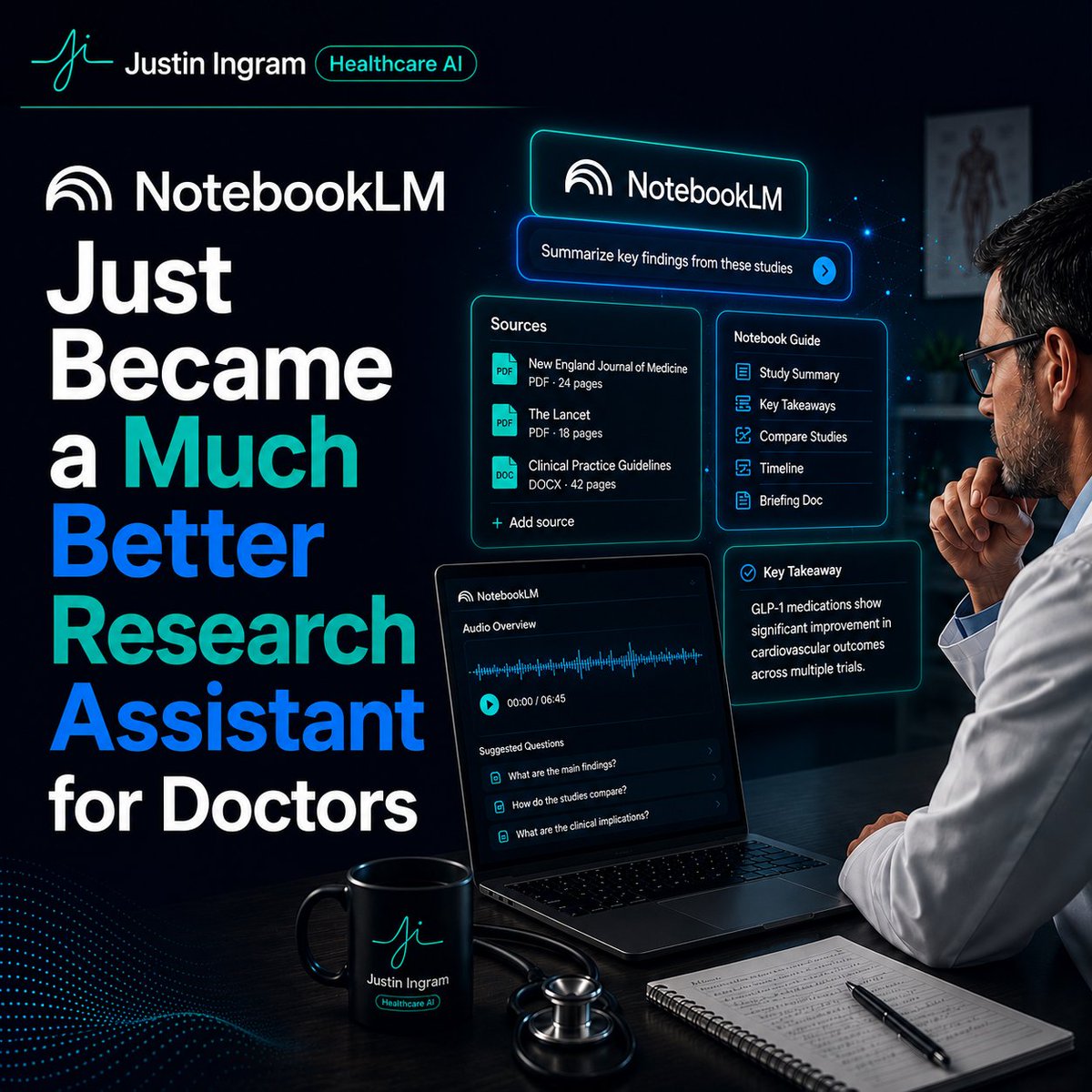
Most doctors using NotebookLM still treat it as a basic PDF summarizer.
That's now the least interesting thing it can do.
Google upgraded NotebookLM with agentic research capabilities. It can now investigate a topic, organize sources, compare findings, and build materials from what it collects, not just answer questions about uploaded files.
A practical workflow for healthcare pros:
One notebook, one specific question
Skip the "Medical Research" dump. Use a focused title like "2026 Prior Authorization Requirements." Narrow notebooks give sharper answers.
Add trusted sources
Upload guidelines, research, policies, or spreadsheets. NotebookLM grounds answers in your sources, but always verify important claims against the original.
Give it a real research goal
Try: "Review these sources and identify where they agree, disagree, or leave questions unanswered. Cite the source for every conclusion and separate established findings from uncertainty."
This beats asking for a plain summary.
Turn research into more than notes
Ask it to build a staff briefing, patient education outline, study guide, quiz, or Audio/Video Overview, all from the same sources.
The hidden trick
Set a custom goal first. Try: "Act as a research assistant for a medical practice. Prioritize accuracy, conflicting evidence, and questions a clinician should review. Do not turn preliminary findings into clinical recommendations." That one instruction changes every answer after it.
What not to do
Don't treat a summary as a substitute for reading the source. Don't upload PHI unless your organization has confirmed the product and workflow meet its requirements.
Try this today
Add 3 nonconfidential papers on one topic to a notebook and ask: "What would a busy healthcare executive misunderstand if they only read the abstracts?" That question surfaces what a basic summary misses.
At Justin Healthcare AI, I help practices turn tools like NotebookLM into repeatable workflows, not another app people open once and forget.
#NotebookLM #HealthcareAI #MedicalResearch #MedicalPractice #ArtificialIntelligence #HealthcareInnovation #PhysicianEducation #MedicalTechnology #AIForHealthcare #JustinHealthcareAI
"AI is going to take my job." I hear this every single day, and I need to say something about it.
Every time I post about AI, the comments say the same thing.
"You're replacing healthcare workers."
"This is bad for society."
"AI is taking people's jobs."
I get it. New technology has always made people nervous.
But after years working inside healthcare practices, here's what AI is actually replacing:
❌ Typing the same follow-up emails by hand.
❌ Writing blog posts and social content from scratch.
❌ Copying data between software systems.
❌ Chasing leads that never get contacted.
❌ Finishing documentation after clinic closes.
None of that is why someone became a nurse, receptionist, office manager, chiropractor, dentist, physician, or physical therapist.
Those are the tasks causing burnout.
The practices I work with aren't firing people because of AI. They're using the time it frees up for higher-value work.
Instead of answering repetitive questions for three hours, they're spending three hours with patients.
Instead of manually chasing every lead, they're helping the people who showed up.
Instead of drowning in paperwork, they're building relationships.
AI doesn't replace compassion, clinical judgment, trust, or experience. It doesn't replace a doctor sitting across from a patient making one of the biggest decisions of their life.
The clinics that win the next 10 years won't have fewer people. They'll have better systems.
My goal has never been to replace healthcare professionals. It's to help them get home earlier, spend less time on admin, and focus on the work only humans can do.
Read the full blog: https://t.co/6ijzCzPHm7
Curious what this actually looks like inside a practice? Let's talk. I'll show you where AI adds value, and where a human should always stay in control.
#HealthcareAI #ArtificialIntelligence #MedicalPractice #PracticeGrowth #HealthcareInnovation #HealthcareTechnology #MedicalMarketing #DentalMarketing #Chiropractic #FunctionalMedicine #Burnout #JustinHealthcareAI
Paying for Claude Pro does not mean unlimited usage.
Claude has two separate limits:
Usage limits control how much you can use Claude over time.
Length limits control how much one conversation can hold.
Activity across https://t.co/UvIwxaNEbR, Claude Code, and Claude Desktop shares the same usage allowance. Heavy Claude Code use affects your regular chats too.
Why long chats burn usage fast
Every message in a long thread reprocesses much of what came before. Your 50th message can cost far more than your first. Claude now auto-summarizes very long chats when code execution is enabled, but they still use more of your allowance.
Simplest fix: start a new chat per task. Don't stack every project, email, and strategy discussion into one giant conversation.
5 ways to stretch your usage
Use Projects instead of one endless chat. Projects retrieve only what's relevant instead of loading everything.
Keep Project instructions focused on role, standards, and general rules.
Turn off extended thinking for simple tasks like rewriting an email or reformatting a checklist.
Disable unused tools like web search or connectors when they're not needed.
Match the model to the job. The strongest model isn't always the most efficient one.
Context window vs usage limit
The context window is how much Claude can hold in one conversation, up to 1M tokens on newest models, less on others. It's not about daily message count. Hit your usage limit and you wait, upgrade, or buy more. Hit the length limit and you start fresh or move into a Project.
#ClaudeAI #HealthcareAI #MedicalPractice
I'm sharing 5 AI prompts that can help you master the phone, improve your conversations, and stop dreading cold calls.
Here's one tip to try right now.
Most people dread cold calling because they open the call wrong.
Stop opening with "Hi, this is [name] from [company], do you have a minute?" That line alone gets you hung up on before you even start.
Try this pattern interrupt instead:
"Hey, this is probably an unexpected call, I'll be quick, is now a terrible time or an okay time?"
It's honest, low pressure, and gives them an easy way to say yes to 10 more seconds.
That's 1 small piece of a much bigger system.
I built a free guide with 5 fully engineered AI prompts for ChatGPT or Claude that build your entire outbound sales system: opening scripts, objection responses, voicemail templates, a full prospecting pipeline, a 30 day follow up sequence, and a performance tracking system.
Comment "Share With Me" and I'll send you the full guide.
Want it built and tailored specifically to your practice instead? Book a FREE 30 minute AI Strategy Call:
https://t.co/zwmGOLwHfh
.
#HealthcareAI #ArtificialIntelligence #MedicalPractice #PatientAcquisition #PracticeGrowth #DigitalHealth #HealthcareInnovation
Your practice may already have everything it needs to build an AI office manager.
The knowledge is sitting inside your SOPs, employee handbook, phone scripts, office policies, onboarding documents, and training manuals. The problem is that your staff cannot find the right answer quickly when a patient is waiting or the front desk is busy.
Here is a simple way to make those documents useful again.
Open Claude and create a new Project called Practice Operations Assistant. Upload five to ten of the nonclinical documents your team uses most, then add instructions telling Claude to answer only from those sources, identify the document it used, and clearly admit when the answer is not available.
Now try questions such as:
“What steps should we follow when a patient cancels on the same day?”
“Turn our onboarding process into a one-week checklist.”
“Find any conflicts between our phone script and scheduling policy.”
“Create a staff training quiz from our employee handbook.”
“Show me every document that mentions refunds and tell me whether the instructions agree.”
That last prompt is a trick most practices never think to use. Claude can compare several documents and identify conflicting policies that your staff may have been following differently for years.
You can also use the same Project to turn long SOPs into short checklists, build role-specific training guides, and create realistic scenarios employees can practice.
You can create a valuable practice assistant using operational documents that contain no patient information.
For more practical AI hacks like this, subscribe to my FREE Weekly Healthcare AI Brief. https://t.co/lVrnUFmQe4
.
#HealthcareAI #ClaudeAI #MedicalPractice #PracticeManagement #HealthcareAutomation #ArtificialIntelligence #MedicalOffice #PracticeGrowth #HealthcareTechnology #JustinHealthcareAI













![JustinHealthAI's tweet photo. I'm sharing 5 AI prompts that can help you master the phone, improve your conversations, and stop dreading cold calls.
Here's one tip to try right now.
Most people dread cold calling because they open the call wrong.
Stop opening with "Hi, this is [name] from [company], do you have a minute?" That line alone gets you hung up on before you even start.
Try this pattern interrupt instead:
"Hey, this is probably an unexpected call, I'll be quick, is now a terrible time or an okay time?"
It's honest, low pressure, and gives them an easy way to say yes to 10 more seconds.
That's 1 small piece of a much bigger system.
I built a free guide with 5 fully engineered AI prompts for ChatGPT or Claude that build your entire outbound sales system: opening scripts, objection responses, voicemail templates, a full prospecting pipeline, a 30 day follow up sequence, and a performance tracking system.
Comment "Share With Me" and I'll send you the full guide.
Want it built and tailored specifically to your practice instead? Book a FREE 30 minute AI Strategy Call:
https://t.co/zwmGOLwHfh
.
#HealthcareAI #ArtificialIntelligence #MedicalPractice #PatientAcquisition #PracticeGrowth #DigitalHealth #HealthcareInnovation](https://pbs.twimg.com/media/HNsRkSCWoAIQz4Q.jpg)


