🇩🇪 Pride is what German soldiers feel arriving to serve in Lithuania.
📈 They highlight Lithuania’s hospitality and the rapid progress in Rūdninkai - now transforming into a modern base for the German brigade.
🤝 A strong partnership, built in action.
China is using access to rare earth -- which it has systematically monopolized -- finally as a weapon.
US reaction: Let's get rid of the dependency! Here's the to do-list!
European reaction: Oh, there is not much we can do, unfortunately. Let's try to negotiate with China
Regarding Shahed drone production used against Ukraine, today’s strikes in Iran are unlikely to have a direct impact. Russia has not only localized production for some time now, but has also modernized and improved the systems to make them more resilient to countermeasures
I'm tracking some back and forth on this site about a point of view, held by some, that a subset of U.S. veterans may hold reflexively anti-Ukraine views due to an innate jealously, or sense of insecurity, regarding the intensity of Ukrainians' combat experiences versus what we faced in Iraq and Afghanistan.
I'll leave that debate to others. Yet, as a former USAF special ops pilot who served in Iraq and Afghanistan and who then reported on those wars from ground level as a war correspondent, and who has also lived in Ukraine since 2014 covering the full arc of Russia's invasions...I'll say something about the differences in the American and Ukrainian combat experiences.
First off: The fear of violent death feels no different if it comes from an Al-Qaeda terrorist's Kalashnikov or a Russian glide bomb.
From my point of view, the dangers of combat are like those of mountaineering. A 100-foot fall from a crag in Colorado can kill you just as easily as an 11,000-foot fall down the Kangshung Face of Mount Everest.
As a journalist, I've been under artillery fire in a Ukrainian trench, and I've been under sniper fire in Iraq and Afghanistan. All are scary. And any American or Ukrainian soldier who has the courage to stand their ground, face the enemy, and overcome their fear of death for the sake of defending their nation is a hero in my book.
Full stop.
What truly separates combat in Ukraine from the GWOT wars isn't the acute fear of dying in combat — it is the grind of years of inescapable war. Ukrainians don't get to grab a Subway sandwich and hit the gym between missions like we did in Iraq and Afghanistan. They are in constant contact with the enemy and live with the threat of death on their shoulders 24/7. That constant psychological burden is a foreign thing to my generation of American veterans. And the rise of drone warfare makes modern combat in Ukraine even more emotionally exhausting.
When artillery shells rain down around you, the threat is objective, mathematical. There are predictable actions to take, which, statistically speaking, will probably keep you alive. With drones it’s different. With drones, you feel like you’re being hunted.
Beyond all that, Ukrainian troops also fear for their families' safety since Russia's missile and drone strikes spare no corner of Ukraine and routinely target civilians. As someone who has lived through Russia's bombardments alongside my wife, I can testify that fearing for her safety supersedes by multiple orders of magnitude whatever worries I may have about my own survival.
The human toll of a conventional, full-scale war is also hard to comprehend. As a pilot, I lost a handful of friends on combat missions over the years. Each one hurt like losing a family member. Ukrainian troops endure that same pain, but on a much larger scale. I don't exagerate when I say that, out of the friends I made in the Ukrainian military from 2014 to 2022, more than half are now dead. And of those who are alive, almost all have been wounded.
My fallen friends belong to a generation of Ukrainian heroes who held their ground when the enemy invaded and saved their homeland and their nation from destruction. The only choice they had was to fight or die. More than three years later, the stakes have not changed — and neither has the Ukrainian nation's courage.
So, circling back to that original question.
A war's size isn't how you measure the courage of the soldiers who fight in it. And any American veteran could come to Ukraine and without knowing a word of the language find a welcoming nation of brother and sister warriors who will instantly understand you, to the core of your soul, in a way that most American civilians never could.
Hi all,
I just published my latest newsletter post where I talk about what we should make of the latest German-Ukrainian long-range strike deal.
You can access the full post with details via the link in my bio.
Short summary below.
1/5
A strategic& forward-looking discussion with @Bundeskanzler Friedrich Merz.
German brigade in Lithuania, joint defense industry projects, shared commitment to strengthening European security – we stand united in action not just words.
Europe must stay strong. Ukraine must win.
Lithuania will allocate around €1.1 billion to the military counter-mobility projects over the next 10 years. The greatest focus is on mine capabilities, with €800 million planned for their acquisition. Among the projects are the joint 🇱🇹🇱🇻🇪🇪#BalticDefenceLine & 🇵🇱#EastShield.
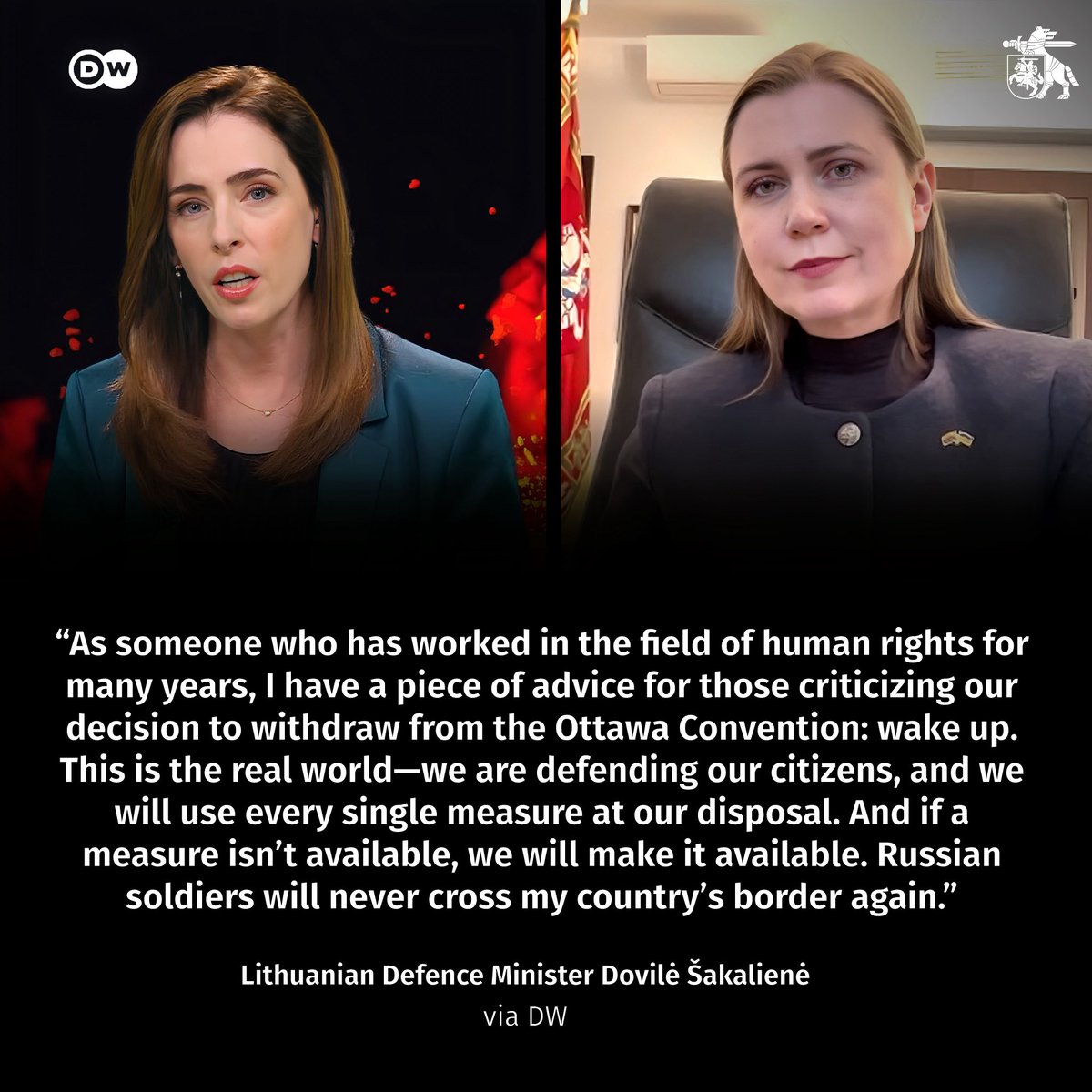
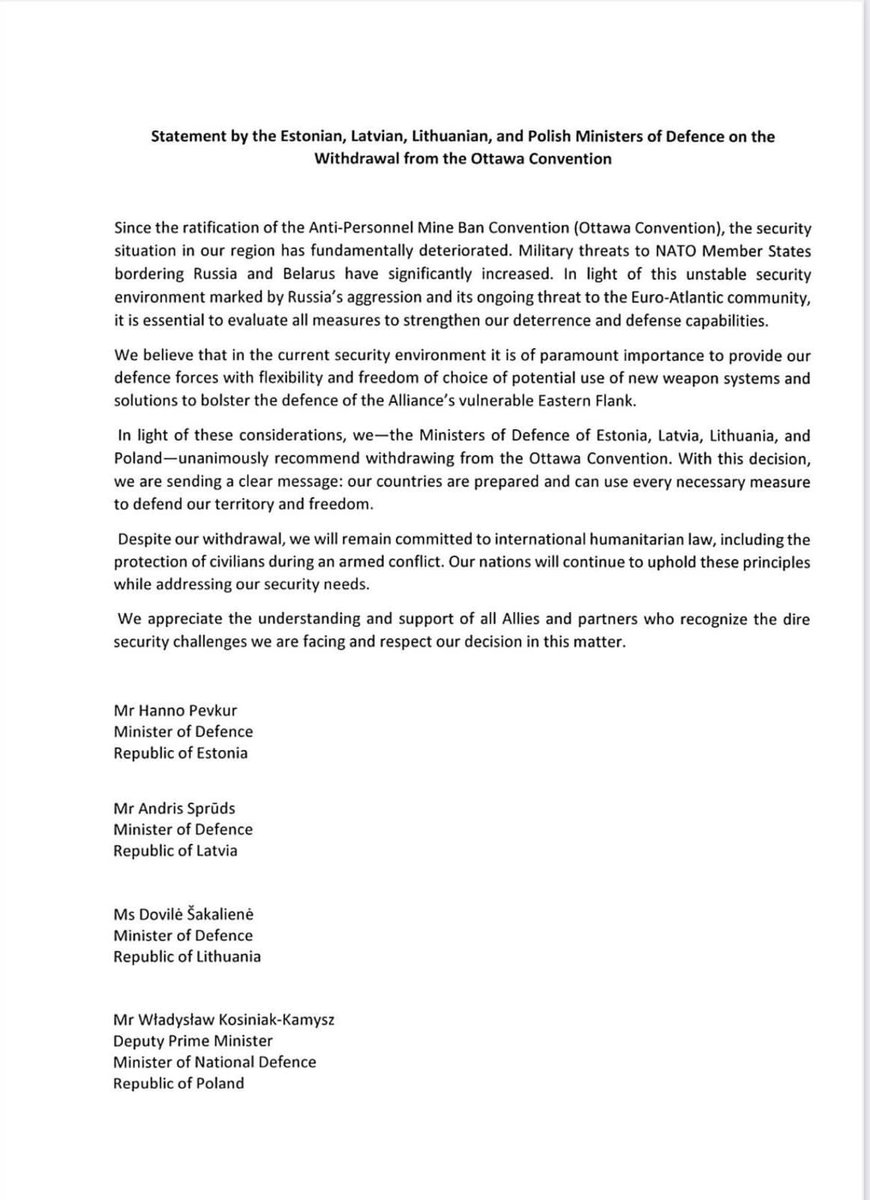
In an interview with @DeutscheWelle, 🇱🇹DefMin @DSakaliene explained our withdrawal from the Ottawa Convention, emphasising the necessity for comprehensive border security against Russia’s threat. Lithuania stays resolute and calls for unity among Allies.
🇱🇹DefMin @DSakaliene has proposed major @LTU_Army reforms: new units, increased troop numbers (20,000 professional soldiers, 6,800 volunteers, 600 cadets) & enhanced social guarantees to boost motivation. All this to raise our readiness & resilience amid growing security threats.
As someone who has worked in the field of human rights for many years, I have a piece of advice for those criticizing our decision to withdraw from the Ottawa Convention: wake up.
This is the real world—we are defending our citizens, and we will use every single measure at our disposal. And if a measure isn’t available, we will make it available.
Russian soldiers will never cross my country’s border again.
3 years since Russia has launched its full-scale invasion of #Ukraine.
3 years of immense suffering of Ukrainian nation - massacres, brutal violence against women& children, shelling of cities, homes, hospitals& kinder gardens.
3 years of incredible strength, courage and resolve of the Ukrainian nation.
3 years of Ukrainians fighting against Russian imperialism, defending Europe’s and global security.
Russian aggression must be stopped once and for all. We must stop it together and we will.
Lithuania stands with Ukraine. Europe stands with Ukraine. Our support is unwavering and will only grow stronger.
Ukraine will prevail, become a member of the #EU and #NATO. Ukraine will recover, grow stronger and prosper.
Lithuania will always stand by your side. Slava Ukraini! 🇱🇹🇺🇦
Le Monde published an article titled "Without the US, Ukraine Would Barely Last Six Months Against Russia." My readers know that I have been consistently accurate in most of my frontline assessments, to the point that some call me a pessimist, so it's hard to accuse me of painting a rosy picture for Ukraine. That being said, the claim made in this article is completely incorrect and does not reflect the reality on the ground.
Since 2024, the vast majority of frontline losses are inflicted by drones, which are produced domestically using locally manufactured or imported components, often from countries like China. ISTAR capabilities are largely covered by short- and long-range reconnaissance drones. While I won’t publicly go into full detail about strengths and weaknesses, the bottom line is that U.S. military aid is important and highly beneficial, but it won't result in battlefield collapse.
As long as financial support from the EU continues, statements about a six-month collapse are nothing more than doomsday speculation based on a lack of understanding of battlefield dynamics. Would the loss of U.S. aid make the situation more difficult for Ukrainian forces? Yes. Would it lead to total collapse in six months? No. It would mean more Ukrainian soldiers and civilians killed, especially as air defense stocks deplete, but on the battlefield, there would be no sudden collapse, thus such claims are irresponsible.
Ukraine offers the opportunity for Europeans to frustrate Russian imperialism for an incredibly cheap prize. All they need to do is to produce some weapons and send them to Ukraine. And yet they still do far too little, putting not Ukraine but Russia in a position of strength.
Stronger together: As of today, our Baltic partners Estonia, Latvia & Lithuania are part of the European electricity grid & independent of the Russian grid. A big step towards protecting critical infrastructure in the EU & a strong sign of co-operation in the Baltic Sea region.
Plugged into Europe! 🔌
Lithuania, Latvia, and Estonia have successfully synchronized with the European power grid. We are now fully connected to Europe, where we truly belong! 🇱🇹🇱🇻🇪🇪
Historic Moment!
Today, Lithuania, Latvia and Estonia have officially disconnected from the BRELL electricity grid, cutting our final energy ties with Russia.
For years, Russia weaponized energy against us, using it as a tool of manipulation. Over the past decade 🇱🇹🇱🇻🇪🇪 have taken decisive action to ensure that the Kremlin can never again hold our energy supply hostage.
A stronger, more resilient Baltic region begins today!