Over the last few days, I’ve been processing the results of a case study I just finished on the decline of @MLB starting pitchers.
I made this video to speak directly to pitchers, especially aspiring professional pitchers, because you deserve to hear this.
Case study: Top 3 pitchers drafted/signed each year since 2013 (all 30 orgs). In-org only (stop tracking once they leave).
• 1,134 pitchers | $1.27B bonuses
• 25.7% reached MLB (with drafting org)
• 6.4% reached 200+ MLB IP
• 38% arm injury | 28% major
The Top High School pitching prospects in this study undergo a major arm injury after just 159 professional innings.
One of our biggest offseason goals was to build a stronger foundation for @uspbl data operations and streamline the delivery of our player development reports.
That goal is now a reality, and it represents a major step forward in our ability to support USPBL players, increase visibility, and help them advance their careers.
There have been a lot of people involved in making this process possible. I want to thank Devin Wiles and Arjun Darbha for their collaboration and commitment to bringing this vision to life for the USPBL.
#WHOSNEXT
Check out our post-game starting pitcher reports, provided by our @uspbl data operations team.
Thanks to Devin Wiles and our crew of baseball operations interns for helping to scale the visibility of our players' progress during the season.
Who's Next?
In 2016, Will Fox and I took a simple approach with USPBL pitchers:
Establish a baseline.
Build a process.
Watch the trends.
We are building that foundation again.
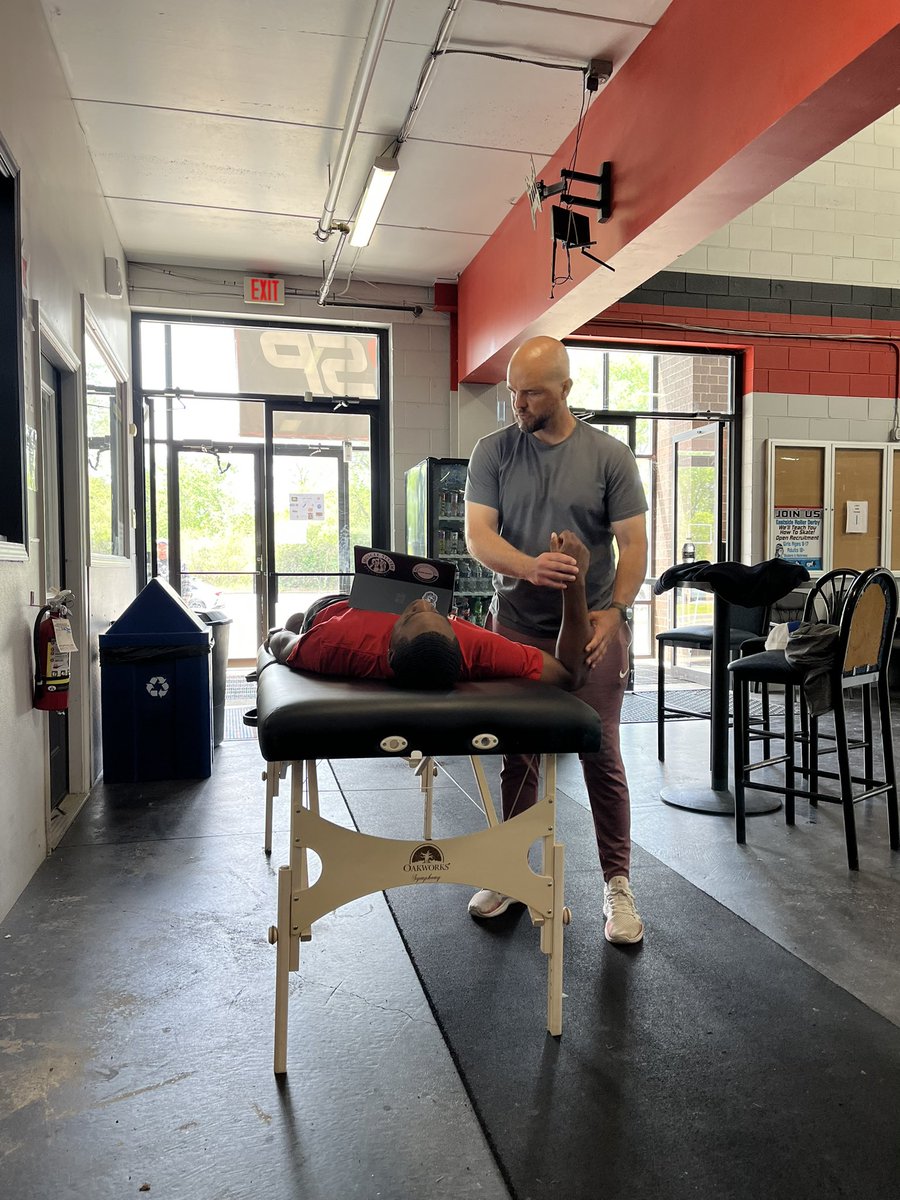
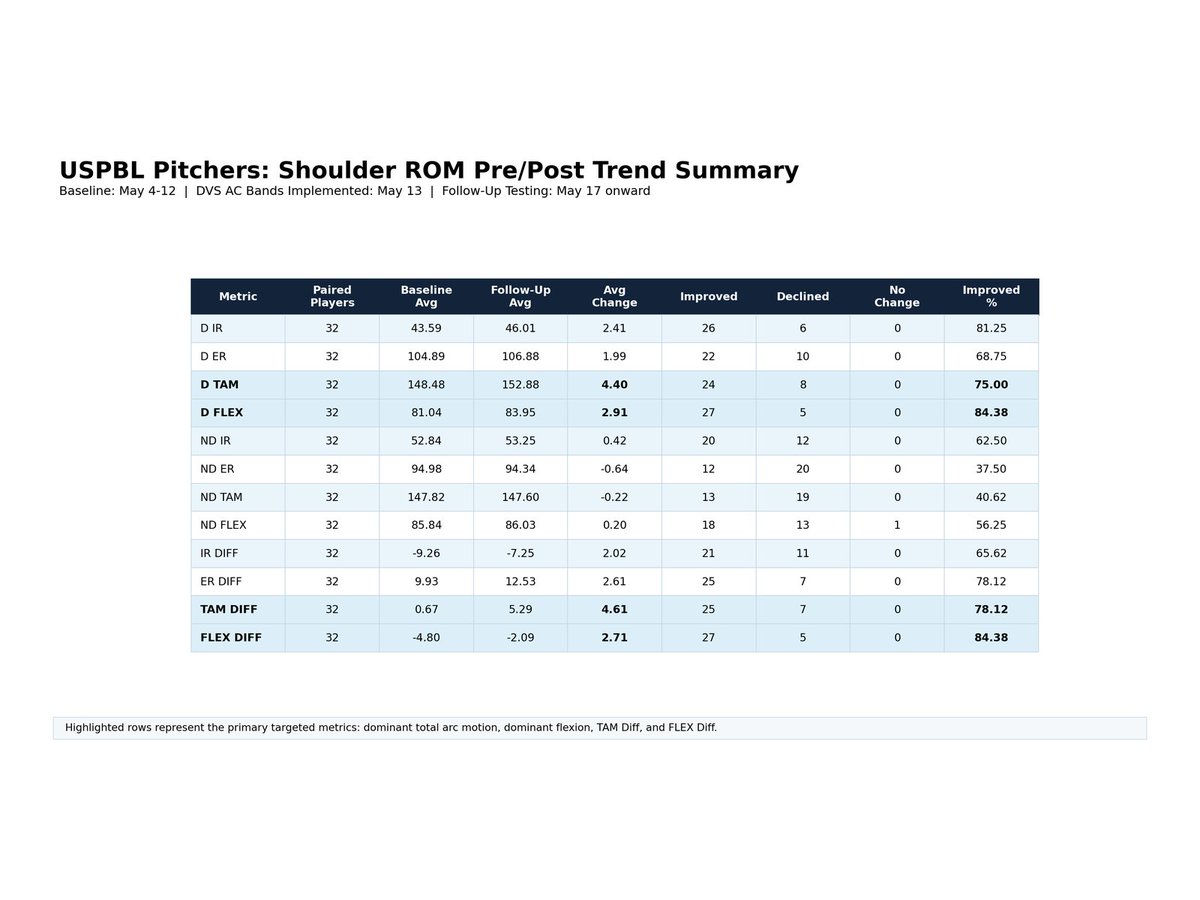
From May 4-12, we established baseline shoulder ROM. On May 13, we began integrating @DVSbaseball AC Bands. Follow-up testing began May 17.
The goal was not to prove a product. The goal was to measure a process.
DVS AC Bands are different because they are not designed simply to stretch the arm. They help pitchers develop strength and control at the end ranges of motion.
Early trends:
D TAM increased from 148.48° to 152.88°
24 of 32 pitchers improved
TAM Diff improved from 0.67° to 5.29°
25 of 32 improved
D Flex increased from 81.04° to 83.95°
27 of 32 improved
Development is not guessing.
It is establishing a baseline, implementing a process, measuring the response, and continuing to adjust.
Built to Last.
For a long time, I thought baseball was who I was.
Then the game humbled me. And I had to learn that your identity is bigger than your toughest moment.
Proud to partner with Pitcher’s Only on a collection supporting Mental Health Awareness Month.
Because one pitch doesn’t define you. ⚾️🖤
Shop the collection: https://t.co/NrwarLYeKo
At the @uspbl, this is how we begin to frame the process of increasing health/function to improve performance and spring training gives us a starting point.
We collected 255 shoulder ROM tests across 40 pitchers.
The clearest finding:
74.9% of tests showed a dominant-side shoulder flexion deficit.
The average Flexion Diff was -4.7°.
We also collected DVS metrics to understand delivery efficiency and arm injury risk.
Average DVS Score: 12.9 / 24
8 of 39 pitchers scored 16+
That tells us there is plenty of room for growth.
This is the value of baselines.
They give each pitcher a clearer understanding of where he is, what needs to improve, and how to take ownership of his development.
Next week, the development system begins.
To all the players that participated in our 2026 @uspbl Open Tryout, we want to say thank you.
For those players who are moving on to Spring Training, see you next week!
We plan to draft 25 players from the @USPBL Open Tryout this year.
Those 25 players will have the opportunity to work with one of our teams during spring training and compete for a starting job.
Our decision process revolves around what you can potentially develop into as a player, rather than the metrics/data you display at the tryout.
Feel free to reach out to us with any questions!
The tryout link will be in the comments.
It’s back.
The throwing program I co-authored in 2016 for the @uspbl is being fully integrated into the daily schedule for all pitchers once again.
This time, though, we’ll be pairing that foundation with advanced technology to create more automation, better tracking, and stronger decision-making around pitcher workloads and recovery cycles.
That original throwing program became the foundation of our pitching model. It gave us quality control over throwing distances, periodization, and daily progression. More importantly, it helped us begin to understand how recovery should be managed based on the individual pitcher, not just a generic schedule.
By using daily shoulder range-of-motion screens and soreness protocols, we were able to evaluate how each pitcher’s rate of recovery was influenced by current function, pitch counts, recovery patterns, and pitching delivery, as measured by the DVS Score.
After several weeks of establishing baselines, we began implementing more prescriptive protocols for each pitcher and continued monitoring fluctuations over time.
This season, all of that information will be captured inside our new league dashboard.
Our pitchers will have transparency into the process, and based on our development inputs, we will be able to better quantify how those inputs translate into performance outputs.
By the end of the season, we’ll have a comprehensive data set to share publicly.