I know only a fraction of students actually pay full tuition, but $70k annually for tuition alone is a confounding sum, even for a relatively good private research university
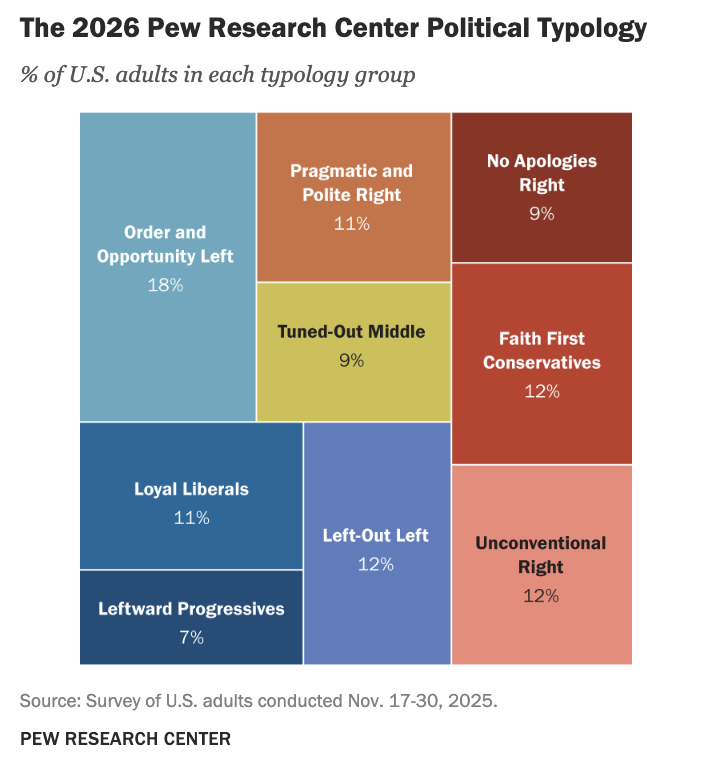
In our 2026 political typology, the public is sorted into nine distinct groups based on their political and cultural values.
What are those nine groups? 🧵
🦔In South Korea, "dopamine sites" have spread among Gen Z. Fake food delivery apps where you browse menus, fill a cart, and simulate an order you never place. Fake shopping sites where you track a courier that doesn't exist. Virtual smoke break rooms where you sit with strangers and watch a timer count down. Young Koreans spend up to 30% of their income on rent. The youth employment rate has dropped to 43.6%. Nearly half a million young Koreans have stopped looking for work entirely.
My Take
I don't know whether to call this sad or rational. Probably both. If you can't afford the delivery, faking the order and taking the dopamine without the bill is a better financial decision than going into debt for the food. That's a sentence I never expected to write, but the logic holds.
This is what the end of the consumer pipeline looks like. Companies spent decades fine-tuning every app and every checkout to trigger the purchase impulse. They got exactly what they built. A generation wired to consume. And then the economy priced that generation out. The dopamine sites are the honest version of what every shopping app already does. The only difference is they took the transaction out. Every other shopping app is a dopamine site that also charges you.
Hedgie🤗
I have cleaned this amazing Autochrome portrait of the French Impressionist painter Claude Monet (1840-1926), photographed in colour by Étienne Clémentel near the water Lily pond in Monet's garden at Giverny in 1917 (often dated online as 1921). It was taken in colour over a century ago using an early colour glass plate process and isn't colourised.
Central Tokyo has on average 6 dedicated purpose built public restrooms per square kilometer (maxing at over 12 in very central locations like Shibuya, 120-130k nighttime pop). London in comparison has 0.01 per square kilometer. These numbers do not include Tokyo's convenience stores that often have restrooms open to the public (12 per square kilometer) nor the other shops or restaurants or stations (497 train and subway stations have public restrooms).
#GoodUrbanism means extensive, numerous, clean and safe, public restrooms.
The two best statistics in the WSJ’s genuinely great article on North Korea’s economic boom:
Pyongyang built more housing last year than LA. (Says something about CA housing dysfunction).
North Korea assembled more cellphones than the USA.
(Assuming the #s are true!)
Korea's won is incredibly weak (global financial crisis or Korean BoP crisis levels ... ) even though Korea's fundamentals are sound (BoP has a massive surplus, fiscal debt is modest, etc).
Will be interesting to see if the Koreans can mount a defense this week ...
1/
They’ve found that sperm whales have such complex language that its structurally comparable to Chinese. They use what are essentially vowels. They have different cultural identity markers for each clan of whales. Thats actually insane.
Not enough people are thinking about economic and tax incidence with respect to China competition and tariffs.
Right now, the world is bracing for a sharp rise in solar panel costs as the Chinese government moves to tackle overcapacity it can no longer afford to underwrite. Increasingly, policymakers see the sector as a prime example of “involution” — a phenomenon in which ever more investment, capacity and apparent productivity generate diminishing returns because resources continue to flow into activities that create progressively less value. At the core of this is a confusion between output and productivity: producing more efficiently is not the same thing as increasing welfare. [For example, criminals can be very efficient, but don’t actually add value because their core activity is value destroying.]
This has major implications for the tariff debate because it suggests that what appeared cheap may never have been cheap at all.
Economists call this bigger-picture issue “incidence”. Incidence is simply the question of who ultimately bears the cost of something and who ultimately receives the benefit. The person who appears to pay or benefit at first glance is not always the person who ends up carrying the burden once you trace the entire chain of effects through the economy.
The conventional argument for years was that the world benefited from cheap (subsidised) Chinese solar production, since consumers everywhere could buy solar panels at lower prices. Looking only at the price tag, that seems obviously true. A panel that costs $100 is better for consumers than one that costs $150.
But incidence asks a different question: where did the missing $50 come from?
Part of the answer is that Chinese households have helped pay for it because such a large share of national income is forcefully swept into investment and manufacturing rather than household consumption by the government. Households save heavily, often receive relatively low returns on those savings, and have fewer opportunities to consume imported goods in return. Thus, some of the subsidy embedded in the cheap solar panels is indirectly financed by Chinese households accepting lower living standards than they otherwise might enjoy.
But the story doesn’t end there!
China sells more goods to the rest of the world than it buys. Those export earnings don’t disappear. They have historically been recycled into Western financial assets, including U.S. government bonds. That means that while Westerners receive cheap goods today, the Chinese accumulate claims on future Western income that generate interest payments.
In a growing number of Western countries, the expense of financing such interest obligations increasingly rivals the largest areas of public expenditure. Today’s cheap solar panel becomes tomorrow’s higher tax bill.
In other words, the difference in cost is actually borne by a combination of Chinese households through suppressed consumption and Western taxpayers through the servicing of foreign-held claims. Also, by workers and communities because a lack of reciprocal purchases contributes to the loss of domestic industrial capacity, eroding national security.
In short: the low sticker price is misleading.
When people say “look how cheap the panels are,” they are looking only at the most visible part of the transaction. Incidence analysis asks where the costs were shifted.
This is why someone like Stephen Miran would argue that focusing exclusively on whether tariffs raise consumer prices misses the core issue.
The relevant question is not simply whether a tariff makes a panel more expensive today. The relevant question is whether the pre-tariff price was genuinely cheap once all the hidden transfers, subsidies, financial flows and future obligations required to produce that price are taken into account.
Based on the rising cost of Chinese panels now that involution is being addressed, the answer is probably no. [chart from the FT]
🚗🔋 Many think Beijing masterfully planned China's EV takeover. Fengming Lu (@ANUBellSchool ) and I spent 3 years and 60+ interviews finding out what actually happened in our latest article @TheChinaJournal. A thread 🧵










![izakaminska's tweet photo. Not enough people are thinking about economic and tax incidence with respect to China competition and tariffs.
Right now, the world is bracing for a sharp rise in solar panel costs as the Chinese government moves to tackle overcapacity it can no longer afford to underwrite. Increasingly, policymakers see the sector as a prime example of “involution” — a phenomenon in which ever more investment, capacity and apparent productivity generate diminishing returns because resources continue to flow into activities that create progressively less value. At the core of this is a confusion between output and productivity: producing more efficiently is not the same thing as increasing welfare. [For example, criminals can be very efficient, but don’t actually add value because their core activity is value destroying.]
This has major implications for the tariff debate because it suggests that what appeared cheap may never have been cheap at all.
Economists call this bigger-picture issue “incidence”. Incidence is simply the question of who ultimately bears the cost of something and who ultimately receives the benefit. The person who appears to pay or benefit at first glance is not always the person who ends up carrying the burden once you trace the entire chain of effects through the economy.
The conventional argument for years was that the world benefited from cheap (subsidised) Chinese solar production, since consumers everywhere could buy solar panels at lower prices. Looking only at the price tag, that seems obviously true. A panel that costs $100 is better for consumers than one that costs $150.
But incidence asks a different question: where did the missing $50 come from?
Part of the answer is that Chinese households have helped pay for it because such a large share of national income is forcefully swept into investment and manufacturing rather than household consumption by the government. Households save heavily, often receive relatively low returns on those savings, and have fewer opportunities to consume imported goods in return. Thus, some of the subsidy embedded in the cheap solar panels is indirectly financed by Chinese households accepting lower living standards than they otherwise might enjoy.
But the story doesn’t end there!
China sells more goods to the rest of the world than it buys. Those export earnings don’t disappear. They have historically been recycled into Western financial assets, including U.S. government bonds. That means that while Westerners receive cheap goods today, the Chinese accumulate claims on future Western income that generate interest payments.
In a growing number of Western countries, the expense of financing such interest obligations increasingly rivals the largest areas of public expenditure. Today’s cheap solar panel becomes tomorrow’s higher tax bill.
In other words, the difference in cost is actually borne by a combination of Chinese households through suppressed consumption and Western taxpayers through the servicing of foreign-held claims. Also, by workers and communities because a lack of reciprocal purchases contributes to the loss of domestic industrial capacity, eroding national security.
In short: the low sticker price is misleading.
When people say “look how cheap the panels are,” they are looking only at the most visible part of the transaction. Incidence analysis asks where the costs were shifted.
This is why someone like Stephen Miran would argue that focusing exclusively on whether tariffs raise consumer prices misses the core issue.
The relevant question is not simply whether a tariff makes a panel more expensive today. The relevant question is whether the pre-tariff price was genuinely cheap once all the hidden transfers, subsidies, financial flows and future obligations required to produce that price are taken into account.
Based on the rising cost of Chinese panels now that involution is being addressed, the answer is probably no. [chart from the FT]](https://pbs.twimg.com/media/HKNBLUrWgAAtrSM.jpg)