The bears are having their moment.
After predicting a top in the AI trade every month for the last 4 years, the bears finally got their moment last week.
However, in 3 to 6 months, we are going to look back at this correction and realize it was just that: a correction.
There is a widespread narrative right now that Nvidia, $NVDA, is quite literally going to collapse. This is a stock that was trading at a record high on October 6th, worth nearly $6 trillion, and the inventor of the most advanced chips in the world (it's not even close).
That's how deeply pessimistic sentiment has become over the last seven weeks.
Even if Nvidia produced half as much revenue as they are guiding for their next fiscal year, this company would still produce close to $400 billion in annual revenue.
Meanwhile, the S&P 500 has posted three consecutive quarters with earnings growth above 25% and eight straight quarters of double-digit growth.
And, sentiment flipped so quickly that the S&P 500 closed the week 4.1 standard deviations below its 50-day moving average on Friday. Not even 2020 and 2008 saw such an occurrence.
The reality is that AI truly is the "next big thing" and the AI buildout is only accelerating.
Bears will sound smart, bulls will make money.
BREAKING: Europe is under a massive cyber attack, with supermarket fridges and freezers in Belgium, Sweden, Luxembourg, Ireland, the Netherlands, Finland and Estonia all hacked today by raising temperatures to up to 50°C, destroying huge quantities of food, per Reuters.
"Everything is destroyed," a sales manager in Sweden said, adding that "there has been a cyberattack and all our freezers reached 50 degrees."
More than 40 supermarkets in Belgium and Luxembourg were affected. "I only have two words for them: wake up, please, because there's something going on," a store manager in Belgium said.
This follows a similar cyberattack last month that hit hundreds of supermarkets in France, raising freezers as high as 80°C and causing major food losses.
It also comes after freezers at 6 US military bases mysteriously malfunctioned, spoiling large quantities of food, which the Pentagon is investigating as a suspected cyberattack.
NTSB investigation: Florida Learjet 60 crash – key highlights
The National Transportation Safety Board (NTSB) has revealed a significant preliminary finding in the investigation of the Learjet 60 crash in Greenacres, Florida.
1. Critical NTSB findings
- Possible in-flight structural breakup
- Investigators have evidence suggesting the aircraft began breaking apart before ground impact.
- The NTSB expects aircraft components may be discovered some distance from the main crash site.
- The NTSB has not confirmed whether the horizontal stabilizer, vertical stabilizer, control surfaces or other structural components detached.
2. Severe weather and icing conditions
- The weather is a major investigative focus.
- The aircraft was cruising at approximately 35,000 feet.
- The crew reported light clear icing, described as manageable.
- Moderate turbulence was reported.
- The crew experienced altitude deviations of approximately 700 feet.
- The aircraft subsequently encountered precipitation.
- The crew requested permission to climb to 37,000 feet.
3. Extremely rapid descent
- The aircraft experienced a catastrophic loss of altitude.
- The reported sequence included:
- An initial report of an unexpected descent.
- A Mayday emergency call.
- A reported descent rate of approximately 10,000 feet per minute.
- A subsequent report of an overspeed condition and descent reaching approximately 20,000 feet per minute.
4. Cockpit voice recorder
- The aircraft was originally equipped with a cockpit voice recorder, according to the NTSB's briefing.
- Investigators are checking whether it was still installed at the time of the accident.
- Recovery of the recorder could provide important information about crew communications and the events inside the cockpit.
- Its recovery and examination remain outstanding.
5. What has NOT been established
The NTSB has NOT yet established:
- That icing caused the crash.
- That turbulence caused structural failure.
- That the aircraft's tail separated in flight.
- That a thunderstorm was directly responsible.
- That a mechanical failure initiated the emergency.
- Whether the aircraft experienced an initial structural failure followed by loss of control, or another sequence of events.
#INVESTIGATION #AVIATION
The US debt crisis is entering uncharted territory:
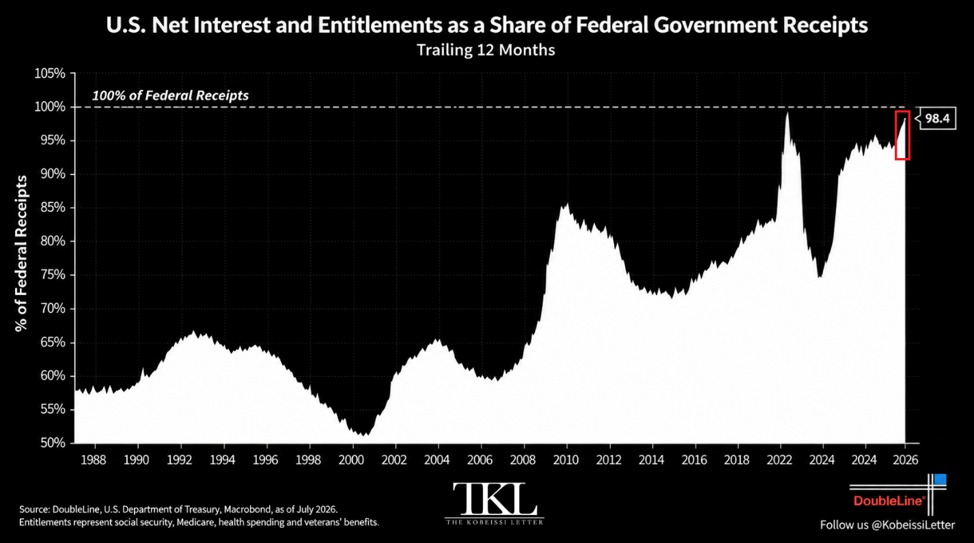
Net interest, social security, medicare, healthcare spending, and veterans' benefits currently consume 98.4% of total federal government receipts, near the highest proportion on record.
This figure has surged +28 percentage points since 2022 and is only below the 2020 pandemic peak of ~99.0%.
Net interest alone has nearly tripled as a % of revenue, to a record 19.7%, accounting for roughly half of that +28 percentage-point increase.
By comparison, during the 2008 Financial Crisis, these expenditures did not exceed 90% of federal receipts.
In other words, mandatory spending and interest costs now consume nearly every Dollar the federal government collects.
What is the long-term plan here?