Better than Black 🛰
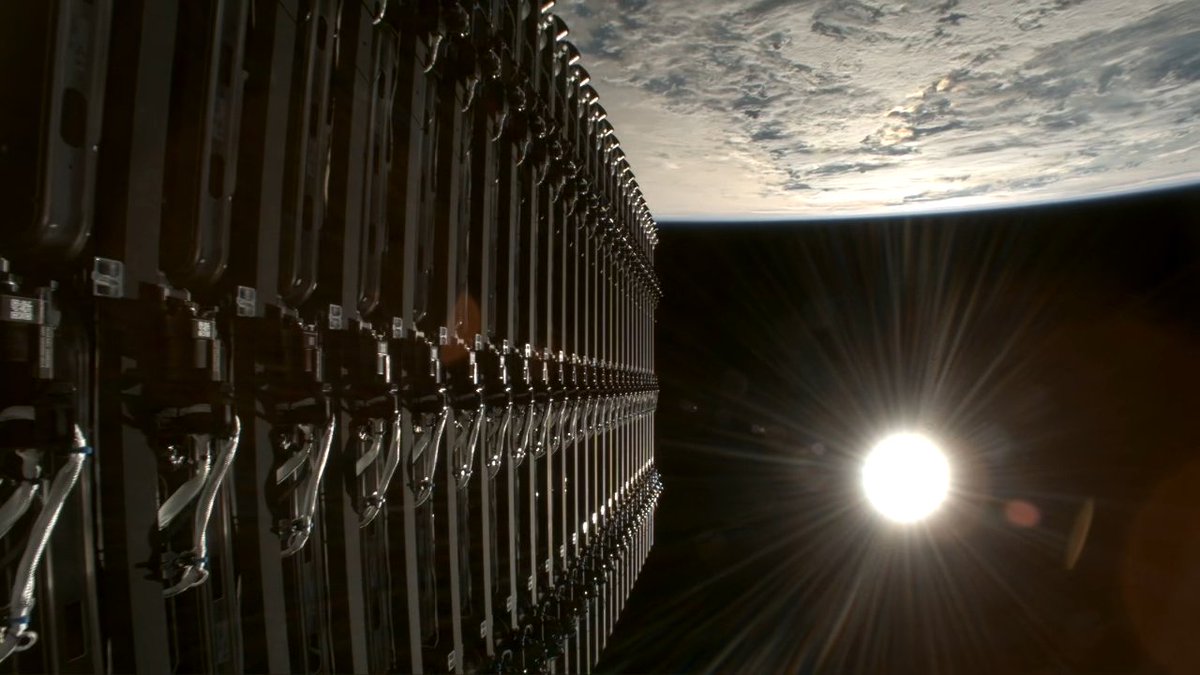
In this clip from the upper stage of one of this week’s Starlink launches, you can see the stack of sats and then a very shiny mirror that reflects the upper stage spinning away over Earth. So much cool engineering visible here: https://t.co/M0gYV0m2oR
The first Starlink sats were black to avoid being visible at dawn and dusk (when the sun still illuminates them at high altitude, but people on the ground are in the dark). But black absorption heats up the satellites and is ~ 96% effective at absorbing light. What’s better? A near perfect mirror that reflects sunlight away from the satellite and from Earth, making the flat phased array antenna panels that always face Earth nearly invisible (reflecting over 99.9% of light). The core of the film is a Bragg mirror, a dielectric mirror film which includes many super thin layers of plastic with different refractive indices that create interference patterns internally to reflect light, but allow radio waves to pass through unimpeded.
Phased array antennae are themselves amazing, a 2D grid of transceivers that collectively steer microwave beams to the Starlink terminals below, with no moving parts.
You can also see one of my favorite engineering innovations SpaceX, developed with an integrated perspective on satellite and rocket design. At the end of the video, you see the upper stage of the Falcon 9 rocket spinning away. Prior to release of the stack of satellites, the entire upper stage goes into a slow spin. Then it pops a couple retention latches, and the stack of 27 satellites splay out like a deck of cards, each with a slightly different angular momentum given the distances from the centroid of spin. This tiny difference in velocity for each satellite gives them a greater separation over time as they orbit Earth. No springs needed; the whole system sets up the deployment dynamics in an elegant, minimalist manner. And this early phase is when they look like a string of pearls, still close together, and visible at dawn or dusk before they get the highly reflective surfaces rotated into proper position.
At the top and bottom at 13 seconds in, you can see the two retention bars that hold the stack of sats in place during launch. That’s very little wasted weight versus a typical ESPA bus holding a bunch of satellites on a central metal cylinder as you see in Transporter missions.
ELON MUSK: Free speech is the bedrock of a functioning democracy
> My timing is amazing. I bought it for at least twice as much as it should have been bought for. But some things are priceless
> Compared to ensuring the strength of democracy, and free speech is the bedrock of a functioning democracy
> The speech needs to be as transparent and truthful as possible
> We've got a huge push on X to be as truthful as possible. We've got this Community Notes feature which is great
> I'm sure everyone would not be pleased with it
> At the end of the day, you know, if the public is happy with it, that's what matters
> The public will speak with their actions. If they find Twitter to be useful, they will use it more... If they find it to be the best source of truth, I think they will use it
The European Commission offered 𝕏 an illegal secret deal last year. If 𝕏 quietly censored speech without telling anyone, they would not fine 𝕏.
The other platforms accepted that deal.
𝕏 did not.
Elon Musk on Optimus:
"The robots are just walking around the office, 24/7 with no one minding them & then they go charge themselves. It's going to be the biggest product of all time, bigger than cell phones, bigger than anything. There could be 10s of billions of robots."
Starlink Direct to Cell operates the largest satellite-to-mobile constellation in the world, delivering data, voice, video and messaging to mobile dead zones across 5 continents.
Since first activating service earlier this year, more than 8M people and counting have relied on Starlink Direct to Cell to stay connected when terrestrial service is unavailable → https://t.co/V1Ehnv3Ybm