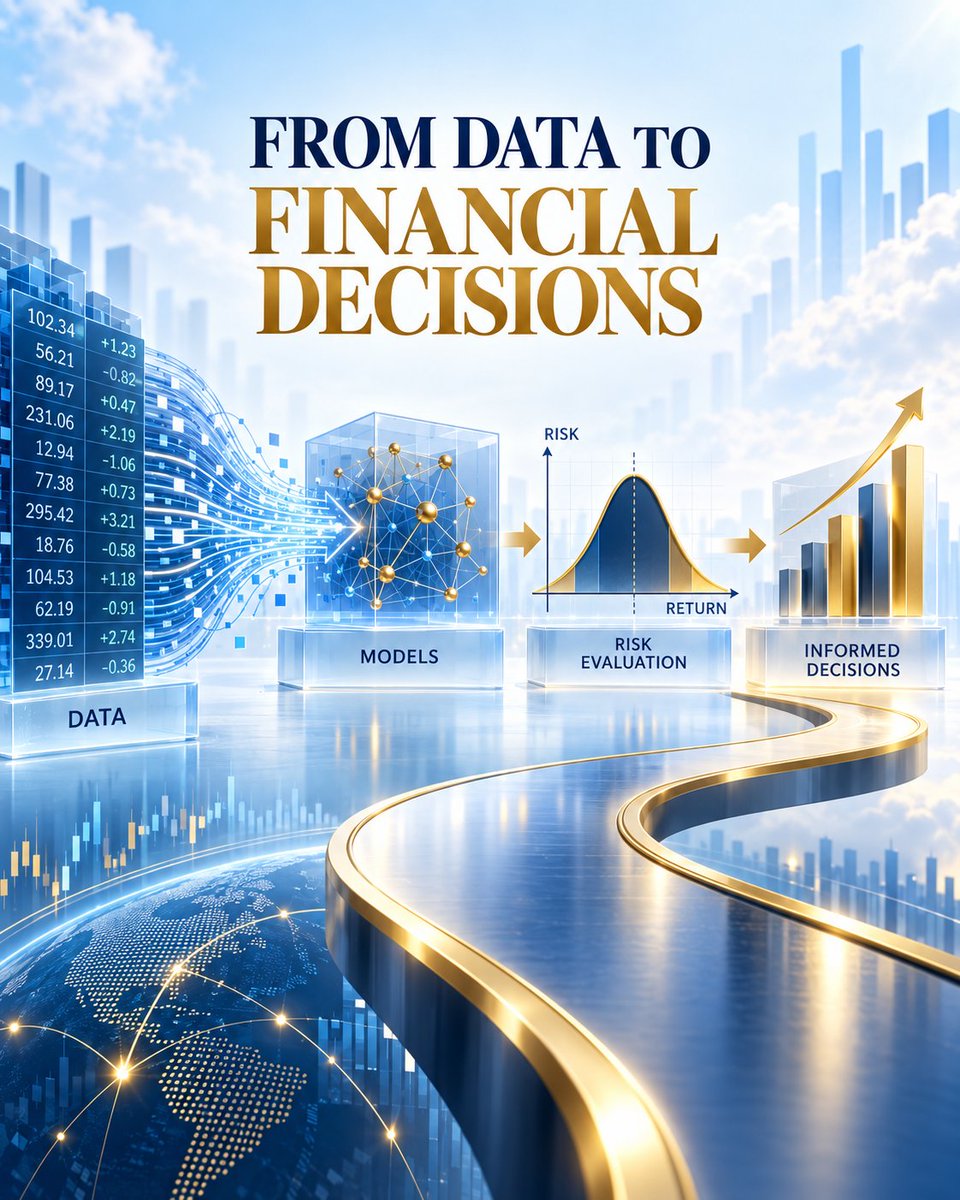
A quantitative signal is only useful if it survives clean data, out-of-sample testing, trading costs and changing market conditions. Research is the process of finding where an idea works—and where it fails. https://t.co/8FMA95iHcw #QuantResearch
A trading signal is the output of a process—not a prediction. Price, volume, indicators, news and sentiment are filtered through rules before an alert appears. Understanding that process matters more than following the label. https://t.co/8FMA95iHcw #TradingSignals
Alpha is only as credible as its benchmark. Compare a small-cap strategy with a large-cap index and ordinary factor exposure may look like manager skill. Match the benchmark to the strategy before judging excess return. https://t.co/8FMA95iHcw #QuantTrading
Market-neutral doesn’t mean market-proof. Pairing long and short positions can reduce broad market exposure, but selection errors, leverage, borrow costs, and broken correlations still matter. Learn how the strategy works: https://t.co/8FMA95iHcw #Investing
Two assets can move together without sharing a stable long-term equilibrium. Pairs trading requires more than similar charts: test the spread, hedge ratio and economic relationship before expecting convergence. https://t.co/8FMA95iHcw #PairsTrading#QuantTrading
Recent performance can persist because information reaches investors gradually. Momentum trading tries to capture that continuation with rules for entry, sizing and exit—not assumptions. Explore the framework: https://t.co/8FMA95iHcw #MomentumTrading
A price far from its average is not automatically a trade. Test stationarity, estimate the half-life, model costs, and define the point that invalidates the signal. Mean reversion needs evidence—not intuition. https://t.co/8FMA95iHcw #QuantTrading
Statistical arbitrage does not predict whether the whole market will rise or fall. It looks for temporary relative-value gaps, often pairing long and short positions while controlling broader exposures. Learn how it works: https://t.co/8FMA95iHcw #QuantTrading
Factor investing uses measurable characteristics—such as value, quality, momentum, low volatility and size—to build portfolios through systematic rules. Learn how the approach works and where its risks lie: https://t.co/8FMA95iHcw #FactorInvesting
A quantitative strategy starts with a testable hypothesis—not a perfect prediction. Reliable data, realistic costs, out-of-sample testing, and risk limits turn an idea into a disciplined trading process.
https://t.co/8FMA95iHcw
#QuantTrading#KAELAI
Systematic trading turns market ideas into repeatable rules for signals, position sizing, risk control and execution. It cannot remove uncertainty—but it can make decisions more disciplined.
https://t.co/8FMA95iHcw
#SystematicTrading#QuantTrading
Quantitative models turn market data into forecasts, valuations, portfolio decisions, and risk estimates. They do not eliminate uncertainty—they make it measurable. Explore how they work in finance: https://t.co/8FMA95iHcw #QuantFinance#FinTech
Quantitative analysis turns financial data into testable models for investing, trading, portfolio construction, and risk management. The goal is not certainty—it is more disciplined decision-making.
https://t.co/8FMA95iHcw
#QuantFinance#KAELAI
Trading signals convert price action, volume, economic news and sentiment into structured alerts. They can support decisions, but they cannot guarantee outcomes. Understanding the data and method behind a signal matters.
https://t.co/8FMA95iHcw
#TradingSignals#KAELAI
AI agents could become a new operating layer for finance—coordinating payments, compliance, risk and customer service across connected systems.
The future is not isolated AI tools. It is governed collaboration.
https://t.co/8FMA95iHcw
#AIAgents#FinTech
AI agents can access data, call tools and take real actions. Secure them with distinct identities, least-privilege access, validated tool calls, runtime monitoring and human approval for high-risk steps.
https://t.co/8FMA95iHcw
#AISecurity#AIAgents
AI agents can continuously monitor transactions, operations, security, and compliance—helping risk teams detect anomalies earlier and prioritize high-impact cases. The goal is faster awareness, not unchecked autonomy.
https://t.co/8FMA95iHcw
#AIAgents#RiskManagement
AI agents can review filings, earnings transcripts, economic data, and market news at scale—giving analysts more time to test assumptions and interpret what matters.
AI organizes the evidence. Humans make the judgment.
https://t.co/8FMA95iHcw
#AIAgents#FinTech
AI agents become operational when reasoning connects to tools. With authorized access to data, APIs, and software, they can observe results, adjust plans, and complete multistep work—not just generate answers.
https://t.co/8FMA95iHcw
#AIAgents#AgenticAI
AI agents need more than reasoning. Memory helps them retain context, learn from outcomes, and continue tasks across sessions. The goal isn’t to remember everything—it’s to retrieve what matters when it matters.
https://t.co/8FMA95iHcw
#AIAgents#AgenticAI